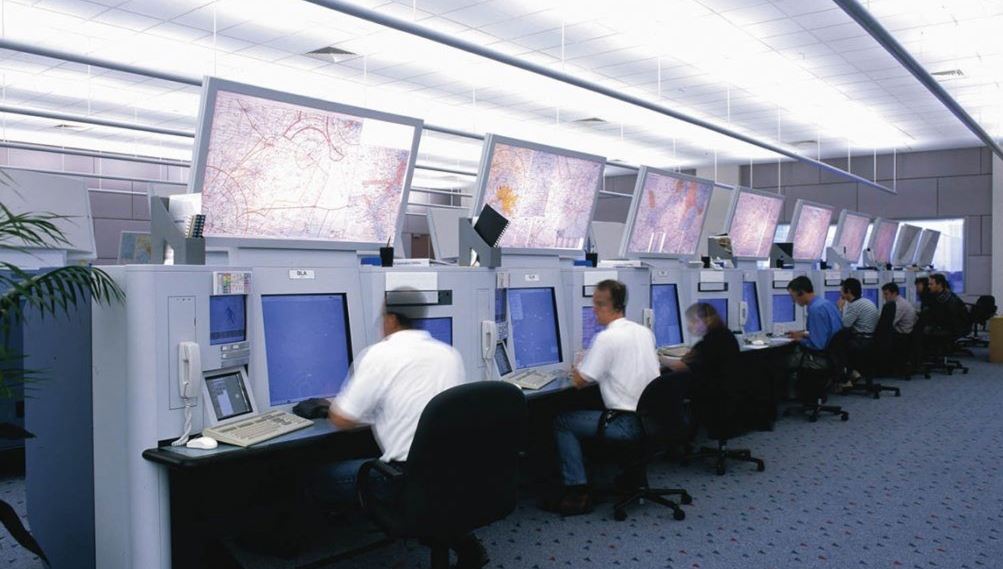
I have been an air traffic controller for nearly 22 years, and I’m lucky enough to be able to say that I still absolutely love my job. A fun fact about me is that I’m actually trained to work in both tower and approach environments, but I’ve always been grateful that my entire career has been spent working exclusively in air traffic control towers. There’s a funny, self-aggrandising hierarchy amongst approach controllers in which they believe that they’re the top guns of ATC, and that the tower is where air traffic controllers go to die (we don’t call them figjam for nothing). I’m not going to get into that debate here, but I will say that every single day I go to work I’m thankful that I get to look out the window and see the aeroplanes I’m controlling, rather than being stuck in a cheerless radar room with row upon row of radar screens and no windows or natural light.
Queen of my domain.
A generic factory floor, oops, I mean radar room. 😉
Truly, one of the joys of my job is just being able to watch the aircraft fly. In 22 years I reckon I’ve seen over a million takeoffs and landings, so you’d be forgiven for assuming I might be a bit jaded by it all. But no, I still totally get off on it. I definitely wouldn’t call myself an aerosexual, but there is one particular aircraft’s takeoff which absolutely fills me with awe and wonder every time I see it, and that aircraft is the Boeing 747. For something that has a maximum takeoff weight of 442,252 kilograms, the Jumbo jet veritably glides off the runway with such elegance and grace, it still takes my breath away.
Taxiing for departure at Al Maktoum International Airport. ♥
The first B747 flight took place from Everett, Washington in the United States in 1969, with the model entering service a year later. Years in the making, the “Dream Team” of over 50,000 employees that worked on the aircraft, produced a remarkable feat of aviation engineering which revolutionised air travel by making it cheaper and easier for people to fly. The Boeing 747, which is capable of carrying 660 passengers (in a single, cattle-class, configuration), is commonly referred to as the Queen Of The Skies and is beloved and revered by aviation enthusiasts all over the world, including me. It’s no surprise that the 747, with its unique and classic shape is one of the most iconic, popular, and most recognisable aircraft in aviation history.
The very first B747. Isn’t she lovely, isn’t she wonderful.
The difference between the B747 and it’s predecessor, the B707, is vast. Which is how the Jumbo jet transformed air travel.
How much do I love the B747? Let me tell you the ways. I own a clock, a truly magnificent work of art, made from an actual Boeing 747 passenger window. I love the fact that I have a little piece of flying history up on my wall. I love that instead of rusting away in some desolate scrapyard heap, part of this remarkable aircraft was salvaged and lovingly handcrafted into a beautiful timepiece. For over two decades, the window that my clock is made from travelled thousands of miles, at altitudes exceeding 40,000 feet. Its history no doubt contains tales of severe turbulence, strong winds, rain, freezing temperatures and possibly even lightning strikes. My B747 has traversed the globe countless times, crossing oceans and deserts, and possibly even poles. Her ports of call have included New York City, Miami, Cape Town, Singapore, San Francisco, Johannesburg and São Paulo (special shout out to all the aerosexuals out there who keep track of this sort of stuff).
That’s my girl.
Who knows how many passengers gazed out of my window, on their way to a holiday, a business conference or to start a brand new life. How many people looked through my window with wonder, how many with terror or sadness or with joy. How many of them had a little too much to drink out of too many miniature bottles of booze? Who was the youngest person to ever sit in my window seat? Who was the oldest? Oh, what stories my window could tell. How many hard landings did she have to endure, and how many landings did the pilot absolutely glue to the runway? Did my British Airways 747 ever experience a near miss? How many times did she have to divert due to a sick passenger, or an unruly one? How much drama and intrigue unfolded in the galley, long after the cabin lights had been dimmed? And exactly how many people were initiated into the mile high club? These are things I’ll never know, but it sure is fun to wonder. The things I do know about my window is that the registration of the aircraft it belonged to was GCIVM (that’s Golf Charlie India Victor Mike to the uninitiated). Her maiden flight was on Tuesday, 27th May 1997 and her final scheduled flight was 23 years later, with wheels touching down on Sunday, 15th March 2020.
Air France’s moving, farewell tribute to their last B747. I’m not crying, you’re crying!!
Sadly, in July 2020 British Airways retired their entire fleet of 31 passenger Boeing 747s due to the sharp downturn in air travel hastened by covid. I received my clock seven months after my B747 was put out to pasture, thanks to two brothers in England who have combined their love of furniture-making and their passion for aviation to form a business called Plane Industries, repurposing old aircraft parts.
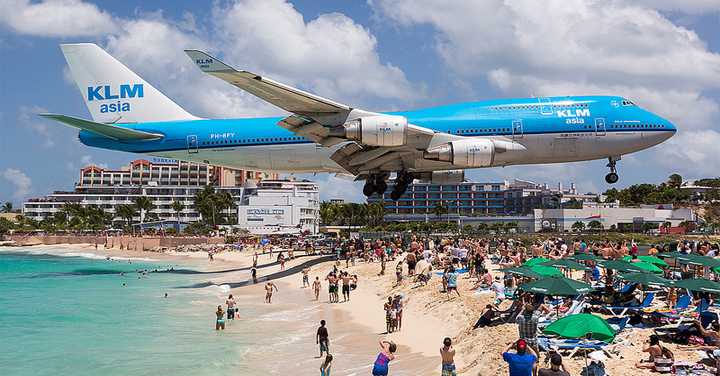
KLM B747 arriving at St. Maarten’s. Pure aviation pornography (oh shit, maybe I am an aerosexual after all)!!
British Airways isn’t the only airline to stop flying the fuel guzzling, four-engine wide-body aircraft. Demand for the Queen Of The Skies has dwindled in recent years and two years ago Boeing regretfully announced that they planned to stop making the aircraft in October 2022. It will be a very sad day in aviation when the last Jumbo jet rolls off the production line, but I do feel some consolation that the B747s currently being used as freighters will remain in service, roaming the skies long after I ride the tower elevator down to the ground floor for the very last time.
Fill her up, buttercup. I bet you didn’t know that this is how they load cargo onto B747 freighters.
How much do I love the B747? At the beginning of May, I got my very first tattoo in Amsterdam, at the ripe old age of fifty. The image is an outline of a Boeing 747 taking off, on the inside of my left wrist. Though it is beautiful, the aircraft doesn’t just appeal to me aesthetically. It also represents my work, which I love. It represents the job that totally changed my life and allowed me to pursue and indulge in my other passion, travel. It represents my wanderlust, and my desire to soar, and to keep seeking new experiences in far-flung places. It represents hope, and anticipation and joy.
My B747 isn’t quite anatomically correct (a lesson in being super precise in telling the tattooist what you want). But I still love her.
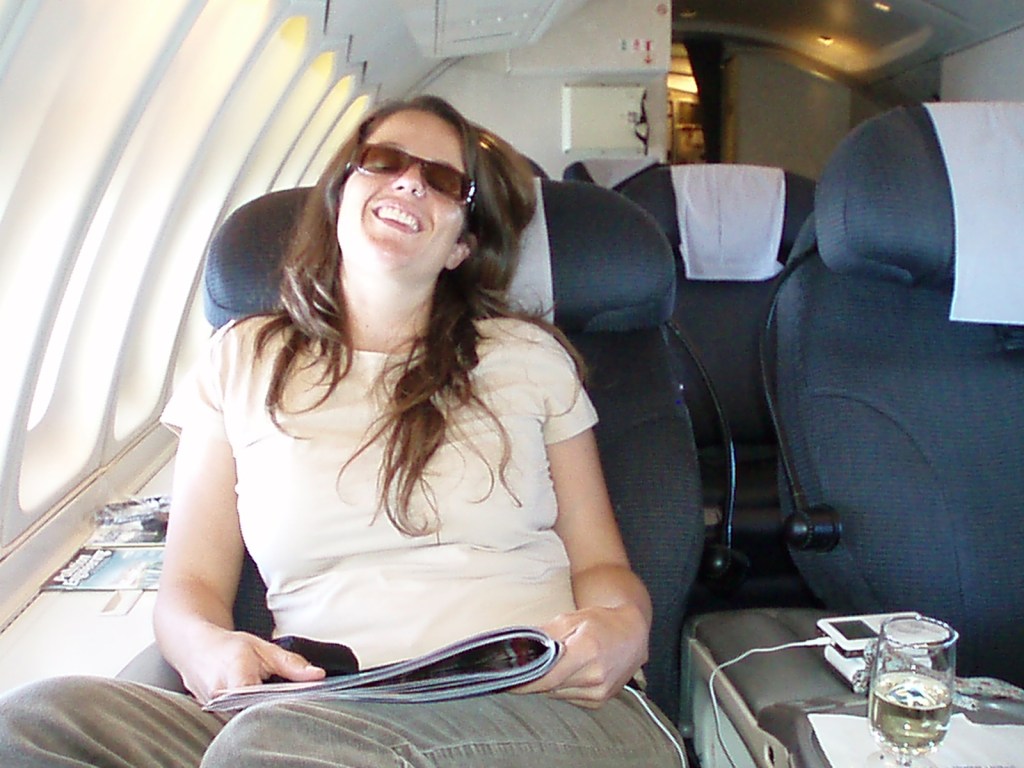
You want to know how much I love the B747? My very first business class flight was in a Jumbo jet. I was travelling home from a trip to San Francisco in 2006 and the plane stopped over for about an hour in Sydney. When we re-boarded to fly the final leg to Melbourne I decided to shoot my shot and boldly asked if I could sit in business class, playing the old “I’m an air traffic controller” card. Don’t ask me how, but it actually worked!! The lovely cabin crew escorted me up that glorious stairway to heaven, also known as the upper-deck, business-class section, where for the next hour they plied me with champagne and treated me like a queen. Queen of the goddamn skies.
Chateau Orquevaux is a magnificent property perched on a hill overlooking the tiny village of Orquevaux in the beautiful French countryside. With a population of about 70, the charming, centuries-old village was in grave danger of fading into obscurity, as its young folk flocked to nearby cities in search of a better life.
That is, until Ziggy Attias came along and breathed life back into Orquevaux. In 2015, he inherited the neglected property from his father, intending to fix the place up and sell it. Instead, he very quickly fell in love with the Chateau and decided to transform it, and its gorgeous grounds, into a place where artists could visit and retreat from the world. A place they could spend time with like-minded people, and find inspiration, creativity and collaboration. A place in which artists could focus on their art, somewhere they could just be. A place of peace and tranquillity, of breathtakingly pristine nature and an overwhelming sense of magic which radiates throughout the entire estate. And so he created the Chateau Orquevaux International Artists & Writers Residence programme.
I recently had the very great fortune of spending two wondrous weeks in residence at Chateau Orquevaux. I shared those two weeks with twelve other artists; mostly painters but also a collagist, a photographer, a musician, another writer, a clay sculptor and a floral sculptor. And while I was there I was very lucky to have the opportunity to sit down with Ziggy to chat about art, what being an artist is about, and his 100 year plan for the future of the Chateau.
What is an artist? What is an artist? I would say an artist is someone that can express themselves in the most honest way, the most vulnerable way. I think an artist is someone that’s outside the box, somebody that is a free thinker. There are a lot of people that call themselves artists that maybe aren’t. The kind of artist that I’m attracted to is somebody who’s loose, not judgemental, somebody that accepts people as they are, and doesn’t try to put themselves on everything. So they can be quirky, they can be a little crazy, all that stuff is okay. But, if they want to be accepted, then they need to accept. So to me, the purest way to be an artist is to be somebody who’s out there and free and expresses themselves, but also accepts that from other people.
So what makes Ziggy an artist? I don’t really do any one discipline. I would say my main discipline is manifesting something out of nothing. So I’m an idea person.
Like the Chateau? Like the Chateau. Seeing something from a little bit of a different angle than somebody else would see it. Obviously I didn’t build the Chateau, but I had an idea of what it could be. I would say all the different forms of art that I’ve done, whether it’s film or jewellery or sculptural pieces or writing, I think I come at things from what I can do. Because there’s a lot that I can’t do. So my creativity, what I think makes me unique and gives me a voice, is that I find these cracks that other people don’t find. I remove all that I can’t do and I see what’s left and then I have to be creative with that.
You know, I struggle with the term artist. I know a lot of people do, and I think in my case, it’s because I don’t do any one discipline for long. I tinker with everything, a lot of different things. And there’s a lot of things I don’t do anymore that I do still think about. Writing is something that I’m interested in, but it’s not necessarily easy for me.
So that’s something you’d like to pursue? Yeah, but not necessarily a novel. All my writing is personal essays. It’s always about my experience, and my experiences here at the Chateau. And I feel like there’s something being built here that will possibly have historical significance. So I think my writing is important in relation to that. I don’t know if it’s important out there in the world, but in relation to what’s happening here in Orquevaux, I think I am an important part of that. So I think my story’s going to be that I’m not an artist like a painter, who paints every day. I feel like this whole place is my studio. And at this point in my life, my strength is empowering a lot of artists, as opposed to me being in my own studio trying to make my mark. I think my mark is in this giant studio that everybody gets to come into, and then hopefully they can do good work and then it goes out into the world.
So that, I see now, is much more important than me trying to make my mark on a specific creative endeavour. You know, I think this whole bigger creative endeavour is more important than any smaller individual pursuit. I don’t know if people necessarily define me as an artist on a day to day basis, even though I feel like I live my life that way. I think my body of work will be my life. And people will look back and they’ll see the different accomplishments I’ve had, different things I’ve done and put it all together and say, “Oh, he created art there”. When you put it all together, I believe that there’ll be no question that, yes, that guy was an artist.
What kind of training have you had? Have you had any formal training or mentorship, or are you self-taught? Everything’s self taught. I didn’t know I was creative until I was around 21 or 22 years old. I would say I was angry prior to that for a variety of reasons. What happened was that I knew this guy who was a friend of the family, a neighbour, his name was David. He was this angry guy, but he was a teacher, an art teacher. And he made this thing with metal and solder. I can’t draw, I can’t paint. I can’t do any of that stuff. And I was just really attracted to this thing that he made. And it was like, can you teach me how to do that? Which was a weird thing for me to ask, because there was no reason to think that I could do that. But he said, well, if you’re serious, go buy these materials. He wanted me to prove that I was somewhat serious. And I went to his house, I think we spent an hour together, maybe an hour and a half, and he showed me how to do soldering, which became, something that I turned, I believe, into an art form.
And because of that, I had a place to put this anger, which I wouldn’t even call anger anymore. I think anger is just one form of expression. I found another way to express myself that wasn’t anger. I was able to create something that people valued. And I was able to turn that into jewellery, and it opened up my whole world. And it opened up these doors of possibility. So I would say that an hour with this guy gave me my whole life.
It led to this, essentially. It 100% led, to this. Because I wouldn’t have been able to do any of the other creative endeavours. I would’ve been a guy cutting grass, because I had a landscape company at that time, and I think I would have been successful at that. I always thought I was going to be a businessman. But that started to change as I found new ways to express myself. So I was becoming worse at being a businessman, and better at being a creative person. And then because I had to make a living, I always tried to find a way to mix the two, like how do I pay the bills, but do something creative, not just for the sake of money.
And so with the writing, what made you want to write or think that you could write? When did that start? I think it started when I did a documentary about a Native American tribe on Long Island. So when we were trying to figure out a direction for the documentary, I realised I knew nothing about them. So I thought that the film could be my personal journey of discovering these Native Americans on Long Island. So then you have to write about that, if it’s a personal journey, you have to journal it in, and that became the film’s narration. So from that, I started to think about my life in different ways, and I would get into these moments where I would just journal. And then when I came to Orquevaux, I knew I could write – personal stuff, it’s all personal, I can’t do fiction. So I started taking the writing a little more seriously when I was here.
So you continued journalling? I never journalled regularly. I think it’s more when you have hard times in your life, that you write. But I started to figure out my place within the context of this job, or this life, that relates to the Chateau. And I started writing, and I’m always nervous when I write. I write from fear, like I’m always thinking I won’t be able to finish the piece, or it won’t have an ending or whatever. So I build it sentence by sentence. Because I’m afraid to go past the next sentence –
So you aren’t able to look forward and see the end? I can’t. I can’t do it like that. I have to have a feeling about something, and I start writing and then hopefully in the first few sentences I’ll find a theme and a direction and that gives me the story. And then I have to do editing and rearranging, because maybe some thoughts came too early. I don’t just write it. I’m like, oh, this story relates to that thought. Then we can consolidate those two thoughts together, things like that. And from that, I discovered that my writing always forms a circle. There’s always an ending that relates to the beginning, and a theme forms. So I get excited by that, but I also get nervous that I can’t do it again. So I don’t write as often as I probably should. I have a bunch of works in progress right now, and I have been tinkering with one, finishing a piece that I’m going to read to you guys tomorrow.
Ziggy reading for Literature Night in the salon.
I look forward to hearing it. Tell me about something new that you are working on? Well, I have an idea for a contemporary art museum here that I initially thought was going be in a building that I bought that’s near the church, but we just made a deal for another property which has about five acres attached to it. So now I have this idea that in the future we’ll be able to build a real contemporary art museum from the ground up, with a large sculpture park. And the park will always be open to the public. Obviously we would run the museum, but the whole thing would be for the people, you know what I mean? So when people come to Orquevaux to do the Cul du Cerf, which is the walk to the source [of La Manoise River], it can become more than just the Cul du Cerf here. Orquevaux will also be this museum and it’ll be the sculpture park and you can bring your lunch with you, and there will be a performance centre and art studios and a gallery. And I think that I can get some help from the government for that, but I don’t think it’s something that is going to happen for some time yet.
But it’s something you’re working on. Yeah, definitely. I like the idea of creating a museum. The residency is the same way. In many ways it’s the unknown artist. So I like the idea of this museum that will be filled with amazing work and that’ll be the reason that people will come here. To see all this new work that they don’t know. And it’ll still be a beautiful experience, because it’s not the obvious. It’ll be completely original, by the power of all the people that helped build this place. And I think we can all create something amazing together. And I love that idea.
What goals do you have for the future? What do you want to achieve personally, artistically, professionally creatively? I think there’s only so much I can do in my lifetime. If I’m lucky I have 30 years, or maybe 35 years left. So I don’t know how much of it I can achieve, but I do want to create an art village, and I’d love for it to be the whole village of Orquevaux. And I don’t think, in my lifetime, that I’ll be able to get the whole village for the residency, but I think we can get quite a bit of it. And then I think the next generation will continue that.
Tell us about your plan for the village? My plan for the village is to make a place that, if you love art, is really a one of a kind village in the countryside of France, surrounded by cow pastures and agricultural land. It’s in a valley, and it’s this magical place with two castles and a beautiful church and art studios, and artists living everywhere and there’ll be music and art and sculptures. It’ll be a creative think-tank, of all the arts. So of course artists will want to come here, but if you’re not an artist you’ll also want to come here to enjoy it and to discover artists, and maybe collect work. I want to create a place that is art driven. And I think it’s a perfect size village, because it’s not too big, but it’s big enough.
And how will that plan live on, after you’re gone? It’ll be self-sustaining, and the question is whether it’s going to be a board that runs it. It can’t be run by one person. I mean, at the moment it is. I have a team obviously, and it’s getting bigger, but right now I’m the driver. But I think in the future, when I’m not here, it shouldn’t be a single person. It should be a collective of some sort, and you could have a president and a residency director and all the jobs that relate to it. Maybe it’ll be not for profit. My first choice would be that the whole thing gets acquired by a big art university. But then my concern is that they would just use it for their students. I want it to be open to the world. So the goal is to create something like that, and have it be self-sustaining, so that artists don’t have to pay to come here, because it shouldn’t be whether you can afford to pay for it or not afford to pay for it. So we’ll see how it works out, but I’d like it to be open to everybody.
Tell me about someone who inspired you artistically. I don’t think I have anybody like that. I had a complicated relationship with my father, but I will say he was a person that just did. So it was just, “do”. I learned that if you want to do something, just do it. Don’t worry about doing one thing a hundred percent, do lots of things at 80%. Just keep moving and try to improve. So I think that watching him as an entrepreneur and a businessman, it must have put those seeds in my head. I’ve been like that ever since I was very young. So some of that is just in me. I think the world inspires me in different ways. If I see something that inspires me, it can open up a whole world for me. And then, even though I don’t know anything and even though there’s obviously fear and anxiety attached to doing it, I don’t not do it.
Do you still get fear and anxiety about things? Sure, all the time. I don’t know how to do anything. So whenever I want to do something, I have to just go and do it. It’s the unknown. From my life, I learned to be comfortable being uncomfortable. I’m always uncomfortable. And when I get comfortable, I’m a little bored. And that’s why every day I have new ideas, and I want to push it further, and push it further. And I think as resources grow I’ll be able to create some amazing things. COVID pushed me back a bit. We were in a good run and then it just pushed it back.
So I don’t know exactly if I could say a specific person inspires me, but I would say open people inspire me, and people that are open to ideas inspire me, because I’m always looking for ideas. I’m always looking. I’m always scanning. I’m like Robocop, always scanning. We have all the artists that come here, and I’m just trying to figure out how do I harness all that energy, and then how do I express that energy in my voice?
Finally, what advice would you give to yourself when you were first starting your artistic journey? And parallel to that, what advice would you give to someone else starting their artistic journey? And would it be the same advice or would it be different? I wouldn’t wish my life on anybody else, because there were so many decisions that had to be made and I’m like a cat with nine lives or 50 lives. I don’t wish it on anybody. There were so many minefields, and some of those mines exploded. I’m just lucky I didn’t lose any limbs, and I managed to get back on my feet and keep moving. And we’re not all cut out to make those decisions, or to make it through that. So everybody’s got their own journey.
For myself – and I would still give this advice to myself now because I still worry a little bit – I would say it’s going to be alright, don’t worry so much, just keep doing the work. And I think that’s the advice I would give to somebody else too. Just keep going, get up every day and do the work. If you want to write, write. If you want to paint, paint. If you want to – whatever you want to do, you gotta do it. If you want to make movies, then go get an iPhone and make a movie. So I think just do the work and, every day try to improve a little bit on what that is. I think that’s the advice. And I would give that advice to myself too. And I would say to myself, try to worry less.
Do you think you’d listen? I don’t know how to not worry. You know what I mean? Because it’s not just about the money. There’s always something to worry about. I don’t know if anxiety’s the right word, but I think that you need a little bit of fear. You need a little bit of risk. There has to be risk, otherwise you’re on autopilot. There’s nothing exciting about just being able to do it. There has to always be a risk involved to try to break new ground.
The amazing gang of artists at Chateau Orquevaux (13-27th May 2022). Photo courtesy of Andrew Putschoegl.
For another very enjoyable chat in which Ziggy discusses the artist residency and his hopes for its future, check out this podcast.
Dubai really is like no other city in the world. Check out this post-covid promotional video if you don’t believe me.
See, I told you! Looks amazing, right? Well, it actually is an amazing city, made even more remarkable by virtue of the fact that it has grown and developed out of nothing, in one of the least hospitable places on earth. That the country even exists at all is testament to the vision of Sheikh Zayed, beloved father of the UAE. And the city of Dubai, the shining star of all seven emirates, is evidence of the determination of His Highness Sheikh Mohammed bin Rashid Al Maktoum to transform the emirate that he rules over into one of the most popular tourist destinations in the world.
In fact, Sheikh Mohammed has many ambitions. His most recent philanthropic campaign is a drive to provide one billion meals to needy people in 50 countries around the world. The Ramadan initiative, called “One Billion Meals”, aims to develop “long-term solutions to improve lives across the world, without any discrimination” by collecting donations from the public until enough money has been raised to provide the aforementioned billion meals to “women, children, refugees, displaced people and victims of disasters and crises”. A noble cause indeed. Unfortunately, the initiative does not include people living in the UAE, with the website explaining, “Charitable institutions and humanitarian associations within the country already engage in community campaigns and continuous projects that meet the needs of impoverished individuals and families in the UAE”. Wonderful.
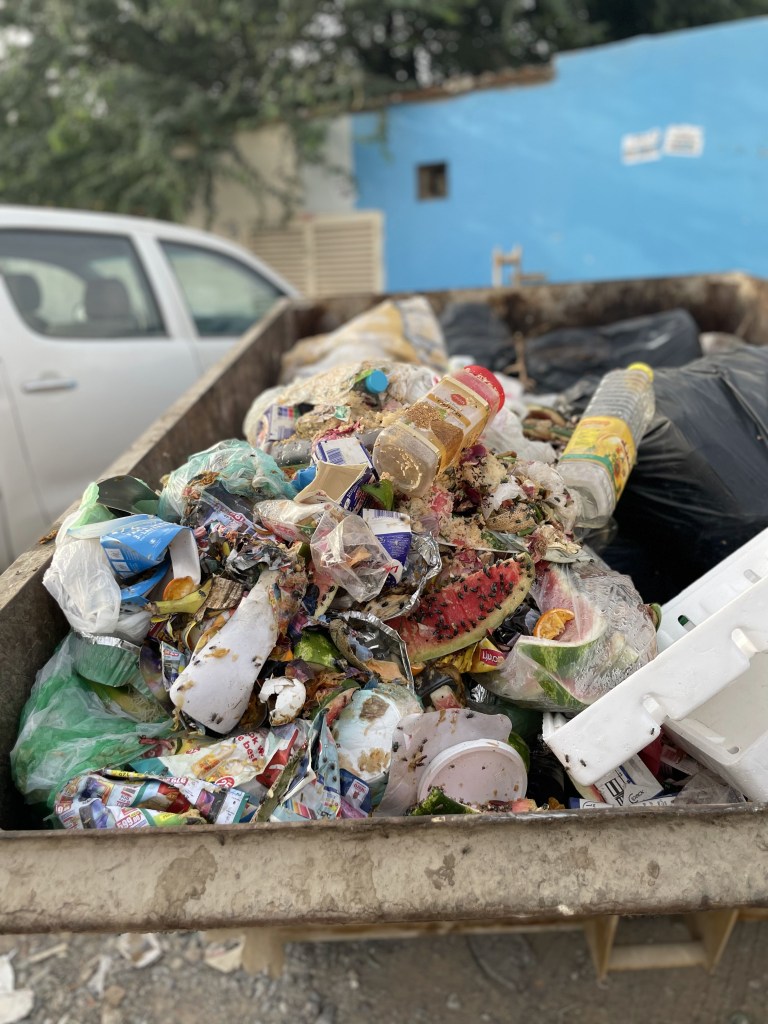
Remember that video I showed you earlier? Every single building you see in that clip, every swimming pool, every harbour, fountain, iconic building, highway, resort, metro, island, amusement park, aquarium, hotel and mall was built by the hands of immigrant labourers, predominantly from Bangladesh, Pakistan and India. It is through their blood, sweat and tears that this sparkly, shiny city was created and yet, for some reason, their faces are never represented in any marketing videos. They get no kudos, they receive no recognition and they are shunted out of the way to live in hot, dusty, squalid labour camps, several men cramped together in a single room, the overpowering smell of garbage inescapable. And that just really sucks because, despite being out of sight and out of mind, they are still here. They are real people. And they deserve a little bit of time and attention and kindness and respect, just like everybody else.
So I want to show you their faces here.
Dudes!
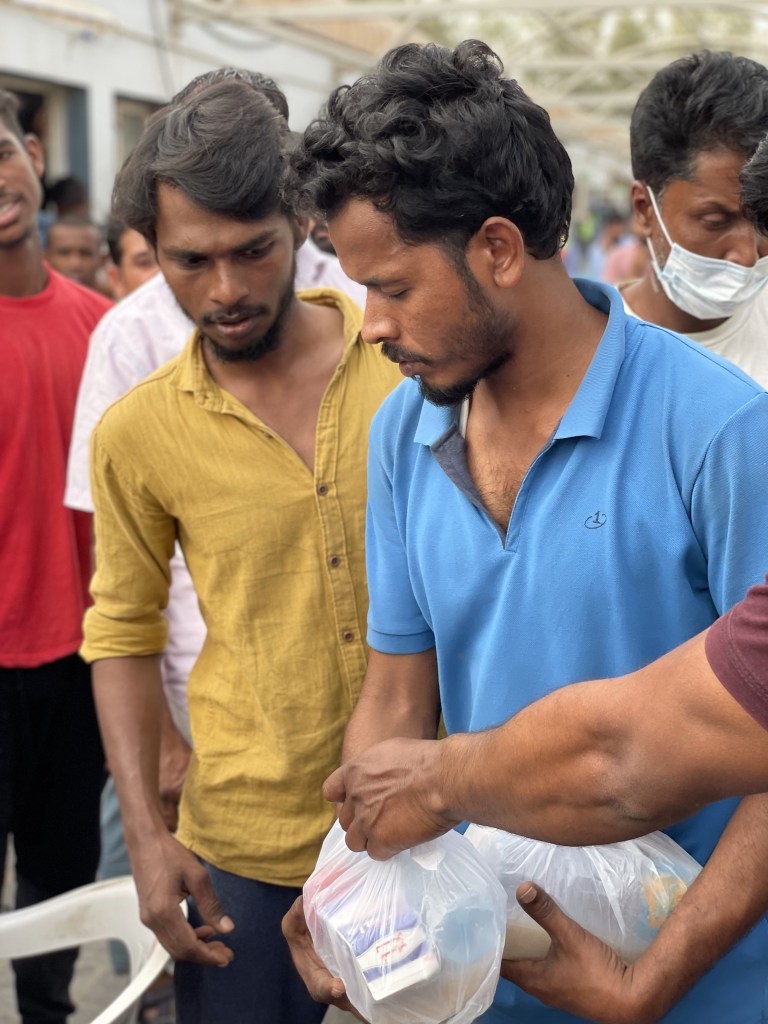
These are the men that the Sheikh doesn’t want to feed as part of his fancy One Billion Meals crusade because their needs are apparently already being met. Charity, it would appear, doesn’t necessarily begin at home. Or maybe feeding your own workers and providing them with better living conditions isn’t as strong a virtue signal to the world as a catchy slogan is (though in my humble opinion, it really would be). So this Ramadan, as we have done for the last nine years, David and I and some of our wonderful, generous friends set out to provide these unseen men with a delicious, filling Iftar meal to break their Ramadan fast.
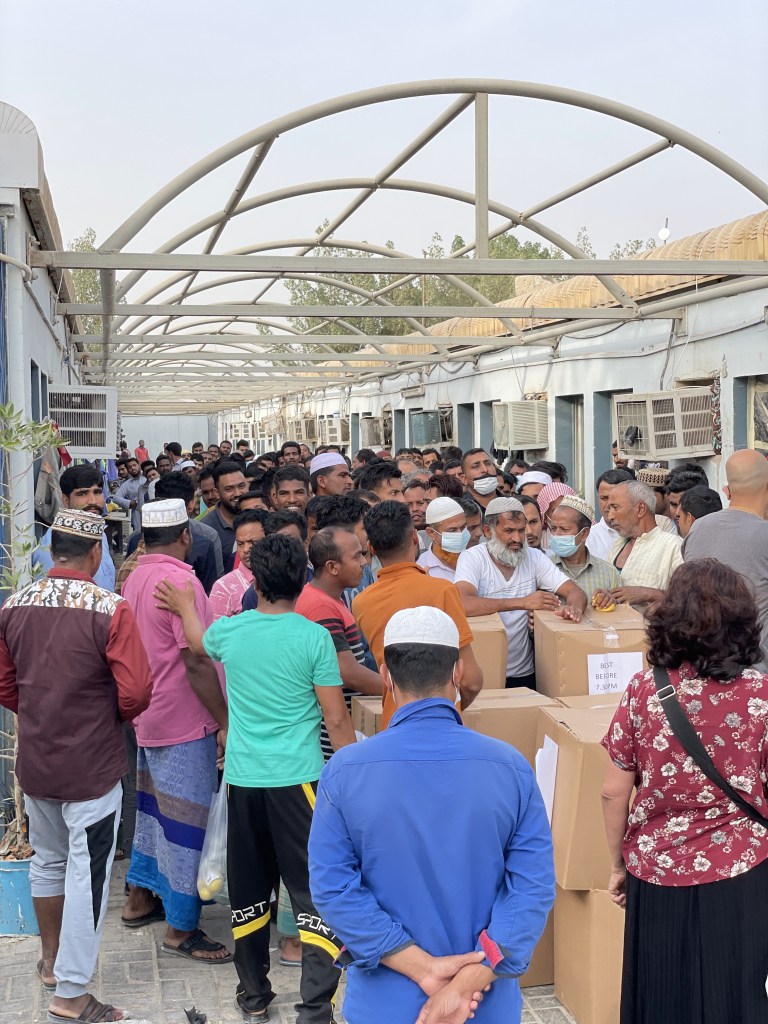
Chaos.
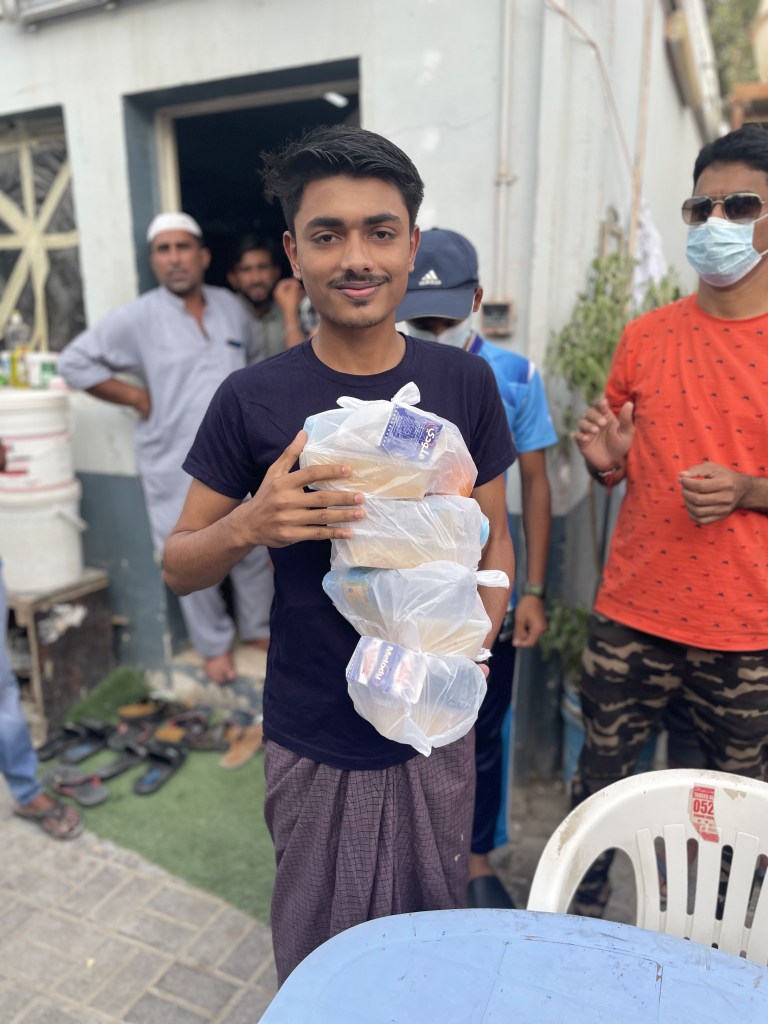
I always get a kick out of being at these food handouts, witnessing the gratitude on the faces of the men, feeling the love that comes from giving to someone in need. And this year did not disappoint. This time though, there was a feeling in the air that was different. Normally we hand out the meals from the back of a van on the street, but this time the meals, packed up in boxes, had been placed inside one of the dormitories. That made it feel more intimate, and more personal. We were in their world now. It was also more chaotic than usual because guys from neighbouring labour camps had caught wind of the handout and swarmed the joint. It always feels really bad that we can’t feed every single person who needs a meal, but that’s life I guess. We were there to give food to the guys living in that particular dorm, and that was made a little tricky by the interlopers. Eventually we figured out a system in which a representative from each room would approach and tell us how many men he was cohabiting with (usually between six and nine) and he would then be given the correct number of bags, each containing some dates, a piece of fruit, a bottle of water, some laban and a hot, tasty biryani. That system seemed to work out OK.
David and I stuck around after the food was gone because I wanted to take some more photos. With the other volunteers no longer with us, we felt a little out of place, like we didn’t belong. But I was never afraid. On our way out, a few of the guys approached us and asked David and me if they could take selfies with us. Of course we agreed, and before long we were surrounded by a throng of young men, taking photos, as if we were movie stars. This was the first time we’ve ever personally interacted with the men we’ve given the Iftar meals to, and it was wonderful. I hope to do it again next time, as it really made my day.
Our campaign to feed 2000 men was a drop in the ocean compared to the billion meals that the Sheikh wants to donate in his name, but for me what made this year so special were the fleeting human connections I made with those men. I had the opportunity to chat to a few of the guys, and I made an effort to look as many of them as I could in the eye. I got the chance to see them. As people. I smiled at a lot of them, and received many smiles in return. And it was these beautiful smiles that truly uplifted me on that day. The Prophet Muhammad (peace be upon him) has been quoted as saying “Even a smile is charity.” And if that is the case, then it was I who was enriched by the experience. Because I walked out of that camp absolutely elated and exhilarated, walking on air. I wonder if Sheikh Mohammed knows the feeling.
My beautiful husband.
Six men live in this tiny room. They were kind enough to let me in to take a photo.
At the end of a hot, sunny day, the stench gets pretty bad.
This young man should be out having fun with his friends, dating, dancing, living his life. Instead he is essentially an indentured servant, working 12-14 hour days to send money to his family.
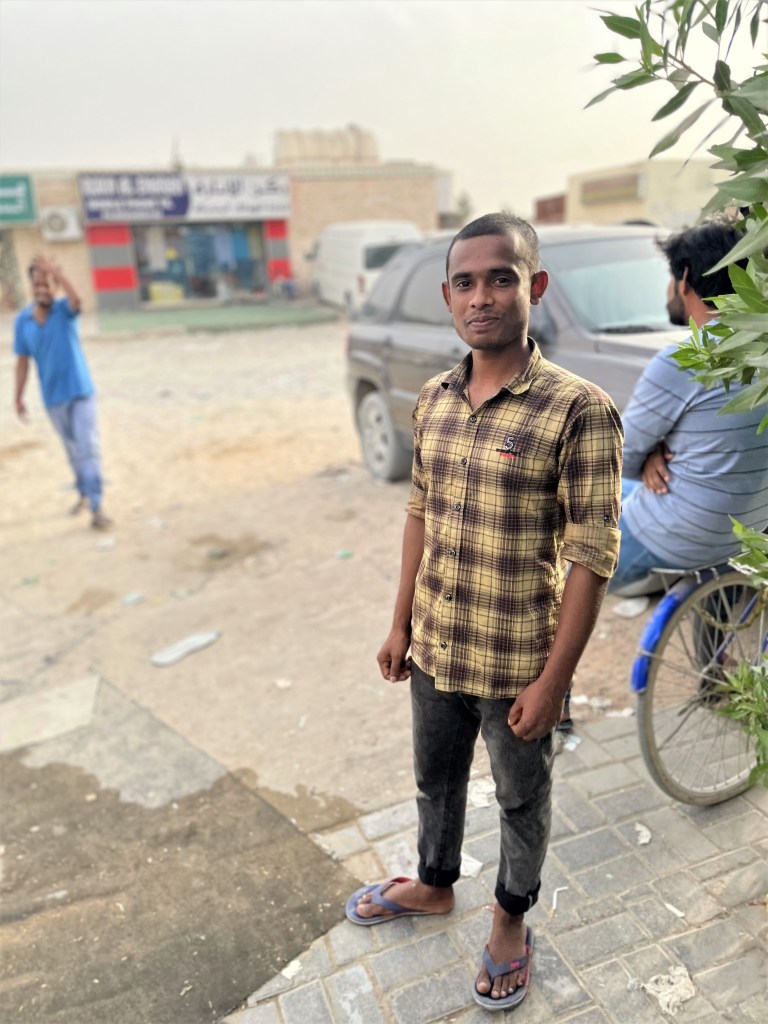
This guy is my favourite. There is a fragility to him, but at the same time a steely eyed dignity. I wish him well.















 Chryss In Dubai