Emirati Info

Ejo #28 – Expat Life In Dubai (Some More Questions Answered)

WHAT ARE THE MOST POPULAR TV SHOWS?

Hmm, I don’t really know to be honest.  I do know that if you pay for cable TV you can watch hours upon hours of utter crap (most of it from America and the UK).  I have, at one time or another, been addicted to the entire Food Network, the antics of the Kardashians, all three versions of CSI and, of course the adventures of Bear Grylls.  And whenever I’m not looking, David will watch sports and Ultimate Fight Club (I just can’t with that show).  For the most part though we don’t really watch broadcast television, preferring box sets.  There are, of course, several programmes on TV aimed at Arabic audiences but the only one I’m really aware of is a show called “Arabs Got Talent” (yes, it is exactly what it sounds like), which became an overnight sensation when it debuted about a year ago.  Do yourself a favour and check it out at Arabs Got Talent.  I promise you won’t be disappointed!


CAN YOU BUY PORK IN DUBAI?

Yes, you can.  A few supermarkets have special little enclaves in which you can purchase basic pork products.  They usually have a cute little sign on top stating “Pork: Not For Muslims” (you know, just in case they weren’t sure).  It’s a little harder to find restaurants that have pork on the menu.  The reason being that the license required to serve pork is associated with the license required to serve alcohol – and those are exclusively reserved for eateries in the large, five-star hotels.  Also, I imagine the logistics of keeping the kitchen “uncontaminated” by pork would be quite difficult.  For instance, a knife and chopping board used to prepare a pork dish could never be used for any other non-pork foods.  As an unfortunate consequence of this, there is a proliferation of bacon substitutes on offer around the city.  Trust me when I say that veal bacon, beef bacon and turkey bacon are all pretty bloody awful and best avoided if you don’t wish to insult your taste buds.


It’s not all bad though.  Very recently I was scouring the city looking for some Jamón Iberico (yeah, right!) for a Spanish tapas dinner party I was planning.  I had almost given up hope when I stumbled across the gourmet deli in Galleries Lafayette (a French department store in the Dubai Mall).  While admiring the lovely epicurean delights on offer, David and I surreptitiously inched our way towards the requisite room up the back.  As we approached the “Not For Muslims” sign, the opaque sliding doors parted to reveal a cornucopia of all things pig!  I do believe that, as the doors slid closed behind us, I jumped up and down and squealed (aptly) for joy.  We were surrounded by handmade chorizo, French pork sausages, prosciutto, smoked hams, streaky bacon and much, much more – and in the centre of this plethora of pork, majestically displayed in a large vice-like contraption, was a full hindquarter of corn-fed Iberico pig, hoof and all.  I sincerely couldn’t believe my eyes.  The attendant, noting the object of my attention, took a carving knife, sliced a little morsel of the deep rose flesh and ceremoniously handed it to me to taste.  Oh my god, it was heaven!  Suffice to say I have a new favourite shop in town!


THERE’S A LOT OF SPORT IN DUBAI, BUT WHERE TO “REGULAR” PEOPLE EXERCISE?

Yes, just like Australia, the UAE is pretty sports crazy.  Things here work a little differently than back home though, in that summertime sends us scampering indoors to hibernate, watch DVD box sets and lose the tan that we acquired during the lovely winter months.  But conversely, those winter months are perfect for all sorts of outdoor activity.  Blue skies and average temperatures of about 24ºC entice a lot of people out of their caves.  People run, walk, cycle, rollerblade, do yoga in the park, swim, sail, surf and even get their butts kicked in beachside boot camps (which is always fun to watch).  When it starts getting too hot to exercise outside, the majority of people retreat to the air-conditioned comfort of a gym (though, naturally, there are a few crazies who exercise outside all year round).  Most apartment buildings have a gym (and pool) for residents to use.  There are also plenty of stand-alone fitness centres around town offering not just gym equipment but all sorts of classes to whip you into shape.  Yoga and Pilates are also both very popular here.  In addition to all this, Dubai boasts the highest number of personal trainers per capita in the world (I’m actually just making this up, but there sure are a lot of them around and until someone proves me wrong, I’m sticking with it).


WHAT COOL BANDS TOUR DUBAI?

I’ll tell you who tours the UAE.  Elton John likes touring here.  Rod Stewart.  Duran Duran, Sting, Gipsy Kings, Snow Patrol, Dave Dobbin, Britney Spears.  Amy Winehouse toured here, five months before she died (and it was not her finest hour).  The Eagles are set to tour.  Engelbert Humperdinck was here two weeks ago!  I am so not joking.  Now, please don’t misunderstand me.  I’m not saying that the performers I’ve mentioned above aren’t good quality performers – or that they don’t put on a good show.  I mean, come on, it’s Engelbert Humperdinck, people!!!  No, I’m not saying that at all.  I’m just saying that they’re not my thing.  I long for some promoter to book Sia for an intimate gig in town.  Or Bill Callahan.  PJ Harvey would be great.  TV On The Radio?  Leonard Cohen?  Unfortunately, I just don’t see it happening, and that makes me sad.


DO YOU EAT OUT MUCH?  WHAT KIND OF RESTAURANTS DOES DUBAI HAVE?

We don’t eat out that much – we did when we first got here and we (rapidly) maxed out our credit cards, and put on an amazing amount of weight.  So, now we tend to go out to eat only on special occasions or when we have guests in town.  As for what kind of restaurants are available here, I’m pretty sure that if you can think of a cuisine you can find it here.  Argentinian, Korean, Italian, Ethiopian, Afghani, Nepalese, Indian, Pakistani, German, Mexican and Russian.  There’s seafood, all types of Asian, steakhouses, fish and chips, vegetarian, halal, middle eastern and so much more.  In fact, a search on Time Out Dubai’s online restaurant section reveals over 1500 choices.  If you can eat it, chances are you can eat it in Dubai (and yes, that even includes pork).


Unfortunately though, simply because it’s available doesn’t mean that the quality is that great.  My experience of dining out in Dubai is that there are very few places that do consistently good food.  The rest?  Not so good.  Strangely enough, it is in the higher end restaurants that I have found the food generally to be bland and uninspiring (which is really insulting considering how much it costs to eat at these places).  Also I’ve found the service to be grossly complacent (if not sometimes outright incompetent) – which I don’t necessarily blame the servers for.  In Dubai, it appears that restaurants prefer quantity of staff, over quality.  The servers are rarely trained to give a high standard of service, so how can it be their fault when they fail to deliver?  It’s difficult to say if the complacence is the cause, or borne, of the number of restaurant closures in town but it seems that not a week goes by that one restaurant or another doesn’t pack it in, to make room for some new (optimistic) venture.  Speaking from a non-financial perspective there just doesn’t seem to be that much investment in creating great dining spaces here, which is such a shame.  More attention goes towards importing already established eateries (Rivington Grill, The Ivy, Ruth’s Chris Steakhouse and Nobu are just a few).  Another common ploy is to stick a famous name on the door.  There are dozens of renowned chefs who have opened restaurants here.  And, unfortunately, fewer than a handful of these chefs frequently visit to check on the menu or even (shock, horror!) cook themselves.


Of course there are a few exceptions.  For special occasion dining it is very hard to go past Reflets par Pierre Gagnaire  – a restaurant we have been to several times to celebrate both of our birthdays, and our wedding anniversary.  A new favourite is Table 9 By Nick & Scott, the successor to Gordon Ramsay’s Verre restaurant in Old Dubai (if you are interested in reading my review of this, and other restaurants, please visit my other site “Foodie In Dubai” – still a young project but one I will definitely be growing).  On the other end of the food spectrum we have the simple, canteen-style eateries where the majority of the population (being from the subcontinent) go to fill up on a daily basis.  There are several places in the city where you can get a couple of fantastic curries and delicious, fluffy naan for less than the cost of a bottle of water at one of the fancier places.  Ravi’s is fantastic, and considered a Dubai institution.  And in the middle we have a few stalwart favourites – such as Mango Tree, our favourite Thai place where we (unadventurously) take all our overseas guests for a fantastic meal.  It’s always a winner, consistently serving up tasty, authentic Thai food and great cocktails!  So hey, why wouldn’t we take everyone there?  Certainly, no one has complained yet!


I’ve recently discovered a great new blog (The Hedonista) written by a fellow Australian chick living in Dubai who loves the same things that I do (food and travel) and posts far more often than me.  Even if you don’t live in Dubai, if you are interested in food and travelling then I think you’ll enjoy reading her.  Check her out.
Ejo #26 – The Most Frequently (And Some Less Frequently, But Still Interesting) Questions About Expat Life In Dubai*

Well, all I can say is thank goodness that it’s a leap year, giving me one extra day to scrape in this month’s ejo (just by the hair on my chinny chin chin!).  Phew!  So, people type some interesting things into Google.  Really interesting things!  Every time this site gets a referral from Google, I get a notification of what the search was that led them to me.  Some queries seem to come up again and again (you’d be surprised at how many people are in the market for an elephant skin jacket – I kid you not!).  My friend Chris (the one that helped me set up the site in the first place – yes, I should probably be paying him) suggested I write a special FAQ ejo to answer the more common questions.  And so, here it is.


CAN YOU HELP ME GET A JOB AS AN AIR TRAFFIC CONTROLLER IN DUBAI?

Far and away, this is the question that I get asked the most often.  Unfortunately for you the answer is no, I cannot.  What I can do though is provide you with an email address (Serco-Admin@dubaiairnav.gov.ae) where you can make enquiries and send your resume.  The rest is up to you.  Good luck.


WHAT DO MEN WEAR UNDER THEIR DISH DASH?

OK, so this is a very close second for most commonly asked question.  Being the intrepid investigator that I am, I summoned up the courage to ask one of my Emirati colleagues what he wears under his (keeping my fingers crossed that he wouldn’t get me deported for breaking some indecency law).  As it turns out I needn’t have worried.  He simply lifted his dish dash and showed me.  Yep!  All the way up.  Anyway, the garment worn under the dish dash is called a ‘wuzar’ (my spelling might not be 100% correct there, but that was the pronunciation).  It looks just like a long, cotton petticoat.  My colleague was wearing one with a loose elasticised waist but apparently you can also buy wrap-around wuzars, depending on your preference.  I asked another colleague (a woman this time, I’m not THAT bold) about the possibility of embarrassment caused by unwanted “physical reactions” and she told me (after laughing at me for a bit) that some men wear underpants, as well as a wuzar, to prevent any embarrassing situations cropping up (so to speak).  Others, more confident, simply go commando.  So there you have it, now you know.


IS ALCOHOL BANNED IN DUBAI?

As you’re about to find out, I have quite a lot to say on this topic.  Far from being banned, alcohol has a very large presence in Dubai.  The duty free allowance per person here is a very generous 4 litres of booze.  To put that in perspective, Australia’s limit is 2.25 litres.  I’ve mentioned in a previous ejo why I think alcohol is allowed in Dubai.  And it has everything to do with money!  Admittedly, not all the emirates are as laid back about it.  For instance Sharjah completely bans the consumption, or even possession, of alcohol.  If you live there, you can’t enjoy a beer with your food, even in the privacy of your own home.  Not legally anyway.  Another point to note is that alcohol is one of the only items in Dubai which is subject to tax.  A whopping 30% tax, making it very expensive.  Officially, in this emirate you need a license in order to purchase alcohol for your private consumption.  Unofficially, whenever you want to stock up, you can just drive to one of the (more relaxed) neighbouring emirates which sells untaxed booze.  Either way, it’s readily available.


I must confess that when we first moved here my drinking became problematic.  Free flowing booze at weekly brunches makes it difficult to know how much you’re actually drinking.  And socially, it’s something that can easily become a habit.  I put on a lot of weight, behaved very badly and suffered some monster hangovers (the worst of my life).  Eventually, I sobered up for long enough to realise that it had to stop.  Not everyone has the same discipline.  The two Brits who were arrested and deported for the ‘sex on the beach’ scandal had apparently been drinking all afternoon at one of the famous Friday brunches.  And there lies the dichotomy.  The Friday brunch is a Dubai institution.  It is government sanctioned and almost impossible to avoid if you want to go out for a midday meal on Friday (which happens to be the first day of the weekend here).  Just about every hotel in town offers a Friday Brunch.  But to actually be under the influence of alcohol in public (whether you are rip roaring drunk or have had just one glass) is illegal.  So, theoretically, the cops could arrest every single person leaving a brunch as soon as they step out of the hotel, though they tend not to as it wouldn’t be very good publicity for the city.  But what amazes me is the number of people who are completely unaware of the law that they are breaking, who are then outraged when they get into trouble for breaking it.  Yes, booze is a big part of life in Dubai, but it exists in a very delicate balance within society.  It’s not something that you can take for granted, like back home (or pretty well anywhere else in the world).  You must be careful at all times, as the consequences can be severe.  A woman found this out a few years ago when, after attending a big brunch, she drunkenly passed out in a hotel bathroom where a hotel staff member raped her.  When she reported the rape, they didn’t just arrest him for the rape, but also her, on charges of being drunk in public.  That’s very scary.


WHAT ARE THE CHALLENGES AND LESSONS FOR A WESTERN WOMAN WORKING IN THE UAE?

David and I moved to Dubai in 2008 after he was offered an ATC job at Dubai International Airport.  When I couldn’t immediately get work as an air traffic controller, people often assumed it was because I was a woman and that women aren’t allowed to work here.  This isn’t true, and my lack of employment was actually the result of the global financial crisis.  A year or so into our move I was offered an ATC job at Al Maktoum International Airport where I’ve been happily working for over two years.  I’m lucky enough to work for a very large multi-national company which implements equal employment rights for women here, and as a result I’ve never experienced any discrimination in the workplace.  In fact I’ve been given opportunities here that wouldn’t so readily be available to me back home.  Not because (or in spite of the fact that) I’m a woman, but based on my ability to do the job.  To be completely honest I’m sure that there are many women here who do face discrimination and challenges in the workplace but I have neither observed or, personally, been subjected to it.


Having said all that, something very disturbing happened to me a couple of days ago which demonstrates that the city has a VERY long way to go towards gender equality.  As I mentioned earlier, a liquor license is required to (legally) buy alcohol here, so I figured I’d apply for one since David’s expired a while ago.  So, off I went to the bottle shop with all the necessary paperwork in hand.  This includes an application form, a copy of my passport and residency visa, a copy of my payslip and a “Letter of No Objection” from my employer (stating that they had no objection to me applying for the license).  I confidently handed it all over and was promptly asked where the “Letter of No Objection” from my husband was.  I’m just going to let that sink in for a minute while I go on to describe how I had to bend down to pick up my jaw off the floor.  Yep, they insisted that, since I’d checked the box on the application form saying I was married, I had to ask my husband’s permission to obtain a license to drink booze.  It’s actually enough to DRIVE you to drink!  I asked, incredulously, if that would still be the case if my husband was my dependant, and I was his sponsor.  The answer came back yes.  The man, it seems, is still the boss.  Being the modern woman that I am, I insisted that they process my application without David’s authority so we’ll wait and see how that works out for me.  I’ll let you know.  While this experience completely flabbergasted me, it is an isolated one (for me at least).  I look forward to never encountering such discrimination here again.


ON A ONE-TO-ONE BASIS WHAT IS THE COMFORT LEVEL BETWEEN ARABS AND NON-ARABS BOTH IN DUBAI AND IN THE RURAL AREAS?  IS THERE COMFORT?  CONFIDING, FRIENDSHIP, ALLIES?  OR ARE WESTERNERS FOREVER A COMMODITY IN A TRANSIENT INTERNATIONAL TRADE?

My experience in Dubai is that, as a general rule, locals are a little wary of expats.  As a whole they probably do see us as a bit of a commodity.  But that isn’t to say that they necessarily resent our presence here.  The city simply wouldn’t be what it is today without us.  Regardless of the overall feeling, my own personal experience is that once an Emirati develops a relationship with a foreigner (whether it be a friendship or a working relationship) then the guard comes down.  Every Emirati that I have the pleasure of knowing through work is warm, generous, hospitable and friendly.  I think that this is their true nature and that the wariness comes as a natural (and understandable) result of being a minority in their own country.  I haven’t met any locals out of the city but from what I hear, Bedouin hospitality is even greater.  So, one-to-one I’d say that yes, relations are good.  There is warmth and acceptance and friendship.  However, I don’t think it would be realistic to expect this to extend to all relations between expats and locals.  I have heard stories of locals being rude, nasty and sometimes just plain malicious towards expats.  I suppose that, just like everywhere else, it depends on the people involved.


HOW DO THEY EXPECT “THE WORLD” TO NOT ERODE AWAY ON A BIG TIDE/STORM SURGE?

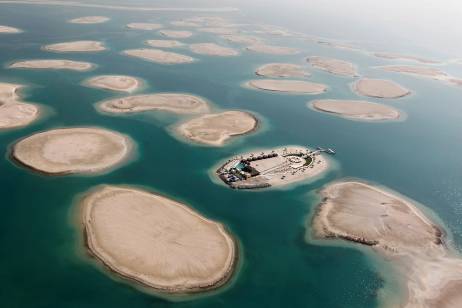
This is an interesting question.  For those of you who don’t know, The World project is a man-made archipelago consisting of about 250 islands designed to look, from above, like a map of the world.  There seem to be regular reports that the islands are slipping back into (and being re-reclaimed by) the sea.  Nakheel, the developer of these (and the more successful Palm Island projects) of course denies these reports.  So, who’s right?  Well, for now it appears that the islands are sticking around, though due to the financial crisis, until recently only one had been developed – and that one belongs to the ruler of Dubai.  Earlier this month though, I heard that an Indian entrepreneur has developed a beach club (complete with swimming pool, beachside cabanas, bar and restaurant) on the island of Lebanon which is due to open any day.  This means that people will be able to visit the islands for the first time ever (which is quite exciting).  Hopefully this will encourage other developers to invest in similar kinds of ventures.  As for the threat of erosion, from what I can tell, the islands lie on a very solid foundation (similar to that of the Palm Islands and also the reclaimed land on which the Burj Al Arab sits).  The technology is sound.  The 321 million cubic metres of sand and 31 million tons of rock which form the foundation would also suggest that The World is here to stay.  (To put those figures into perspective, 1.8 million tons of debris was recovered from Ground Zero after 9/11.)


Lebanon Island


HAS LEEWIN FOUND A WIFE?

Not yet.  And, in a lucky twist of fate, the search has temporarily been called off after his cousin (a numerologist) did a reading and discovered that Leewin’s profile on a whole bunch of matrimonial sites had been registered on an unlucky date.  How about that!  His brother quickly took down all of Leewin’s information from the internet, and is waiting a couple of months (and for a new numerology reading) before re-registering him.  Marriage: 0, Leewin: 1.


OK, so I hope that your question has been answered.  This is actually part one in a two part special so standby for some more interesting facts about life in Dubai next month.  In the meantime if you have a burning desire to have a myth debunked or just want some information on something you’re unsure about, please just drop me a note and I’ll see if I can add it to the next FAQ ejo.


* (Unfortunately,) I feel obliged to state that the answers to these questions are 100% opinion only.  If I’m wrong about something, I apologise and am very open to being corrected.

Ejo #25 – Sheikh Zayed: The Father Of The United Arab Emirates

Every day I drive to and from work on a freeway called Sheikh Zayed Road.  It’s a 16 lane behemoth, flanked on either side (in the downtown area) by the soaring skyscrapers that define the city’s skyline.  It’s a very impressive thoroughfare and so it should be, for it is named after a very impressive man.  That man is the topic of this month’s ejo.


Sheikh Zayed bin Sultan Al Nahyan is widely regarded as the father of the United Arab Emirates.  Before 1971, the country as we know it didn’t even exist.  The seven emirates that make up the country (Abu Dhabi, Dubai, Sharjah, Ajman, Fujairah, Umm Al Quwain and Ras Al Khaimah) were then collectively known as The Trucial States.  They were called that because in 1820 they all signed a treaty with Britain, called the Perpetual Maritime Truce.  In layman’s terms, the treaty gave Britain exclusive rights in the region in exchange for protection against external threats, particularly from Europe.  England allowed the emirates to rule themselves but oversaw governance – which involved, amongst other things, arbitrating the frequent disputes between the sheikhs.


Almost 150 years later, in 1968, England announced that they planned to withdraw from the region and Sheikh Zayed (ruler of Abu Dhabi at the time), sensing an opportunity to form a coalition with the other emirates, proposed to them that they unite to become an independent country.  Of course, now it seems obvious that they would do so.  But at the time, this idea was revolutionary.  The states may have agreed to form a trucial union way back in 1820 as a British protectorate, but the ruling Sheikhs of 1968 were prone to disputes, and in particular Abu Dhabi and Dubai had clashed a number of times.  They weren’t exactly on friendly terms.  In addition to this obstacle, some of the other states (namely Bahrain and Qatar) had plans for their own independence and wanted no part of Sheikh Zayed’s preposterous idea.


However, such was the Sheikh’s conviction that unity would provide strength, that he diplomatically persisted for three years until he convinced the others to sign on.  On 2nd December 1971 six of the emirates signed an agreement to form the country the United Arab Emirates.  A few months later, Ras Al Khaimah joined them and the country as we know it was born.  Last year marked the 40th birthday of the UAE (an excellent vintage, if I do say so myself)!  Now, if you think the USA puts on a good show for their Independence Day (4th July) celebrations, you ain’t seen nothing!  The citizens of the UAE are not just proud of their country, they absolutely adore it.  The National Day celebrations each year are bigger than anything else on the social calendar, including New Year’s Eve.  Emiratis, and expats alike, adorn their cars with the national colours of red, white, black and green.  Ribbons, stickers, flags, paint (yes, people paint their cars) and streamers.  They fill the streets, covering everything with glitter and silly string.  They sing, they dance, they do cartwheels.  They beep their car horns and shriek with glee.  There are parades and concerts and fireworks.  It’s quite something to behold and you really can’t help getting caught up, not just in the excitement but also the great sense of national pride.  And of course the undisputed hero of National Day is the man that made it all happen, Sheikh Zayed.


National Day car decorations


Zayed was born in 1918 into Abu Dhabi’s ruling family.  When he was ten years old his father died, leaving Zayed’s older brother Shakhbut ruler of the emirate.  Back then the entire region was poor and underdeveloped – oil hadn’t been discovered yet and the economy relied heavily on pearling and fishing, which provided scant income.


Zayed spent most of his youth in Al Ain (a desert oasis outpost), hanging out with his Bedouin tribesmen.  They taught him their way of life, skills and traditions – a love of which stayed with him for the rest of his life.  In fact even after he became very powerful he preferred to spend time with the Bedouin rather than with people of his own status.  It was in the desert that he felt most comfortable, and it was there that he was taught, and became passionate, about hunting and falconry (though when he was 25 he famously gave up rifle hunting to set an example for wildlife conservation – another of his passions).


When Zayed was 28 his brother appointed him ruler of Al Ain and his political life was born.  He started travelling extensively, particularly throughout the Middle East, Europe and the USA and it was on these travels that he noticed the high standard of education and health care available in the more developed countries.  He saw how large the divide was between the Trucial States and the rest of the world, and he believed that it was imperative to bridge that gap.  Unfortunately, as long as his brother Shakhbut was in charge, Zayed’s hands were tied and he was unable to effect any change.


When oil was discovered in 1958 things started to look up economically.  Sheikh Shakhbut, however, was a frugal and cautious leader accustomed to a more austere lifestyle in keeping with Abu Dhabi’s historically hard times.  Members of the ruling family became unhappy with how slowly he was progressing with oil exploration and development and in 1966, with Britain’s backing, they decided to oust him and appoint Sheikh Zayed as new ruler of Abu Dhabi.  Zayed took to the role as though born to it.  Using his own funds, he immediately set about making many changes and improving the emirate – developing housing, schools, hospitals.  Later on when the oil money started pouring in he spent it on ports, roads, an airport and other infrastructure.  He also began a lifelong project of conservation, responsible for the planting of millions of trees throughout Abu Dhabi (becoming known in the process as “The Man Who Turned The Desert Green”).


After taking power, he also realised that for Abu Dhabi to truly prosper it would need to co-operate and join forces with its neighbours.  And when Britain declared its withdrawal from the area his vision for the UAE was ignited.  At a time when the Sheikhs of the other emirates were looking at how they could gain advantage over each other, Zayed was looking at a bigger picture.  He saw that if they got together they could achieve much more than if they remained separate entities and just a few short years later, his vision became a reality and the country experienced unbelievable growth (bolstered of course by the discovery that Abu Dhabi sat atop nearly 11% of the world’s natural oil reserves).


When the UAE came into existence in 1971, Sheikh Zayed was naturally elected President.  He continued to be re-elected, and serve as ruler of the country, until his death in 2004.


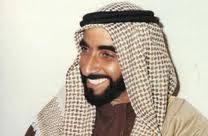
Sheikh Zayed in the desert wearing traditional Bedouin clothing


When he died at the age of 86, the entire nation went into deep mourning.  They were shattered.  They had lost not just their leader but their father.  And Zayed loved his people in the same way.  He was once asked in an interview why he donated land and housing to his people, why he gave them free utilities, education, health care and many other advantages.  To paraphrase, his response was, “Don’t you feed your children?  Don’t you put a roof over their heads, put them in school and take care of them when they’re sick?  That’s all I’m doing too – I’m taking care of my children.”  His vision of the UAE as a powerful force in the world wasn’t restricted to economics, or finance, or oil.  He wanted his people to be educated and healthy so that they could in turn contribute to their country, and to the world.  Idealistic?  Perhaps.  But it was these ideals that made him one of the most adored rulers in history.


Why was he so loved?  The basic answer is that he took care of his people.  But it goes much deeper than that.  He actually loved them, and no matter how powerful he became he never presented himself as being better than anyone else.  He remained accessible.  He prayed in the mosques with the common men, he sat and drank tea with the Bedouin, and if someone approached him in the street with a gripe he would listen.  And yes, he would walk the streets.  The idea of locking himself up in a palace didn’t appeal to him.  Even after he’d amassed a personal fortune of over USD20 billion it wasn’t in his nature to act the privileged Sheikh.  To the end he remained within reach and open to his people.


Perhaps what made Sheikh Zayed different was that he understood he was lucky, and he generously shared his wealth, not just with the citizens of the UAE, but with other countries in need.  He donated fantastic sums of money to charities and causes around the world.  He was also famously moderate in his views, believing in and encouraging women’s rights in the workforce.  And even though he was devoutly Muslim, he was open-minded enough to allow the building of temples and churches in the UAE.  This was something that more conservative Muslim countries such as Iran and Saudi Arabia thought was outrageous.  But Sheikh Zayed firmly believed that tolerance, not tyranny was the right way to govern.  His intelligence and perspicacity made him a visionary leader.  His warmth and wisdom and approachability made him a loved one.  Sheikh Zayed was considered the country’s national treasure, and today the UAE is a living memorial to his greatness.


The friendly and wise Sheikh Zayed


I have developed a deep respect and love for the father of my adopted home.  Every day when I drive past his enormous memorial poster on Sheikh Zayed Road, I look up and think about what kind of man he was, I think about everything that he achieved, and how to this day I have not heard one bad word said about him.  There seems to be something almost magical about Sheikh Zayed.  And every day, his warm eyes and wise countenance look down upon me and it feels as though, even though he’s now long gone, somehow he’s still watching and looking over all his children.