Good Life

Ejo #145 – Drunk In….. Greece (Santorini Edition)

Can you believe that even after we had to quarantine for three weeks after returning from Japan in March 2020, I still didn’t really comprehend how serious covid would turn out to be? I just thought woohoo, another three weeks off!! I didn’t realise that the whole world would come to a grinding halt. Or that so much would change. Did you? When it became crystal clear that it might be a while before things would get back to normal (a very long time, in fact), I was surprisingly stoic about what that meant for my travel plans. I usually have at least a couple of holidays in the planning pipeline, which is how I keep sane – I always have something to look forward to. For instance, my sisters and I had planned a big fat Greek family reunion for June 2020. We planned to visit relatives that we hadn’t seen for years (and which my youngest sister Pieta has never met, except as a toddler). It was to be an opportunity to grieve our Mum’s death with our aunt and other extended family, and to scatter her ashes into the sea. And it was an excuse for my sisters and I to holiday together in Europe, which is something we’ve never done before.

Guess how that went. Yep, cancelled. We were, of course, all very upset about it but obviously we were let off lightly in the greater scheme of things. My heart breaks to think of everyone who has missed their loved ones’ funerals, or had to cancel wedding plans or missed the birth of their own children. People have really suffered. We’re lucky. We just rescheduled. For later this year. Tentatively. Coz that’s what you’ve gotta do these days, am I right? You simply cannot make firm plans for anything anymore. But at least we’re back to being able to make plans now, even tentative ones. In April of 2020 when there appeared to be no end in sight to the grounding of international flights I was faced with an interminably empty travel calendar spreading out before me, with no end in sight. No plans to travel. Everything cancelled. Stuck, in Dubai. I mean you all know that I’m not in Dubai because I like being there. I’m there because I like travelling. Since our first holiday to Turkey in May 2009, David and I have never spent more than four straight months in Dubai (hey, don’t hate me coz you ain’t me). So would it shock you to learn that I actually handled the mental abyss of no travel prospects surprisingly well. It’s not as if I had a choice. It’s not as if ranting and raving and crying and losing my mind would change anything. I was bravely chilled out and quietly zen in the face of my own personal worst case scenario.

Six months after covid made its global debut, in a wonderful twist, the universe suddenly rewarded me by offering up the generous hospitality of my grandmotherland. You see, Greece is almost solely dependent on tourist dollars for its survival. Six months of global lockdowns caused a lot of economic grief for Greece. So it made sense that they were one of the first destinations to reopen their borders to tourists in August of 2020. As soon as Emirates started flying to Greece again, David and I jumped on a plane and embarked on a pandemic pilgrimage to the country of my ancestry. I was so happy to be travelling again but I did feel super guilty about being able to travel while my sisters were trapped in an endless lockdown loop back in Melbourne. And I felt guilty because I was specifically going to Greece without them, when we had all planned on going together. And then I also felt guilty because I wasn’t going to visit my relatives in Korinthos, choosing instead to go to Santorini. What I’m saying is that there was some guilt. But guilt is a wasted emotion, so I explained the situation to my rellies and made sure that my sisters were cool with it, and off we went.

The flight out of Dubai was virtually empty, and the attendants were all decked out in PPE gear that made them look like they were serving food at a diner in Chernobyl. Being on an aeroplane again after so long felt a little weird, but it felt so right at the same time. I was so happy. We flew straight into Santorini, picked up a car rental at the airport and drove to the tiny town of Finikia. Two tanned and muscle-bound young men met us in the carpark and, quite impressively, hoisted our extremely heavy suitcases onto their shoulders, briskly marching us through a whitewashed labyrinth of twisting, cobbled paths until we eventually reached our beautiful villa, home for the next ten days. Moments later, Marilena, the eccentric manager of the hotel group exploded on the scene in wafting chiffon, jangling bracelets and squeals of “Dahhhling”. She was a little bit crazy, very extra and an absolute delight. The location of Finikia was perfect for us because the madness of Oia, where all the action takes place, was a very calm 20 minute walk away. We could walk to town whenever we felt like it, but our villa was in a super quiet and very secluded part of the island.

Santorini has always been on my list of places to visit because all my Greek aunts and uncles and cousins have, at one point or another, swooned over what a beautiful island it is, insisting that I must see it with my own eyes. However it was never super high on that list because of the famous summer tourist swell. For instance, in 2019 Santorini’s population of 10,000 grew to over three million people. Eww, gross. David and I saw the pandemic as an opportunity to visit a gorgeous Greek island when most other travellers were still stuck at home baking bread and learning how to use Zoom. And it was perfect!

Despite the island being relatively quiet due to covid, Oia still got extremely crowded, particularly in the evenings when shoulder-to-shoulder crowds would throng the streets trying to secure the best vantage point for the extraordinary sunset display over the caldera. Sadly, we were often the only ones wearing masks, and to be honest, the cavalier attitude of the other tourists towards the pandemic made us feel quite uncomfortable being amongst the crowds so we didn’t spend a lot of time in Oia. Finikia had a much more relaxed vibe and we enjoyed many dinners at the local taverna Santorini Mou, which translates as My Santorini. The homemade food was delicious and the hospitality warm and welcoming. It was frequented by many tourists, but unlike some restaurants in Oia the quality and authenticity of the food didn’t feel dumbed down for international tastes. One of the highlights of the restaurant was the live music they played every night, accompanied occasionally by some dancing. It was such a treat to listen to the music of my childhood, and the entire family running the taverna were super sweet to us when they found out that I was Greek-Australian. The singer would often sing out my name in the middle of a song, winking at me with a smile, which was a little embarrassing but also really lovely. Every time we ate there they would greet us by name, as if we were old friends. It was hospitality like this that made me fall in love with Santorini.
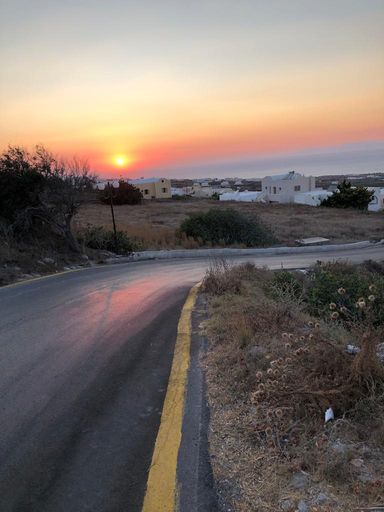
The deserted, stark road from our villa to the restaurant.
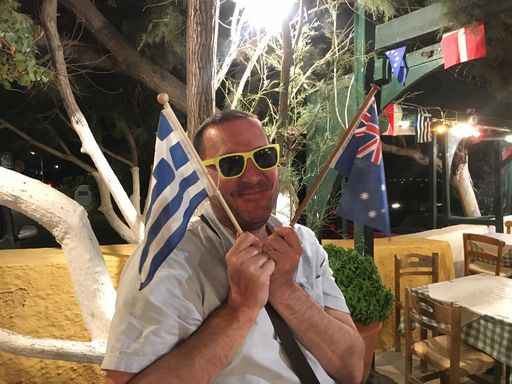
They were delighted when they found out I was Greek-Australian.
The delicious food. Hand-cut chips, octopus, tzatziki and taramosalata (which is fish-roe dip). YUM!!!

When Marilena checked us into our villa on the first day, she went through all the different experiences and packages on offer to us as guests of the hotel. We decided to do two of them. A sunset luxury catamaran cruise and an island winery tour. The catamaran tour was awesome. We were greeted at the port at around 3.30pm and escorted onto our vessel with only three other couples, which was great because some of the other cruises departing that day were really overcrowded. The crew were super friendly and very keen to make the trip as fun as possible for us, handing out snacks and glasses of champagne straight out of the port. We sailed around for a while, checking out parts of the island that are only accessible by boat, and we also stopped at a few different spots so that we could swim, snorkel and explore. It was a lot of fun and I’d definitely recommend it to anyone visiting Santorini.

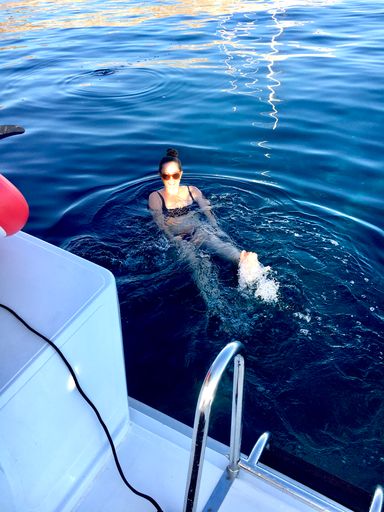
Chilling in the deep blue sea of the southern Aegean Sea.
I made sure to chill only in the shade of the catamaran as I was severely sunburnt.
This is what we came for. A beautiful sunset and free-flowing champagne)

The winery tour was also really fun. A lady picked us up near our villa and drove us around to three different wineries where we did tours of the vineyards and saw how the wine was bottled. It was fascinating. Greek wine has always had a really bad rap thanks to retsina, the resinated white or rosé wine that has been made in Greece for at least 2000 years. It’s an acquired taste, to say the least. In contrast, wine from Santorini is actually world class. The rocky, bone-dry volcanic soil of the island is uniquely conducive to producing incredibly structured, mineral forward wines, and in particular whites. When you think about how hot (scorching) and how windy (gale force) Santorini gets it’s not surprising to learn that in order to produce fruit that can be made into wine, the vines must be trained into characteristic kouloura shapes, like wreaths laid out on the ground. This offers them some protection from the elements and produces marvelous varietals such as our absolute favourite Assyrtiko. If you ever have the chance to try an Assyrtiko, I would definitely go for it, and please let me know what you think. I was blown away that Greece, the place where wine is sold by the kilo at tavernas, could produce such superlative wine.

A typical Santorini vineyard
Some Santorini kouloura vines are centuries old.
At the Argyros winery tasting we tried a rosé, a basic Assyrtiko and also a very special Assyrtiko made from at least 200 year old vines (amazing!!!) and the wonderful Vinsanto.

Another wine that is a specialty of the island is the Protected Designation of Origin dessert wine called Vinsanto, and oh my god it’s so good. It’s produced by taking overripe white grapes (at least 51% Assyrtiko) and laying them out in the hot sun to dry for about a week. Absolutely no sugar at all is added during the maturation process resulting in a naturally sweet wine bursting with the flavour of raisins, figs, honey, coffee and nuts. The wine is matured in oak barrels producing a delectable drop which I just couldn’t get enough of. Of the three wineries we visited, Argyros was our favourite, and in addition to all their wonderful wines, they also sold a block of chocolate filled with a ridiculously delicious, oozing Vinsanto centre. To die for. We ate WAY too many of these but I have zero regrets and I’d do it again in a heartbeat. Argyros also produced our favourite Assyrtiko and we bought several bottles from them during the winery tour. In fact, we liked it so much that we went back to the winery two more times on our own to restock.

Vinsanto chocolate accompanied by a very fine Vinsanto.

We certainly drank a lot of great wine on Santorini, and we also ate a lot of good food. My favourite thing about Greek food is its simplicity. I used to be a really big fan of fancy food. Smears, spherification, Michelin stars. Blah, blah, blah. In the end, the theatre of the food becomes more important than the taste of it. Which is how the fancy food movement lost me. Over the years I have gravitated back towards the basic and unfussy food of my childhood. The food my parents fed me. The meals that I grew up with. Simple, tasty, honest food. And so, some of my favourite meals on the island were the ones that we put together ourselves at our villa. Yes, we had a kitchen, but we didn’t do a lot of cooking. When you’re hungry, there’s not a lot that can beat a simple table of local cheese, olives meats, tomatoes, feta, homemade tzatziki (David makes a mean version), bread and olive oil. Accompanied, of course, by a locally made bottle of white wine or dry rosé. A perfect meal. And so, we ate a lot at home, chilling out by the pool or whiling away the afternoon, reading under the sunshade.

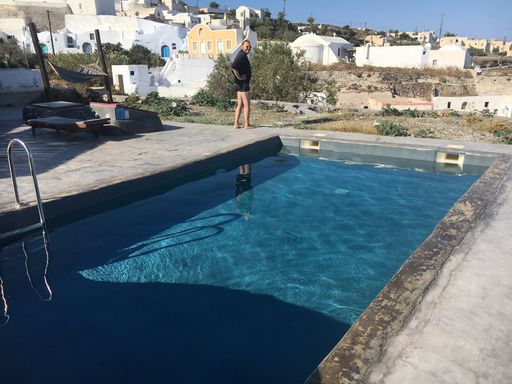
Peasant food is best.
Our pool.

It was on one of those afternoons that I got severely sunburnt. I honestly can’t remember how it happened, but I do remember we had eaten a lovely lunch, similar to that pictured above. I do know that a bottle of wine had definitely been consumed, maybe even two. After lunch we’d retired up to the pool area to swim and have a bit of a lie down. I must have fallen asleep in the sun because when I woke up I was burned on the entire upper half of my body (front and back, somehow). I woke up feeling a little sore, but it was only the next day that the extent of the damage became clear. I was in excruciating pain for the next ten days. I don’t want to say that it completely fucked up our holiday, but it’s certainly not much fun being in so much pain that showering or changing clothes or even sleeping is difficult.

This was taken the day of the burn. The redness intensified over the next couple of days and I definitely resembled a stupid lobster. Lesson learned.

We lay low for a day or two after the sunburn because I literally couldn’t do anything without it hurting like a motherfucker. I’m pretty sure I cried. But a couple of days later, we decided to walk to Oia to experience the famous sunset and have a nice seafood dinner by the water. Ouch! Walking into the sun for 20 minutes, even with a hat covering my face and a shawl over my shoulders was one of the worst experiences I’ve ever had on vacation. Every step felt like I was being splattered with burning lava. Waaaaaaaaaaa!!!!! But, we made it and we took some beautiful photos of the caldera and the town, stopping off for a glass of wine at Fino Wine Bar to refresh ourselves after the hot walk. After our quick wine break, we decided to keep walking to the restaurant rather than stop and take more photos of the sunset because it felt like 100,000 people had suddenly all turned up at the same time and we just wanted to get away from them. So we took the rocky road made of about 300 steep stone steps down the side of the cliff face to Ammoudi Fish Tavern at the bottom. The taverna is accessible only by those rocky steps, or by boat. It was a little touristic, which is to be expected, but we had some nice food in a gorgeous setting before making the (way more difficult) trek back up the steps.
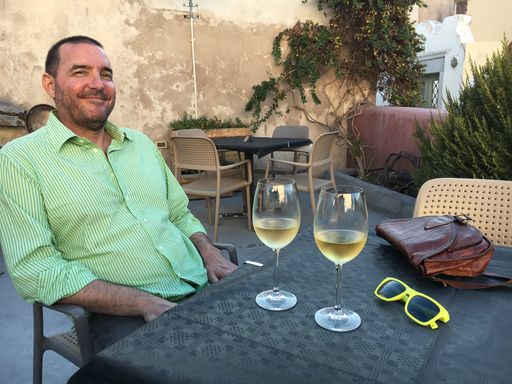
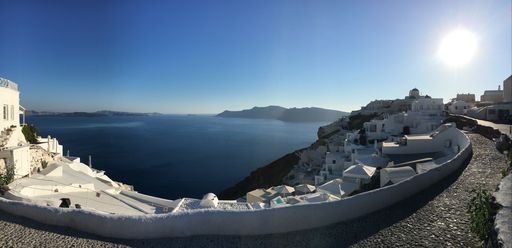
A well earned glass of chilled white wine.
The stunning caldera of Santorini. Also the brutally fierce sun. Ouch.
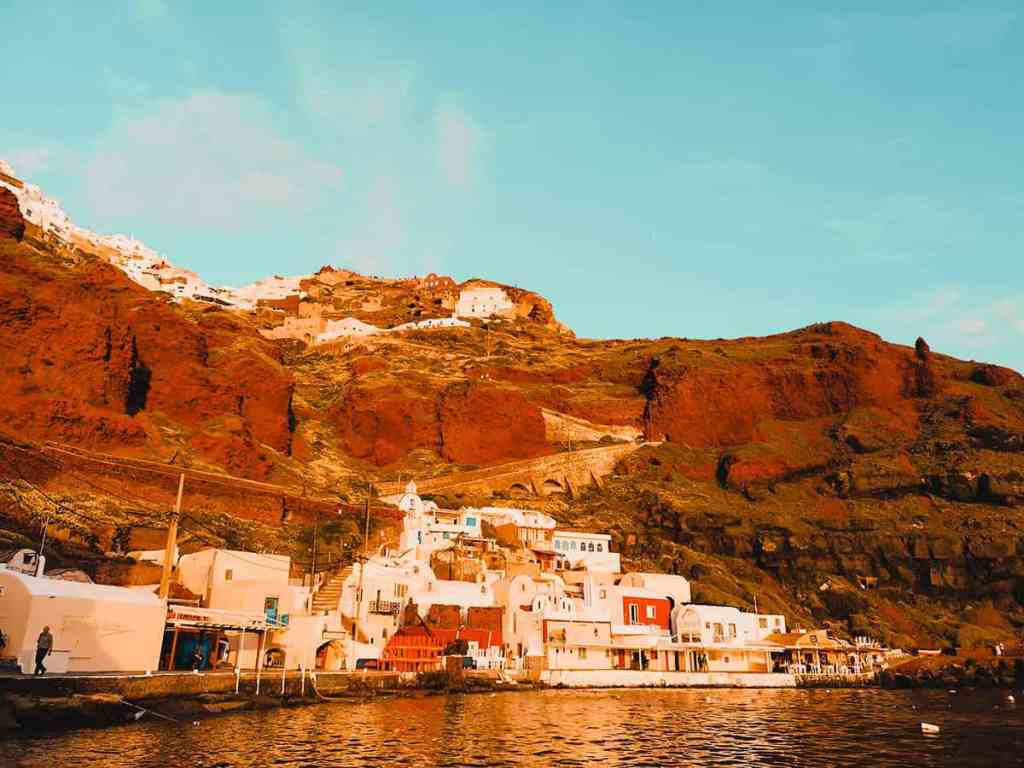
The restaurant is on the right, and you can see the ancient stone steps cut into the mountain face. The colour of the mountain is due to rich deposits of iron.
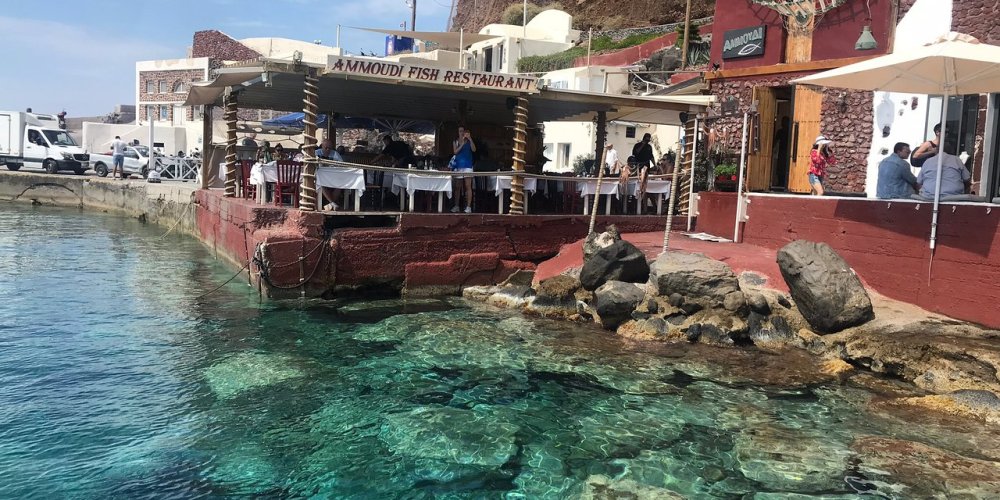
The gorgeous seaside setting. And yes, that really is the colour of the water.

One of the most delicious meals we had on the island was another simple, traditional Greek dish of souvlaki. There are loads of souvlaki joints on the island, but the one with the best reviews, the one that everyone raved about was Pitogyros. So we went along one evening after a day of pretty hard drinking to see what all the fuss was about. After all, everyone knows that souvlaki is one of the best foods to eat when you’re off your face. Apparently many other people were also off their faces because when we arrived there was a long line of people in front of us. I really don’t mind waiting when the reward is a taste of something amazing, and we were not disappointed. Our pork souvlakia came out absolutely perfect, accompanied by salad and chips (which I tried not to eat, but failed miserably). We washed it all down with half a kilo of very delicious white wine.

Perfect souvlakia.

There were a few more places we ate and drank but because of all the eating and drinking I don’t remember the details. Here are a couple more pics from our pandemic tour of Santorini.

Um… check out this ridiculous view. We stopped here for lunch as part of the winery tour. The food and the service were unremarkable but the view was outstanding.
An absolutely spectacular seafood lunch by the sea.

Ejo #144 – “A Family Guide: Herbal Remedies” by Maria Stathopoulos

So it’s the last day of the year.  Time to pay the piper.  As you may recall, earlier this year I laid down a strongly worded promise to my Mum, in addition to a few other shitkicker goals that I’d hoped to have completed by the end of this year.  In other words, today. 

To recap, the first goal was to learn all the words to the eight minute rap song, The New Rap Language.  It brings me no joy to report to you that while I did learn the first few stanzas, there were another 45 verses that I didn’t quite get around to.  Bummer.  I also wanted to learn how to pick locks.  Sadly, no-one will be calling me to take part in any craftily planned heists any time soon.  Zero progress.  Bummer.  As for my goal to put together a fabulous death party (also known, by more basic bitches, as a funeral), I have managed to put together a list of some pretty kick-ass ideas, so I am happy about that.  But these promises were all secondary to the one that I made to my Mum that I would translate her book of herbal remedies into English. 

So, how’d I go?  Well, technically the promise has been satisfied.  I have, with some help from google translate, made a rudimentary translation of every single chapter from Greek into English.  And the reason I say “technically” is that google translate isn’t great at translating nuance, so I need to go through the entire text word by word with a dictionary to ensure the veracity of the translation.  And I’m not that great at translating Greek, so it’s a slog.  And I am nowhere near a final draft.  So technically, yes, it is something I can tick off, but it almost feels like a hollow victory.  In my mind, when I said that I’d translate Mum’s book this year, I’d idealistically imagined that I’d be holding a printed copy, hot off the presses, in my hand right now.  And that definitely isn’t the case.  And I am disappointed. 

My Mum isn’t alive so I don’t know how she would feel about it, but I do like to think that she would be forgiving, sympathetic and understanding.  Because that’s who she was.  And instead of beating myself up about it, I think I should also be forgiving, sympathetic and understanding towards myself.  I have resolved to get my Mum’s work out there in one form or another.  And I will.  Whether it’s an actual physical book, an e-book or even perhaps a website.  Her wisdom must be shared, and it has to be me that makes that happen.  Because I said I would do it. 

When I started doing the painstaking, word by word translation I learned things about my mother that I had never known before.  Can you believe that I had never even read the introduction to her book?  Why would I?  It was in Greek!  Ugh, I’m definitely not proud of that.  Regrets, I have a few.  But in translating the introduction, I found that I was bringing my Mum, through her words and through her experiences, back to life.  The urge to call her, to talk to her, was overwhelming.  It felt like she was right there. And I have so many questions that I wish I could ask her.  I would have loved nothing more than to work on a translation together with my Mum, as a team, and I know that she would have loved it too.  That’s no longer possible but I am going to stick to my promise.  I will find a way to print my Mum’s work in a way that pays tribute to all her knowledge and all the hard work she put into her learning, into her garden and into this book.

Below, I am publishing my English translation of the introduction to “A Family Guide: Herbal Remedies” by Maria Stathopoulos.  Our writing styles are very different so I have made a great effort to remain faithful to Mum’s voice, and to not imbue it my own tone.  It has given me unparalleled joy to open my mother’s book, take out the words she wrote and be able to publish them here. It feels like I’ve unearthed some long-buried treasure for you all. Please enjoy, and I wish you all a healthy, happy and wonderful new year ahead.  🎉

____________________________________________________________________________

The author. ♥

My name is Maria Stathopoulos née Roumelioti.  I was born in 1947 in Ancient Korinthos, a beautiful village at the foot of the mountain castle Akrokorinthos.  I lived there until I emigrated to Australia in 1965.

When I was a young girl, my village didn’t have its own doctor, but a doctor did visit once a week and we would go and see him if we weren’t well.  When that doctor wasn’t available, we would have to travel to New Korinthos, which was a one hour donkey ride away.  The long distance was always a problem and many times it prevented us from travelling at all, which is why we only made the journey in cases of serious illness. 

At that time, the elderly women of most small villages in Greece used herbs as first-aid for many different ailments, helping those who were in need.  I watched what they were doing with fascination, curiosity and awe for their methods, and for the ease with which they would mix the herbs when making medicines.  I wanted to be like them when I grew up.  The fact that they were always willing to help anyone who needed it was also a reason I was interested in studying botany.  As a young girl I kept detailed notes about which herbs were used, and how they were applied.  I always dreamed that, one day, I too would specialise in the use of herbs.  

Anyway, the years passed, and I grew up and came to Australia, like so many others.  In Australia I worked hard and started a family.  Everything was going well until I suddenly became very sick with chronic internal infection and bleeding, blood in the urine and terrible pains in my abdomen.  I remembered the herbs of my childhood and decided to experiment with my own treatments.  But I discovered that everything I had seen, heard and learned in my village was useless to me, because I did not know the names of the herbs in English.  The knowledge I had was insufficient to help myself.  The horrible pains forced me to go to the doctor many times, and after undergoing the appropriate examinations without being able to find the cause of the problem, they referred me to another doctor, who also found nothing and referred me to a specialist.  The specialist, despite conducting many tedious examinations, could also not find the cause of the problem and sent me to another doctor who in turn sent me to another specialist.  One specialist sent me to another.  And then they would refer me to yet another.  I felt like a tennis ball, bouncing from doctor to doctor, from examination to examination, from cauterisation to cauterisation and from surgery to surgery, all to no avail.

At that time I was a mother of three small children and many times I remember having to crawl on my hands and knees to do the housework and to look after my kids.  This went on for 15 whole years.  The doctors prescribed, and I took, every antibiotic and every painkiller available on the market, all without any relief.

Desperate, I stared truth in the eye and decided that in order to get better I had no choice but to become my own doctor.  The treatments I had undergone with synthetic drugs had not helped me at all.  They just created new problems for me, and increased my suffering.  Fifteen years of necessarily excessive drug consumption had also resulted in chronic nephritis and a very dangerous penicillin allergy.  “Only a miracle can save you”, I thought to myself.  A miracle to rid me of all the pain and suffering.  I threw away the drugs and looked for treatment elsewhere.  In my despair, I once again remembered the herbal remedies of my childhood and decided to try again.  I started reading books about my problem, and how herbs could treat it.  Timidly at first, I started experimenting on myself, and very quickly I realised that I was doing something right, because the pain started to diminish so clearly.  I continued the treatment.  My pain and symptoms subsided continuously and I felt better every day.  Using herbs on a daily basis I regained my health and eventually became completely well.  The problems that had tormented me for 15 years just disappeared, and have never returned.  The miracle I had hoped for actually happened. 

I had solved my problem, but ultimately that was not enough for me.  I wanted to know why, when and which herbs act positively on which diseases.  So I decided to enroll in a botany class at the local college, which has a dedicated horticultural department.  That’s where I learned the names of herbs in English, their uses, their structures, their healing properties, what each plant contains within it, and how and when to use them.  Although I got the result I wanted for myself, I did not stop studying.  I continued reading, and learning more every day. What I remembered as a child and all that I learned at school, I write about in this book, to help as many people as I can.  To help those who wish to no longer suffer needlessly, as I did.  They will realise, as I and so many others have realised, that herbs bring balance to the body.  Their healing substances help to heal our shocked health and strengthen us because, like them, we also belong to nature.  A nature so powerful that she provides us with everything we need in the form of food and medicine.  All you have to do is reach out and take what nature offers to us so generously. 

It’s a shame that humans have created a world of our own making, in which our own synthetic substances sicken and kill us every day.  We refuse to abandon them because they’re convenient and comfortable.  But this convenience makes us unable to see that we are losing what is most valuable to us; our health.  Unfortunately we have become what we eat; foods full of poison, toxins, chemicals, preservatives and artificial colours that are harmful.  Will we ever understand that the foods containing these ingredients should never be eaten? The human body endures to a point, but then begins to react, giving us danger signals that we sometimes recognise, but not always.  We breathe polluted air, exhaust fumes, industrial waste and more.  We eat inappropriate food and drink dirty water.  And the danger lurks.  Our only shield is to add herbs to our diet and to make better choices about what we eat.  It is only then that we may be able to avoid the diseases that threaten us every step of the way.  Everything we eat, everything we drink and everything we breathe is reflected in our health, whether we like it or not.  The time has come to realise that without health we have nothing.  Who knows, if I had continued taking the pharmacological drugs that did me so much harm, I might still be sick and running from doctor to doctor.  Fortunately, I stopped in time.  I searched for a cure in nature, and I found it.

In herbs we discover beneficial and healing properties that give us confidence over time, because the more we use them the more we realise and understand that they protect us and help us.  I am not a doctor, nor do I try to present myself as a doctor.  But I was suffering and I speak from experience.  I tried the herbs and I know they work.  For my problem, which was internal infection, bloating and blood in the urine, I eliminated from my diet white bread, white flour, peanuts, mushrooms, yeast, tomatoes, dry figs and dairy of all kinds except plain yoghurt for six months.  I did herbal treatments every day, and after six months I reintroduced everything except sugar. 

After going to hell and back, I was finally able to solve the problem that had tormented me for 15 years by using humble but powerful herbs.  That’s why I’m proud of, and want to share, what I know with those who are interested to learn.  With herbs I did something that the doctors I’d visited hundreds of times could not do, because they believed only in chemical treatments.  Before readers conclude that I am against orthodox medicine and its doctors, let me assure you that I firmly believe in them, and in science. We need doctors for diagnoses, surgeries, etc. but we do not need to ingest chemicals for minor conditions, and I do not believe in the way, or the ease with which, drugs are prescribed to us. 

Nature has provided our planet with all the herbs to treat every disease, and a natural bounty with which to live comfortably, free of health problems.  We were not given chemicals or fast food.  These were created by us, and as a result we all suffer issues with our health.  So it is time to take the steering wheel of health in our hands and turn it towards mother nature. She has provided us with the medicine for all our ailments.  These are found in various types of food, containing ingredients suitable for the proper functioning of the body and with no side effects.

In order to be worthy descendants of the ancient Greek philosophers and herbalists Socrates, Dioscorides, Aristotle and Galen, we must believe, as they believed and taught, that in order to cure a disease we must cure the whole body and not only the symptoms.  These great sages, writers and doctors of antiquity posited that food be our medicine and medicine be our food.  In other words, what we eat should not only satisfy our hunger, but also heal us.  If we can truly understand the depth and the meaning of these words, we will forever hold onto these useful, tried-and-true herbal remedies.  Everything I have learned through personal study and diligence, everything that I have put into practise, I have recorded for you in this informative book which was written with patience and love.  It is my hope, my wish and my belief that one day the doctor’s office and hospitals will all be emptied of patients.  

Ejo #142 – Words With Chryss (Volume 3)

Do you place any meaning in life, either for you or for our species, and what philosophy do you apply to living your life?
Funnily enough, I do have some Words With Chryss® brand ideas of what life is about.  What it means to be alive, why we are here.  And what happens when we die.  My philosophy about life (and death) has evolved in recent years, and is still evolving.  An ongoing search for my life’s “purpose” has led me to much introspection and internal deep-diving.  It has guided me towards meditation, therapy, yoga and lots of reading and learning.  And all of that has led me to the basic conclusion that life is a bizarre phenomenon that we cannot explain using the information that we are in currently in possession of.  Which goes some way towards explaining why the idea of a god that actually gives a shit about people has gained so much traction over the millennia.  So, god.  A fantastic being that isn’t just omniscient and omnipresent, but also (cue fireworks and harpsichords) omnipotent as well.  Seems a little convenient, don’t it?  Look, I just don’t buy into all that jazz.  It feels nonsensical to me, and in the absence of any evidence, I’m happy to risk eternal damnation for my disbelief. 

But hey, speaking of atheism, have you ever thought very deeply about something and formed a belief structure around your efforts only to discover that an olde worlde Dutch philosopher by the name of Bucher Spinoza came up with the same idea almost four hundred years ago?  LOL, me too.  Of course there are huge differences in the complexity of our ideas – mostly because he spent his entire life in deep, critical thought and I spend all my free time binging Netflix.  And yet… we still somehow landed on the same idea.  That the closest thing to “god” in physical, scientific reality is the universe that surrounds us.  The universe that is a part of us, and that we are a part of. 

When people think of the universe they think of galaxies and stars and black holes and the big bang and dark matter.  But everything on earth is composed of elements of the universe that existed billions of years ago.  We are literally all made of stardust.  If I did believe in a god, that would be it.  And I don’t mean to brag, but Einstein was totes on the same page.  He famously said, “I believe in Spinoza’s God, who reveals himself in the lawful harmony of all that exists, but not in a God who concerns himself with the fate and the doings of mankind.” 

Everything that exists in the universe, everything, is a part of the universe.  Including us.  I think that sometimes we tend to identify as observers of the universe, rather than understanding that we are inextricably woven into its fabric.  Personally, I subscribe to the notion that human beings are expressions of the universe, and that the minutiae of our lives are absolutely irrelevant, serving only as distractions to our attention.  I believe that the true purpose of our existence is to shrug off those distractions in order to focus our attention on the present moment, and to be fully aware of ourselves and our own awareness.  And… to simply release everything else.  What do I mean by “distraction”?  I mean breaking your favourite mug, being hungover, your car breaking down, people gossiping about you, failing an exam, being bullied, running late, overdue bills, headaches, pulling a muscle at the gym, an argument with your partner, being overlooked for a promotion or getting mugged.  And if you want to level up, distractions can also include divorce, cancer, or being thrown in jail and tortured for your political beliefs.  I mean, sure, that’s some Mt. Everest shrugging, but it is possible. 

I believe that the universe breathes life into us, in the form of energy flowing through us.  And I believe that we die when that energy ceases to flow.  For the most part people tend to live their lives in a kind of weird denial of the fact that we are only here for a finite time.  Which is a shame because far from being a morbid preoccupation to think of your own death, it can actually serve to crystallise the fact that this moment (in potentially being your last) can be transformed into something extraordinary. 

How would I see the world around me, the room around me, the people around me, if I knew that my next breath would be my last.  I honestly think that right now, I could take a deep breath and look around and feel happy, knowing that I’ve lived an amazing, textured life.  Knowing that I’ve lived true to myself.  Knowing that I’ve been loved.  Knowing that I’ve loved others, and loved myself.  And even if I weren’t ready to die, if I did know that it was coming, I would be grateful for everything that came before.  Every moment is a beautiful gift.  And the gift is that we are here to receive it.  The gift is that we are here to experience it.  And I’ll say it again, because it bears repeating: the gift is that you are here. 

What do I think happens to us after we die?  I think that’s it.  The end.  Lights out.  We return to the place we were before we were born.  We return to oblivion.  Darkness.  Nothingness.  We simply cease to exist.  And after a significant amount of time passes, even the memory of us will disappear.  Nothing of us remains.  The universe is vast, it is powerful, it is everywhere, it is everything.  It is old.  It is beautiful.  The universe is us, and we are the universe. 

What do you dream of achieving? 
Transcendence.  That may seem like a flippant answer, but I promise you it’s not.  Apart from retirement, I don’t really have very many corporeal ambitions.  Every single day, however, I toil to break free from the binds of being “only human”.  This is going to sound pretty new-agey, but I feel like I’ve figured out what my purpose in life is.  In simple terms, it is to be present and aware of this moment, because that’s all I have.  The long version is that I aspire to rise above (transcend) the dramas and emotions, the ups and downs, the constant rollercoaster of the human condition, and to identify with the purest, most unadulterated version of myself – my consciousness.  My awareness.  My life force. 

So what does it mean to “be present”?  It simply means that while I am writing this, I know that I’m writing.  It means that when you’re reading it, you know that you’re reading, almost like you’re watching yourself doing it.  Being present doesn’t mean that you can’t think about anything else, it just means that when you’re doing that, you know you are doing it.  It means that you don’t lose yourself when you’re thinking about those other things.  You remain here, and now.  Being present means not leaning into the next moment, and not clinging to the last. 

People are funny.  We spend so much of our time engrossed in thought about things that aren’t even in front of us, things that may never happen, or things that have happened that we can’t change.  We spend a lot of time responding and reacting to the world around us when, in fact, nothing is ever actually happening to us.  Things are just happening.  Ooooh yeah, let that sink in for a second.  Nothing is happening to me, things are just happening.  Taking that to the highest level, (as much as it may have felt like it) my Mum’s death didn’t happen to me.  It was something that happened, but it didn’t happen to me.  (Fuck yeah, and if you want to get into some ninja-level shit, it didn’t even happen to her; it was just something that happened).

The concept that nothing is happening to *you* can be difficult to grasp.  You are the centre of your universe and it takes a bit of work to mentally shift your framework away from that sole point of reference.  It’s only when you are able to see yourself as being part of something bigger that your reference point can change.  Usually the “something bigger” is religion, right?  Because it’s organised, and actually designed to provide us with comfort and a sense of belonging.  It makes sense, to some degree.  But where it falls apart for me, personally, is that it’s all based on fantasy.  I totally get that seeing yourself as an expression of the universe is far weirder than imagining you are somehow descended from Adam and Eve, because we know very little about the mechanism behind how the universe works.  There’s no handbook.  Is the universe alive?  Is it conscious?  Is it self-designing?  Is it chaos?  Is it exerting a will?  If we are part of the universe, is our will our own, or are we just puppets being controlled by it?  If I am an expression of the universe, then….. shit, am I the universe?  These are big, scary questions for which we do not have answers.  My journey has taken me on a path that doesn’t even need answers.  I don’t need to make up stories to comfort myself.  I’m OK with the discomfort of not knowing.

I’m not going to pretend that I’m anywhere near achieving my goal of transcendence, but I’ve definitely seen some personal growth in my ability to just let shit go.  My progress is hardly linear though (as I’m sure David would attest).  Some days are more difficult than others, and I always do better after I’ve had a cleansing session with Zimmy.  I always do better when I lay off the booze.  But, I am no longer searching for my purpose.  I know my purpose, so I have a head start.  I just need to keep on trying.  Transcendence seems a long way off, but I am prepared to spend the rest of my life trying. 

What makes you angry? 
This was (hands down) the most difficult question anyone asked me.  I pondered this question almost every single day for months, trying to come up with what felt like the right answer.  It became a Gordian knot that I was driven to untangle. 

On a global scale, I’m angry at capitalism, I’m angry at massive, inscrutable corporations making zillions of dollars at humanity’s expense, I’m angry at governments for allowing it, and I’m angry at the injustice of it all.  I am angry that a handful of people benefit (obscenely) from the abject destruction of our beautiful earth.  The climate crisis is not the people’s fault.  It is capitalism which allows a very small number of people to gain everything, as the rest of us helplessly watch our home burn (and flood, and shake, and freeze, and fall apart).  I am angry about the information recently published in the Pandora Papers, exposing the billions of dollars of cash and assets hidden from public view by billionaires and government officials including kings, presidents and prime ministers from countries like Jordan, the Czech Republic, Kenya, Hong Kong, UAE, Chile, Sri Lanka and Ukraine.  Countries in which the divide between the rich and the poor isn’t just vast, it’s incalculable.  I’m angry that billionaires even exist.  Because to make a billionaire, millions of people must live below the poverty line.  I’m angry that capitalism lauds religion to soothe the poor and hungry masses, when it is the capitalists themselves who keep them poor and hungry.  I’m angry that despite it being a very broken system, we all cling to it because we believe that without it we may be stripped of all the nice, shiny things we’ve surrounded ourselves with under the illusion that they’ll make us happy.  I’m angry at Musk and Bezos for squandering billions in their small-dick race to colonise the planet Mars, our inhospitably dusty, red neighbour, when people are starving to death in muddy slums.  On this planet. 

WTF!

So yeah, I’m angry about a few things.  But these angers don’t burn red-hot in the pit of my stomach.  I feel them more as a dull, heavy weight, compressing me whenever I think about the state of the world.  It feels overwhelming, and hopeless, and I see no potential resolution for any of it.  I actually envisage it becoming worse.  If I allowed my anger to burn about these things, I would flame out and die. 

But hey, if we’re talking about anger on a personal level, that is something I have worked on a lot.  Holocaust survivor and psychologist Edith Eger mentions in her book, “The Gift” that anger is often caused when there’s a gap between our expectations and reality.  And I believe this to be the root cause of all anger.  Whether you are angry because you’ve lost your patience with someone, or you’re being disrespected, or you’ve suffered an injustice, it all boils down to reality not meeting the expectations that you had.  So, the easiest way to solve that problem is to not have any expectations.  Right? Well, actually it’s not easy at all; it’s extremely bloody hard.  It also happens to be one of the tenets of Buddhism. 

The Buddha considered “craving” to be the single greatest fetter (shackle, or chain) to achieving happiness and enlightenment.  Aspiring to something (a possession, a relationship, a state of being) is fine.  But as soon as you start to expect a desired outcome, it becomes a condition that can prevent you from being happy and at peace in your life. I want to be happy and at peace. Letting go of expectations doesn’t mean that you don’t give a shit about things or people. It just means that you can experience it all without gripping onto it for survival.  When you can learn to do that, you’ll be able to experience negative emotions, like anger, without reacting to them; and you will no longer be defined by these transient flows of energy.  You’ll be able to step off the rollercoaster.  And that’s a beautiful state to be in.

As well as learning to let go of anger mentally, and emotionally, I’m also learning to let go of it physically.  Last year, during the early months of COVID, I took up yoga as a way to keep my body moving, and I’ve been practising nearly every day since then.  At the end of every session there is a pose called savasana, also known as corpse pose, where you lie on the ground with your legs apart and your arms by your side.  Believe it or not, this is the single most important pose in yoga.  It is the pose in which we learn to relax our body on command, and I can’t stress enough what a gift that is.  Whenever I’m having trouble sleeping, I harness the power of savasana to assist my body and mind to just let go.  It has also helped me in moments of anger.  I might feel the anger rising up in my body, as a physical reaction, a tightness in my chest, but I am able to neutralise it, simply by relaxing my body, taking a deep breath and letting go of the tightness.  This is not the same as pushing the anger down or denying it.  I actually allow myself to feel the emotion, to honour it.  But then I just let it go. 

OK, so it’s not always as neat as I’m making it sound, and sometimes it’s extremely fucking messy.  Sometimes it just doesn’t work at all, and the anger erupts and I snap or yell or tense up.  Despite all my efforts, I am still only human.  But I’m working on it.

Do you lash out or project your anger onto others? 
This is something that I definitely make a huge effort not to do.  You know, I think I used to be a much angrier young woman than I am now.  I think I used to stomp around feeling like I wasn’t getting mine, or whatever.  I don’t feel that way anymore.  I no longer feel like I’m owed anything.  By anyone, not even the universe.  And so, with effort I have learned to manage urges to lash out.  I have learned to view the world as neutral, something to be observed.  Remember; nothing is happening to me, things are just happening.  And so there is no need for me to ever feel targeted or victimised by anything that happens.  Ever.  Instead of being personally affronted by things that would have made me angry in the past, I try to see them as an opportunity for growth.  A chance to practise letting go, almost like a game.  Of course it doesn’t always work, and yes, things happen that might be a hassle, or annoying, but it no longer ruins my day.  I can shrug it off and even choose to be happy!  And therein lies the freedom of being able to transcend all the bullshit, rather than getting mired in it.  All day long, regardless of what’s going on around me, I can make the choice to be happy. 

Are you angry with yourself for being taken in?
I am usually less angry with myself and more disappointed if that happens. 

And ultimately can you let it go and move on? 
I am always letting go.  I wake up every morning with the intention of releasing everything, and not holding onto anything.  I don’t need to be right.  I don’t need to be understood.  I don’t need to have my way, and I don’t need to prove anything.  I just need to be happy, and I make that my priority. 

Are you pissed off that you weren’t taught how to spot the flags of abusers?
No.  What I’ve come to realise is that someone can teach you to spot all the flags, and in the end it still doesn’t stop abuse.  My Mum was always a bit of a worry wort.  She instilled in us the very real knowledge that there are bad people out there in the world and to never really trust anyone.  It didn’t prevent abuse. 

At whose feet do you lay the blame for that?
I blame nobody but the abuser.