I love you Mum. My awareness of you, and my awareness of the lack of you, ebbs and flows with time. But you are always there, like the moon pulling at the tides. So what the hell is this expansion and contraction? One second is one second, right? A minute is a minute. And a year is supposed to be a year. So, how is it possible that five years have passed since the day you died? Five whole years?? I was 47 years old, but I can’t remember anything about being 47, except that’s how old I was when you died. In some ways it feels like time stopped at that moment. Except it wasn’t time at all, it was you. You stopped. Existing. In the present tense, anyway. You just froze in time. And the last message you ever sent me will always be the last message you ever sent me.
The last message.
But still, I talk to you. As if you were here. Or there. Or somewhere. Not in fully formed sentences, but more like fragmented thoughts. Like I wish, I wonder, I’m sorry, I love you. Half-formed ideas that stick in my throat, and in my heart. Because the second they start forming, I realise there’s nowhere for them to go. So they abort. They reject. They miscarry, but still, I talk to you. It hurts Mum. It really fucking hurts. But it’s OK, I let it hurt. I want it to hurt. Because hurting is better than not hurting. But sometimes the pain of missing you is so bad, that I can’t help but cry. And the crying helps, so I sob. I crumple, and I sob my fucking heart out. And the oxytocin floods my body and I feel a little bit better. But the pain doesn’t actually go away. The pain is still there, and you are still gone.
I was clueless. I didn’t know, I honestly didn’t know that I would experience it so painfully. You were so unwell, and your life seemed so stripped of joy towards the end. I had brief, guilty, cavalier thoughts that perhaps death would be a kind of blessing for you. Fuck, I actually thought that. I thought it might be better. I had no idea.
I’ve thought about you a lot over the last five years. I’ve wondered a lot of things that I will never know because you’re no longer here to tell me. I wonder what you would think if you saw your beautiful rings on my fingers. The very same rings that you wore every day, and that were a part of you. I wear them now, every day, with love and pride. Would you think it was weird to see your rings on someone else’s fingers? I wonder if I could have done more to make you feel important. I wonder how you would have coped with covid. With all the lockdowns. I wonder if you knew exactly how stunning your smile was. And I wish you knew how much I love it when people tell me I look like you. I wonder what happened that day in 2012 when you left your dirty jeans in the laundry hamper in your bedroom in the house in Greece, and then just flew back home to Melbourne for the last time. How could you know that you would never go back? That you would never see your jeans again. Or your sister. How could you know that eleven years later I would pull your jeans out, with the worst feeling of finality that I’ve ever felt in my life?
Sisters ♥
I wish I could hold your beautiful face in my hands and tell you how much I love every line, every wrinkle. Every sign of a full and spirited life. I wish I could tell you how desperately I miss you. I wish you’d known that you were so adored that your absence has created a massive black hole in my heart. I wish you could tell me how I’m supposed to go from a life enveloped by your love, to a life devoid of it? Because, when you were alive, no matter where I was I was bathed in pure and unconditional love. How do I go from that, to suddenly having it ripped away from me without any fucking warning, without any kind of preparation? I’m still grappling with that. I know that you never truly appreciated how important you were, and how much of an impact you had on people’s lives, but you were an extraordinary woman and you still are the most extraordinary woman I’ve ever known. I wish I had told you that more often. I wish I’d made sure that you knew it. That’s a regret, because I’m not sure that you did know. I’m not sure that I did convey it well enough. And now it’s too late.
I wonder about your collection of beautiful rocks and crystals, which I had to arm-wrestle Mary and Pieta for when the three of us went through all your things. I had to give up some pretty good shit for the honour of claiming them as mine. I wish I could ask you where you got them from. Each and every one seems like it must have a story behind it. I wish I knew what they meant to you.
Each one a geological marvel, each one part of my mother’s story
I wish I’d spent more time with you. I wish I’d talked to you more. I wish I had been more affectionate. I wish that we had listened to more music together. I wish we’d gotten high together. Danced together. I wish I knew the recipe for your rice pudding. I wish I had made you laugh more. I wish I hadn’t been so dismissive. I wish you could hear me speaking Greek. I’m getting so good at it, and you’d be so proud of me. I’m taking online lessons with a gorgeous woman from Piraeus called Marilena, and we’ve become such good friends. Her personality reminds me so much of you. I wonder if you knew that life is a circle. Μακάρι να μπορούσαμε οι δυο μας να κουβεντιάσουμε στα ελληνικά. I wish I’d bought you a better mobile phone. I wish that neither of us had to deal with our feelings of social anxiety alone. I wish you didn’t have to worry so much about money. I wish you’d had more joy in your life. More than anyone I’ve ever known, you deserved more joy. I wonder if you know where my purple dress is? The beautiful one I made when I took up sewing after Dad died? I can’t find it and I don’t know where it’s gone. I’m sorry that David and I had a big fight in front of you a month before you died. I’m sorry I didn’t listen when you told me what you wanted, and when you told me what you didn’t want. I’m sorry I took you for granted.
Life is a circle
I wish you’d used your mobile phone to call an ambulance when the landline wasn’t working. I wish you’d pressed your medical alert. I wish you’d gone to the neighbour’s house before sunrise. I wish you’d knocked on their door and woken them up in the middle of the night. I wish you’d bashed their door down. I’m sorry I wasn’t there in the hospital with you, with Mary and Pieta. I’m sorry I wasn’t there when you died. I’m sorry I didn’t have the chance to say goodbye to you. I wish we could have heard each other’s voices, just one more time. I wish I could have told you that I love you. I wish you’d known that I was there with you. I wish you knew that you are always here with me.
My husband, David, has been an air traffic controller for over 35 years, and you can bet he’s got some juicy aviation tales to tell. One of my favourite anecdotes is an oldie but a goodie from when he was doing ground control at Dubai International during a crazy busy shift. Every pilot wanted a piece of him and he was trying to prioritise and get to everybody in turn, but one pilot in particular kept interrupting him to ask about his position in the queue. David told the guy to standby a couple of times, but the pilot obviously didn’t care about the chaos on frequency because he just kept nagging and nagging (which, by the way, is incredibly poor airmanship). Eventually David just had enough and snapped at the pilot, “Mate, I’ve got 75 things to do, and you just became number 76! STANDBY!” This comment has, justifiably, become legend over the years.
One of the joys of being married to another air traffic controller is the after-work debrief. While David and I actually work at different airports in Dubai, we do work the same shift pattern, so we arrive home from work at around the same time. After several years of marriage we’ve settled on the ritual of greeting each other with a kiss, putting away our work stuff, getting changed into comfy clothes and then decompressing. Thirty minutes maximum. And in case you were wondering, yes, there is always (always) something to decompress about. Being able to vent to somebody who understands ATC is a game-changer, because they get what you’re talking about in a way that a normie simply could not, no matter how much they tried.
So what do we whinge about? Well, some of the time it’s about management, but mostly it’s just about the bloody pilots. The men and women we talk to all day, moving them around like pieces in a 3D chess game. It often feels like pilots think they’re the only aeroplane on our board (as demonstrated by #76 in David’s example above). But we are the ones that have the big picture. Only we know where everything fits, and that is why pilots must do our bidding. To ensure that everything flows safely, expeditiously and in an orderly fashion.
When I walk home through the arrivals terminal at the end of a shift, I often intermingle with the passengers that have just disembarked from an aircraft. And just like the Red Sea, the crowds always seem to part for the pilots, confidently strutting through the terminal in their crisp, smart uniforms. Sure, they might get all the adulation, and even I begrudgingly have the utmost respect for airline pilots. But at the end of the day it’s the anonymous woman camouflaged in her civvies walking amongst the masses that the pilots have to answer to. In my tower, when I give an instruction to a pilot I expect them to comply. In fact, if they don’t comply, I’m obliged to report them to the regulator. That’s how much sway air traffic controllers have over pilots (we are what it says on the tin). But we don’t issue instructions willy nilly. There are rules, and we have to be able to justify every single instruction that we give (in the subsequent court of inquiry, as we like to say in the biz). Everything we do is recorded and everything we say is recorded. Every mouse click, every finger on a touch screen, every glance through the binoculars. Even my carefree dancing in the tower at 2am on a quiet Friday night, is recorded on CCTV.
Unfortunately, “failure to comply with ATC instruction” is common and routine. It happens every single day, though it doesn’t always result in a big drama. If I tell a pilot to turn left on a taxiway, and they turn right, it’s not the end of the world. No-one’s going to die. But it’s still a failure to comply, and a report needs to be submitted. Also, it’s a fucking pain in my ass because I’m the one that has to fix it. Most of the grievances that David and I share at the end of the workday stem from things like this. Pilots that just don’t do what they’re told. Pilots that just don’t listen. Even the simplest instruction of, “Turn left on zulu, right whiskey 8, hold whiskey 8 bravo” will sometimes be read back as, “Right on, um zulu, right victor, hold… um”. To which I will gently respond by saying, “Negative” and then patiently repeating the instruction. When they get it wrong again is when I change my tone. I do not raise my voice, but it is quite clear from my tone that I am not impressed with the pilot, and that they are wasting my time. I repeat the instruction once more, this time imbued with that tone, and if they get it wrong again (which trust me, they do) I issue a stern “hold position” instruction, and carry on with the other aircraft under my jurisdiction. I do not do this to be punitive. I do it because this pilot obviously needs special attention and I do not have special attention to spare at that particular moment. Usually, by the time I get back to them, they’ll have sorted it out and we can all get on with our day. I don’t think it’s rude to say that it’s the business jet pilots that give me the most trouble. In comparison, commercial airline pilots are the epitome of professionalism. And (quite rudely) I will leave those two facts there for you to make the connection.
As I said, I don’t punish pilots for fucking up. We’re all human, and we all make mistakes. But some air traffic controllers do, which I think is unbecoming and unprofessional. A young colleague recently boasted to me of how he humiliated a pilot that had made an error after landing, berating him all the way to the parking stand. I was not impressed with this show of immaturity. When David told #76 that he’d been relegated to the end of the queue, he didn’t mean it. The aircraft held its place in line, but I guess the pilot didn’t realise that, and ended up complaining (which is how the story became lore).
Aviation is a system that utilises redundancies to compensate for all the messy humanness of the people that use it. We all have to remember that there is a human being on one end of the radio, and a human being on the other end; and when a pilot makes that first call to you, a human connection is created. They are not aeroplanes and they are not call signs. They are human beings. With all their quirks and weirdnesses and stupid dad jokes. When I first started out in Melbourne airport, a Russian IL76 had made a stopover and was parked on one of the outer taxiways. Most of us had never seen one before, and one night a Qantas pilot taxiing past asked me, “What type of aircraft is that?” I naively responded, “Apparently, it’s an Ilyushin,” to which he wisecracked, “No, no, it’s definitely there, I can see it with my own eyes”. Groan! I guess I walked right into that one.
About 12 years ago a Russian cargo plane was in a hurry to depart Al Maktoum so that he could make his strict arrival slot time in Kabul. As he was taxiing to the runway, a colleague of mine spotted smoke coming out of the engines and as I turned to look, even greater plumes of white smoke started pouring out. As is standard procedure, we pressed the crash alarm button to alert the Airport Fire Service of an aircraft ground incident, and I instructed the pilot to hold position. He objected and kept taxiing, saying that he had to make his departure slot time. I heard the commercial pressure that he was under, and the stress, in his voice, but I insisted that he hold position and told him that the fire trucks were on their way to inspect the aircraft due to smoke. He ground to a screeching halt and started yelling at me that it was completely normal to have smoke coming out of the engines of this type of aircraft. But I didn’t know if that was true. It might have been, but still, I wasn’t comfortable letting him depart. Imagine if I’d let him go, and he crashed shortly after departure (don’t forget that court of enquiry I was talking about earlier, I never do). I allowed the pilot to rant and rave, as he was the only aircraft on my frequency at the time, and after he’d exhausted himself and come to the realisation that he wasn’t going anywhere, I invited him up to the tower to have a chat about it. He stomped up the stairs in his khaki jumpsuit, smoke coming out of his ears, angry and ready to fight. But I greeted him politely, offered him a cup of coffee, and showed him exactly where it was printed in my instruction manual that I had no choice but to call the fire service in a situation like that. Fifteen minutes later, he left, all sweetness and light. We smiled and shook hands before he walked down the stairs and out of my life forever. I like to think that he didn’t get into trouble over the incident, or lose his job because he missed his slot, but I really can’t be sure.
So we develop relationships with pilots, even if it’s just for the few minutes that they are on our frequency. (One colleague from Melbourne tower took this to the next level and actually married one!) We crack jokes. We get shitty with each other. We all say happy new year when the clock strikes twelve. We all shared an eerie feeling of shock, support and camaraderie on 12th September 2001. Sometimes we misunderstand each other or we make a mistake, and when that happens the other one will either laugh it off or they’ll rub it in and say I told you so. I was taught the old-school way of never apologising to a pilot, even when I’m wrong. But that’s not my stripe. I have a little replay button on my comms screen that I can use to go back and check what was said, and if I’m the one that made the error, I’m more than happy to admit it to the pilot and to say I’m sorry. The response is always respectful gratitude, which is its own reward.
More recently at Maktoum airport I was working the doggo, which is when I turn on my night shift voice (you know – smooth, dulcet, graveyard-shift, radio DJ vibes). I had a couple of planes on the go and as one of them taxied to his stand, he said, “You know, you have a very lovely voice”. The other pilot piped up and added, “I was just thinking the same thing, it’s so reassuring!” This totally made my night, and I spent the next 30 minutes blushing to myself in the tower.
A snippet of my twilight voice (my night shift voice is even more reassuring)
As I said earlier, we don’t have any passenger airlines based at my airport, but we do have a couple of helicopter operators, one of which is the Dubai Police Airwing and the other, a commercial helicopter operator called AeroGulf. Flying for almost 50 years, their bread and butter is offshore flights ferrying Dubai Petroleum staff to and from oil rigs, which they do out of Al Maktoum several times a day. Recently, the UAE’s General Civil Aviation Authority’s preliminary report of the helicopter accident that occurred offshore on 7th September 2023 stated the following:
An AeroGulf Bell B212 Helicopter, registration marks A6-ALD, was scheduled for a non-revenue training flight for night operations to an offshore helideck under call sign Alpha Lima Delta (ALD). The Helicopter took off at 1518 (UTC) from runway 30 of Al Maktoum International Airport (OMDW) for the offshore ARAS driller rig located in Umm Al Quwain. There were two flight crewmembers onboard.
Later in the report:
At 1605, the Helicopter took off from the rig and changed direction heading northwest and continued the flight. One minute later, at 1606, the Helideck Landing Officer (HLO) reported that the Helicopter had crashed approximately 600m away from the rig in the northwest direction. At 1608, a distress call for search and rescue was initiated.
Photo courtesy of AeroGulf.
What the report fails to mention is that at 1730 GMT, I walked up the stairs into the air traffic control tower at Al Maktoum airport to commence my night shift. As soon as I got there, I knew something was wrong. I asked what was going on and was told that A6-ALD had crashed into the sea. My breath caught in my lungs, and I felt like I’d been kicked in the chest. Oh my god. I was asked if I was OK to work the shift, and I said yes. Of course. I was OK, but still devastated and fearful for the safety of the two pilots on board. I talk to these guys every single day. I’ve never met any of the AeroGulf pilots, but they’re my guys. When I am on shift, I am responsible for them. And two of them were now missing and presumed dead. And I didn’t know which ones. During my shift the police helicopter operated under the Rescue callsign, searching for the pilots and the wreckage in the inky darkness of night, returning to refuel and then take off again to continue the search. I could hear the exhaustion and the hopelessness in the police helicopter pilot’s voice. I hoped that he could hear the compassion and hope in mine. In the early hours of the morning the police helicopter landed one more time and taxied back to their hangar for the night. The search would resume in the morning.
The body of one pilot was found the next day, and the second pilot’s body was found two days later. Even though I had known that the impact of a helicopter crashing into the sea would be fatal, I (and I’m sure many other people) had held out hope that the pilots would somehow survive. That maybe they’d been picked up by some fishing boat. But sadly, that wasn’t the case. All that remains now is for the full investigation to reveal what happened on that fateful night.
About a month after the crash, my curiosity got the better of me and I asked a colleague if she knew which of the AeroGulf pilots had died. She tried to describe the voice of one of them, and my heart just broke. She was describing my favourite guy. Super friendly, very good at his job, someone I could always rely on. Even though I’d never met him, and even though I didn’t know his name, we had a relationship. I felt like we could trust each other, and that we had each other’s backs. I would issue him clearances that I would never give to other helicopter pilots, simply because I knew that he understood my instructions perfectly. He was switched on and reliable, and not all pilots are. Of course it didn’t make a difference that he was my favourite, the fact was that two men had died and I was really sad about that. But knowing that I would never hear his lovely, cheerful voice again was heartbreaking.
The very next day, when I arrived at work I saw a flight plan for an AeroGulf helicopter, so I wasn’t surprised when a pilot called me for an airways clearance. But I was shocked that the pilot who called me was my guy!!!!! He was alive. He’s alive!!! I can’t tell you how happy and relieved I was to hear his beautiful voice. But I felt conflicted, knowing that my joy was a slap to the faces of the two pilots who did die. I felt disgusting, but still revelled in the relief of knowing that my favourite pilot was alive and well. It took every ounce of professionalism for me not to tell him that over the radio.
And now whenever I talk to my AeroGulf pilot, I like to think that I’m conveying in my voice how deeply happy I am to hear his. How happy I am that he’s alive. In my tone, I also try to convey my deepest condolences for the loss of his colleagues. I often think about how he might be scared to be flying around without yet knowing what happened to them. And I often think about how sad he must be. I wish to convey in my voice all of these things when I issue standard instructions like, “Take off your discretion”, “Join right downwind runway 30”, “Taxi via zulu, victor seven, back to AeroGulf”. And with every single instruction that I give him, every single thing that I say to him, my voice is heavy and thick with meaning.
And when he departs my control zone on his way out to some oil rig and I instruct him to “Broadcast MBZ 134.65”, I hope that he can hear in my voice how much I love him and how much I hope that he comes back. How much in my heart I’m saying, please, please, please, please, please, please come back. Please be safe. Safe travels. I’ll wait for your return. I’ll be here. I’ll be waiting. Because two of his colleagues never came back. They left Al Maktoum airport and they just never came back. And I can’t imagine how that must feel. So I just hope that he can sense how much I care for him, as I care for all the pilots under my control. I’m looking out for each and every one them. It’s my job to keep them safe. It’s my job to send them all out into the world, and to bring them all back home again, safe and sound. Sometimes I can’t do that, but it’s still my job.
My father died 20 years ago today. His death fucked me up pretty good. Actually, his illness didn’t do a bad job of fucking me up either. Watching him deteriorate from a strong and vital man into a shell of a human being, someone I barely recognised, sent me plummeting into the deepest and darkest depression I’ve ever experienced. The ten months of his illness were agonising, and the months afterwards were very much worse.
Until my father died, work was a source of great comfort for me. A place I could escape the gnawing torment of his decline. A place of relief from the anguish. I was working as a junior air traffic controller at Moorabbin, which is a busy airport full of training aircraft. It’s chaos. Delving into work, my focus was laser sharp and blinkered, all the better to not allow any thoughts of my father to seep into my consciousness. I was depressed, yes, but I was functional. In stark contrast, after Dad died, I became catatonic. I couldn’t eat, I couldn’t sleep, I couldn’t do anything. And I certainly couldn’t work.
I was off work for three months, and spent all that time at our family home with my Mum and sisters. I slept in the living room on a foam mattress which I made up every night, and packed away every morning. Sleep was elusive; my head filled with swirling memories and jagged thoughts that were so painful I would just sob into my pillow for hours. I was eventually prescribed sweet, merciful Temazepam to help with the debilitating insomnia, which was a life buoy thrown to me when I was drowning in a tempestuous sea of grief. My waking hours were spent staring into space. Aimlessly shuffling from room to room. I was completely numb and I don’t remember much from that time. I lost a lot of weight. I rarely left the house. I cut myself off from all my friends. My father’s death knocked me out. It was a king-hit that took me more than 18 months to emerge from.
My mother never resurfaced from her loss. When Dad died, a very large part of her did as well. She never stopped loving him with all her heart, and she stubbornly refused to live a full life without him. To my Mum, Kon’s ashes embodied his soul, and until the day she died she kept a lit candle beside his urn on the mantelpiece in the living room. She said goodbye to him when she left the house, and hello when she returned. Goodnight when she went to bed, and good morning when she woke up. It was her way of staying connected to him, even though he was gone. It was her way of keeping him alive, and that gave her comfort.
My mother’s death hit me very differently. Firstly, even though I knew she was sick, I didn’t know that she was at death’s door, so I was totally unprepared. Secondly, she was my mother, not my father. And thirdly, after Dad died, I still had my Mum around for another 15 years. But when she died too, suddenly they were both gone and I experienced not just the loss of a very important person in my life, but the loss of my roots, my anchor, my family unit, and my very foundation. And the loss was profound. I didn’t get depressed, like when Dad died. Instead I succumbed to an extreme and overpowering sadness, the depth of which I could never have imagined possible. The sadness that I felt was not normal. My whole life leading up to this event, sadness was a room on the ground floor. Maybe when things got really bad, it went down to the basement. But suddenly, when my Mum died, I realised that it was not the lowest, or the worst, that I could feel. I learned that there were twenty cavernous levels below the earth that could fill up and overflow with my sadness. It’s like when people say you don’t know how much love you can truly feel until you have a baby. Well, maybe you don’t know how much sadness you can feel until you lose your mother.
I’ve spent the last four and a half years since my mother’s death fiercely grieving her. I miss her deeply and still sometimes cry myself to sleep when it just hits me in the chest that she’s gone and that she’s never coming back. I think of her every single day. I see her picture on my bedroom wall every single day. And every single day something reminds me of her, and I’ll say emphatically, “I love my Mum”. Because I really fucking do.
Conversely, in the last four and a half years, I have hardly thought about my Dad at all. Deplorably, I haven’t had any room in my heart for him. And I feel so incredibly guilty that the all-consuming grief I feel for Mum has completely supplanted the grief that I was holding for my Dad. And of course, intellectually and emotionally, I know (I know!) that I still love my father and I know that I miss him and I know that I grieve for him. And of course it’s not a competition about who I love or miss the most. But I am grateful that this, twentieth anniversary of his passing, is an opportunity for me to once again focus on my Dad, and to once again make some room for him in my heart where he belongs.
My parents were very different people, and had very different parenting styles. My Mum was all heart, loving, open and warm. My Dad was more outgoing and filled the room with his personality… which could sometimes be a lot. He had been raised in a household where the man was in charge, the man was the be-all and end-all, the man wore the pants and the man had the last word. My Dad’s gentle nature prevented him from becoming the kind of authoritarian parent that his own father was, but still he could be pretty strict and uncompromising, especially when my sisters and I were teens. I think that when his three daughters started growing up, it triggered an internal clash between his easy-going personality and the stern parental conditioning he’d grown up with. And this started causing a rift in our family. Being the first born child, being the one for whom rebellion simply wasn’t an option, I accepted all the rules. I was the good girl. And I’m grateful to both of my sisters, for being significantly more ballsy than I was and smashing down the barriers that had been put around us. I’m grateful because, even though it caused a great deal of heartbreak and strife and tension in the house at the time, it was the catalyst for our father to change. As a parent, and as a man.
I have to give my Dad props for being able to shed generations of toxic masculinity, and to look inwards and realise that he no longer had to be so overprotective and controlling of his daughters. He understood that if he didn’t make changes within himself, he was at risk of pushing us away, or even losing us completely. And he changed. He just did it. He softened, he became more accepting, and he became more affectionate and open and loving. He became more himself. It was a truly remarkable transformation. Over the years, my relationship to my Dad evolved from worship, to reverence, to fear, to shame, to disrespect, to ambivalence. And then I went back, and I got to know him as a person, as a human being. And I started loving him again. And finally, at the end, after all that, we were friends. I’m so grateful that we had the opportunity to complete that circle while he was still alive.
I have so many beautiful memories of my extravagant and irrepressible father, whose extraordinary zest for life left an impression on everyone who knew him. Even though it may seem trivial, a memory that I hold very dearly is of how gentle my Dad was when he put my hair up in a ponytail when I was a kid. As opposed to my Mum’s confident and efficient method of whisking my hair up and quickly twisting the hair-tie around the ponytail, my entire head fit into my Dad’s enormous hands as he tenderly stroked my hair, trying so hard to not pull even a single one as he lovingly gathered it up on top of my head. And I knew, I just knew, even then, as a five, or six, or seven year old, that it was a special moment between us. I cherished that moment when I was a kid. And I cherish it now.
One family story that became legend over the years demonstrates how meticulous and fastidious Dad was about certain things. He always took such great pride in the way that he looked, and in particular the clothes that he wore. His sisters, Dimitra and Sophia, recently recalled the story for me, setting the scene at a large family dinner. Dad, Mum, aunts and uncles and friends of the family were all there, gathered around the table. Someone was carving and serving a large roast chicken, and a few droplets of gravy splashed onto my Dad’s shirt. As was his wont, he became very upset. Everyone there was accustomed to witnessing Dad’s over-the-top reactions whenever he got even a minor stain on his clothes. But this time, apparently, he became so melodramatic about it that my Aunt Sophia (who was up to here with Dad’s histrionics) lost her patience, and lost the plot. Wild-eyed, she pushed her chair back, walked around the table to where my Dad was sitting, grabbed the chicken drumstick off his plate and furiously started rubbing it all over his shirt, yelling, “It’s just a fucking stain, Kon!!!” As you can imagine, everyone was so shocked at the unexpected insanity of the moment, they all burst into laughter. Everyone, that is, except my Dad, who sat frozen like a statue, staring straight ahead with a stony look on his face.
Hello police, I’m dressed to kill and I’d like to report a murder.
Thinking back, I remember lots of stories from my Dad’s youth. Like the time a tree he was standing right next to was struck by lightning. Knocked out by the impact, my father lost his sight and couldn’t see for hours afterwards. When his eyesight returned, he went back to the tree, which had been cleaved in two, and found a stunning gemstone in the cradle of the split trunk. The stone was a brilliant azure blue, and I remember seeing it and holding it and being in awe of it when I was a kid. My Dad treasured that gemstone, and I wish with all my heart that I knew where it was.
My father’s family were so poor that his parents couldn’t afford to feed all six of their children, so when my Dad was 17 years old, a deal was struck to foster him out to some neighbours, a rich family that lived just down the road. Until then, my father had never even worn a pair of shoes. So the pride that he took in his clothes later on in life makes total sense to me. The couple that “adopted” my Dad were in their sixties and didn’t have any children, but they promised to secure him financially and to love him like their own. The first few months went smoothly, and Dad helped them on their farm and generally did whatever was needed around the house. He even used to drive the couple to church every week. In a village where most families couldn’t even afford a bicycle, this was a big deal.
After a while though, the couple started talking about weddings, suggesting that Kon marry their niece, but he wasn’t interested. So the old guy started imposing a curfew, saying that my Dad (who was 19 years old by that time) had to be home by 10pm on Saturdays. Obviously this was total bullshit and Kon justifiably stayed out until the wee hours of the morning that first weekend. He did the same the weekend after. And on the third weekend in a row that he came home late, he found the door to the house locked. And that was it, that was the end of the deal. That Sunday morning, his younger brothers and sisters woke up to find Kon sleeping on the floor next to their beds, and the whole family rejoiced that he was finally back where he belonged.
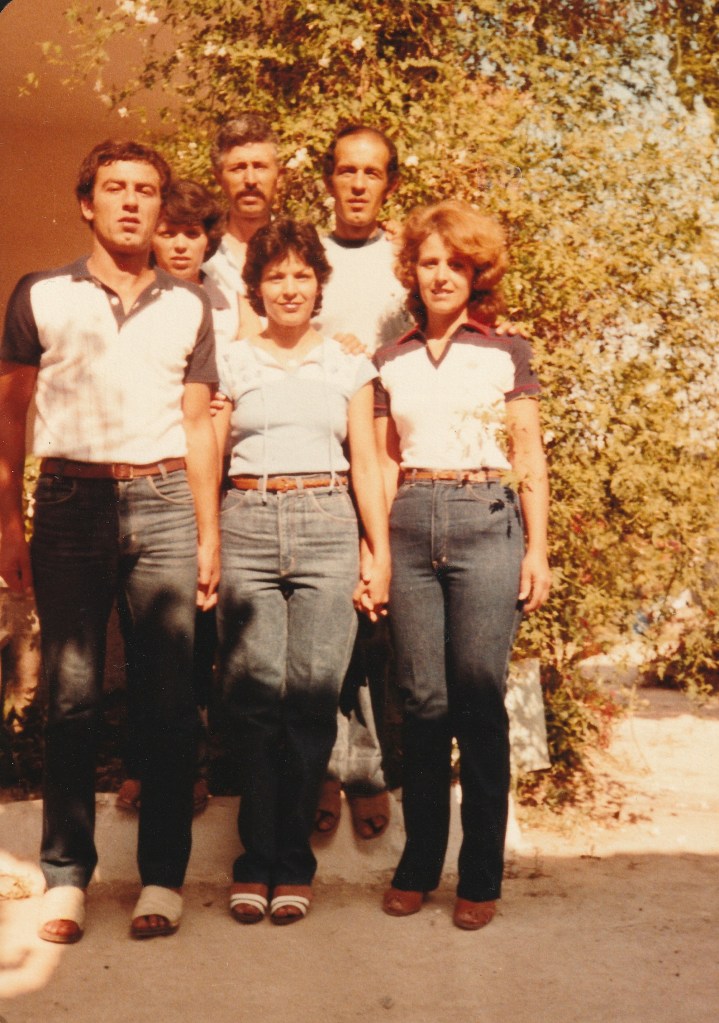
Beloved siblings (Back row: Roula, Kon & Christos and Front row: Stavros, Sophia & Dimitra)
Kon Stathopoulos was a singularly brilliant man. He pulled himself out of abject poverty in Greece, and created a whole new life for himself in Australia. He completely rewrote his destiny. My Dad was a dreamer and a big thinker! Sure, he drove trucks, and then later taxis, but my Dad was too big to be a taxi driver forever. He worked some shitty jobs to make ends meet, but in his spare time he was an enthusiastic entrepreneur. Bow ties, light up yo-yos, silver screens for cars, decorative ceramic tiles. He tried a whole bunch of innovative business ideas before finally starting his own company, Plastercraft Contractors.
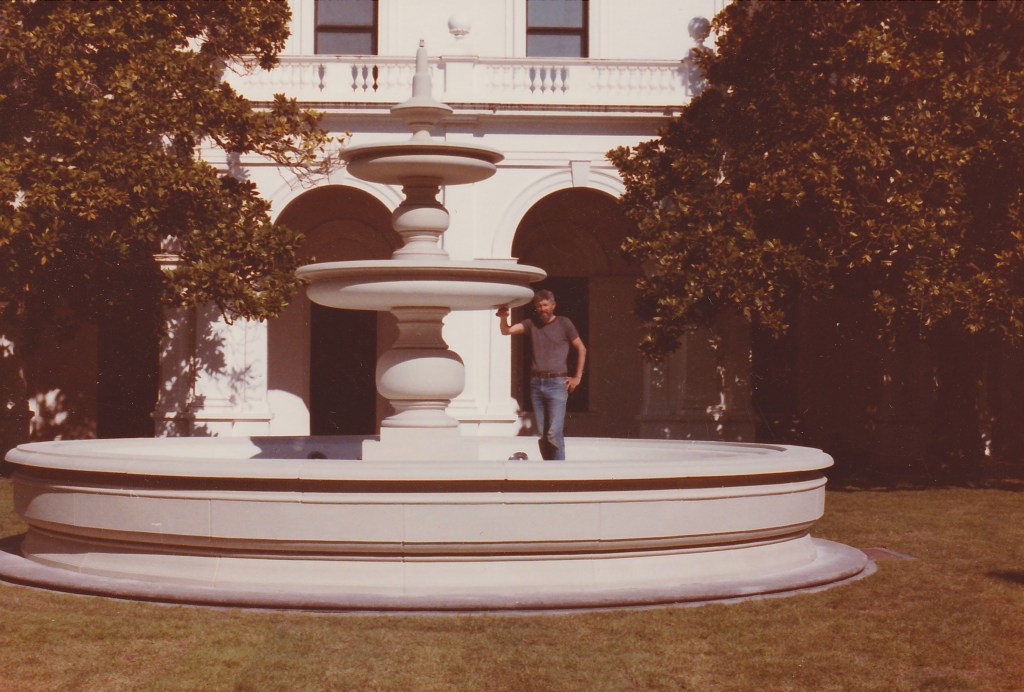
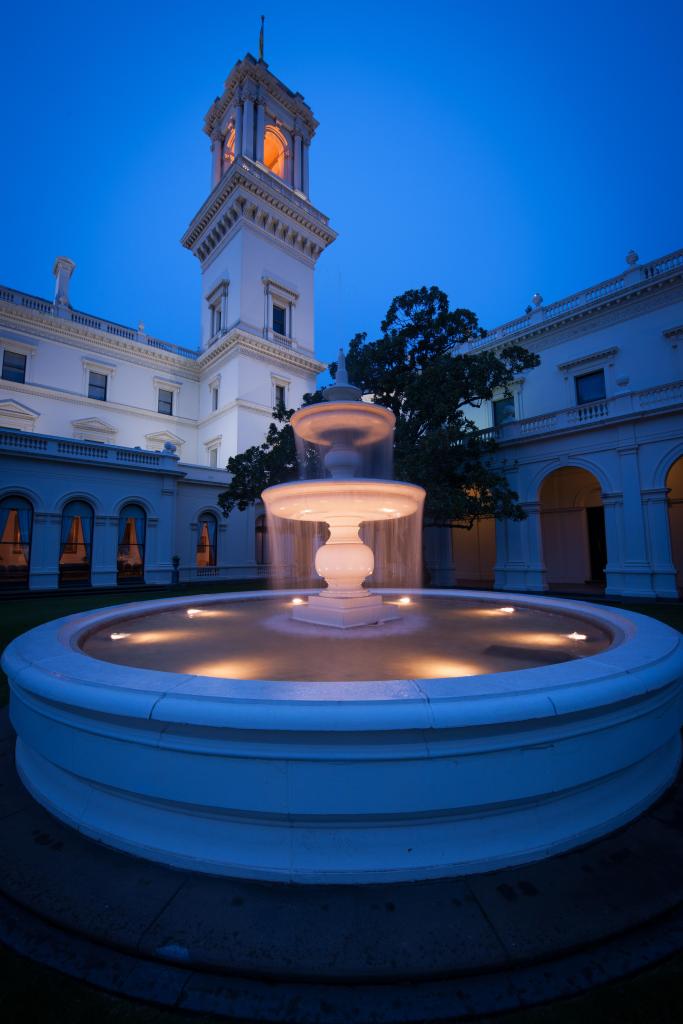
A one-man show, my Dad took solid plastering to the next level, turning it into an artform. Within just a couple of years he had built such a great reputation in the industry that he was asked to singlehandedly restore the exterior of a large church in Ballarat. He was also commissioned to create a new plaster cast emblem for the Red Eagle Hotel, in Albert Park, the very same bar where Kylie Minogue had her 21st birthday party!!! He then landed the extremely exclusive job of re-designing and building the beautiful and iconic fountain at Government House in Victoria. Every year on 26th January, Government House opens its doors to the public, and thousands of people get a chance to peek inside the stately home and to roam through the gardens. There are also monthly tours of the 11 hectare garden which anyone can book, so why not go along on one of these tours and see for yourselves the amazing sculptural achievement created by my very own father.
The construction phase.
.
The standing ovation phase.
.
The current phase.
Later on, due to the success of his business Dad expanded into larger scale projects like apartment building construction sites. He often invited me to join him and earn a little bit of extra cash, and I once hit the jackpot, making $400 in one week being an elevator girl, asking big burly construction workers wearing hardhats, “Which floor?” for eight hours a day. It was here that I first saw the man that my father had to be when he wasn’t with his family. For the first time, I heard him casually throwing around words like, “fair dinkum”, “bloke”, “smoko”, and I even heard him say “fuck” a few times. My brain exploded. As a 21 year old I’d never heard my Dad swear at home, yet here he was cursing with such ease and regularity. It was surprising, but also kind of nice, to discover this other side of Dad that I’d never seen before. It added yet another dimension to him.
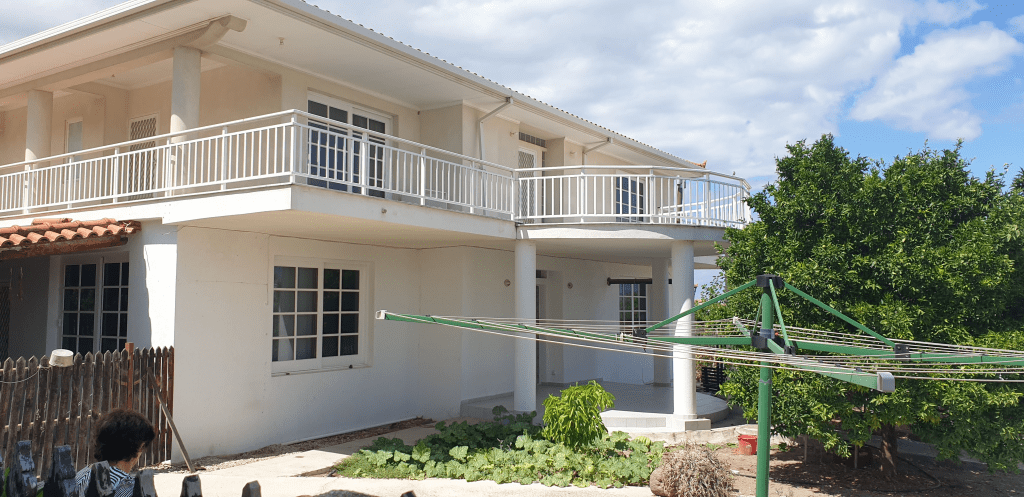
My Dad left his mark on some pretty important buildings, but his passion project was building a holiday home for our family in Ancient Korinthos, in Greece. The construction took him several years, and was (mostly) finished just before he was diagnosed with lung cancer in 2002. His dream was for the five of us to holiday there, as a family. But tragically, he never lived to see that happen. The house is still there, an empty monument to one man’s vision.
Mum and Dad hard at work. Literally building their dream home.
.
The dream. With Greece’s only Hill’s Hoist.
I have a cute little blue urn on my bedside table, which holds a little bit of my Mum’s ashes and a little bit of my Dad’s ashes all mixed together. I thought that having my parents close to me when I sleep would provide me with some sense of closeness to them, like my Mum used to get from having Dad’s ashes near to her. But I was wrong. I get nothing from it, except an academic understanding that my Mum and Dad’s cremated remains are next to me when I’m in bed. I have no response to it at all, emotionally. Sometimes I’ll shake the urn, and listen to their bone fragments rattling inside. I know what’s in there, I know that it’s them, but even so, there’s no connection to who they were when they were alive. I wish there was.
Hello Mum and Dad, it’s me, Chryss.
My Dad really shaped the first 32 years of my life. His first job in Melbourne was in the inner-city suburb of Carlton. So naturally my father was a Bluebagger. Therefore I am a Bluebagger. Dad inspired my love of tennis, and I played competitively for years, even aspiring to turn professional when I was sixteen. He taught me all the tricks of how to play a solid game of backgammon. When I was 15, he taught me how to drive a manual in a rusty old Land Rover on a hilly farm with no roads. And once I’d mastered that, he took me to an abandoned industrial estate in Springvale to learn how to drive his crappy work van. The one with the dodgy clutch and the sticky column shift. And once I could drive that, I could drive anything. I’m pretty sure that the reason I love to throw epic parties (and I really do love to throw epic parties) is because I inherited my Dad’s passion for entertaining, and showing people a good time, and living large. It’s funny, what gets passed down from father to child. Being a sports fan can be one of those things. Wanting things to be just right, might be another. A house in Greece, another still. But maybe a zest for life and knowing how to dream big are the most important things a man can pass on to his daughter. Thanks Dad.









 Chryss In Dubai