Islam

Ejo #26 – The Most Frequently (And Some Less Frequently, But Still Interesting) Questions About Expat Life In Dubai*

Well, all I can say is thank goodness that it’s a leap year, giving me one extra day to scrape in this month’s ejo (just by the hair on my chinny chin chin!).  Phew!  So, people type some interesting things into Google.  Really interesting things!  Every time this site gets a referral from Google, I get a notification of what the search was that led them to me.  Some queries seem to come up again and again (you’d be surprised at how many people are in the market for an elephant skin jacket – I kid you not!).  My friend Chris (the one that helped me set up the site in the first place – yes, I should probably be paying him) suggested I write a special FAQ ejo to answer the more common questions.  And so, here it is.


CAN YOU HELP ME GET A JOB AS AN AIR TRAFFIC CONTROLLER IN DUBAI?

Far and away, this is the question that I get asked the most often.  Unfortunately for you the answer is no, I cannot.  What I can do though is provide you with an email address (Serco-Admin@dubaiairnav.gov.ae) where you can make enquiries and send your resume.  The rest is up to you.  Good luck.


WHAT DO MEN WEAR UNDER THEIR DISH DASH?

OK, so this is a very close second for most commonly asked question.  Being the intrepid investigator that I am, I summoned up the courage to ask one of my Emirati colleagues what he wears under his (keeping my fingers crossed that he wouldn’t get me deported for breaking some indecency law).  As it turns out I needn’t have worried.  He simply lifted his dish dash and showed me.  Yep!  All the way up.  Anyway, the garment worn under the dish dash is called a ‘wuzar’ (my spelling might not be 100% correct there, but that was the pronunciation).  It looks just like a long, cotton petticoat.  My colleague was wearing one with a loose elasticised waist but apparently you can also buy wrap-around wuzars, depending on your preference.  I asked another colleague (a woman this time, I’m not THAT bold) about the possibility of embarrassment caused by unwanted “physical reactions” and she told me (after laughing at me for a bit) that some men wear underpants, as well as a wuzar, to prevent any embarrassing situations cropping up (so to speak).  Others, more confident, simply go commando.  So there you have it, now you know.


IS ALCOHOL BANNED IN DUBAI?

As you’re about to find out, I have quite a lot to say on this topic.  Far from being banned, alcohol has a very large presence in Dubai.  The duty free allowance per person here is a very generous 4 litres of booze.  To put that in perspective, Australia’s limit is 2.25 litres.  I’ve mentioned in a previous ejo why I think alcohol is allowed in Dubai.  And it has everything to do with money!  Admittedly, not all the emirates are as laid back about it.  For instance Sharjah completely bans the consumption, or even possession, of alcohol.  If you live there, you can’t enjoy a beer with your food, even in the privacy of your own home.  Not legally anyway.  Another point to note is that alcohol is one of the only items in Dubai which is subject to tax.  A whopping 30% tax, making it very expensive.  Officially, in this emirate you need a license in order to purchase alcohol for your private consumption.  Unofficially, whenever you want to stock up, you can just drive to one of the (more relaxed) neighbouring emirates which sells untaxed booze.  Either way, it’s readily available.


I must confess that when we first moved here my drinking became problematic.  Free flowing booze at weekly brunches makes it difficult to know how much you’re actually drinking.  And socially, it’s something that can easily become a habit.  I put on a lot of weight, behaved very badly and suffered some monster hangovers (the worst of my life).  Eventually, I sobered up for long enough to realise that it had to stop.  Not everyone has the same discipline.  The two Brits who were arrested and deported for the ‘sex on the beach’ scandal had apparently been drinking all afternoon at one of the famous Friday brunches.  And there lies the dichotomy.  The Friday brunch is a Dubai institution.  It is government sanctioned and almost impossible to avoid if you want to go out for a midday meal on Friday (which happens to be the first day of the weekend here).  Just about every hotel in town offers a Friday Brunch.  But to actually be under the influence of alcohol in public (whether you are rip roaring drunk or have had just one glass) is illegal.  So, theoretically, the cops could arrest every single person leaving a brunch as soon as they step out of the hotel, though they tend not to as it wouldn’t be very good publicity for the city.  But what amazes me is the number of people who are completely unaware of the law that they are breaking, who are then outraged when they get into trouble for breaking it.  Yes, booze is a big part of life in Dubai, but it exists in a very delicate balance within society.  It’s not something that you can take for granted, like back home (or pretty well anywhere else in the world).  You must be careful at all times, as the consequences can be severe.  A woman found this out a few years ago when, after attending a big brunch, she drunkenly passed out in a hotel bathroom where a hotel staff member raped her.  When she reported the rape, they didn’t just arrest him for the rape, but also her, on charges of being drunk in public.  That’s very scary.


WHAT ARE THE CHALLENGES AND LESSONS FOR A WESTERN WOMAN WORKING IN THE UAE?

David and I moved to Dubai in 2008 after he was offered an ATC job at Dubai International Airport.  When I couldn’t immediately get work as an air traffic controller, people often assumed it was because I was a woman and that women aren’t allowed to work here.  This isn’t true, and my lack of employment was actually the result of the global financial crisis.  A year or so into our move I was offered an ATC job at Al Maktoum International Airport where I’ve been happily working for over two years.  I’m lucky enough to work for a very large multi-national company which implements equal employment rights for women here, and as a result I’ve never experienced any discrimination in the workplace.  In fact I’ve been given opportunities here that wouldn’t so readily be available to me back home.  Not because (or in spite of the fact that) I’m a woman, but based on my ability to do the job.  To be completely honest I’m sure that there are many women here who do face discrimination and challenges in the workplace but I have neither observed or, personally, been subjected to it.


Having said all that, something very disturbing happened to me a couple of days ago which demonstrates that the city has a VERY long way to go towards gender equality.  As I mentioned earlier, a liquor license is required to (legally) buy alcohol here, so I figured I’d apply for one since David’s expired a while ago.  So, off I went to the bottle shop with all the necessary paperwork in hand.  This includes an application form, a copy of my passport and residency visa, a copy of my payslip and a “Letter of No Objection” from my employer (stating that they had no objection to me applying for the license).  I confidently handed it all over and was promptly asked where the “Letter of No Objection” from my husband was.  I’m just going to let that sink in for a minute while I go on to describe how I had to bend down to pick up my jaw off the floor.  Yep, they insisted that, since I’d checked the box on the application form saying I was married, I had to ask my husband’s permission to obtain a license to drink booze.  It’s actually enough to DRIVE you to drink!  I asked, incredulously, if that would still be the case if my husband was my dependant, and I was his sponsor.  The answer came back yes.  The man, it seems, is still the boss.  Being the modern woman that I am, I insisted that they process my application without David’s authority so we’ll wait and see how that works out for me.  I’ll let you know.  While this experience completely flabbergasted me, it is an isolated one (for me at least).  I look forward to never encountering such discrimination here again.


ON A ONE-TO-ONE BASIS WHAT IS THE COMFORT LEVEL BETWEEN ARABS AND NON-ARABS BOTH IN DUBAI AND IN THE RURAL AREAS?  IS THERE COMFORT?  CONFIDING, FRIENDSHIP, ALLIES?  OR ARE WESTERNERS FOREVER A COMMODITY IN A TRANSIENT INTERNATIONAL TRADE?

My experience in Dubai is that, as a general rule, locals are a little wary of expats.  As a whole they probably do see us as a bit of a commodity.  But that isn’t to say that they necessarily resent our presence here.  The city simply wouldn’t be what it is today without us.  Regardless of the overall feeling, my own personal experience is that once an Emirati develops a relationship with a foreigner (whether it be a friendship or a working relationship) then the guard comes down.  Every Emirati that I have the pleasure of knowing through work is warm, generous, hospitable and friendly.  I think that this is their true nature and that the wariness comes as a natural (and understandable) result of being a minority in their own country.  I haven’t met any locals out of the city but from what I hear, Bedouin hospitality is even greater.  So, one-to-one I’d say that yes, relations are good.  There is warmth and acceptance and friendship.  However, I don’t think it would be realistic to expect this to extend to all relations between expats and locals.  I have heard stories of locals being rude, nasty and sometimes just plain malicious towards expats.  I suppose that, just like everywhere else, it depends on the people involved.


HOW DO THEY EXPECT “THE WORLD” TO NOT ERODE AWAY ON A BIG TIDE/STORM SURGE?

This is an interesting question.  For those of you who don’t know, The World project is a man-made archipelago consisting of about 250 islands designed to look, from above, like a map of the world.  There seem to be regular reports that the islands are slipping back into (and being re-reclaimed by) the sea.  Nakheel, the developer of these (and the more successful Palm Island projects) of course denies these reports.  So, who’s right?  Well, for now it appears that the islands are sticking around, though due to the financial crisis, until recently only one had been developed – and that one belongs to the ruler of Dubai.  Earlier this month though, I heard that an Indian entrepreneur has developed a beach club (complete with swimming pool, beachside cabanas, bar and restaurant) on the island of Lebanon which is due to open any day.  This means that people will be able to visit the islands for the first time ever (which is quite exciting).  Hopefully this will encourage other developers to invest in similar kinds of ventures.  As for the threat of erosion, from what I can tell, the islands lie on a very solid foundation (similar to that of the Palm Islands and also the reclaimed land on which the Burj Al Arab sits).  The technology is sound.  The 321 million cubic metres of sand and 31 million tons of rock which form the foundation would also suggest that The World is here to stay.  (To put those figures into perspective, 1.8 million tons of debris was recovered from Ground Zero after 9/11.)
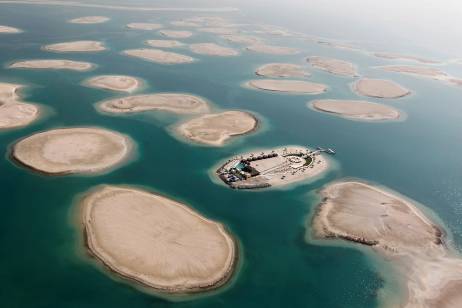
 

Lebanon Island


HAS LEEWIN FOUND A WIFE?

Not yet.  And, in a lucky twist of fate, the search has temporarily been called off after his cousin (a numerologist) did a reading and discovered that Leewin’s profile on a whole bunch of matrimonial sites had been registered on an unlucky date.  How about that!  His brother quickly took down all of Leewin’s information from the internet, and is waiting a couple of months (and for a new numerology reading) before re-registering him.  Marriage: 0, Leewin: 1.


OK, so I hope that your question has been answered.  This is actually part one in a two part special so standby for some more interesting facts about life in Dubai next month.  In the meantime if you have a burning desire to have a myth debunked or just want some information on something you’re unsure about, please just drop me a note and I’ll see if I can add it to the next FAQ ejo.


* (Unfortunately,) I feel obliged to state that the answers to these questions are 100% opinion only.  If I’m wrong about something, I apologise and am very open to being corrected.
Ejo #20 – A Few Thoughts On Islam (And What It Means To Be Muslim)

“Beware! Whoever is cruel and hard on a non-Muslim, or curtails their rights, or burdens them with more than they can bear, or takes anything from them against their free will; I will complain against that person on the Day of Judgement.”  So said the Prophet Mohammed, preaching tolerance, kindness and understanding towards us heretics.  It isn’t the picture most people have in their minds of the Islamic faith – and that is, perhaps, unfortunate.  The reason could be related to the rising number of acts of aggression against the western world, ostensibly in the name of Islam.  But as many Muslims would be at great pains to point out, these acts of terrorism strike against the very kernel of what it is to be a member of the Islamic faith.


I’m not religious in the least but I have always been curious about the concept. When I moved to Dubai I was able to learn a little bit about Islam.  I could probably write 20 ejos on the subject, but I won’t.  What I’d like to do is shed some light on a belief system and way of life that is sometimes shrouded in mystery, and quite often veiled by misinterpretation.  If I can bust just one myth or clear up one misconception for anyone that’ll make me happy.  I’m hardly an expert though; what follows is just a few personal observations backed up with a bit of research.


Let us begin.  The reason Muslims call their deity Allah is to differentiate him from other gods – it is the personal name of Islam’s one true god.  Whereas the word “god” can be pluralised and genderised, the word Allah cannot.  Allah is merciful and compassionate, and really just a very nice god indeed.  For instance, if you intend to do a bad deed and then don’t actually go through with it, he won’t hold it against you (even though, of course, he is fully aware that you did think about it).  It is only when you act on the intention that it counts against you.  Furthermore, if you truly regret what you did, the slate automatically wipes clean.  The simple act of repentance leads to Allah’s forgiveness.


Some people wonder about the importance of the Prophet Mohammed in the faith.  He was just one of many thousands of prophets, but Mohammed is the greatest of them all because he was the last prophet, the one that completed all of Allah’s revelations and sealed them together to create the teachings of Islam as they have been known, unaltered, for the last 1400 years.  He is second only to Allah in importance.


The word Muslim means “to submit” and Islam is based on its believers living out the will of Allah, as far as humanly possible.  It is founded on five pillars.  They are:

1) testimony of faith, i.e. accepting that there is no god but Allah, and Mohammed is his messenger.

2) praying five times a day;

3) Zakat, which is the giving back to the community of a certain amount of money, usually as a charitable donation;

4) fasting during Ramadan; and

5) pilgrimage to the holy city of Mecca at least once during a Muslim’s lifetime (for those who are physically and financially able).


The second pillar of Islam is prayer.  Muslims are required to pray five times a day– furthermore they must be “clean” when they do so.  A ritual ablution occurs before the prayer and this includes washing the face, arms and feet so as to be pure when presenting themselves to Allah.  To facilitate this in Dubai, every toilet (private and public) has a long hose and nozzle in it so that wherever they may find themselves at prayertime, a Muslim is able to wash in preparation.  It is also why, sometimes, when entering a bathroom after a Muslim you may find it absolutely soaking wet.  I guess in striving to become clean, it is sometimes necessary to create a mess.  You get used to it.


Zakat is the requirement to donate to charity or to give to those less fortunate. Muslims are obligated to give 2.5% of any income they’ve earned for the year which is surplus to their family’s requirements.  This is usually collected and distributed during Ramadan.


Ramadan is the month of the Islamic calendar during which Muslims must fast – refraining from eating, drinking, smoking, having impure thoughts or engaging in sexual activity during daylight hours.  These sacrifices transcend physical discipline and bring the faster closer to Allah.  This year Ramadan has fallen during August, which happens to be the hottest time of year. Fasters have been going without food and water for up to 15 long hours a day, which as you can imagine is super difficult.  Hunger and thirst remind fasters of others who are less fortunate and who go hungry and thirsty everyday.  It also serves as a trigger to commune with Allah, to give thanks, and also to atone for any sins committed during the year.  It is an extremely important time of year for all Muslims.  To read more about Ramadan check out Ejo #9 – Ramadan In Dubai (What It Means And What To Expect).


As with all religions, some things are considered right, and others wrong.  “Halal”encompasses everything which is good (and thus permitted in the eyes of God), whereas “haram” describes the opposite – all which is harmful (and thus forbidden).  The word halal actually refers to a wide spectrum of things, but is most commonly used to describe meat that has been prepared in an approved way. A lot of animals these days are killed by electrocution – but this method is deemed haram by Muslims.  The animal suffers and so it is forbidden to eat its meat.  To be considered humane, the knife that will kill the animal must not be sharpened in front of it.  Animals should be killed quickly, and as comfortably as possible, and one animal must never witness the slaughter of another as this would frighten it, making the meat haram.  The animal should be well fed and watered despite the fact that it shall soon be lunch.


Intoxicants, such as alcohol, are considered haram – the reason being that alcohol decreases your ability to control your own mind and body.  There is an old Islamic fable: “A man was told to either rip up the Holy Quran, or murder a child, or bow in worship to an idol, or drink one cup of alcohol, or sleep with a woman.  He thought the least sinful thing to do was drink the cup, so he drank it.  Then he slept with the woman, killed the child, tore up the Quran and bowed in worship to the idol”.  Being a Muslim is all about controlling your impulses and you attain closeness to God when you restrain yourself from physical and mental urges.  Alcohol takes away all of that restraint, rendering one vulnerable to the temptations of the devil (and anyone who’s ever been drunk can surely attest to that – I know I can!).


The Quran clearly refers to men and women as being equal.  Oppression of women tends to be more culturally and nationalistically based, than theistically.  But often the culture fostering the oppression is so closely entwined in an Islamic identity it is difficult to separate the two.  Although women are thought of as being equal to men, the physical differences between them has been taken into account and because of this women have been granted the right of protection by (and from) men. One of the major components of Islam is modesty (for both sexes, albeit predominantly for women).  As such, men are required to not look upon women sexually and women are required to cover up in public.  Islam sees the covering up of a woman’s body as the opposite of female repression. Because it hides her womanliness they believe that it is really a form of female liberation, allowing her to be appreciated for her character and mind, and not just for her body.  Nowhere in the Quran or in the prophet’s messages does it state that women must cover their faces – to force a woman to do so (as the Taliban do in Afghanistan) goes against the very spirit of Islam.


Even with all this covering up though, occasionally a person might find themselves sexually aroused in a public place by a person who is not their spouse. Hey, it happens!  One of my favourite of prophet Mohammed’s recommendations is that, should this occur to you, you must immediately hurry home to your husband (or wife) and satisfy that sexual urge honourably.  Yipee!


While men and women are created equal, they most definitely have different roles to play in marriage and family life.  The husband is expected to provide for the family and the wife is expected to look after him and the household (including children when/if they have them).  This doesn’t mean a woman can’t go out and work if she wants to.  She can, but she must still fulfil her obligations at home too (what else is new, right?).  The role of housewife and mother is regarded as one of the most honourable occupations in Islam.  Staying home to raise a family garners the greatest respect from the community, because it is arguably one of the most difficult jobs to do.


Polygamy is permitted in Islam but not in the way most people imagine.  Men are allowed to marry up to only four women, and there are many restrictions.  For instance, a man can only marry another woman if he can afford to keep her in the same way he keeps his first wife; giving them the same amount of food, clothing, leisure, living space, time and compassion.  Plus, he actually needs the permission of his first wife in order to take another.  Theoretically, anyway.  Polygamy was sanctioned, initially, with the intention of providing security and a stable family life for the women left behind after the first Islamic war. Rather than leave the many widows and orphans to fend for themselves it was encouraged for families to give them a home – and since a woman and a man who are not married are forbidden from living under the same roof, marriage was the solution.  Today, however, women are able to support themselves.  This negates the requirement for a man to marry multiple women.  Governments look after those in need, providing welfare to ensure financial stability and security.  The burden of this responsibility has been removed from the man, however polygamy (of course) still occurs.


Well, that’s just a drop in the ocean.  If you have any questions about Islam please feel free to ask and I will try and get an informed answer from one of my Muslim colleagues.  Look out next month for another episode from The Misadventures Of Dangerous Doug.

Ejo #16 – Crime In The UAE & Little Moosa’s Tragic Story (Do You Believe In The Death Penalty?)

After reading my ejos people sometimes ask me if Dubai is as wonderful as I make it out to be.  The simple answer is yes, as those who have come  to visit can attest.  But the simple answer is very rarely an accurate one.  The city is not all shopping malls, beaches, restaurants, five star hotels and indoor ski slopes.  In fact, if you scratch a little bit behind the surface, Dubai is not at all what it appears to be.  True it has a low crime rate compared to other major cities, but just like anywhere else in the world there is a dark underbelly hidden beneath the glossy exterior.

I still feel safer here than I did living in Australia.  It’s perfectly safe to leave your handbag, phone or wallet in the car in clear view.  Car theft is virtually non-existent.  And because the consumption of alcohol outside of the home is so regulated, you very rarely hear about drunken punch ups or public violence.  There are no wolf whistles emanating from construction sites, and it feels safe to walk the streets at night (even though just like other cities, some streets feel safer than others).  The city is mostly inhabited by law abiding citizens – simply because the penalties for breaking the law are so harsh.  Most of the time an infraction attracts a jail sentence followed by possible deportation.  This provides a very satisfactory deterrent. 

Nonetheless crime does exist.  Open the pages of any newspaper and you can read about a number of bizarre and unsavoury cases that have gone to trial.  Drug cases, burglary and theft, kidnapping, prostitution and even human trafficking.  And, of course, murder.  Recently I read about a Bangladeshi man who owed one of his friends a few thousand dirhams.  The guy was demanding payment and the Bangladeshi man decided it would be a good idea to kill his friend and keep the money.  He lured the man to his food delivery truck with the promise of payment.  Instead of money though, the man received a knock to the head and was pushed into the back of the truck.  The Bangladeshi man set the temperature to -4°C and left him there to die while he went home to bed for the night.  Early the next morning when he went to dispose of the body he found his friend completely frozen, yet miraculously, still alive – his eyelids blinking in terror.  The Bangladeshi man panicked, fetched a knife and proceeded to cut his friend’s throat from ear to ear.

This was a particularly strange case, however it’s representative of a great number of the types of crime that occur here.  That is, crimes of greed, passion or opportunity, usually involving a friend or compatriot, and committed in desperation.

The most horrific crime that I’ve heard of happened about a year after we moved to Dubai.  It occurred in November 2009, during Eid al-Adha, which is an Islamic feast celebrating Ibrahim’s faith and obedience to Allah in sacrificing his son, and also, Allah’s mercy – it translates literally to “Feast of the Sacrifice”.  It is a very important occasion, as it is a time to bond and connect with family and close friends.  People dress in their very best clothing and prepare great feasts to share with loved ones.  It is a particularly joyous time for kids (kind of like Xmas for the rest of us), as they receive gifts and are free to play and run around the neighbourhood. 

Pakistani father of three, Mukhtiar Ahmed Khudabaksh remembers his middle child, four year old Moosa, being particularly happy and excited that it was Eid.  He remembers that at around 11am that Friday morning, Moosa was sitting right beside him eating cheese crackers, before running out of the house to join the other children playing outside.  It was the last time he saw his son alive.

The next time he saw Moosa, it was to identify his body in the morgue of the local hospital.  The family received no immediate information about Moosa’s death and assumed that, since he’d been found in the bathroom of the mosque next door to their house, that he’d slipped and fatally struck his head on the floor.  Of course they were devastated.  But they had no idea of the horror yet to come.  The next day they got a call from Police saying that Moosa had been murdered by a 30 year old Emirati fishing boat captain.  They had the man in custody and he had confessed to the killing.  Can you even begin to imagine the shock and anger his family felt towards this man??  And those feelings would have amplified exponentially when they found out the details of how their young son died.

Little Moosa


According to a statement made by Rashid Al Rashidi, the man charged with the murder, he’d been drinking that morning and when he’d seen Moosa playing outside he’d lured him to the nearby mosque with promises of Eid gifts.  Moosa, excited at the prospect of more gifts, and having no reason to mistrust the man, followed him into the mosque where Al Rashidi led him into the bathroom.  While hundreds of other men were praying in the main room, and while an Imam intoned the holy prayer, Al Rashidi raped the little boy. 

Details of what happened to Moosa have not been released, and I am very grateful for that because I am haunted enough simply by the idea of what suffering that little boy had to endure.  Al Rashidi confessed that Moosa was shouting in pain during his ordeal, and when he heard someone else come into the bathroom he covered Moosa’s mouth with his hands to keep him quiet.  When that didn’t stop the little boy from screaming, he slammed his little head hard on the floor.  Twice.  He then fled the scene, leaving Moosa to die on the bathroom floor.  After he was caught, he admitted to intending to rape Moosa but said that he never planned to kill him.  He showed remorse during the hearings and pleaded for mercy from the victim’s family and the courts. 

The reason I am writing about this is mostly for myself.  It has weighed on my mind for a long time and I’ve needed to sort out in my head whether or not I believe he deserved the sentence he received – death!  At 8.35am, on 10th February 2011, Rashid Al Rashidi was executed by firing squad, in front of a few witnesses, including Moosa’s parents.  Did he deserve mercy when he showed none to a small, defenceless boy?  As the prosecution stated, “he raped and murdered an innocent angel in the house of God”.  Wasn’t Rashidi’s own death more humane and civilised than the one which he inflicted upon Moosa? 

Moosa’s family will never have him back, and they will forever live with the pain of what happened to their little boy, but following the execution his father said that he had “finally found some peace”.  And I understand that.  After the execution, he went and prayed in the very same mosque in which his son was killed.  This was not an act of forgiveness, though.  From the moment he found out about what Al Rashidi had done to his son, Mukhtiar Ahmed Khudabaksh had campaigned for the death penalty and said that he could never forgive the man who killed his son.  He said, “I don’t need anything in life except his death.”  And he got it.  Will Rashid Al Rashidi’s execution make him happy?  No, probably not.  But I believe that it will allow him to feel that justice has been served.  That the ultimate (and appropriate) price has been paid for the crime committed against his son.  Anything less would have been a miscarriage of justice.

I’m sure some of you are probably against capital punishment and, of course, everyone is entitled to their own opinion.  I don’t particularly condone it, but I do think that in this case it was justified.  I’d love to hear what anyone else thinks about it. 

Sorry to hit you with the hard and heavy stuff today.  Next month it’ll be some easy breezy reading with more adventures from Dangerous Doug.  See you then.