Ramadan

Ejo #45 – Iftar Meal Handout


A couple of weeks ago, I wrote an ejo asking for people who were interested to contribute some money towards buying some of the less fortunate residents of Dubai a nice, hot, tasty meal to break the Ramadan fast. As well as David and me, FIFTEEN others stepped up and sent me money. Every single cent of that money went towards the food. Here’s how it all went down:


It was somewhat fitting that the day of the Iftar dinner handout was particularly hot and humid. After all, should I really expect to feel comfortable whilst handing out food to impoverished people on the street? I don’t think so. Unfortunately for me, I was also feeling a little bit under the weather from a pretty bad head cold. And to top it off, I’d only had two hours sleep the night before. We arrived home from a trip to Switzerland at 1.30am and I had to wake up at 3.45am to get to work. I can hear you: Trip to Switzerland?? And you want us to feel SORRY for you?? I guess not, but c’mon, two hours sleep is still only two hours sleep. Anyway, to sum it up, I was feeling pretty crappy and I would much rather have been at home in bed sipping on chamomile tea than driving around the back streets of Satwa trying to find a parking spot to set up the handout. But I had made a commitment, and nothing was going to stop me from honouring it.


The amazing Green Palace Restaurant that packages the meals for handouts at a SUPER reasonable price.  Thank you so much to the guys that help out with organising the food!!

The amazing Green Palace Restaurant that packages the meals for handouts at a SUPER reasonable price. Thank you so much to the guys that help out with organising the food!!
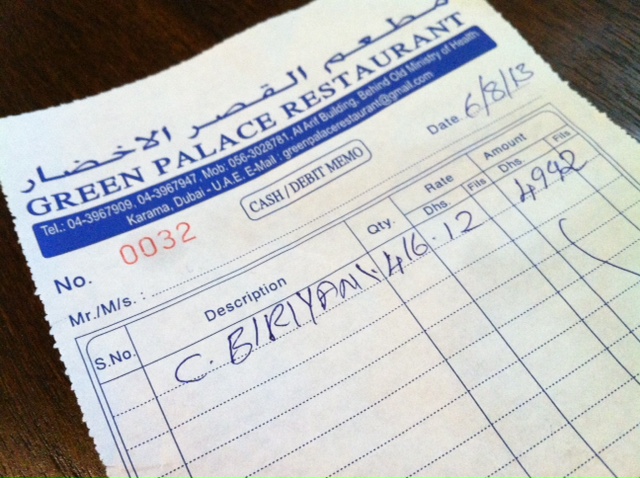
 

416 meals at 12dhs each comes to 4992dhs.  Thank you to each and every person who gave money towards this cause.

416 meals at 12dhs each comes to 4992dhs. Thank you to each and every person who gave money towards this cause.


When Roshni finally found a place to park and set up, men were already beginning to form an orderly line. Thanks to the wonderful and generous people who parted with their hard-earned cash to share a meal with someone in need, we had 416 packages to give away. And we had 416 men with hungry bellies and grateful eyes lining up, ready to receive their gifts. Each package contained dates (traditionally eaten to break the Ramadan fast), a hot chicken biryani and samosas, a tub of yoghurt, fruit juice, a crisp apple and a small dessert.
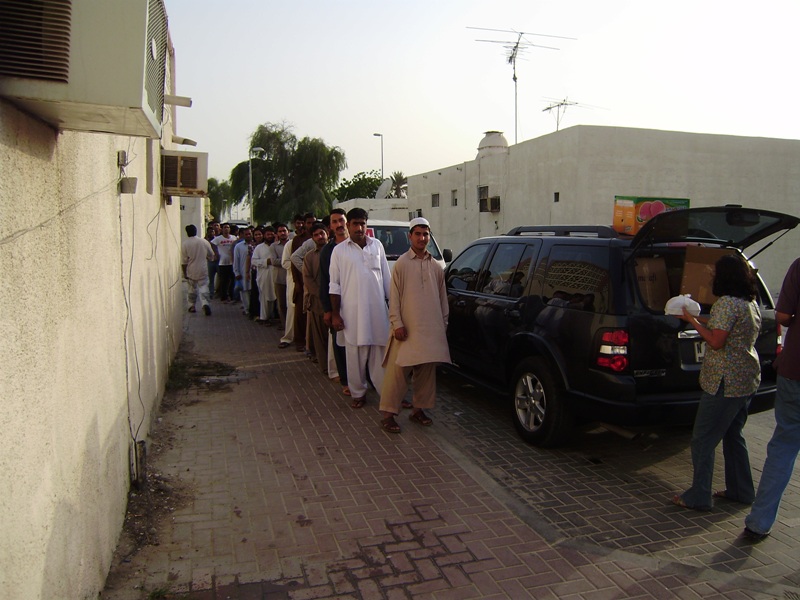
 

Getting in line.  Throughout the handout some cheeky men tried to cut in line but we sent them right to the back!  The whole thing ran like a very well oiled machine!

Getting in line. Throughout the handout some cheeky men tried to cut in line but we sent them right to the back! The whole thing ran like a very well oiled machine!


I started handing out the meals to the men, the sun beating down on all of us. Before long my jeans were sticking to my legs, sweat ran down my back and trickled down my face. But I didn’t care. I was just so happy to be doing what I was doing at that very moment. And the men were hot too, some of them soaked with perspiration. For me it was a temporary discomfort, for them it was probably something that they have to live with all day, every single day. I kept handing out packages. I tried to look each man in the eye as I handed him the bag containing his food. Not all of them looked back at me. Some just wanted to grab the meal and go. And that’s OK. I absolutely understand that. The ones that did make eye contact though, the ones that looked me in the eye and said “thank you” and allowed me to say “you’re welcome”, the ones that connected with me, brought me such an intense shot of sheer joy that I felt like I was going to burst with happiness. I was grinning from ear to ear.


Trying to balance all the boxes in the car with Mridul's help.

Trying to balance all the boxes in the car with Mridul’s help.


If you look closely you can see that the guy in the foreground has two different shoes on.  He probably just found them on the street.  That's the level of destitution of some of these men.  And it's heartbreaking.  Particularly in this supposedly RICH city.

If you look closely you can see that the guy in the foreground has two different shoes on. He probably just found them on the street. That’s the level of destitution of some of these men. And it’s heartbreaking. Particularly in this supposedly RICH city.
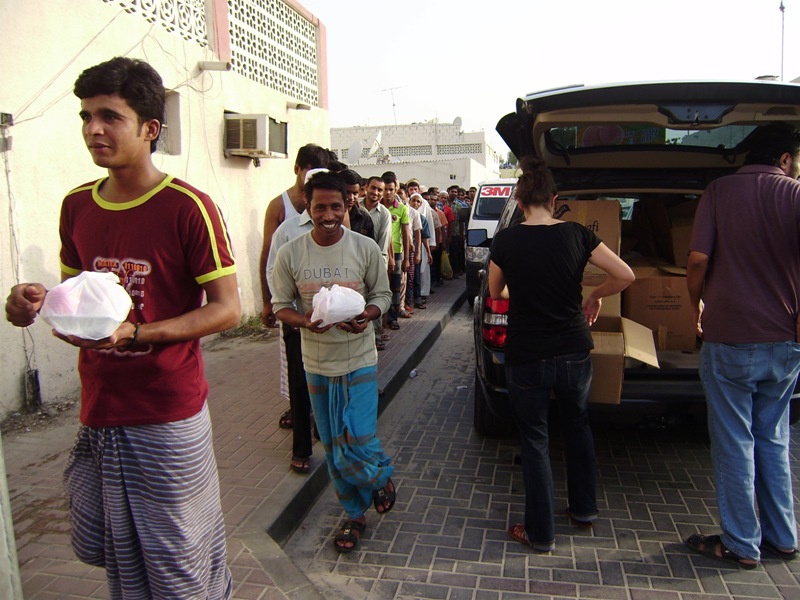
 

Look at that beautiful, happy face.

Look at that beautiful, happy face.


Sweaty, but happy!

Sweaty, but happy!


More happy customers.

More happy customers.


Smiles all round.  The good feelings were palpable!

Smiles all round. The good feelings were palpable!


Bon appetite!

Bon appetite!


Some of you might be aware (maybe because I keep going on about it????) that I’m not really loving living in Dubai right now. I don’t feel like I’m at home here. I haven’t found my “people” so I don’t feel like I belong. And this puts me in a perpetual state of lassitude. If I’m not sad, I’m feeling disconnected, switched off and isolated. Naturally, this is not a very nice way to live and I am hoping it’s just a temporary phase. But until it’s over, I’ve found that (short of actually getting on an aeroplane and getting the hell out of the country) not much alleviates this melancholia. But you know what does make things better? Getting involved in this kind of charity work, alongside one of the most generous, giving, empathetic, compassionate and hard working people I know – Roshni Raimalwala. I drove home from the handout absolutely floating on air. In fact, I was so emotional, so overwhelmed with how good I felt about what we’d done, that I actually had a little cry in the car on the way home. But it was a good cry. Tears of joy.


To give money to charity is wonderful. But to actually hand a person something that they need is something else altogether. To touch that person’s hand, and see the gratitude in their eyes and be able to elicit a smile from them is a mountain of a reward. It’s the pinnacle. It’s Everest! I wish that all of you who gave money for this handout could experience the same amazing feeling. I hope that by writing about it, it puts you there in my shoes for just a moment so that you can feel it for yourselves. Because you deserve to feel this good. You haven’t just handed over money, you’ve dipped into your humanity. You’ve reached out and changed someone’s life, even if just a tiny little bit.


So thank you. From me, from Roshni, Mrinal and Mridul, and from the 416 people that we helped to feed on the last day of Ramadan 2013.
 

Ejo #44 – Ramadan: It’s A Time For Giving

And so this is Ramadan. The time of year that our Muslim friends abstain from eating, drinking, chewing gum, smoking, having sex, dancing, singing and having bad thoughts during daylight hours. Wow man, it all sounds rather difficult. If you don’t think so, perhaps give it a go. Say, starting tomorrow. For a month!!!! Yeah, I thought so.


The reasons for fasting are numerous. It’s supposed to give you a greater understanding and appreciation of what less fortunate people experience every day of their lives. People for whom hunger and thirst are a constant struggle. So it fosters compassion. It is also a time for gratitude, for the blessings that have been bestowed upon you. Ramadan is all about showing restraint and self-control. Not just in fasting, but also in the way that you think about, and treat, other people. It’s a time to show good manners, compassion, patience and engage in a feeling of community. Ultimately though, Ramadan is meant to remove the distraction of the trappings of everyday life (sustenance, food, entertainment) in order to allow the faster to focus on communing with God. Ramadan is when a Muslim’s devotion to their faith is at its most concentrated and pure.


It is a really special time in a Muslim’s year, and even though it is something that must be very difficult to do, I have never heard a Muslim complain about having to fast. Everybody seems to do it with great grace.


An aspect of Ramadan that I’d like to talk about a little more is goodwill and charity. The prophet Mohammed (Peace Be Upon Him) once said, “A man’s wealth is never diminished by charity.” One of the five pillars of Islam is Zakat, the requirement to donate 2.5% of whatever you have earned that year to aid those in need. Zakat can be done at any time of the year, however it seems that most people tend to give during Ramadan. And I’d like to join in.


Let me tell you something. Living here is hard for me, for a number of reasons. One of those reasons is the major disparity between the “haves” and the “have-nots”. The divide is enormous. I think because we’ve lived in a veritable construction site for the last four and a half years, constantly exposed to the daily grind of labourers, it’s something that we can’t simply ignore. A lot of other people can. It’s not in their face, so they don’t worry about it. I do worry about it. I’ve written often in the past about how the plight of these guys cuts me to the bone. I’ve written about how I’ve tried, in my own very tiny way, to humanise them. To hand them a bottle of juice or some fruit once in a while. To wave hello and goodbye. To smile. It hasn’t been enough, but it’s something. Unfortunately, with the way the construction is constantly changing the landscape around our apartment building, we are no longer in constant contact with any particular labourers, so we are no longer able to develop any kind of bond or friendship or acquaintance. It’s more difficult to make a connection when you don’t see someone every day. Which is why it’s all the more important for me to try to do something special to help ease their lives, even briefly. Even if it’s just for one meal.


My friend Roshni, who used to work with Karama Kanteen is my biggest inspiration. She has devoted her life in Dubai to helping those that need it the most. The men that even the government has shamefully turned their backs on. Whenever I have some spare money, I call Roshni and we organise a hand out. She tells me what food and drinks to buy, and she uses her contacts at the labour camps to rally the men together.


Some of you might remember my Christmas Ejo of 2011, where I organised a collection from friends all around the world. Well, I think that Ramadan 2013 is a fantastic time to do it all over again. A lot of these unfortunate men are Muslim, and they must fast during the hottest time of year. And let me tell you, it has been HOT!


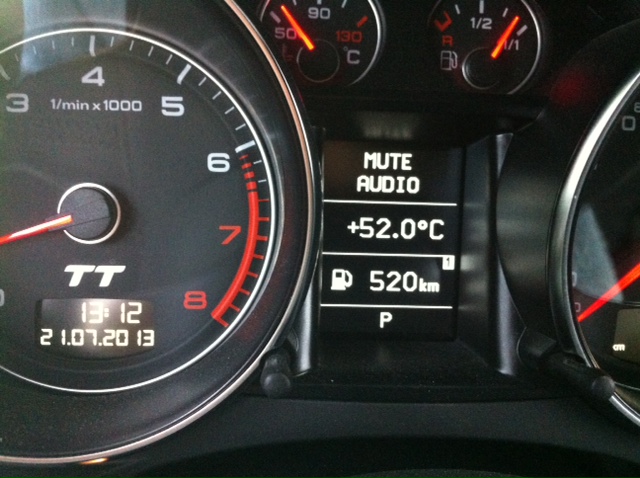
This is the hottest I've ever seen my car register.  Let's just say it was a VERY uncomfortable day - and I was outside for a total of about ten minutes.

This is the hottest I’ve ever seen my car register. Let’s just say it was a VERY uncomfortable day – and I was outside for a total of about ten minutes.


Try to imagine not eating or (even worse) not drinking water for 15 hours a day. Now imagine doing that while you have to work outside in these temperatures. And then, when the time came to break your fast with the Iftar meal (the all-important reward for sacrifices made during the day), all you could afford was a cup of rice and some water. It’s this that I want you to imagine, when I ask you to dig deep and find your compassion, empathy and generosity. My friend Roshni and I will organise a handout to give these guys something to look forward to for one Iftar. A nice cooked meal, some nutritious fruit, laban (yoghurt drink) or juice to wash it down with and maybe even a tasty sweet for dessert.


Last time 14 of us got together and raised 4500dhs and fed close to 450 men. I can’t begin to tell you how amazing it is to be a part of something like this, and I’m sure those of you who donated last time can attest to that. Let’s see if we can get even more people to donate this time. I am not asking for huge donations. If you can spare five bucks, that’s enough to feed someone. If you can spare more, fantastic! As before, every single cent goes towards the men – there are no “hidden costs” to this campaign, everything is done by volunteers. If you are interested, then please email me and we can organise a way for you to transfer the money. I know I have left it late, but please let me know in the next week or so if you would like to donate. And we can collectively bring a little bit of Iftar joy to a group of deserving men.

Ejo #20 – A Few Thoughts On Islam (And What It Means To Be Muslim)

“Beware! Whoever is cruel and hard on a non-Muslim, or curtails their rights, or burdens them with more than they can bear, or takes anything from them against their free will; I will complain against that person on the Day of Judgement.”  So said the Prophet Mohammed, preaching tolerance, kindness and understanding towards us heretics.  It isn’t the picture most people have in their minds of the Islamic faith – and that is, perhaps, unfortunate.  The reason could be related to the rising number of acts of aggression against the western world, ostensibly in the name of Islam.  But as many Muslims would be at great pains to point out, these acts of terrorism strike against the very kernel of what it is to be a member of the Islamic faith.


I’m not religious in the least but I have always been curious about the concept. When I moved to Dubai I was able to learn a little bit about Islam.  I could probably write 20 ejos on the subject, but I won’t.  What I’d like to do is shed some light on a belief system and way of life that is sometimes shrouded in mystery, and quite often veiled by misinterpretation.  If I can bust just one myth or clear up one misconception for anyone that’ll make me happy.  I’m hardly an expert though; what follows is just a few personal observations backed up with a bit of research.


Let us begin.  The reason Muslims call their deity Allah is to differentiate him from other gods – it is the personal name of Islam’s one true god.  Whereas the word “god” can be pluralised and genderised, the word Allah cannot.  Allah is merciful and compassionate, and really just a very nice god indeed.  For instance, if you intend to do a bad deed and then don’t actually go through with it, he won’t hold it against you (even though, of course, he is fully aware that you did think about it).  It is only when you act on the intention that it counts against you.  Furthermore, if you truly regret what you did, the slate automatically wipes clean.  The simple act of repentance leads to Allah’s forgiveness.


Some people wonder about the importance of the Prophet Mohammed in the faith.  He was just one of many thousands of prophets, but Mohammed is the greatest of them all because he was the last prophet, the one that completed all of Allah’s revelations and sealed them together to create the teachings of Islam as they have been known, unaltered, for the last 1400 years.  He is second only to Allah in importance.


The word Muslim means “to submit” and Islam is based on its believers living out the will of Allah, as far as humanly possible.  It is founded on five pillars.  They are:

1) testimony of faith, i.e. accepting that there is no god but Allah, and Mohammed is his messenger.

2) praying five times a day;

3) Zakat, which is the giving back to the community of a certain amount of money, usually as a charitable donation;

4) fasting during Ramadan; and

5) pilgrimage to the holy city of Mecca at least once during a Muslim’s lifetime (for those who are physically and financially able).


The second pillar of Islam is prayer.  Muslims are required to pray five times a day– furthermore they must be “clean” when they do so.  A ritual ablution occurs before the prayer and this includes washing the face, arms and feet so as to be pure when presenting themselves to Allah.  To facilitate this in Dubai, every toilet (private and public) has a long hose and nozzle in it so that wherever they may find themselves at prayertime, a Muslim is able to wash in preparation.  It is also why, sometimes, when entering a bathroom after a Muslim you may find it absolutely soaking wet.  I guess in striving to become clean, it is sometimes necessary to create a mess.  You get used to it.


Zakat is the requirement to donate to charity or to give to those less fortunate. Muslims are obligated to give 2.5% of any income they’ve earned for the year which is surplus to their family’s requirements.  This is usually collected and distributed during Ramadan.


Ramadan is the month of the Islamic calendar during which Muslims must fast – refraining from eating, drinking, smoking, having impure thoughts or engaging in sexual activity during daylight hours.  These sacrifices transcend physical discipline and bring the faster closer to Allah.  This year Ramadan has fallen during August, which happens to be the hottest time of year. Fasters have been going without food and water for up to 15 long hours a day, which as you can imagine is super difficult.  Hunger and thirst remind fasters of others who are less fortunate and who go hungry and thirsty everyday.  It also serves as a trigger to commune with Allah, to give thanks, and also to atone for any sins committed during the year.  It is an extremely important time of year for all Muslims.  To read more about Ramadan check out Ejo #9 – Ramadan In Dubai (What It Means And What To Expect).


As with all religions, some things are considered right, and others wrong.  “Halal”encompasses everything which is good (and thus permitted in the eyes of God), whereas “haram” describes the opposite – all which is harmful (and thus forbidden).  The word halal actually refers to a wide spectrum of things, but is most commonly used to describe meat that has been prepared in an approved way. A lot of animals these days are killed by electrocution – but this method is deemed haram by Muslims.  The animal suffers and so it is forbidden to eat its meat.  To be considered humane, the knife that will kill the animal must not be sharpened in front of it.  Animals should be killed quickly, and as comfortably as possible, and one animal must never witness the slaughter of another as this would frighten it, making the meat haram.  The animal should be well fed and watered despite the fact that it shall soon be lunch.


Intoxicants, such as alcohol, are considered haram – the reason being that alcohol decreases your ability to control your own mind and body.  There is an old Islamic fable: “A man was told to either rip up the Holy Quran, or murder a child, or bow in worship to an idol, or drink one cup of alcohol, or sleep with a woman.  He thought the least sinful thing to do was drink the cup, so he drank it.  Then he slept with the woman, killed the child, tore up the Quran and bowed in worship to the idol”.  Being a Muslim is all about controlling your impulses and you attain closeness to God when you restrain yourself from physical and mental urges.  Alcohol takes away all of that restraint, rendering one vulnerable to the temptations of the devil (and anyone who’s ever been drunk can surely attest to that – I know I can!).


The Quran clearly refers to men and women as being equal.  Oppression of women tends to be more culturally and nationalistically based, than theistically.  But often the culture fostering the oppression is so closely entwined in an Islamic identity it is difficult to separate the two.  Although women are thought of as being equal to men, the physical differences between them has been taken into account and because of this women have been granted the right of protection by (and from) men. One of the major components of Islam is modesty (for both sexes, albeit predominantly for women).  As such, men are required to not look upon women sexually and women are required to cover up in public.  Islam sees the covering up of a woman’s body as the opposite of female repression. Because it hides her womanliness they believe that it is really a form of female liberation, allowing her to be appreciated for her character and mind, and not just for her body.  Nowhere in the Quran or in the prophet’s messages does it state that women must cover their faces – to force a woman to do so (as the Taliban do in Afghanistan) goes against the very spirit of Islam.


Even with all this covering up though, occasionally a person might find themselves sexually aroused in a public place by a person who is not their spouse. Hey, it happens!  One of my favourite of prophet Mohammed’s recommendations is that, should this occur to you, you must immediately hurry home to your husband (or wife) and satisfy that sexual urge honourably.  Yipee!


While men and women are created equal, they most definitely have different roles to play in marriage and family life.  The husband is expected to provide for the family and the wife is expected to look after him and the household (including children when/if they have them).  This doesn’t mean a woman can’t go out and work if she wants to.  She can, but she must still fulfil her obligations at home too (what else is new, right?).  The role of housewife and mother is regarded as one of the most honourable occupations in Islam.  Staying home to raise a family garners the greatest respect from the community, because it is arguably one of the most difficult jobs to do.


Polygamy is permitted in Islam but not in the way most people imagine.  Men are allowed to marry up to only four women, and there are many restrictions.  For instance, a man can only marry another woman if he can afford to keep her in the same way he keeps his first wife; giving them the same amount of food, clothing, leisure, living space, time and compassion.  Plus, he actually needs the permission of his first wife in order to take another.  Theoretically, anyway.  Polygamy was sanctioned, initially, with the intention of providing security and a stable family life for the women left behind after the first Islamic war. Rather than leave the many widows and orphans to fend for themselves it was encouraged for families to give them a home – and since a woman and a man who are not married are forbidden from living under the same roof, marriage was the solution.  Today, however, women are able to support themselves.  This negates the requirement for a man to marry multiple women.  Governments look after those in need, providing welfare to ensure financial stability and security.  The burden of this responsibility has been removed from the man, however polygamy (of course) still occurs.


Well, that’s just a drop in the ocean.  If you have any questions about Islam please feel free to ask and I will try and get an informed answer from one of my Muslim colleagues.  Look out next month for another episode from The Misadventures Of Dangerous Doug.