Australia

Ejo #170 – The Farm

I was recently leafing through a Condé Nast Traveller magazine and came upon a page where contributors were asked to share their favourite summer holiday memories.  As I sat on the toilet contemplating all the far-flung destinations my travels have taken me to, my head filled with countless pleasant memories created since David and I moved to Dubai fifteen years ago.  As a lot of you know, I do not like living in Dubai so much, but I do acknowledge that residing here has given me a pretty remarkable life, full of travel and adventure and the opportunity to make friends all over the world.  With a faraway look in my eye, I smiled and reminisced as I tried to settle on just one favourite sun kissed memory. 

I thought of our three pilgrimages to Burning Man and in particular that one glorious morning when my friend Marya, David and I all woke up before dawn and cycled a few miles out to the trash fence in skeleton bodysuits to watch the sun rise majestically over the playa.  Rubbing our sleepy eyes, we squinted at the champagne coloured clouds from which a dozen or so large black dots appeared to magically materialise. 
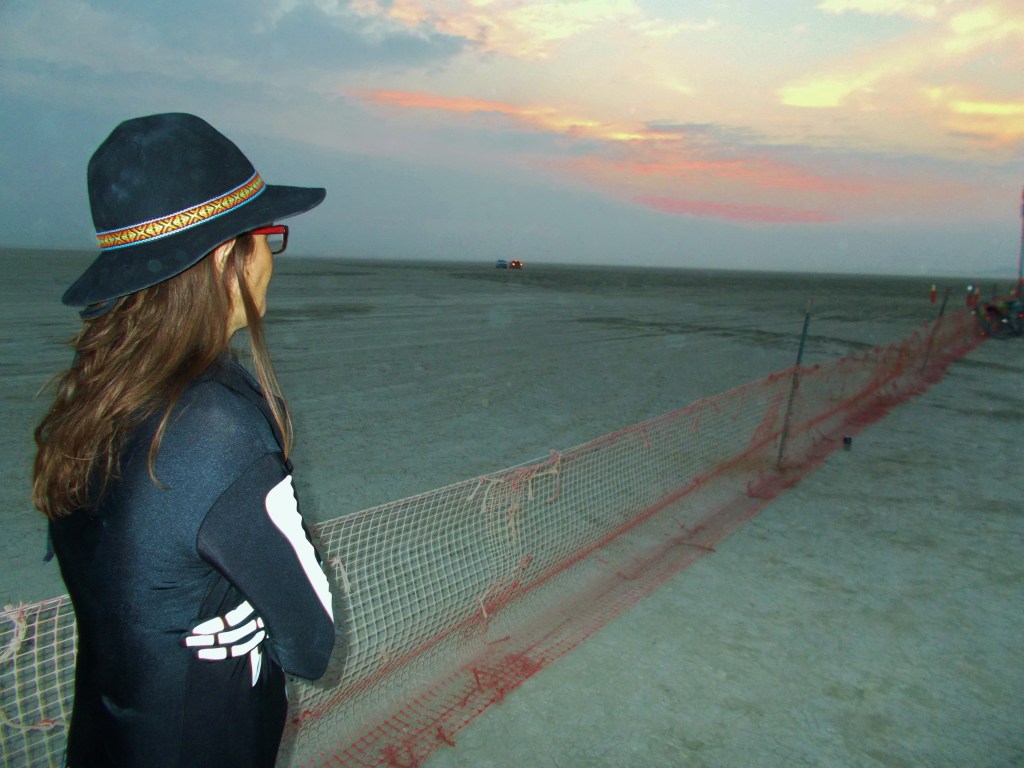
Waiting for Daft Punk’s trash fence gig to start

As we blinked incredulously at the golden light, the dots seemed to get bigger and develop brightly coloured tails.  Marya and I glanced at each other, a little alarmed.  What was happening?  Were we hallucinating?  NO!  It slowly became apparent that what we were seeing were a number of daring parachutists who had jumped out of a plane at daybreak and were now painting the sky with their rainbow coloured chutes, gracefully trailing beautiful long flags in a wondrous tapestry across the heavens.  It was such a beautiful moment and I’ll never forget it, but was it my favourite summer holiday memory? 

After searching for months I found this video of the people that we saw dropping out of the sky that morning.

I didn’t think so, but the floodgates had opened.  I remembered wiling away long hot Ibiza days drinking sangria and eating tapas, followed by misspent nights dancing to our favourite DJs.  I remembered the simple, but delicious seafood lunch served to us by the captain of a Turkish gulet we’d hired off the Turquoise Coast of Antalya.  I remembered hiking the wild and windy coastline of southern Corsica, staying in some random Moroccan billionaire’s summer home that our friends Gwen and Didou were managing for the season.  I remembered trekking through vast mountainous canyons to explore the ancient Jordanian city of Petra, and then a few days later bobbing around the Dead Sea, smearing its healing and beautifying mud all over our faces and bodies.  And I remembered countless summer days drowsily contemplating the hypnotic cicadas in a tiny ancient hamlet called Adine in Siena, Italy, one of my favourite places on earth.  Occasionally we’d summon the energy to drive into town to eat pici served with locally caught wild boar.  And afterwards we’d devour nocciola and Amarena gelato while sitting on the cobble stones of the town square, watching toddlers awkwardly chasing pigeons and teenagers awkwardly chasing each other.  Later that night David and I chased fireflies in the hamlet’s olive grove.

Late summer days in Siena’s Piazza del Campo

I remembered trips to Thailand, Malaysia, Singapore, Vietnam, Hong Kong, Japan and Taiwan.  Mostly just to eat the street food, but also to lounge around on beaches or pools or in izakayas and rooftop bars, kicking off the day-drinking with breakfast beers and seamlessly graduating to lunchtime cocktails and then bottles of wine at dinner.  I remembered evenings wandering narrow backstreet warrens looking for the perfect place for a late night meal, and somehow always finding it. 

And of course I remembered Greece and her beautiful islands, which I discovered relatively late in life.  First Mykonos, and then, in quick succession, Santorini, Milos, Sifnos, Naxos, Zakynthos, Skiathos and Kefalonia.  Distinct memories of wandering down overgrown sandy tracks to discover completely secluded beach coves, with the bluest and clearest water I’ve ever seen in my life.  Enjoying the simple but delicious food of my childhood, chased down with surprisingly good wine by the kilo.  Always followed by the obligatory afternoon siesta.  Balmy fragrant nights laden with the promise of a good time floating on the sound of a bouzouki being strummed somewhere.  Everywhere.  These are all gorgeous memories that I will keep forever.  But are they my favourite summer memories?  I realised that no, they were not.  To access those, I had to go back to Australia.  I had to go much further back in time, to my childhood.  I had to go back to the farm. 
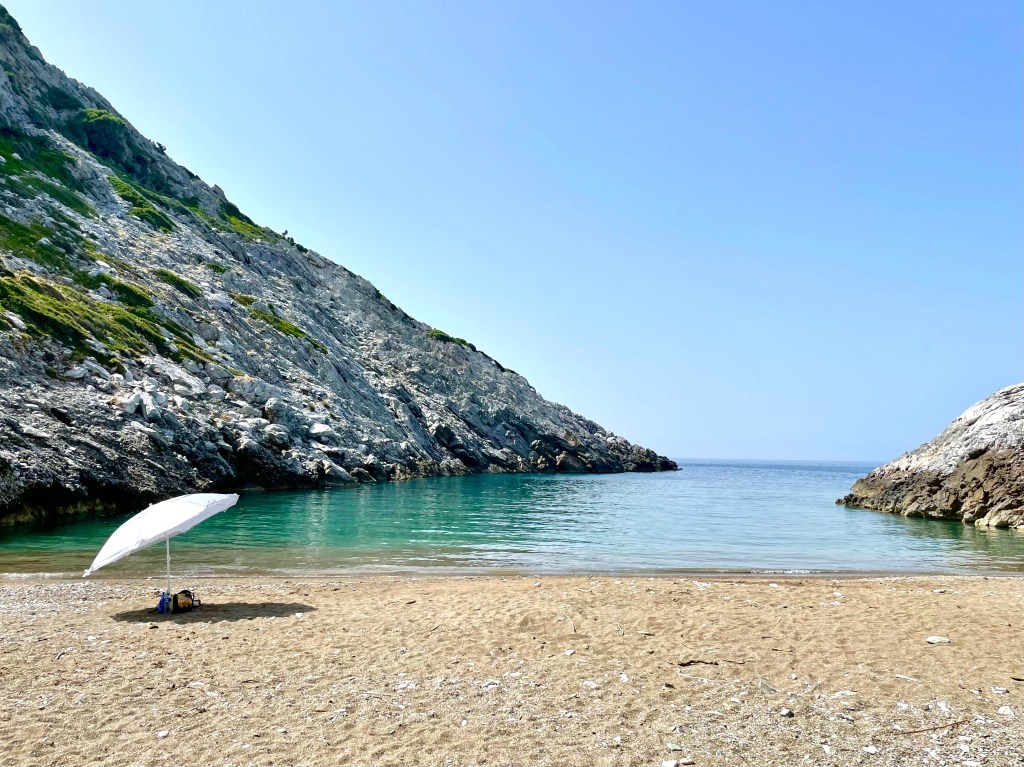
If sheer perfection was the criteria…

When I was about 12 years old my parents went into cahoots with my aunt Dimi and uncle Alex to buy a plot of land in the Victorian countryside.  I remember being dragged around with my sisters to endless real estate inspections of properties on the Mornington Peninsula, about an hour and a half drive from Melbourne, until they eventually found the perfect one.  Lot 3, Boneo Road, Cape Schanck was a hilly ten acres of overgrown tea-tree shrubs and native grasses.  And that was it.  It was wild, it was untamed and it was magnificent.  For the next five or six years, we spent most weekends and summer holidays at the farm.  And even though it was, in no way, shape or form an actual farm, that was what we called it.    

In the beginning, we camped in tents.  Later on my Dad laid the foundation for what would come to be known as The Shed.  And of course, because it was my Dad, it wasn’t built out of wood or steel or bricks.  He built it with materials used by NASA.  And I am not even joking about that.  The stuff was basically slabs of Styrofoam enclosed in a bright green metallic casing.  The shed was four walls and a roof.  Our family of five had a tiny bedroom to sleep in, and my aunt and uncle had an even tinier one.  My Dad built us all bunk beds.  The rest of the shed was an open space kitchen, living, dining area.  The floor was a concrete slab. And that was our holiday home.  It wasn’t fancy, but it was ours. 

Our days and nights were filled with adventures, accompanied by a rotating roster of friends, children of family friends, cousins and even kids off the street.  One morning while my sisters and I were playing at the bottom of the driveway three young girls on ponies materialised in front of us and asked us if we wanted to go for a ride.  Hell yeah we wanted to go for a ride.  Other times the three of us, and whoever happened to be around at the time, would explore the property, trying so hard to get lost, going so deep into the dense tea-tree shrub that we sometimes had to fight through the thickets on our hands and knees, our arms and legs covered in bloody scratches.  We were always so disappointed when we hit the fence-line and had to retreat back to the clearing.  But that never stopped us from trying again. 

I learned how to drive on the farm, in an old unroadworthy Land Rover that needed a crank to start the engine.  The same Land Rover that we would all pile into and be jostled around on the 2.5km dirt track down to a secluded, rocky beach that was essentially our own private paradise.  I don’t remember seeing more than a handful of people in all the years we spent on that beach, and when I recently tried to find it on a map, I discovered that it still doesn’t even have a name.  If you want to find it, it’s somewhere between Gunnamatta and Fingal beaches, but good luck getting to it. 

Driving lessons on the farm, being herded by Joshua.

Oh, that beach.  It was ours!  It was ours!  We’d drive down in the morning and stay all day, carrying down platters of homemade food for a sumptuous feast sprawled on the rocks.  We’d recline for a while in the shade of a rocky overhang, and afterwards we would fish, always hooking a bounteous catch of butterfish to cook on the BBQ later that day.  Sometimes we would search for elusive abalone in the many tidal pools, and sometimes we would be lucky.  My Mum would tenderise and pickle it, and cook it up in a stir-fry with rice, the thought of which still makes my mouth water.  My sisters and I would confidently leap from rock to rock, like agile little mountain goats.  We trudged up massive sand dunes, just so that we could tumble back down them, and then do it all again.  And we dove and frolicked in our very special, swimming pool-sized rockpool for hours, exploring every single nook and underwater cranny, trying to catch the little fishies that had been washed in with the previous tide.  But they were always quicker than we were, and they were always somehow able to dart away, out of reach of our prune-fingered grasp.  This is what favourite summer holiday memories are made of. 

The rockpool.

Back at the farm we zoomed around on my uncle Alex’s three wheel motorcycle.  Oh what a thrill it was to wrap my arms around his waist as he floored it up what felt like an insurmountable summit.  The wind whipped my hair around, because it was the 1980s and helmets weren’t a thing.  I was always scared that he would rev it just a little bit too much and the two of us would flip backwards.  But facing that fear and always reaching the crest and landing those three wheels back on solid ground was an exhilarating experience that I’m fairly sure not many other 14 year old girls were lucky enough to have. 

Our hobby farm was right next door to an actual, working farm with a couple of horses and a paddock full of grazing sheep.  There were also ducks and chickens and a pigeon coop and a small corn field and a gorgeous black and white Border Collie called Joshua.  Every time we drove up the driveway to the farm, Joshua would be there waiting for us.  And apart from dinnertime and bedtime he spent every waking minute with our family.  He would even chase the Land Rover to the beach, whenever we drove down there, and he’d spend the whole day with us.  I don’t know if Farmer Murphy was aware of it or not, but Joshua was our first family dog.  We loved him and he loved us. 

My sisters and I developed a routine of knocking on the Murphys’ back door every Sunday night, collecting large hessian bags filled with stale loaves of sliced bread and heading down to the pastures to feed the sheep.  I remember the first time we did this.  We entered the enclosure and clicked the gate behind us.  It felt like every single sheep in that three acre pasture stopped what they were doing and looked up at us.  And then, the sheep started running.  A hundred sheep stampeding towards three nervous young girls holding sheep food.  I’m pretty sure we all started screaming, and I’m pretty sure I thought the three of us were going to die.  And as they approached us and the fear escalated, somehow, we started running back towards them and the killer sheep dispersed.  And we laughed and laughed, mostly as a release to the fear, but also because it was just funny.  And we started throwing slices of bread all over the place and the sheep lunged at it like ravenous wild animals.  And when we ran out of bread, the sheep just disinterestedly sauntered away.  As if nothing incredible or mind-blowing had just happened. 

The Murphy’s were really nice to us, letting us feed their sheep and steal their dog.  They sometimes even let us chase around the cute little springtime ducklings and chicks that had just hatched.  But the truth is that they probably didn’t love us being there.  We were a rowdy bunch of Greek immigrants who would often be up until the wee hours of the morning revelling and carousing and generally being festive motherfuckers!  I remember one particularly merry night, my Dad was playing guitar and Alex, taken with the spirit, grabbed a drawer from his bedroom dresser, theatrically flipping the contents on the floor and, with his leg up on a chair, started using it as a drum, rhythmically banging the shit out of it.  My Mum, inspired, grabbed a coffee jar full of rice from the kitchen to use as another instrument in this unhinged jam session, and everyone danced and sang along.  We kids watched in wonder as our normally mannerly relatives just rocked the fuck out.  The carefree exuberance and unbridled high spirits of moments like these stay with me, and fill me with joy decades later.  These are what favourite summer holiday memories are made of. 

Sometimes the singalongs came at the end of the night.  Sometimes they were the opening act.  Depending on the tides, sometimes my sisters and I would be woken up at one or two in the morning and then we’d all drive down to the Fingal Beach hiking trails.  A dozen of us carting buckets, torches and gardening gloves, we traipsed down the steep, sandy steps to the rocky beach below to catch crabs.  As the tides started going out, the crabs would emerge from the rockpools in search of food and we would be there to grab them.  We were young kids running around in the middle of the night in gum boots on jagged rocks catching crabs as the tide went out into an inky black, and sometimes wild, roaring sea.  Hell yeah! 

The cliff path might have felt like a thousand steps going down, but it felt like a million steps climbing back up with buckets full of salivating crabs.  We’d drive back to the shed, put a huge pot of water on the stove to boil and enjoy a glorious supper of the most ridiculously tasty, freshly caught seafood bonanza you could ever imagine.  The memory of cracking open a thick leg to pull out delicious, tender, meaty morsels of crab at 3 o’clock in the morning, bleary eyed and surrounded by my loved ones has to be one of my favourite summer holiday memories in a life filled with them. 

I spent those years on the farm being a free and feral child, living a wild and precious life.  Whenever David and I go back home to visit Australia, my sisters and I always make sure to get together at Fingal Picnic Area where we used to barbeque the butterfish that we caught on our private beach all those years ago.  We gather now to reminisce about those good old days, and to pay our respects and to honour the memory of the wonderful childhood our parents gave us. 

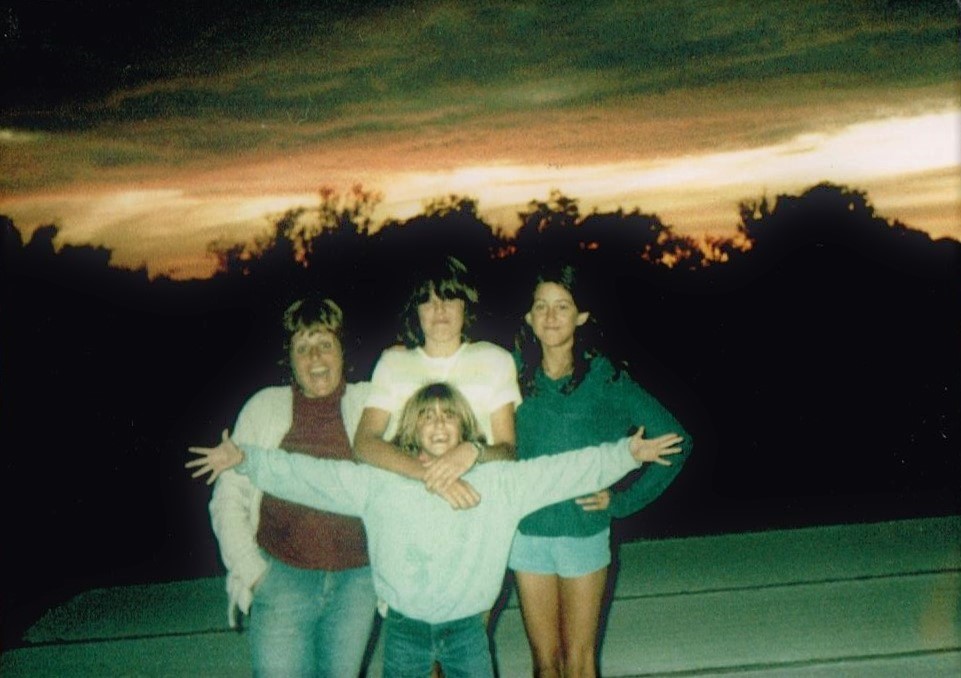
My Mum, my sisters, fourteen year old me and a family friend at the Fingal BBQ

We were there just a few days ago and on our drive to the picnic area, I asked to stop off at Lot 3, Boneo Road.  A gorgeous new house has since been built on the highest point of the property, but the old shed is still there.  A little nervously, we walked (trespassed?) up the driveway to the shed which is now being used as a garden shed.  The exterior has been painted black, but inside it’s still bright green.  The old grape trellis my father built is in total disrepair, and the garden my Mum cultivated is a riot of wild grape vines, passionfruit plants and lemon trees.  But, most notably, nature has fiercely taken back what was once hers.  The natural world that we constantly had to fight off to build the shed, and to live in the shed during our summer holidays, has won the battle.  Mother Nature, biding her time, grew back with a vengeance, surrounding the shed, enveloping it and ultimately reclaiming her space.  My Mum and Dad are gone.  Alex is gone.  One day Mary, Pieta, Dimi and I will be gone, and every single memory of those summer days down at the farm will be gone.  But as we stood there the other day, looking at this familiar, cubic building that somehow seems to have become part of the landscape of what used to be the farm, I found that there was something really beautiful about that.  The farm now belongs to someone else.  The shed, still standing nearly 40 years after my Dad built it, belongs to someone else.  And yet somehow it still all belongs to us.  It will always belong to us. 
The top of the shed felt like the top of the world.

Ejo #129 – (It’s Easy) Bein’ Green

My friends Andrew and Chris were recently talking about all the work they’d done to their homes in an effort to make less of an impact on the environment. I’d been aware that they were pretty clued up about this kind of stuff but I was blown away to learn exactly how much they knew. I asked them if they would be interested in sharing the wealth of knowledge and experience they’ve amassed over the years with all of you, and they both said yes. You’re welcome, readers!!!

Chryss: So let’s get started with what people can do to reduce their energy consumption in the home.

Chris:  I think home efficiency first, including draught-proofing, double glazing, etc. Then maybe electrification; convert to an all-electric home including solar, heat pumps, aircon, heating and hot water.  Efficiency can be very cheaply done and have massive wins.  Whereas changing the house to all-electric is more of an investment.

Andrew: For house efficiency, draught-proofing is #1.  It’s very cheap, and will payback in a year.  Glazing; there are millions of types.  Maximum reduction is replacing the entire window (with either double or triple glaze) but it’s also highest in cost.  Best value for money in glazing is window insulation film.  The average house uses 40% energy for heating, 30% for lighting and 30% on the rest.  A well designed house basically chops the heating by 80%, the lighting by 70% and leaves the rest.

Think about reducing your consumption of energy.  Use the house like in the old days, open the windows at night and in the morning for fresh and cool air, and shut them during the day.  This costs zero dollars, but equals big comfort.  If you want to spend maximum dollars for maximum return, get a high coefficient of performance aircon.  High COP means that for each unit of electricity consumed from the grid, you generate five or six units from your aircon/heat pump/fridge etc.  Solar panels are a no-brainer in Australia.  You can payback in four years for most people in Melbourne now.  Which is a pretty nuts return on investment.  Plus you become more sustainable.  It wakes people up to what the hell they are consuming when they look at an app and see all the things chewing the electricity. 

So, the order in “bang for buck” is draught-proofing, then lighting, then curtains/blinds, then windows.  All of these are ‘passive’ improvements so they don’t use energy to be beneficial.  Also they can’t really break or become obsolete.  Then you can move towards energy efficient equipment. There’s no need to buy new, but just replace old appliances with the latest; things like fridge, induction stove, etc. (exceptions to this are getting rid of plasma TVs, or replacing an old dryer with a heat pump dryer – these are immediately beneficial).  Even the new kettles that can boil just one cup.  This is the important bit.   

Then you go active. With aircon, proper LED lights, a heat pump if you have cash for hot water, otherwise use solar hot water.  Then you reduce external inputs to the house.  Get solar panels.  As Chris said, if you can get off gas that’s great (I haven’t succeeded so far). 

Chris: Another thing is shading.  You can use natural elements to shade walls.  For example, a new house around the corner from me has a north-facing, double-storey, single width, BLACK brick wall, with NO insulation.  Talk about crazy.  Now, if they mounted a huge trellis over that wall, and grew a passionfruit plant, or grapevines, we’d have three things in great play.  Shading for a huge heat sink to prevent the wall from getting the sun, we’ve put in plants to help absorb CO2, and, the kicker, we’re growing delicious, home-grown food.  People often think of high tech when, really, we can use nature to our advantage in so many ways.  For example, in Coober Pedy they build houses underground. 

It “feels” more natural to work in harmony with nature than to fight against it with, for example, pesticides, herbicides, mono-cropping, etc.  But for betterment of self and the planet I like the word stewardship as it elicits a desire to look after something for a short period of time (our life), to pass on a better world to future generations.  We are stewards of the planet, which means we should be embracing appropriate technologies that allow that.  Sure, allow modern life to remain in place and to advance, but also embrace nature and natural processes that have been around for millions of years.  For instance, why make a CO2 capturing machine, which is highly complex, when you could just plant a forest??  Or, just use cows to restore soil, restore nature, and consequently capture carbon, and feed us at the same time.

Andrew:  I mean I could go to town on it all, but it will just bore people and turn them off. I have read the IPCC (Intergovernmental Panel on Climate Change) reports and actually worked with clients on trading carbon credits etc. so I do have some clue, but there’s still plenty to learn. 

Chris:  I don’t think people are that interested though, are they?  Solar, sure.  It’s perfunctory though; buy solar panels, move on with your life.  Big efficiency, lifestyle changes, lowering CO2, those are the much bigger life changes needed.  As Andrew said, no one is truly really engaged with those.  Or maybe they are, I dunno.  It’s a very big topic, way beyond solar.  Our goal should be reversing our impact on the planet.  Our goal with solar is to make our current lifestyle sustainable, but unfortunately if we sustained our current level of use of everything, we’d be toast.  Precious metals are being depleted at rates that simply can’t be sustained more than 30-40 years.  Arguably, our most valuable asset, top soil, has about 30 seasons left.  Instead of sustainable, the thing we need to think about now is regenerative. I think it’s important to point out that lifestyle change is needed, and that simply adding solar isn’t a “Well, I’ve got solar. I’m done now” proposition.  My perspective is that solar is but one of many steps we can take to address our impact.

Andrew: Learning about all of the things you can do, I realised that different elements can be prioritised; whether it’s reduced energy bills, more self-reliance, less carbon emissions or just a sense of shared help for others. Any step people take is a step in the positive direction!

Chris: It would be good to explain the “why” though.  People can make all the changes their wallet desires, but the “why” behind the change might put things into perspective and inspire more?  Long lasting change, that is. Solar panels and generation of electricity is pretty much a commodity.  It will save people money over five years, so it’s an easy sell.  As is cutting gas and going to an all-electric house.  Try convincing anyone they need a drop toilet though.

Chryss: Can I ask you both to talk me through your own personal journeys of how you arrived to where you are now, in terms of your commitment.  I’ve known you both for nearly 25 years, and I can’t remember you being this interested in saving the environment back in the day.  So how did you both get to this point?  Also, do you think that becoming parents has amplified it at all?

Chris: About eight years ago I went on a health journey that started with, “You need to take statins”.  After researching that and deciding I didn’t actually need them, I ended up learning a lot more about food, and health.  I lost 40kg, and 33cm off the belly, cured a lot of other ills I didn’t even know I had, and I am now in the best health of my life.  Part of that health journey led me into looking at food, and resulted in me doing a course in permaculture, which is about sustainable living, sustainable lifestyles, growing food, and living a life more in line with nature.

We need to be able to pass on a better world to our children (or to future generations, for those without kids).  This doesn’t mean sacrificing modern lifestyle – it’s just about being more mindful, and making positive informed changes.  Sure having my own child has maybe brought that to bear a little more, but I’d like to think I care enough about everyone else that I would have made those changes anyway. 

Andrew: So I got into what I call acting sustainably in a very slow fashion, starting as a teenager, thinking about why the snow in the mountains was greater or lesser each year.  I read STARK by Ben Elton as a late teenager, and later the IPCC, which is the entity that publishes the climate change research and the various consolidated scientific models on this.  I was focused on what the impact would be in the various places that I cared for (Melbourne, France, the mountains). 

I also disliked the very emotive language used (little did I know how pervasive it would become).  This was early 2000s, before Al Gore etc., and I wanted to get to the analysis sitting under it, to protect myself and my investments.  Since becoming a father, this has not changed, I believe.  The action that I take will not make one bit of difference.  I am doing it to simply say to myself that I did something to reduce my impact on the world, and also to reduce my financial risks (i.e. if I have lower electricity costs, then I need less income/salary to live day-to-day). 

ChryssWhat exactly have you guys done to your homes?  And why?  Could you please go into as much detail as you can.

Chris:  I’ve converted my entire home from using gas and electricity to an all-electric house.  We completely decommissioned the gas.  In place of the gas central heating, gas hot water and gas cooktop (which are all very inefficient) I’ve installed a 6.6kw solar system, heat pump (often called reverse cycle) heating and cooling in each room and a heat pump hot water system (which heats during the middle of the day only).  For a couple of years we had a portable IKEA induction cooktop simply positioned on top of the unused gas cooktop, but recently we bought a new oven stovetop with induction built in. Those portable IKEA induction cooktops are excellent though, as a temporary measure, for $59.  By switching from gas to electricity it did several things.  We’re safer, as gas leaks account for a LOT of the methane in the atmosphere and can often leak into the house.  We also ditched the connection fee for gas, leaving us with a single, low connection fee for electricity (with Tango Energy, which also has a low kwh charge, and a good feed-in tariff). 

In addition to those things I personally sealed up the house, making a priority of draught-proofing.  This was the first step I took in improving my home efficiency.  Any gaps in walls, floors, doors and windows got either a tight silicone strip or a silicone seal, to ensure no air leaks.  I also sealed up all the internal air vents, all the internal central heating vents and all the gaps behind appliances and under sinks.  Building contractors just smack holes in walls for wires and plumbing, so sealing up these big gaps is crucial to efficiency.  Check your entire building envelope for air gaps!  I also sealed up all the chimney cavities with cut up bits of foam mattress bought from Clark Rubber. 

We use to have on-demand gas hot water.  A stored heat pump hot water system is by far the most efficient when used in combination with solar.  I know some dudes who did in-depth analysis on all of the hot water heat pumps, and Sanden was the winner so we got that.  We only heat between 12pm and 2pm (peak solar times), and it’s perfect hot water at any time of day.  We bought other new appliances too.  We now have four Mitsubishi reverse cycle coolers/heaters.  The old dishwasher, washing machine, large commercial freezer, oven and cooktop, kitchen extraction fan, light fittings, wall/kitchen and bathroom fans were all replaced with low energy efficient versions (with backdraft protection, to prevent air leaks).  We reduced the number of appliances needing power.  We turn them off, replaced them, or just got rid of them. 

I replaced all the windows in the north facing kitchen area with double glazing myself, and even managed to feature in the ReNew Magazine a couple of times with my home handyman work.  We invested in a full roof replacement, using lighter coloured Colorbond sheets, and we installed R6 roof insulation (due to limited space we used foil lined foam panels specifically designed for cathedral ceiling spaces).  We installed a 6.6kw solar system, fed back into the grid to effectively use the mains grid as a “battery” so we can draw back when there is no sunlight, and to minimise costs.  For about five months of the year we have zero electricity costs, for another four months it’s about 50% and the three months over winter it’s about 10% fed back into the grid.  We’re on track to pay off our solar in less than four years. 

Outside, I put in plants that provide shade for north and west facing walls in summer.  These produce food (grape, raspberry, kiwi berry), draw CO2 from the atmosphere, and they look pretty.  I installed a measured irrigation drip system with a solar powered pump for efficient use of water, a 3000 litre water tank for rain water collection and I also diverted all downpipes to the water tank.  We got a bee hive to pollinate our plants and also to provide honey (not that we eat it, but we can trade with it or give it away).  I removed all the non-productive plants, for example the 15 metre lilly pilly plants at the rear of property, and replaced them with three apple trees, three pear trees and other productive food plants, allowing more sunlight to the backyard, for us.  We grow a lot of our own berries and fruits in water-efficient wicking beds (hundreds of plants in total).  It’s no secret that a LOT of the food we buy is one of the biggest carbon footprints.  For instance, where did that banana come from? And where was that Coles/Woolies bread made?  Where was the soy in that Bonsoy milk grown?  So one of the biggest things we can do to reduce our impact is to buy local, in-season produce, and direct from farmers.  For example, the beef I buy is from a farmer I know who is less than 100km from my house.  We can reduce our own fossil fuel use, but we also have to consider first, second or third hand usage too!

Finally, we grow azolla, a plant that draws nitrogen from the atmosphere and turns it into a great fertiliser, while being a great habitat for water animals.  Also, bees can land on it and get water without drowning.  We also grow comfrey, another nitrogen fixing plant used as fertiliser (both of these mean I don’t need to import fertilisers, and it’s all organic) and we keep all organic material (cardboard, kitchen scraps etc.) for the garden.  There are lots of ways to be efficient beyond just electricity, but all have an impact on either energy use, or conservation.

Chryss: Andrew, how about you? 

Andrew:  My list is in priority order, meaning bang for buck, and not necessarily the order I actually did it chronologically.  Bang for buck meaning maximum reduction in energy costs/liveability factor for minimum cost.  I personally believe this is the only way to get people to move, which is slightly different to Chris’ view (I mean, I agree with his view, I just don’t think that other people will behave altruistically.  I don’t behave altruistically so why should I expect others to).

Draught-proofing and sealing up gaps.  I paid someone to come to the house and do this professionally.  It cost me 1,200AUD.  The person put dropdown seals on all the doors, filled in around all the windows, put draught stoppers in the bathroom exhaust fan, and silicon sealant in various gas wall vents.  Payback on this is probably a year or so in winter heating bill reduction (our house was leaky, and still is)

LED lighting.  First we replaced bulbs with LED globes.  This works and is cheap to do. Everyone can start with this and reduce the lighting part of their bill by maybe 60-70%.  It causes some heat loss due to the design of bulbs though, so I ultimately replaced them with full LED units (these have a computer inside the unit and are fully sealed so no leaks from your roof, which is a big deal with heat loss).

Roof insulation.  Hot air rises. Melbourne is a heating dominated climate so we need to focus on improving heat retention.  I put R6 insulation in the roof (actually R4 plus another lot of R2).

Solar panels.  We paid way too much for very high end solar panels (with a slightly tricky install due to shadowing).  Nevertheless, my panels output crazy amounts of kw.  I have 8kw of panels, which means that for three months of the year I get paid, three months I pay nothing, and six months I pay a bit (we still use a lot of electricity).  I installed a lot of panels, partly because whoever buys the house after us will always need a lot.  Current payback period is about four years.

Underfloor heating.  We replaced ducted with underfloor heating.  This is NOT economic.  I mean it’s 20% cheaper than the gas-ducted heating to run. But we will never recoup the installation cost.  It was installed for allergy and comfort reasons.  It’s very pleasant to have the house at one temperature, and a smart sensor means it switches off when it’s not needed.  We also installed underfloor insulation (though there’s no need to do this unless you do something like underfloor heating).

Double glazing.  We paid a lot of money for very well sealed double glazed units from Paarhammer.  We could only afford to do the bedrooms.  We like very quiet bedrooms so it was a key element.  There is a good firm called Thermawood that can replace just the glass, keeping your wooden frame, which saves a fair bit and is quite useful for Melbourne houses.

Induction cooktop.  This is good for cooking.  Modern ones are much better than the previous models (we still have both gas and induction).

Dryer.  Obviously the best option is to dry your laundry outside.  But if you are going to have a dryer (and we do), then buy a heat pump dryer.  These use fridge technology in reverse, are very mild on clothes and use very little energy

Heating/cooling.  Similarly, install reverse cycle air-conditioning for the same reasons (it uses fridge technology, which means that each 1kw you consume gives you 6-7kw of cooling/heating).

Pool pump.  Install one with variable speed pump and auto chlorinator.  We don’t have a pool, for environmental reasons (and they are a complete schlep to maintain).  But if you do, installing these reduces electrical and chemical usage.

I mean there’s lots of other things I have done that I don’t want to bore you with.  For example, I bought a thermal camera (which plugs into an iPhone) to see where gaps are.  I bought a meter to track consumption, planted trees, I’m riding my bike more, not buying replacement stuff.  The old reduce, reuse, recycle (in that order).  But there are still large errors in my behaviour.  I am happy to fly (which, by far, has the biggest CO2 impact).  I still use gas (as the cost to move to underfloor electric is astronomical).  I still buy food from France.  Hence I am not comfortable to say anything to anyone.  Any step that someone takes is great as far as I’m concerned, it doesn’t matter how small. 

Chryss: Seriously impressive guys.  Hats off to you both.  Now here are some questions that I’ve fielded from people who are interested in making changes but don’t know where to start. 

What size unit would we need to cover our average daily energy usage?

Chris: You’d need to check your electricity bill to work that out, but my personal view is to maximise solar generation on your roof.  I think most of the deals going around now are about $2000 for a 6.6kw system (after rebate). This is about 20-22 panels, so that’s fair chunk of roof.  I have a 6.6kw system, 22 panels.  This gives us five months electricity bill free, about four years payback.  Current deals pay back in two years.

Andrew:  Divide your daily bill by 3.5 so, for example, 35kwh of usage would need 10kw of panels. To be clear you will (in Melbourne anyway) generate 1.5x your panel size in winter and 5.5x in peak summer.  Chris is right though. Panels are so cheap you should just get the maximum size that fits on roof, given labour versus panel costs.  IKEA have a good offer at the moment.  Payback period on that, assuming all self-consumption, is about two and a half years. Assuming just feed in tariff is five years.  You get a return on your cash of around 30%p.a. for the self-consumption version.  That’s not bad to feel good about your impact on the environment.

Is the additional cost of the top quality solar cells worth it for the extended warranty (25 years versus 10 years)?

Chris:  Not sure I have an opinion on the warranty (I’d probably say top of the range is never, in any technology, the best bang for buck), but I will say this; most package deal systems out there use Tier 1 panels, e.g. Jinko Tier 1, and they come with 25 years warranty anyway. 

Andrew:  Yes and no.  Focus on what percentage the panels are scheduled to generate after ten years.  Also better quality panels will have lower reduced losses if temperature is higher (look for a low temperature coefficient).  If you want maximum output, generally it’s easier to just add more panels.  The key to keep cost down is to check if you have any shadowing due to chimney/trees etc.  If you do, then you need to look into optimisers or microinverters, which are mini computers that optimise the output of each panel if there is shading (if you don’t have them, then in one line of panels you can only produce at the lowest output of any of the panels, which can significantly chop your output).

What kind of solar panels are good, and why?  What inverters would you recommend?

Chris:  I recommend Tier 1 manufacturer, with a moderate panel.  I wouldn’t choose the most efficient, but probably 3rd or 4th down in the range (about 330w).  Like all tech, don’t bother with the top of the range – it will pay you back, but it will be a much longer timeframe.  I’m sure Andrew will touch on this, but a decent panel with Enphase microinverters is probably considered the “best” but only because it handles shading, and partial solar generation.  If you don’t have much shading, like me and unlike Andrew, then you can get good Tier 1 panels with a string inverter, and you end up producing just as much (maybe more as there is less wiring) pound for pound than more expensive options.  The price difference in setup?  We’re talking $15k+ versus around $2k.  Shading on the roof is the factor in determining this.

Andrew:  Bang. Nothing to add. 

Any idea what impact solar panels have on roofing?  For instance new Colorbond roofs state that the warranty ill be invalidated if solar panels are installed.  Any idea why?

Chris:  I don’t know.  They pull up screws in your roof, and attach the frame through those same holes, so there are no extra holes.  The impact solar panels do have, a very positive impact in my opinion, is that they provide shading on your roof.  The sun never hits the sunniest parts of your roof, so this keeps your roof from getting as hot, and thus lowers your cooling requirements!  Win-win.

Andrew:  Agree.  If you get a decent installer, there is no problem as they mount on a frame (having said that I have tiles, so I don’t have specific experience).  One thing I’d suggest is to make sure you put as many panels west facing.  You can thank me later.  But generally put as many panels as you can fit on.

How much more would we need, if we wanted to charge an electric vehicle every day?

Chris:  Good question.  I’m not sure I have the specific answer as it varies by the amount of charge/energy you use in the car, and when you’re charging it.  If we go back to the previous point, get the most number of solar panels/setup you can afford, and use the electricity you generate to power everything you need during the day, feeding back into the grid any excess so you can draw back electricity when you need it over night.  I’m presuming electric cars would be charged over night, so, yeah, you’ll need to be feeding back into the grid as much as possible.  From a pure energy view point, in a Nissan Leaf, if you charged in the middle of the day, then for the 10kwh needed for 100km travel, you’d likely need a 2.5kw solar system just for that single car.  The same car to charge in winter, you’d need a 25kw solar panel system – in Melbourne anyway.  There are so many factors, and too little detail in the question to fully answer though.

Andrew:  From the reading I have done, you will struggle to have enough excess to charge your electric vehicle.  A Tesla car battery is 75kwh.  So on its own, it needs say 20kw of panels to charge from empty.

How much do we reduce our carbon impact on the environment with an electric vehicle charged by solar rather than from the grid?

Chris:  Damn, that’s a complicated one.  Probably less that you might think.  Your panels are made of plastic, silicone, glass, etc.  They are manufactured in China, transported here, trucked around, and need to be replaced every 20 years.  Compare that to charging from the grid in Melbourne, which is now becoming more and more wind and solar powered every day.  It’s easy right now, home solar is better.  But it’s a tough call what the lower impact will be in five years.  I suspect in the next ten years there will be very little difference in environmental impact, grid versus home solar.  But you will find home solar electricity is cheaper/free.

Andrew:  Large losses due to transmission mean home production is always better.  For instance, 100kw produced in Mildura might only be 30kw by the time it hits your meter, due to losses in the power lines and transformers.  Electric vehicle versus petrol?  A simpler car means less to break down, less replacement costs/maintenance.  The main one is battery recyclability and degradation.  Petrol cars are very efficient.  Honestly, the analysis I’ve read is that for an identical car, EV versus petrol, you would be better to buy the petrol car and buy CO2 credits with the saving.  That doesn’t get you the green status symbol though.

Should we get a battery?  

Chris:  A battery is not worthwhile at present.  The economics don’t work out well.  Better to treat the grid as your “battery” by feeding back into it with your solar setup, and drawing back from the grid at times when your solar setup isn’t providing all the energy you need.  Batteries are not worth it on several levels.  

The big advantage of a battery would be being able to use power when it’s dark, and selling power at a better time of day (though there’s no flex pricing at the moment), and if you were completely off-grid as the only option. The downside is that batteries degrade more quickly than panels and need to be replaced, they contain toxic chemicals (so if my goal is to improve the environment, this conflicts), and ultimately you will still need a grid connection as backup, as we use more power than we generate over winter months, meaning the connection fee is fixed.  Until there are some significant improvements in battery technology I think this is probably a good compromise.

Andrew:  I agree with Chris on the economics. I also agree that recyclability of batteries is terrible at moment.  Actually charging at night helps stabilise the network (it doesn’t help climate change but it does reduce instability, and hence the possible need for extra gas-powered quick-start plants).  You’d need the Tesla battery price to be $7000 installed, for the economics to work in Melbourne.  It would need to be half the price, or prices need to vary intraday by 20-30% more than they do currently.  Basically a way better to spend the $12k of a Tesla battery is on reducing your household leakage. For example, there are houses out there that can keep warm with only human heat (and sun, during the day).  Hence the only consumption at night is for lights, and that’s tiny.

Is it better to have solar panels or get electricity from green energy companies like AGL Green Energy.

Chris:  With a two year payback on a 6.6kw system priced at $2100 after rebate, with a life span of 20-25 years, get solar.  It’s a no-brainer.

Andrew:  As per above, economically.  And also note that buying green power costs you more and doesn’t change the retailer behaviour.  It is actually cheaper for them to source renewables now, so you’re paying them to do something they would do anyway.

Ejo #103 – An Open Letter to Annette of Holiday Shacks


capture

The email that launched a thousand words.  A simple apology would have seen the matter die a natural and quiet death.

Dear Annette of Holiday Shacks,

Thanks so much for your email. I must say though, it wasn’t exactly the response I’d been hoping for. I thought, perhaps, you might go for something a tad more conciliatory. A touch more apologetic, considering your crappy handling of what went down when we rented one of your “shacks” earlier this year. I sure as hell wasn’t expecting you to so nimbly squirm out of accepting any responsibility at all. Allow me to recap.

In April of this year I rented one of your ludicrously priced holiday homes for a weekend. You see I live abroad, so whenever my husband David and I are back in Melbourne we have this little tradition of renting a country house with my sisters so that we can all catch up, have some drinks, cook some food, dance around, swim, play games, shoot the shit and just have some good old fashioned, wholesome, family fun.

As you can imagine, we were suitably impressed when we arrived at Oceania Retreat – it’s a stunning property. Which is why I rented it, notwithstanding the astronomical (and actually pretty embarrassing) price tag. I’m sure you’ll agree that $3050 for a weekend away is a shitload of money, Annette. Because I would hate for you to think that I can go around splashing cash like that on the regular. No, no, no. It was definitely way above my budget. To be very honest with you, I actually booked it by accident one night, when I was super drunk. Oops! And I’m not ashamed to say that paying that much money for a two day getaway made me feel a little bit like vomiting in my mouth. But as I’ve already said, time with my sisters is very special to me, so I went through with the booking.

So yes, we were impressed with the house. But as I told you in my initial complaint, there were a few things we were not so impressed with. Especially considering the price we paid. For instance, the dirty socks we found on the back porch. What the hell, Annette? For $3050, the least you could have done was pick up the socks? Also for that price, how about providing an umbrella that actually fits into the picnic table, instead of one that doesn’t. And hey, why would you advertise the house as having a “coffee maker” and a “fully stocked gourmet kitchen and pantry” but not actually provide any bloody coffee? That’s just nasty, girlfriend. I mean, alright, coffee might not seem like such a big deal… but it kinda is a big deal Annette. It kinda is! And while you’re at it, you might also want to think about asking the owner to repair the broken bi-fold doors that we were strictly forbidden to use. The busted bi-folds were a hoof to the face, Annette. I bloody love bi-folds!! I love the effortless blending of indoor and outdoor living that they provide. The bi-folds were one of the main reasons I booked Oceania Retreat in the first place. And the fact that the entire wall of them was broken and unusable does not seem fair considering that I paid full price for the house.

HS Ejo Pic4

The row of bi-fold doors that are designed to welcome the outdoors inside.  These were locked shut during our weekend stay.


HS Ejo Pic3

This is the house I thought I was renting.  Sadly, because the bi-fold doors were locked shut, it’s not the house I got.

But look, all of those inconveniences paled into comparison when, at around 9.30pm on Friday night, the electricity in three quarters of the house just went out. And no Annette, despite your strident assertions, we had not overloaded the system. Not in the least. Nary an iPhone was being charged at the time. But the power went kaput anyway. Being practical people, we figured we’d just find the fuse box, flip the safety switch and get back to having fun. Except Annette, we couldn’t find the fuse box. We looked everywhere, inside and outside of the house. But it was nowhere to be found. Was it because we were drunk? No. Was it because there were no lights? No. It was because the fuse box was hidden… wait for it, behind a locked door!!!

IMG_4813

Curious.

Which begged the question, Annette, where the fuck was the key? I still believe that was a very reasonable question to ask, sitting in a big-ass summer house with no electricity on the first night of a weekend away that cost us an asspile of money.  For some reason, you disagree.

We spent a couple of futile hours looking for the damn key before giving up, a little after midnight, and calling the number in the guest compendium. We called twice, because we felt that the situation was serious enough to warrant immediate attention. But the woman who took our calls obviously didn’t think that a power outage in a luxury holiday property was worth waking anyone up for. And so we spent the night in a $1525-a-night house with no electricity. Which was significantly worse than a mere “inconvenience”.

Look, Annette, ultimately it wasn’t the electricity failure that pissed me off. It wasn’t the dirty socks or the sadistic, empty promise of coffee. It wasn’t even that the fuse box was stupidly locked in a room that we couldn’t access – even though that was fucking ridiculous. I mean, come on. If you were going to give us the key anyway, why lock the door in the first place?  Mess with your guests, much?  (For future guests staying in Oceania Retreat, the key is in a small bag, in a box, on a middle shelf in one of the cupboards in the laundry – good luck finding it in the dark.)

No Annette, what really upset me was your email. How long it took me to make my initial complaint is irrelevant; I’m a busy person. And I’m sorry that most of your guests are in bed by midnight, I truly am.  But we paid for the privilege to stay up as late as we wanted.  So sure, we called after midnight, but the power had been out since 9.30pm. We called only because we were out of options and we were worried that the fridge situation was going to become a health hazard. The meat was starting to smell and the beer was getting warm. And that is most certainly not OK.

I know you’re not a hotel. Duh! I’m not interested in a 24 hour concierge desk.  I’m interested in 24 hour electricity.  I have stayed in over 50 holiday homes through companies such as yours, as well as 72 Airbnb rentals. I have never seen a fuse box locked in a room with no access. You know why Annette? Because I’m fairly certain that it’s illegal. And the reason the room was locked? To protect the secret treasure trove of wine and coffee hidden inside (oh yeah, there was fucken coffee!!!). Seriously, if the owner is so concerned about their mediocre wine collection they should find another place to hide it. The fuse box needs to be accessible 24/7.

Your final comment was: “We consider that his matter has been finalised as we dealt with the situation in an appropriate time frame and don’t consider Facebook as the appropriate forum when the situation was resolved.”

Listen, seven hours to respond to what I would call an urgent situation is not dealing with it in an appropriate time frame. And indeed Annette, Facebook was definitely not the best forum on which to air my grievances about Holiday Shacks. High five for pointing that out. Hospitality, you see, is an industry that relies on excellent customer experiences and positive word of mouth. Particularly the rarefied realm of luxury hospitality in which Holiday Shacks lurks. Your website bandies around terms like, “luxury holiday accommodation business”, “luxury coastal and rural holiday homes”, “luxury villas” and “guest luxury experiences”. That’s a whole lotta jive about luxury, Annette. But do you know what I don’t consider a luxury? Electricity. I tend to think of electricity as more of your “essential” type item. You rent mansions (not caravans); on the Mornington Peninsula (not outback Australia). Unlimited access to running water and electricity is not optional. And ten hours without electricity is not an inconvenience. It’s fucking unacceptable. And even worse, avoidable.

Before I finish, I’m going to leave you with a suggestion. Some constructive criticism, if you will. Seeing as you work in customer service, perhaps you could try using a bit more diplomacy next time you receive a complaint. Instead of blaming us, your customers, for a situation that was not our fault, perhaps you could … oh, I don’t know, maybe just think about apologising instead?? Just saying, Annette. I have a feeling that your email to me was so dismissive and contemptuous because you presumed that the final word was yours. But you were wrong, Annette. It’s mine.

And now the matter is finalised.