air traffic control

Ejo #81 – ATC 101: Stress

Air traffic control is one of the few things I know well enough to write about with any authority.  Turns out, it’s also one of the more popular topics I write about.  So, being the people pleaser that I am, I’ve decided to start a new series called ATC 101.  It will delve into the basics of the job, as well as my thoughts about various aspects of it.  Obviously I won’t be going into too much detail (coz shit can get technical and -believe it or not- quite boring), and most of what I’ll write about is most definitely going to consist solely of my opinion – meaning that it is in no way a definitive account of the job.  Just my two cents worth.

This month, spurred by a recent incident that occurred at Dubai International Airport, I’m going to write about stress and the air traffic controller.  Whenever I tell someone what I do they always respond with some variation of, “Wow, that’s such a stressful job”.  But is it actually stressful? What exactly is stress?  How is stress defined in this context?  If the question being asked is, “Am I constantly on edge with my heart racing and sweat beading on my forehead, from the time I clock on to the time I go home?” the answer is no.  But for some reason, the flying public’s perception of the job is that it’s super high pressure all the time.  Nothing could be further from the truth. Though if you were to read the ridiculous New York Times article that inspired the ridiculous movie “Pushing Tin” you could be forgiven for thinking that it was.

Taking away the fact that my current job is obviously less taxing than when I was an air traffic controller at an airport with more traffic (i.e. Melbourne), I’m still going to lead with the premise that the job itself, despite its reputation, is actually not stressful.  Yes, over the course of a day we handle billions of dollars worth of aircraft holding the lives of thousands of people.  But we are just one line of defence against an accident occurring.  There are safety systems in place – procedures, equipment, pilots, aircraft maintenance, emergency responders – the list goes on.  Sure, we can’t afford to make mistakes but a whole bunch of mistakes have to be made along the line before an accident happens.

There’s a theory about the cause of accidents put forward by researcher Professor James Reason famously known as the Swiss Cheese model of accident causation.  The theory posits that each line of defence against an accident is basically a piece of Swiss cheese.  Sure, it might have holes in it (and that’s OK, because there is no perfect resistance against errors) but when the holes of successive pieces of cheese line up, an accident occurs.  So I am a piece of cheese, and yes, my actions prevent an unknown number of accidents but that’s my job and that’s what I’m trained to do.  Just as the pilots are trained to do their job, and airport electricians are trained to do theirs etc. and collectively we make it a safe and efficient way to travel.
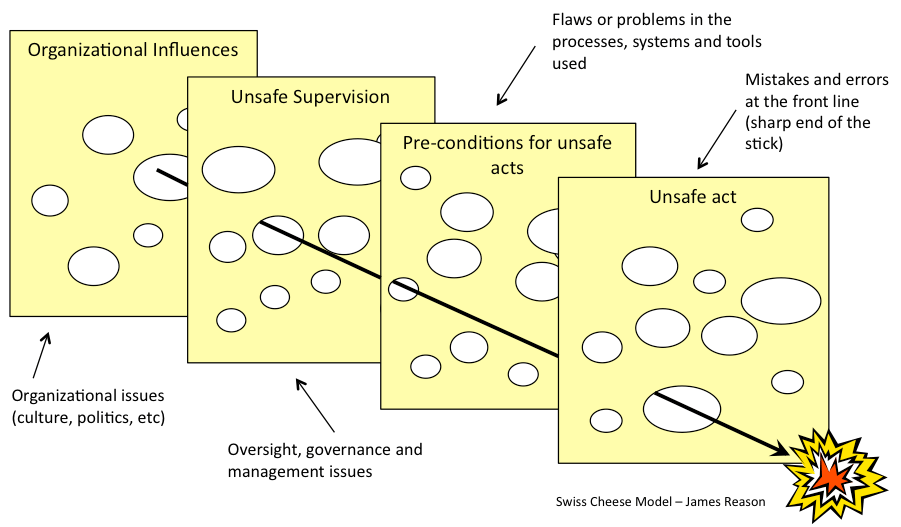
 

Reason Model

When the holes line up = bad.


Air traffic control, by its very nature, is a job defined by rules and procedures that MUST be adhered to.  And we all know that when you do the same thing, over and over and over and over again, it becomes monotonous.  So air traffic control can sometimes actually be a really dull job.  Even when you’re dealing with lots of traffic. But no-one ever says, “Ugh, that must be a really boring job!”

In my personal experience, there are three situations which have caused me stress at work.  The first is training. Training is stressful.  Yes, we learn the basics of ATC at the beginning but each new place we work has local instructions in addition to the regular rules.  New routes to learn, new procedures, new phraseology, new traffic patterns.  Training sucks.  Seriously, just ask any air traffic controller.

Something else that sucks is the annual competency check we have to do, to ensure that we are operating to the expected standard.  It consists of a written exam, the questions for which are mined from the reams of paperwork we are expected to memorise in order to do our job.  In addition, there is an oral examination (which is basically the same as the written exam, but just seems SO much harder) and then a two hour assessment in each position that you’re qualified to control in.  You might be the best ATC in the world, it does not matter.  No-one likes having another person sitting over their shoulder watching them work and taking notes.  No-one.  Decisions that you would make every day without blinking an eye suddenly become difficult.  You second-guess yourself.  It’s just awful.  But hey, standards have to be maintained and that’s just the nature of the job.  If you fail a check, you need to get re-trained in the necessary areas.  It’s a way of keeping everyone sharp.  So yeah, every October, when my check is rostered, you could say I find that to be a stressful situation.  And even though I know what I’m doing and feel very confident about my abilities, the relief is enormous every time I pass and it’s over for another year.

The third situation that I found stressful was actually one that isn’t necessarily associated with the job itself.  A couple of years after I qualified as an ATC, in late 2002, my father got sick with cancer.  He was sick for ten months, and during that time my work was actually a really great distraction from the depressing situation at home.  It was an escape.  But then, in September 2003 my father died and suddenly my world fell apart.  I tried to continue at work but I knew, I just knew, that I couldn’t put on a headset and talk to pilots and still be safe.  I pulled myself from the roster.

One of the definitions of the word “stress” is being in a state of “mental or emotional strain or tension resulting from adverse or demanding circumstances”.  My work has never caused that. But my father’s death was stressful.  And it caused me stress in the workplace.  Perhaps if I had a different kind of job I could have continued working.  But being an ATC, I couldn’t. You have to know your limits  and you have to know yourself. Maybe that constant self-scrutiny also contributes to latent stress. Who knows?

There is something, in my line of work, called CISM.  It stands for critical incident stress management.  And it refers to the education and support provided to air traffic controllers in order to help them deal with stressful situations.  Now, a stressful situation can be something that occurs outside of the workplace, like a loved one’s death.  But more often than not, CISM is provided in response to an incident that happens at work.  Like an accident.  Like earlier this month, when EK521 crashed on landing at Dubai International.  We don’t yet know the reason for the crash.  We don’t know which Swiss cheese holes lined up to cause the accident. We do know that the Airport Fire Service were the piece of cheese with no holes. If it wasn’t for their incredible response, the outcome could have been catastrophic.

The first I heard of the accident was when I arrived at work for an afternoon shift and was told to expect a busy shift because an aircraft had just crashed at Dubai.  My immediate response was to ask, “Oh shit, did everyone get out OK?” which is what most people would ask.  But my second instinct was to ask about the air traffic controller who was in charge of the flight, and ask if they were OK too. And that’s something that most people would not necessarily think about.  They wouldn’t think about the guy or girl who has responsibility for that tin can full of human beings. Or how it must feel to have that tin can impact with the earth – something that’s never supposed to happen.  But I did. Because I’m that guy or girl. And that aeroplane full of people is our responsibility. Even when there’s absolutely nothing we could have done to prevent it.  We are the ones talking to the pilot.  That aircraft was in our jurisdiction.  We had “control” – it’s in the fucking job title.

So I guess, that’s where the most stress lies.  In the possibility that something that happens safely every day thousands and thousands of times (aeroplanes taking off, and aeroplanes landing) might, one day, go wrong.  But here’s the thing.  As air traffic controllers, we simply cannot think about that.  We can’t worry about the holes lining up.  Because if we did, we’d be paralysed.  We just have to get on with the job of trying to keep the holes in our cheese as small and as few in number as possible.

I was talking to a friend of mine the other day.  We studied ATC together, sixteen years ago.  She’s one of the most experienced, and one of the best, controllers I know.  But she’s no longer working traffic.  She is now a manager in the Safety department – an office job.  When I mentioned to her that I was feeling a little under the weather that day for my morning shift she said she was really pleased not to have to deal with the stress of turning up to work every day at 100% capacity. Even though she had no idea I was writing this ejo, she said that she was a lot less stressed now that she was no longer an air traffic controller. She also said that she never would have thought of herself as stressed when she was doing the job. She only realised it after she switched to office work

And therein, I suppose, lies the crux of what we do.  We deal with stress, with stressful situations, all the time.  But we don’t consider it stressful.  We can’t afford to. The stress is there – but we raise our threshold in order to cope with it.  We toughen our skins, and we harden the fuck up. And we pay the price for that. Increased risk of heart disease, diabetes, high blood pressure, sterility (yup, sterility), divorce and obesity. And you know what? There’s nothing else we’d rather do. But more than that, we’re the only ones who can do it.
 

Ejo #72 – Do You Have What It Takes To Be An Air Traffic Controller?

I very often get asked how I became an air traffic controller.  It certainly hadn’t been a lifelong dream of mine.  I’d never even considered it.  When I was younger I’d wanted to go into medicine.  I was a straight-A student and a total nerd and everyone assumed that because I was bright and motivated, I’d easily fulfill my potential and become a doctor.  I thought my high IQ and the simple fact that I wanted it would be enough.  Fools, the lot of us!  I didn’t become a doctor, thankfully.  I don’t think I’m actually equipped to help people in that way.  But that’s not what prevented me from fulfilling my dream.  Nope.  It was good old-fashioned hormones.   And boys.  (I blame the boys.)  Anyway, suffice to say I didn’t get good enough grades to go to medical school.  I barely scraped into a Science degree (that I didn’t particularly want to do), and went to university for two and a half years.  I didn’t go to many classes, but I did spend a lot of that time playing poker in the community hall.  I didn’t finish my degree, but I reckon I’m a pretty good poker player as a result so it wasn’t a complete waste of my time.

Anyway, after it dawned on me that finishing my Science degree WAS going to be a waste of my time, I decided to take time out from studying to earn some cash and try to figure out what I really wanted to do.  I spent the first whole year unemployed because I considered myself overqualified to do menial jobs, when in fact I was underqualified to do anything else.  Life lesson: learned.  Eventually I got a government job at the Department of Defence doing payroll and HR for civilian personnel.  Not very thrilling, and certainly not how I’d imagined myself at 22 years of age.  Let’s face it, I was a bit of a disappointment.  But, I was earning money for the first time in my life, I had a great group of friends and a wonderful boyfriend so I was happy.  Every now and again though, the disappointment would seep through to the surface, and I would ask myself the difficult question of where I was going.  A deafening silence would usually ensue.  I was adrift.  I actually started envisaging myself slaving away in a government office for the rest of my life.  That was a low point.  My colleagues were certainly happy enough with the easy hours, job security and slow but steady climb up the government ladder.  I was not.  The thought terrified me.  I needed to get out but my options were limited.

While most of my workmates saw their jobs as a career, I saw it as just a way to make some dough and enjoy my life.  Which is what I did.  It was during a weekend trip to a Sandy Point beach house in April 1994* (and I remember this moment like it was yesterday) that I was lounging around reading Cosmopolitan magazine.  I flicked the page and there it was.  The gauntlet.  Thrown.


DO YOU HAVE WHAT IT TAKES TO BE AN AIR TRAFFIC CONTROLLER?


I jolted upright, as if a flash of lightning had slammed into me, my hair standing on end.  I felt awakened, after years of being asleep.  I had never read words that were truer for me before in my life.  They struck into my very soul.  Did I have what it took to be an air traffic controller?  You bet your fucking life I did.  I ripped the page out (I still have it to this day) and when I got home, I called the number which would send my life hurtling into a completely different trajectory to the one it had been on before I’d flipped that page.

Australia’s Air Navigation Services Provider (ANSP) at the time was the Civil Aviation Authority, and they had placed that ad in Cosmo, in the hope of recruiting more young women into the very male dominated and aging workforce.  It worked.  A lot of women responded.

The first step in the selection process was a questionnaire determining people’s suitability for the job.  Ten thousand people applied.  The next stage was a three hour written exam conducted at the old Crown Casino.  I think around 400 people sat the exam.  The feeling I’d had when I’d first seen the advertisement – that I was so right for this job – was reinforced as I breezed through the exam.  My brain was wired for this stuff.  I had, sadly, stopped thinking of myself as being smart over the years because… well, I hadn’t exactly proven myself in that arena.  Suddenly the neurons were firing up again.  It was magical.  The exam consisted of several sections, each testing aptitude.  There was a memory test, reflex test, spatial awareness and complex reasoning tests.  Some parts required you to do mathematical calculations while being interrupted from time to time to answer a comprehension based question before returning to the first task, testing mental agility.  Time was constrained.  It was a high pressure exam and I flourished in its embrace.  I was in my element.

Of the 400 applicants who did the test, I think 50 got through to the interview stage.  There had been a long wait (about a year) between testing and interviewing because, in the interim, the CAA had split into what is now known as CASA (Civil Aviation Safety Authority) and Airservices Australia (ASA).  The interviews were conducted on behalf of ASA by a business consulting firm hired to select the best people for the job.  I was one of those 50 people.  I couldn’t believe it.  I was so excited.  For the first time in my life I had real focus.  I had a real, attainable goal.  A future.  I couldn’t afford to fuck it up.  Unfortunately, that’s exactly what I did.  The day of the interview, I got up super early and mapped the route to the office where I would be meeting with the consultants.  An hour before I left the house I got a phone call saying there had been a change of venue, and I was given directions to a portable office in the middle of a field in the middle of nowhere.  I got lost.  I started panicking.  I was going to be late.  I eventually found the office and was greeted by three burly men festooned in ill-fitting suits, pointing at their watches.

“Not a very good start is it?” they intoned, haughtily.

I was shaking, nervous and short of breath.  Their questions confused me.  They belittled me, saying I’d already failed the first part of the interview by getting lost, so we were all essentially wasting our time.  And they finished me off when they told me that the creative streak exposed by my psychological evaluation was not a very useful attribute in air traffic control.  They destroyed me, and then they sent me trudging through the mud back to my Honda Civic.  I sat in my car and cried for the next ten minutes.

Two weeks later, I got a letter in the mail.  There it was in black and white.  I did not, in fact, have what it took to be an air traffic controller.  To say I was devastated doesn’t even begin to scratch the surface of my despair.  I died a little inside.  That part of me is still dead.  I allowed grief to engulf me for a suitable period of time.  And then, I fought back.  I called ASA’s recruitment department in Canberra and asked for a second chance.  I called every day.  They stopped taking my calls.  So I started writing letters.  Every week.  I offered to make my way to Canberra, on my own dime, for another interview.  I begged, I grovelled, I pleaded.  My letters were probably passed around the office for a laugh, and I probably made a complete ass of myself, but I didn’t care.  This was my LIFE!  I knew this was one of those times when you would look back years later and wonder if you had done enough.  I had to do everything possible before I could allow myself to give up.  After about 18 months they told me to please stop writing.  That my best chance would be to re-apply “next time”, though they couldn’t give me any idea of when that would be.

I wouldn’t say that this was the point that I gave up, but my glimmer of hope shrunk to a microscopic dot.  I decided to leave it behind me and start living again.  I had to, once more, figure out what the hell I was going to do with my life.  My job at the Department of Defence was becoming untenable.  I had been shown AIR TRAFFIC CONTROL and I found it difficult to give much of myself towards subtracting people’s leave balances and fielding questions about superannuation.

In 1997 I decided I needed a break.  I took two months off work and travelled to the US to spend time with a friend.  The day I got back, my Dad casually told me that I’d received a phone call from Airservices Australia while I’d been on the plane.  I thought he was joking.  My microscopic dot of hope throbbed painfully in my chest.  Why would they be calling????  Turns out (and this really is a tremendously wonderful part of the story), the consulting firm they’d hired to recruit air traffic controllers had absolutely no fucking idea what they were doing.  All the people they’d selected as suitable had failed on the job.

They asked me if I was still interested?  I said…. well, we all know what I said.

Because so much time had lapsed between the last selection and this one, I had to do the battery of aptitude tests again.  Also because of the time that had lapsed, they were now computer based.  I spent two days holed up with 8 other applicants staring at a computer screen, proving that I did indeed have what it takes to be an air traffic controller.  Beyond any shadow of a doubt.

Then, the interview.  Compared to the seventh circle of hell interview I’d had to endure in the cow shit-ridden fields a couple of years earlier, this one was conducted at the airport (what a brilliant idea) and was a cakewalk .  The interviewers were air traffic controllers (another genius decision) and asked me relevant questions that I was able to answer with ease, thanks to my painstaking preparation and research.  I got through to the final stage of selection, which was somewhat of a social experiment.  Airservices Australia thought it would be a good idea to gather the “chosen ones” for dinner at a restaurant, ply us with alcohol and take notes about our behaviour.  I got drunk, and promptly went to the top of the class.  😉

The next letter I got from ASA advised me that I was one of 16 people who had been accepted into the ATC training course (which is a whole other ejo).  It was the letter I’d been dreaming of for five long years.  I was so proud of myself for achieving my goal.  I still am, really, and I hope that doesn’t sound arrogant.  During those many years of waiting, I would sometimes boastfully pretend to strangers that I actually was an air traffic controller.  Now, that I am one, I hate telling people what I do because I worry that my pride will come across and that it’ll seem like I’m bragging.  But I’m not.  If I wasn’t an air traffic controller, I have a feeling I wouldn’t be very much at all.  I just love my job, and I’m grateful every day for the chance to do it.


* This all happened a while ago, so some of the dates and numbers might be approximate.  I’ve done my very best to remember it as accurately as possible, but I can’t guarantee it 100%.

Ejo #26 – The Most Frequently (And Some Less Frequently, But Still Interesting) Questions About Expat Life In Dubai*

Well, all I can say is thank goodness that it’s a leap year, giving me one extra day to scrape in this month’s ejo (just by the hair on my chinny chin chin!).  Phew!  So, people type some interesting things into Google.  Really interesting things!  Every time this site gets a referral from Google, I get a notification of what the search was that led them to me.  Some queries seem to come up again and again (you’d be surprised at how many people are in the market for an elephant skin jacket – I kid you not!).  My friend Chris (the one that helped me set up the site in the first place – yes, I should probably be paying him) suggested I write a special FAQ ejo to answer the more common questions.  And so, here it is.


CAN YOU HELP ME GET A JOB AS AN AIR TRAFFIC CONTROLLER IN DUBAI?

Far and away, this is the question that I get asked the most often.  Unfortunately for you the answer is no, I cannot.  What I can do though is provide you with an email address (Serco-Admin@dubaiairnav.gov.ae) where you can make enquiries and send your resume.  The rest is up to you.  Good luck.


WHAT DO MEN WEAR UNDER THEIR DISH DASH?

OK, so this is a very close second for most commonly asked question.  Being the intrepid investigator that I am, I summoned up the courage to ask one of my Emirati colleagues what he wears under his (keeping my fingers crossed that he wouldn’t get me deported for breaking some indecency law).  As it turns out I needn’t have worried.  He simply lifted his dish dash and showed me.  Yep!  All the way up.  Anyway, the garment worn under the dish dash is called a ‘wuzar’ (my spelling might not be 100% correct there, but that was the pronunciation).  It looks just like a long, cotton petticoat.  My colleague was wearing one with a loose elasticised waist but apparently you can also buy wrap-around wuzars, depending on your preference.  I asked another colleague (a woman this time, I’m not THAT bold) about the possibility of embarrassment caused by unwanted “physical reactions” and she told me (after laughing at me for a bit) that some men wear underpants, as well as a wuzar, to prevent any embarrassing situations cropping up (so to speak).  Others, more confident, simply go commando.  So there you have it, now you know.


IS ALCOHOL BANNED IN DUBAI?

As you’re about to find out, I have quite a lot to say on this topic.  Far from being banned, alcohol has a very large presence in Dubai.  The duty free allowance per person here is a very generous 4 litres of booze.  To put that in perspective, Australia’s limit is 2.25 litres.  I’ve mentioned in a previous ejo why I think alcohol is allowed in Dubai.  And it has everything to do with money!  Admittedly, not all the emirates are as laid back about it.  For instance Sharjah completely bans the consumption, or even possession, of alcohol.  If you live there, you can’t enjoy a beer with your food, even in the privacy of your own home.  Not legally anyway.  Another point to note is that alcohol is one of the only items in Dubai which is subject to tax.  A whopping 30% tax, making it very expensive.  Officially, in this emirate you need a license in order to purchase alcohol for your private consumption.  Unofficially, whenever you want to stock up, you can just drive to one of the (more relaxed) neighbouring emirates which sells untaxed booze.  Either way, it’s readily available.


I must confess that when we first moved here my drinking became problematic.  Free flowing booze at weekly brunches makes it difficult to know how much you’re actually drinking.  And socially, it’s something that can easily become a habit.  I put on a lot of weight, behaved very badly and suffered some monster hangovers (the worst of my life).  Eventually, I sobered up for long enough to realise that it had to stop.  Not everyone has the same discipline.  The two Brits who were arrested and deported for the ‘sex on the beach’ scandal had apparently been drinking all afternoon at one of the famous Friday brunches.  And there lies the dichotomy.  The Friday brunch is a Dubai institution.  It is government sanctioned and almost impossible to avoid if you want to go out for a midday meal on Friday (which happens to be the first day of the weekend here).  Just about every hotel in town offers a Friday Brunch.  But to actually be under the influence of alcohol in public (whether you are rip roaring drunk or have had just one glass) is illegal.  So, theoretically, the cops could arrest every single person leaving a brunch as soon as they step out of the hotel, though they tend not to as it wouldn’t be very good publicity for the city.  But what amazes me is the number of people who are completely unaware of the law that they are breaking, who are then outraged when they get into trouble for breaking it.  Yes, booze is a big part of life in Dubai, but it exists in a very delicate balance within society.  It’s not something that you can take for granted, like back home (or pretty well anywhere else in the world).  You must be careful at all times, as the consequences can be severe.  A woman found this out a few years ago when, after attending a big brunch, she drunkenly passed out in a hotel bathroom where a hotel staff member raped her.  When she reported the rape, they didn’t just arrest him for the rape, but also her, on charges of being drunk in public.  That’s very scary.


WHAT ARE THE CHALLENGES AND LESSONS FOR A WESTERN WOMAN WORKING IN THE UAE?

David and I moved to Dubai in 2008 after he was offered an ATC job at Dubai International Airport.  When I couldn’t immediately get work as an air traffic controller, people often assumed it was because I was a woman and that women aren’t allowed to work here.  This isn’t true, and my lack of employment was actually the result of the global financial crisis.  A year or so into our move I was offered an ATC job at Al Maktoum International Airport where I’ve been happily working for over two years.  I’m lucky enough to work for a very large multi-national company which implements equal employment rights for women here, and as a result I’ve never experienced any discrimination in the workplace.  In fact I’ve been given opportunities here that wouldn’t so readily be available to me back home.  Not because (or in spite of the fact that) I’m a woman, but based on my ability to do the job.  To be completely honest I’m sure that there are many women here who do face discrimination and challenges in the workplace but I have neither observed or, personally, been subjected to it.


Having said all that, something very disturbing happened to me a couple of days ago which demonstrates that the city has a VERY long way to go towards gender equality.  As I mentioned earlier, a liquor license is required to (legally) buy alcohol here, so I figured I’d apply for one since David’s expired a while ago.  So, off I went to the bottle shop with all the necessary paperwork in hand.  This includes an application form, a copy of my passport and residency visa, a copy of my payslip and a “Letter of No Objection” from my employer (stating that they had no objection to me applying for the license).  I confidently handed it all over and was promptly asked where the “Letter of No Objection” from my husband was.  I’m just going to let that sink in for a minute while I go on to describe how I had to bend down to pick up my jaw off the floor.  Yep, they insisted that, since I’d checked the box on the application form saying I was married, I had to ask my husband’s permission to obtain a license to drink booze.  It’s actually enough to DRIVE you to drink!  I asked, incredulously, if that would still be the case if my husband was my dependant, and I was his sponsor.  The answer came back yes.  The man, it seems, is still the boss.  Being the modern woman that I am, I insisted that they process my application without David’s authority so we’ll wait and see how that works out for me.  I’ll let you know.  While this experience completely flabbergasted me, it is an isolated one (for me at least).  I look forward to never encountering such discrimination here again.


ON A ONE-TO-ONE BASIS WHAT IS THE COMFORT LEVEL BETWEEN ARABS AND NON-ARABS BOTH IN DUBAI AND IN THE RURAL AREAS?  IS THERE COMFORT?  CONFIDING, FRIENDSHIP, ALLIES?  OR ARE WESTERNERS FOREVER A COMMODITY IN A TRANSIENT INTERNATIONAL TRADE?

My experience in Dubai is that, as a general rule, locals are a little wary of expats.  As a whole they probably do see us as a bit of a commodity.  But that isn’t to say that they necessarily resent our presence here.  The city simply wouldn’t be what it is today without us.  Regardless of the overall feeling, my own personal experience is that once an Emirati develops a relationship with a foreigner (whether it be a friendship or a working relationship) then the guard comes down.  Every Emirati that I have the pleasure of knowing through work is warm, generous, hospitable and friendly.  I think that this is their true nature and that the wariness comes as a natural (and understandable) result of being a minority in their own country.  I haven’t met any locals out of the city but from what I hear, Bedouin hospitality is even greater.  So, one-to-one I’d say that yes, relations are good.  There is warmth and acceptance and friendship.  However, I don’t think it would be realistic to expect this to extend to all relations between expats and locals.  I have heard stories of locals being rude, nasty and sometimes just plain malicious towards expats.  I suppose that, just like everywhere else, it depends on the people involved.


HOW DO THEY EXPECT “THE WORLD” TO NOT ERODE AWAY ON A BIG TIDE/STORM SURGE?

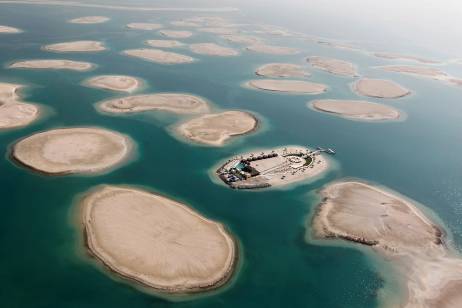
This is an interesting question.  For those of you who don’t know, The World project is a man-made archipelago consisting of about 250 islands designed to look, from above, like a map of the world.  There seem to be regular reports that the islands are slipping back into (and being re-reclaimed by) the sea.  Nakheel, the developer of these (and the more successful Palm Island projects) of course denies these reports.  So, who’s right?  Well, for now it appears that the islands are sticking around, though due to the financial crisis, until recently only one had been developed – and that one belongs to the ruler of Dubai.  Earlier this month though, I heard that an Indian entrepreneur has developed a beach club (complete with swimming pool, beachside cabanas, bar and restaurant) on the island of Lebanon which is due to open any day.  This means that people will be able to visit the islands for the first time ever (which is quite exciting).  Hopefully this will encourage other developers to invest in similar kinds of ventures.  As for the threat of erosion, from what I can tell, the islands lie on a very solid foundation (similar to that of the Palm Islands and also the reclaimed land on which the Burj Al Arab sits).  The technology is sound.  The 321 million cubic metres of sand and 31 million tons of rock which form the foundation would also suggest that The World is here to stay.  (To put those figures into perspective, 1.8 million tons of debris was recovered from Ground Zero after 9/11.)


Lebanon Island


HAS LEEWIN FOUND A WIFE?

Not yet.  And, in a lucky twist of fate, the search has temporarily been called off after his cousin (a numerologist) did a reading and discovered that Leewin’s profile on a whole bunch of matrimonial sites had been registered on an unlucky date.  How about that!  His brother quickly took down all of Leewin’s information from the internet, and is waiting a couple of months (and for a new numerology reading) before re-registering him.  Marriage: 0, Leewin: 1.


OK, so I hope that your question has been answered.  This is actually part one in a two part special so standby for some more interesting facts about life in Dubai next month.  In the meantime if you have a burning desire to have a myth debunked or just want some information on something you’re unsure about, please just drop me a note and I’ll see if I can add it to the next FAQ ejo.


* (Unfortunately,) I feel obliged to state that the answers to these questions are 100% opinion only.  If I’m wrong about something, I apologise and am very open to being corrected.