painter

Ejo #175 – Hollow (aka Jonny Farris): What Is An Artist?

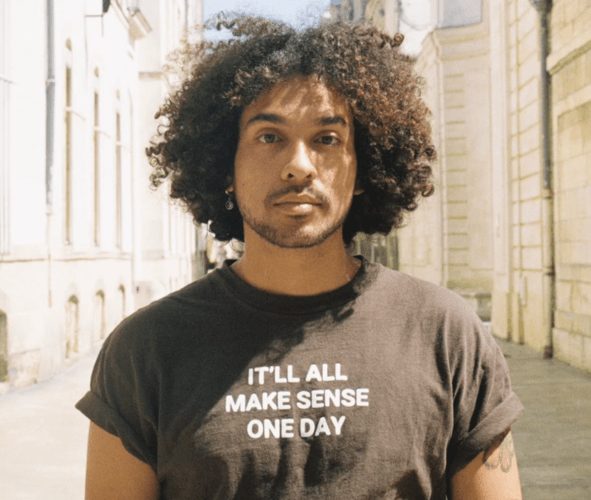
Working as Hollow, Jonny Farris is an artist from the San Fernando Valley who specialises in anything he wants. He is best known for the portraits in which he captures a subject’s energy and essence. He hopes to help people through the arts, and to relate and inspire. Hollow stands for Hovering Over Lament, Later Over Worlds. This saying expresses the message Jonny would like to spread, that in order to be of this world you must be of yourself. Later: world domination.

We sat down to have a chat about Jonny’s career and his grand dreams for the future when we were both artists in residence at Chateau Orquevaux, France.

What is an artist?
An artist is someone who can’t wake up in the morning or go about their day without doing what they love – which for me is either painting, writing, making music, drawing – and not look at it as a job.  And, sure it can be a job, but it’s also what you love.  And I believe you could be an artist and do anything.  Like you could be a doctor and that could be a form of art.  So as long as you wake up in the morning and do what you do best and what you want to do, then that makes you an artist.

So what makes Jonny an artist?
I can’t live without it.  Probably that.  I literally cannot live without doing this thing.

So you suffer when you can’t make art?
A little bit, yeah.  If it’s not suffering, it’s a form of anxiety.

3 Eye Baby Steez – Hollow (Jonny Farris)

So tell me about something that you’re working on, something new or something that you have an idea for.
Well, this right now, right in front of you.  As you know, I’ve primarily just been painting these window paintings, with characters involved in symbolism.  So right now I’m just working on somebody saying hi out the window.  In general they’re usually night-time paintings and a little darker, but recently I decided to paint more bright.

Was that a conscious decision or did it just happen?
It just kind of happened because I painted this one that you see right here, which has the room that has all this light, and it almost looks like it’s daytime while the other half is more sombre.  

Night Morning – Hollow (Jonny Farris)

Yeah, I love it.
Yeah, there’s no malice about it.  There no morbid feeling about it, you know?  It’s nice.

It’s hopeful.  Like a new start.
Yeah, very.  And you can see a direct comparison between them.

What do windows represent for you?
Well, first I got the idea from a painting called Femme Écrivant, which means woman writing, and it’s by Picasso, and it’s a woman in a window, but it’s so abstract and so good that I started just painting one window.  And then after that, it was just a lot more.
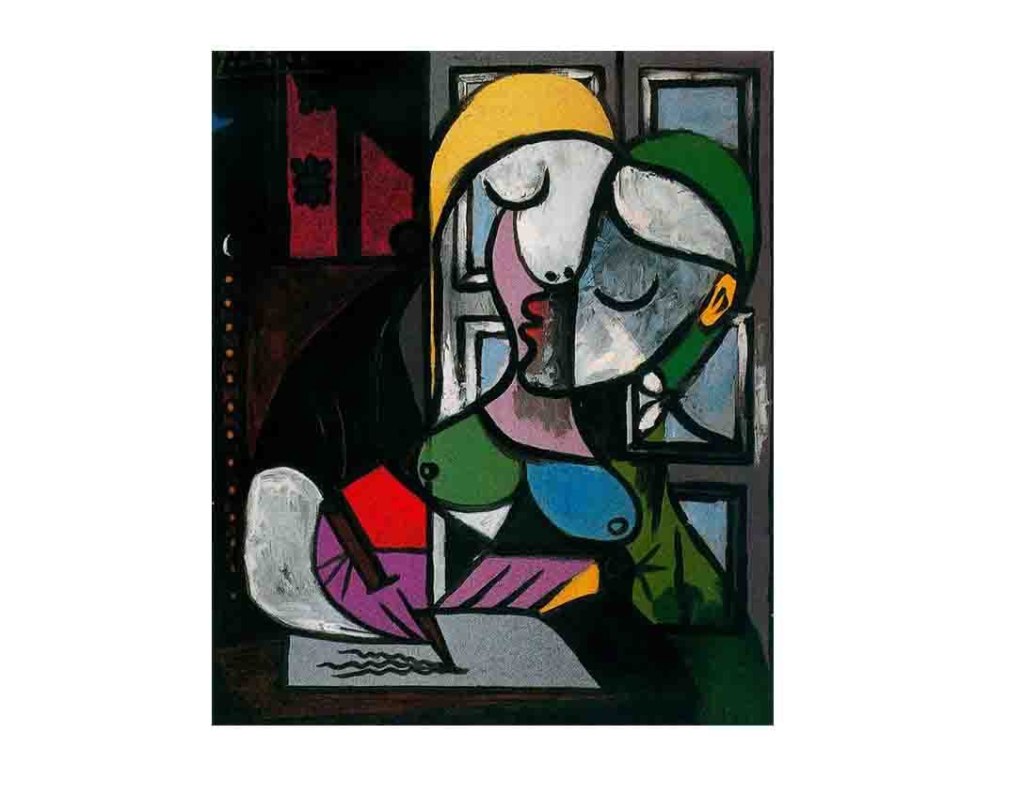
Femme Écrivant – Picasso

So Picasso is an influence?
Yeah. Picasso, Basquiat and Pollock.  So if you can notice in the smaller sketches, I dripped stars the way Pollock would drip his paint.  He’s more complex with it.  I just literally flick my fingers.  And then I like Basquiat’s stamina a lot.  He was just able to create and create and create.  And I feel like that’s something I can do.  Just keep creating.

Just a Trumpet – Hollow (Jonny Farris)

And what’s the inspiration for this new one?
It’s just a person saying hi at my window.  It’s going to be a girl saying hi, outside the window. And it’s going to be a very basic face.  It’s just going to be round, and the distinguishing feature is going to be face piercings.  So in a way it’s probably based on my [former] girlfriend, and her saying hi to me outside of the window.  Or maybe goodbye.
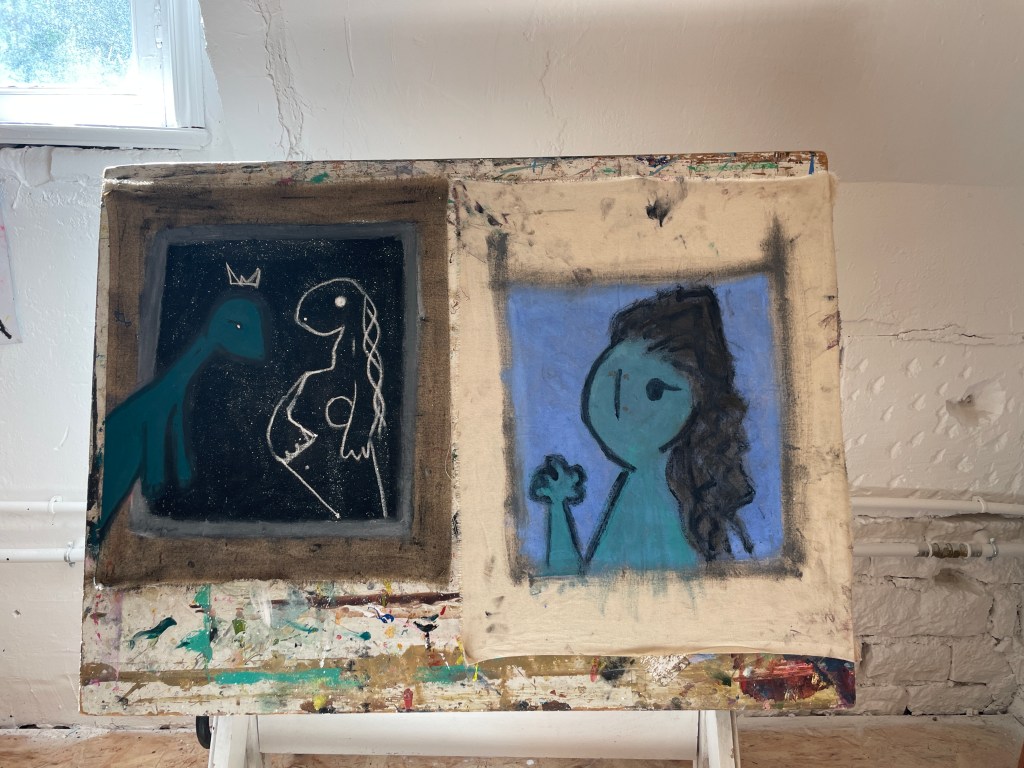
Distraction and Mia – Hollow (Jonny Farris)

Do you always have an idea before you start?  Or do you start painting and let an idea come to you?
It works in many ways.  So some of these ones were planned, but it’s really fun to do pieces like this where you don’t know what comes out of it.  Which is what I’m doing right now.  

What goals do you have for the future artistically and professionally?
I don’t want to sound cocky when I say this, but I want to be one of the greats. Yeah, I want to be one of the greats.  Coz man, I look at these fools before me and they were so good.  And I’m pretty good I think, but not only that, there are certain things that I really want to do.  Like I want to get my grandma’s name out there into museums.

Your grandma’s name?
Yeah, Hernandez, my dad’s name.  There’s a museum in Guadalajara, next to their hometown, and I want to put a portrait of them in there.  I want to paint the people that I love very much.  I want them to live forever and I want them to have their own spot in a museum.  So, that portrait I showed you of my girlfriend?  That one’s going to go into a museum for sure.  And I tell them, I’m gonna make you guys live forever.

Portrait of Mia – Hollow (Jonny Farris)

Do you have a step-by-step plan for how you’re going to achieve that goal?  
Nope.  Well, being here, I’ve come to realise that this was very good for me.  I was able to hone in on my style and perfect some sort of craft, but not only that, talking to Beulah I learned there are ways to go about this.  So I have a handful of paintings at home that are big and I just want to start calling galleries and I want to get a grant.  I still don’t fully know what that is, but I want to get a couple of those possibly. And I dunno, I just got to keep moving and doing stuff and putting stuff everywhere, you know.
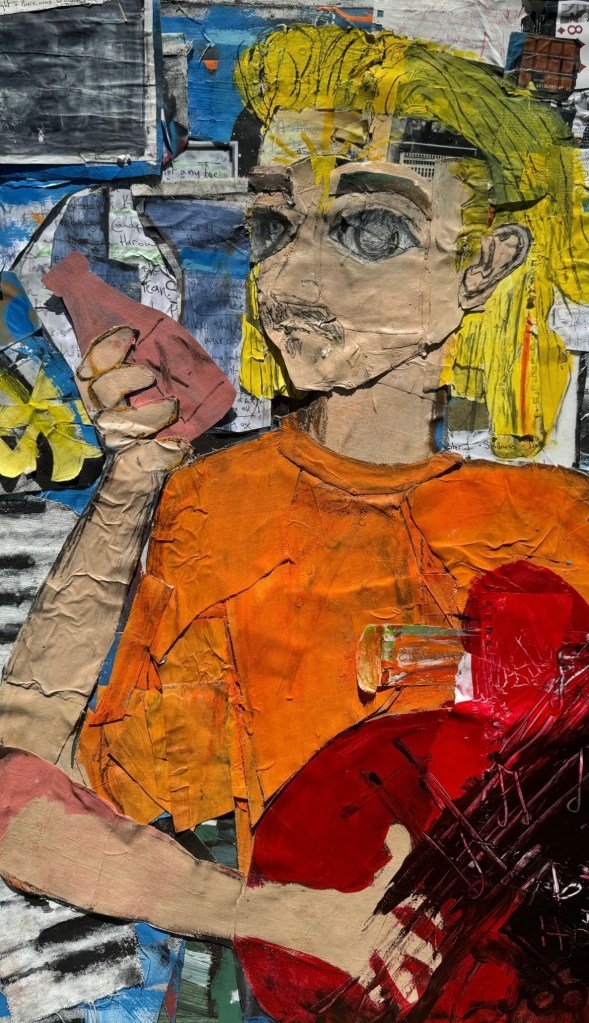
A Man In Nimbus – Hollow (Jonny Farris)

So tell me about someone who inspired you artistically.  Picasso, Pollock and Basquiat as painters, but has anyone else personally inspired or motivated you?
Yeah.  My friend Bijan.  He’s like my brother, he is pretty much my brother.  We’re not related, but that fool’s got my back and I’ve got his, no matter what.  And he’s been a really good friend and we helped each other out through tough times, and we keep telling each other there’s good things coming for us and we’ve got to keep doing what we’re doing.

Is he an artist as well?
He is, he’s a filmmaker.  And he was so stressed out for the past couple of weeks, making a film for a film festival.  And he won, he won first place.  He won best short film and he won the best overall film.  And this fool was stressing out so much.  And for good reason, he was doing a lot of fricking work.  You know, he was putting his work over himself, which is… in a way I think it’s noble.

That’s what artists do.
Exactly.  And it paid off, it really paid off.  But there’s so many moments of doubt that I remember coming from him about what he was doing, and it literally all worked out.  And also my dad too.  He never liked my rap music, but he always told me to keep painting. 

Why didn’t he like your rap music?
He was like a boomer.  He liked Frank Sinatra and stuff.  Yeah, he was a good guy. 

But he did love your paintings?
He always told me to keep painting.  He bought me my first easel in 2020, when I was 22 years old.  That’s when I really started painting.

So what triggered that?  Was it a specific event in your life or something else?
In a way it was a bunch of things, but I just started studying more art, and I really liked the painters and I was like… well, there’s two things.  One was Jim Morrison.  I really liked Jim Morrison and his poetry.  I would sketch in the poetry books, just sketch weird things.  And then one day I had cardboard and papers and I papier-mâchéd a painting.  And I only had a small tube of blue paint, so I broke a pen to use the ink.  And I think the painting turned out pretty good.  And I have it hung up still.  That was back in 2019.

Do you have a picture of it that you could share with me?
Sure.  It’s called “Making Music”.
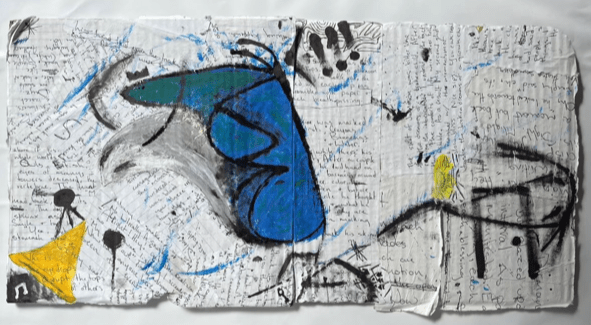
Making Music – Hollow (Jonny Farris)

And before that you were rapping?
Yes, I was rapping and I was writing novels.  I used to do a lot of slam poetry, so that was a good transition into rapping.

You do slam poetry?  You write your own stuff?
For sure.  Yeah, definitely.  Always reading my own stuff.

What defines slam poetry, how is it different to poetry?
Poetry is just the words.  Slam poetry is when you get the words and you slam them on the ground until… well, it’s more of an expression of the poetry written.

It has to be performed, right?
Slam poetry is definitely performance.  Otherwise you just have words.  

What kind of training have you had as an artist?  Have you had any formal training or mentorship, or are you self-taught?
You know, I wish I had training, that sounds sick.  To have like a sensei, you know what I mean?  So fire. 

I love that.  An art sensei.
But nah, I haven’t had much training.  I guess I teach myself.

Just by doing?
Yeah.  And you see, like we discussed about the people that inspire me, you just see them do it and you just kinda do it.  And here’s the thing, we’re not all the same, so if you try to do something it’ll come out totally different.  And honestly, coz I would always say so-and-so is my teacher, and I was talking about Picasso or Basquiat, and in a way they were because I read their quotes, I read their stories, I read what they had to say about painting.  For example Picasso says good artists copy, great artists steal.  I’ve stolen a lot from that fool, you know what I mean?  But in a way, I made it my own.  Just like he used to.  So I just read about painting and tried to figure it out on my own, and that’s how I got to what I have now, I suppose. 

Ode to Fay – Hollow (Jonny Farris)

How did you hear about this residency?
One of my favourite artists went to this residency.  Her name is Elinor Shapiro, and she’s really, really good.  She does really good faces.  And she actually worked here for a little bit which is dope, and I just heard about it through her, and I applied a while ago.  Probably before the pandemic.  How about you?

Some friends of mine live near here, about a 20 minute drive away.  I was visiting them a couple of years ago and they told me about it.  And I just kind of kept it in the back of my mind.  And then I applied in early 2021.
That’s what’s up.  I’m glad you applied, you’re pretty cool. 
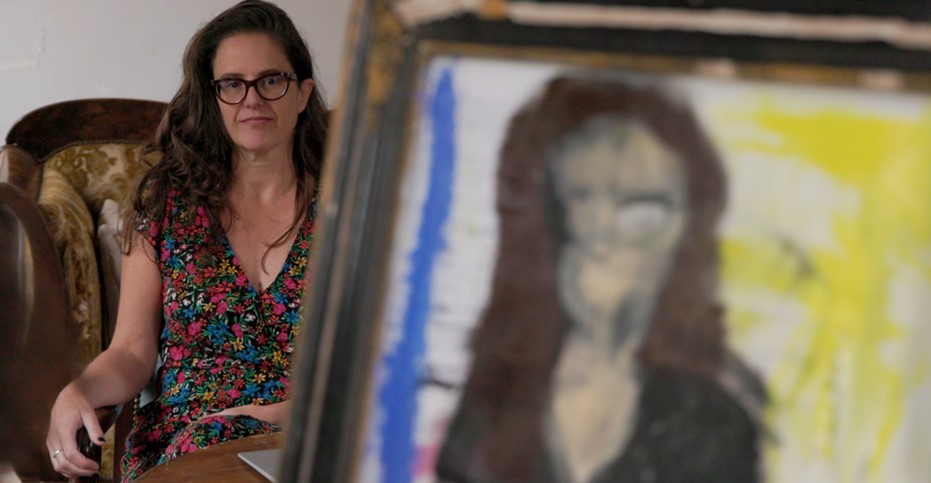
Work in progress – © Andrew Putschoegl

Me too, I’m really glad that I applied because it’s so out of my comfort zone.
Really?

It is, it is.  But at the same time, it’s also really inside my comfort zone, to be surrounded by such talented, creative people.  It’s a delight.  Because I don’t have that in my day to day life.  I don’t have artistic people, so it’s wonderful to be around you guys. 
Yeah, it really is wonderful to be here, because like you said, I’m not around artistic people either.  It’s kind of a bummer, but yeah. 

Yeah, and you just kind of feed off each other.  There’s this huge support and encouragement and acceptance that everyone has.  It’s beautiful.  It’s fucking beautiful. 
Thank you. 

So finally, what advice would you have for someone who was just starting to explore their artistic side? What would you tell them?  What would you tell yourself when you were first starting out?
Don’t stop.  Do not stop.  If you get criticised, or feel hurt from someone else’s opinion, keep moving.  Do not stop, because what you do right now will build up into your future.  So do not stop.  

Portrait of the writer, Chryss – Hollow (Jonny Farris)

Ejo #173 – Catherine Meeks: What Is An Artist?

It was just over two years ago that I completed a two week artist residency at Chateau Orquevaux in the French countryside.  One of my favourite people that I met there was a lovely painter called Catherine Meeks who I was instantly drawn to for her optimistic and sunny disposition.  Her joie de vivre made her an absolute joy to be around, and our interview for my What Is An Artist series was one of my favourites because she’s so interesting and fun, and so easy to talk to.  So much so that after we were done, I stuck around and we gossiped for a bit, and were totally busted by Beulah, the residency’s Art Director, who was in her office and could apparently hear every single word that we were saying!!!  Oops! 

What is an artist?
I think independence and creativity.  Independence from opinions.  Other people’s opinions. And I’m not independent, but I try to be.  And I’m more independent than I was ten years ago. I care less than I used to.  And with the creativity, it’s the confidence to do whatever you feel like doing, regardless.

And what makes Catherine an artist?
I know that I see things differently from people who are not artists.  And I know artists who see the same thing I do; but not the general population.  It’s people with a selective eye, who just see things differently. I mean, we can see the green out this window, the top of that hill. But what I see are the shapes of the branches of the trees and my brain is going, “Oh, that’s a… what do you call that tree?  Oh, and that’s a pine tree over there.  And that’s a this, and that’s a that.”  And I point that out to other people and they say, “Are you crazy?”  Also clouds.  When I had a corporate job, we would get out at five o’clock and the engineers would stand out on the front steps, smoking cigarettes before they went home.  And I would come out and I’d see these clouds, and they were all purple and yellow and pink and orange.  And I’d say to these guys, “Look at those clouds!”, and they would just go, “Uh-huh, that’s the artist”.  I was the only designer in the company and they just thought I was whacked.  Because I came out and looked at the clouds.  They came out and smoked, but I was the one who was whacked.

Some time ago, years ago, somebody said, if you’re wondering if you’re an artist or not, the thing to do is start saying “I’m an artist”.  When people ask, what do you do, just say “I’m an artist”.  Or you can say, “I have a full time job but I am an artist”.  And you know, that kind of did it for me because I got accustomed to saying that and nobody reacted in any kind of negative way.  They said, “Oh, okay”.

It feels kind of bold to say it though, doesn’t it?
The first few times it was very bold.  I pretend I’m an artist.  I just go with it.  I’m an artist, I’m a skater, I’m a dancer.  Other people aren’t scared to say things like that.  Right?

Yeah, absolutely. And now you own it.
Yeah.

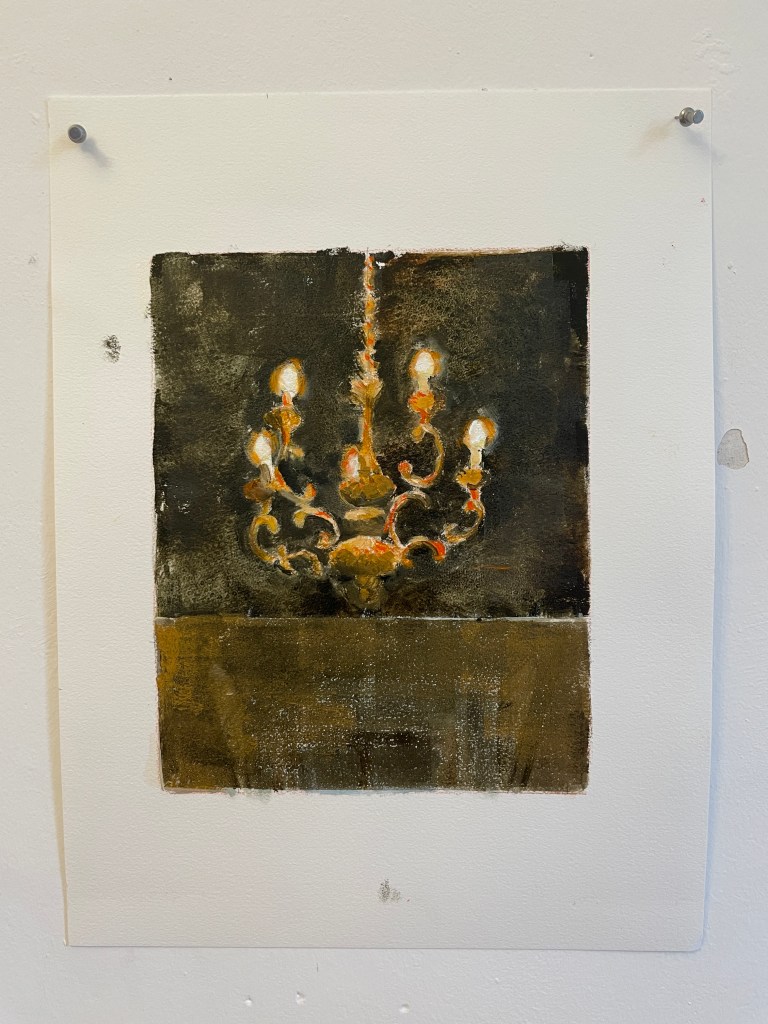
By the way, I love this middle piece, the chandelier.  I can’t stop looking at it. 
I’m going to do another one in that series, the chandeliers, because I liked doing it so much.  I work on more than one piece at a time, partly because I need to wait for paint to dry, sometimes for a day or two, and sometimes I need to go over it in my head.  I take a picture with my phone and then I have a little tiny image of it and I can look at it anytime and figure out what I’m going to do next.

The chandelier in Catherine’s studio

You mentioned the other day that you can see things in that tiny little picture that you don’t see on the canvas?
Absolutely.  Oh yeah.  You know, I had this one hanging before I added the pink and I was thinking, “I’ve got to toss that, that’s so awful”.  And I didn’t know why, just looking at the paper. But when I looked at it on my phone, I knew why it was dead.  And I knew what I had to change to fix it. 

Resuscitated still life

So tell me about the chandelier series.  What inspired you to start, and what makes you think that you have more to say about chandeliers?
There’s a Belgian painter that I follow who does a lot of chandeliers and glasses, and he’s currently doing lakes and ponds.  So his current work looks just like what we have out there, out the window.  So I feel connected to him, but the first time I saw his work, I was fascinated by these light fixtures in a dark room. And so, coming here, I feel free to try out what he’s doing.  Nobody here is going to say, oh you’re copying Jan De Vliegher.  Because it’s just a thing in my head.  And he doesn’t do the separation of the two colours, like I do.  He doesn’t do that.  So mine is more abstract in that regard.

Let there be light

Are you painting from the chandeliers in the house?
Yeah.

That’s nice.  So you have the subject matter in front of you.  I really like the dark one. 
I like the dark one too.

Do you normally work with dark colours?  Because all the other ones are a little bit lighter.
You know, I used to work with dark colours.  I do a calendar every year, of twelve paintings and I sell them in retail stores.  And the owner of one of the stores looked through them and said, these are way too depressing, I’m not going to carry your calendar.  And I looked through them and she was right, they were depressing.  Later, I was on vacation at the beach in Massachusetts and I invited another painter I knew, a Californian woman, to come with me, and we went out painting together and we would paint the same subject.  And because she was from a sunny place, hers were so happy.  And mine in comparison, were just awful.  Depressing.

Because of the colour?
Because I live in a colder climate, I don’t have sun 360 days a year.  And I think that kind of affects your perspective, and the way you think, and maybe the way you paint.  So I’ve been putting in an effort to go a little lighter and a little brighter.  A little happier. 

Young Tree at Orquevaux, 10 x 10, Oil on panel.

Does that feel natural?
Yeah, it does.

That’s interesting that you made a conscious decision to do that.
I had to.  I felt like I had to, or I could go down this dark rabbit hole forever.  I could do that. You know, I’m fascinated by the basement here, in the chateau.  And I would paint that in a minute, ten years ago.  But I’m not going to paint that now.

I’m so curious to see more of your dark, depressing work.
I love dark old places.  I even love, it’s awful to say, bombed out buildings.

I do too. There is a beauty to them, I think.
Did you go into any of those old houses here?  Avital and I went into one of the old houses, and it’s all rubble and old lumber and just crap.  I love that stuff.  I love the old windows and things that are falling apart.

I actually think there is a market for art like that.
You think?  Look at that, I love this ceiling.  It leaks but I love it.

Listen, I don’t want to give you advice or anything, but please don’t stray too far from what you love to paint.
I did a painting of some friends renovating an old building.  They were in the basement and they had all this lumber lying around and it was new lumber, but the place was a mess and I did a painting of it and I sold it, almost immediately. I don’t know what it is.  I’ve taken pictures in the Chateau basement, so it’s possible.  I just have, you know, little pictures, but we’ll see.  As long as there are other people around and a rat isn’t going to come out and bite me.  

I actually like going down there by myself.  I like to scare myself a little bit.  Just a little frisson to start the day, haha.  Okay, so have you had any classical training or are you self-taught?  How did you acquire your skillset?
Mostly self-taught.  When I was in art school everybody was doing conceptual art.

What is conceptual art?
Art that’s not really… it’s not a painting.  It’s an idea.

Can you give me an example of conceptual art?
Christo’s art is conceptual, the wrapping of the structures and buildings.  It’s an idea, a concept.  For my project in conceptual art, I constructed a cardboard birthday cake and I frosted it, and for candles I put in these thin electrical light fibres.  So it wasn’t totally conceptual, but that’s what my project was.  So that’s what was going on when I was in school. Also the Vietnam war was going on and we were fighting for the end of that.  And my art school was very, very involved in trying to stop the war.  

Where did you go?
Massachusetts College of Art.  Everybody was making t-shirts.  Everybody was demonstrating. They changed the grading system to pass/fail.  So you either showed up, or you failed.  A lot of schools were doing that then.  And a lot of schools were doing violent protests, but we were not.  We were making things for marches, that kind of stuff.  So I hate to say it, but school work was probably only half of what we were doing, because we were all very anti-war and it was huge, and the war ended not too long after I got out of school. 

So the training, whatever you want to call it, I really got from looking at other people’s work.  So I take their colour palette or their style of drawing or, you know, I just take something from it.  Mainly illustrators because I majored in illustration.  I loved illustration.  I learned to read with a book that my parents had called “The Story Of Mankind” and the illustrations were done by Rockwell Kent.  He did a lot of work in Maine, so there are a lot of small mountains and hilly areas and ocean.  He made woodcuts.  I was fascinated with the black and white thing.  Fascinated.  So from a really early age, it was illustration that attracted me.  But now I have to work to avoid having a narrative in my paintings.  Because that’s what an illustration is, it’s telling a story or it’s helping to tell a story, and I have to work hard to not do that.  You know, if you asked me, what are you saying here with this painting?  I’m not going there, because it’s a visual thing.  So that’s been part of my self-training.  Looking at a thing, and asking why do I love this?  I love the illustration style, but I’m not going there.  

Do you still illustrate?
Occasionally I do.  I helped do a book last summer.  A woman I went to college with had me do illustrations with a pepper in them, a green or a red pepper.  That was the only information she gave me. She never told me what the book was going to be.  So I did three different ones.  I sent her the photographs last summer and she’s just now starting to work on the book and I still don’t know what it’s going to be.  It was kind of fun.  And the summer before I did a whole bunch of illustrations for a man who was doing a memoir, a pianist in New York City.  And he was very cranky and fussy, but I got through the book and the work, and it was fun.  It was fun when he wasn’t cranky.

How did you get that job?
Crazy, on Facebook!  I got a message that said, Catherine, do you do black and white illustrations?  If you’re an illustrator and you want to work, you say yes, no matter what the question is, right?  So I said, yes I do.  And it turns out she was working with this guy in New York and we connected, and I sent them some samples and they agreed to hire me for the project.  I did it all in pen and ink.  I drew them by hand because I can’t draw on a computer as well, and it was fun.  And if there was a mistake, which there were, I could do a patch on another piece of paper and just glue it on.

Because you weren’t sending the actual piece, right?  You were sending an image of it?
Right.  So I had to do that several times.  I had to do one drawing of a party, a social get-together with wealthy donors.  So I did that and I had a little space on the page, so I put in a table with a vase of flowers and this guy said, “No cut flowers!!  We don’t believe in cut flowers!!”  Okay!  I didn’t want to know why, but isn’t that funny?  So I had to make a patch and I put something else there.  It was the last thing I expected anybody to ever say, no cut flowers. 

So tell me about a new project that you’d like to work on, something that you haven’t started yet.  Do you have anything in mind, something brewing away or the seed of something planted?
You know, this trip is what’s been brewing away for quite a long time.  I am having a show next winter so I have to think about that, but I haven’t thought about it yet.  And it might be derived from these chandeliers.  You know, most of my stuff derives from something else, and sometimes it’s just something I saw on Instagram or Pinterest.

Sunset, 8 x 10, Oil on panel

So after you finish the painting you’re working on now, you don’t have any other plans?
I don’t.  In preparation for this trip, I completely opened my mind.  Made no decisions.  Flying over here I had no idea what I would do.  Because as you know, you have to be here, to experience this place.  The photos are great, but until you’re here, it’s just photos.  So no, I don’t have any plans.  No plans.  Am I the first person who’s said that to you?

Yeah, but you’re only the third person I’ve interviewed, so we’ll see what everyone else says.  So what goals do you have for the future, then?  You mentioned the upcoming show.  What goals do you have for your career and for your art?
Well, now that you’re going to be my agent I want to possibly get into NFTs.  You know, after we talked about that I started looking through my Pinterest board.  And I changed one of the boards to digital drawings, because I have a lot of them.  It’s very interesting to me, because some of the digital work that I’ve done, I actually like more than my paintings.  So that is definitely something I want to look into.  And I’m never going do an art fair again.  Beulah was saying go to openings, but there are no openings.  My local gallery doesn’t have openings. 

Yeah, I think a lot has changed since the pandemic.  And in the meantime this huge digital revolution in art has taken place.
Exactly.

Tell me about someone who inspires you artistically. 
Well, I was just looking at Bonnard and Vuillard.  Are you familiar with them?  I think they lived at the same time.  I love their work.  I love John Singer Sargent, you’re familiar with him?  I just love his work, his buildings.  He did a lot of work in quarries.  He painted the workers working in these quarries, and they’re full of light because the stones are limestone, light coloured and they reflect the sun.  I love his work, love his work.  And of course, you know, Monet and the usual suspects.  But I do have my favourites.  Vuillard and Bonnard painted home scenes; a woman making bread.  And their work has a lot of pattern, like wallpaper pattern or tablecloth pattern.  And sometimes they use many different patterns, and I love that. It’s not the way I paint right now, but I love it.  The colours all work together and it’s dreamy for me.

Interior, 1902 – Edouard Vuillard

What advice would you give to yourself when you were first starting out, with all the knowledge that you have now and also what advice would you give to another new artist?  And would the advice be different?
No, I think the advice is the same, and it’s the advice I tried to give my students when I taught.  Push any button.  Try even the stupidest thing.  Try anything.  Go all over the place.  It doesn’t matter.  If you hate it, tear it up.  That’s the advice I give.  And my students refused.  We were working on a computer with Adobe Illustrator.  They were like, how do I…?  And I would say, try pushing a button.  And they wouldn’t do it.  They wouldn’t try anything.  

Out of fear?
I think so.  And they wanted me to tell them every single step.  You know how I learned?  I taught myself everything.  I never went to school to learn Illustrator.  I tried things out, and sometimes it crashed the computer, but so what.  That is my advice to any artist.  Try stuff out.  Right?  Close your eyes and paint.  Paint with your other hand.  All those things.  Challenge yourself.  Even if you have no idea where it’s going.  Especially if you have no idea where it’s going.

That’s great advice. I love that.
Do you do that?

Do I push myself?  
Yeah.

I’m here.
Push the button

Yeah.
This was kind of a push.

Yeah.  Me too.  Big time. I’m not great at meeting new people.
Neither am I.

You seem so at ease.
Well, I’m working at it.

Yeah, me too.  And I’m feeling more and more at ease as time goes past.
It is hard.  I envisioned myself, and I think my husband envisioned me, staying in my room the whole time.

Oh really?
If I lived where Christine lives, in the gatehouse, I would never leave.  So it’s good that I’m here, in the chateau, because you kind of have to do the work.

I actually applied for the gatehouse and they told me I could have it.  And then I turned up and I didn’t have it.  And I was a little upset about it.  But now I’m really glad that I didn’t get it.  I’m glad to be in here, in the Chateau.
I know.  Marcie and I were going to have the house where Charles and Jonny are living.  And we looked at it yesterday, and it is beautiful, and they have a kitchen, they have a microwave and a coffee maker.  We were going to have it until a week before we got here.  And I’m glad that I’m here in the Chateau too, because it’s so charming.  The boys’ house is fabulous, but this is charming.

A Door in Siena, 10” x 10”, Oil on panel

Oh yeah, I’d never leave.  I’d write all day, and come here, to the Chateau, for dinner and then I’d leave and go back to my cosy little house.
I would probably do little drawings in my little watercolour book.

And we’re more involved living here.  You feel more involved.
Whether you want to be or not. 

Beulah shouts out, laughing, “You two are hilarious!” 

Oh shit!!
Oh whaaaat??!

The interview is brought to an abrupt end with awkward peals of laughter.   

Ejo #166 – Christine Olmstead: What Is An Artist?

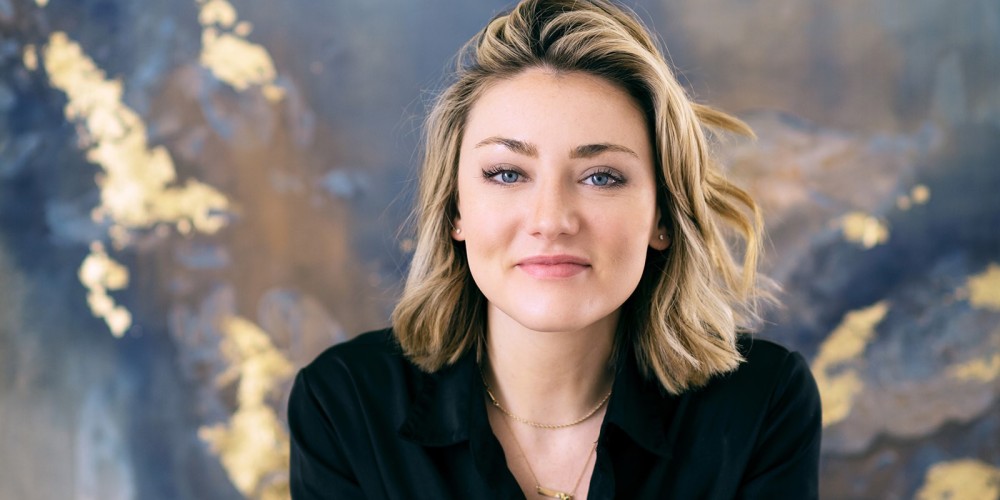
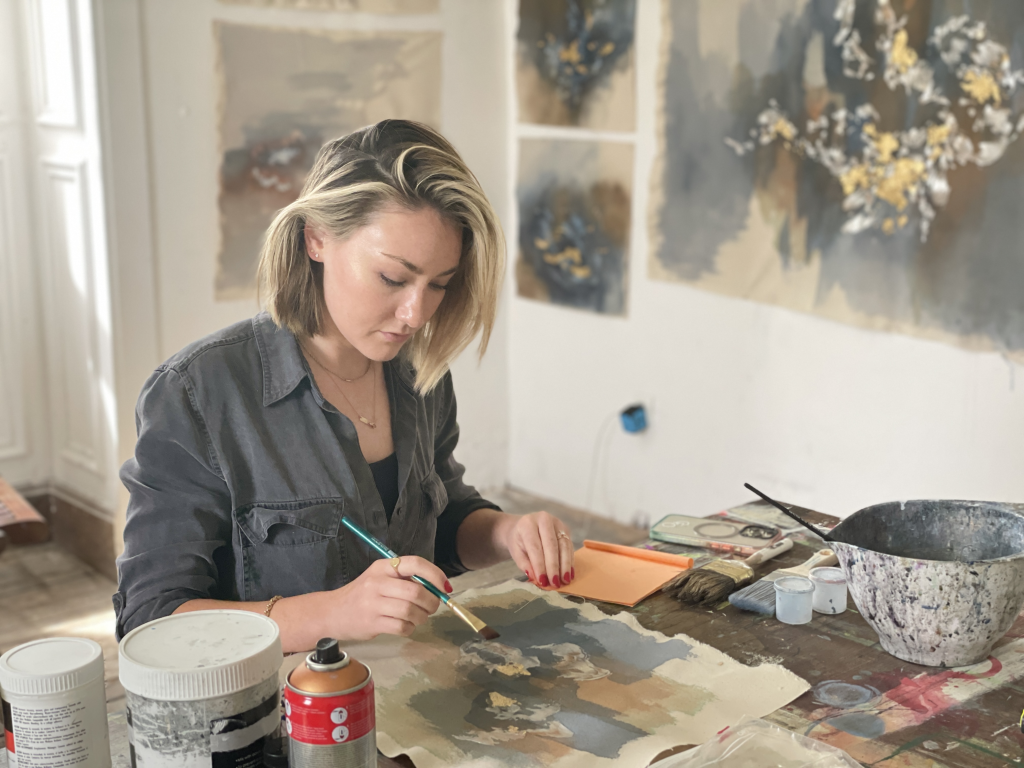
While we were both in residence at Chateau Orquevaux in May 2022, I had the opportunity to sit down with award-winning conceptual and abstract mixed-media artist Christine Olmstead while she was working on her collection A Little More. We chatted about her history, her art and her creative process. And she was kind enough to allow me to delve a little deeper into what she’s looking for in her life and in her career, and how she plans to get there.

I caught up with Christine while she was working in her Chateau studio.

Okay, so let’s dive in. What is an artist? 
I think an artist is someone who has the ability to make connections and create something new from many sources.  And I think that you can be an artist in every area.  You could be a math artist, you could be a financial artist, you could be a writer, a word artist.  I think that the term artist connotes creativity and the ability to see things and make connections and create something new in whatever your craft is.  

And what makes Christine Olmstead an artist?
What makes me an artist?  The complete desperation and lack of ability to do anything else.  It felt like the only thing that I could do, the only option.

Talk us through the formal training you’ve had, and also any self-taught training.
My mum taught us traditional art history growing up.  She wanted my brother and me to be able to understand and recognise art movements as well as try to recognise an artist based on their stroke palette or subject matter.  So growing up, she taught us a lot.  And then, we both did art lessons, learning charcoal and pencil portraiture, in elementary and middle school.  And then, in high school I was doing still life in oil with a teacher.  So that’s most of the training that I’ve had.  In college I did some graphic design and illustration as well. And then I did go to grad school for an MFA in the studio and painting, but I dropped out of that.

Why?
Um, a few reasons.  I was in the middle of it when covid hit, and my husband was laid off, so I was the only one earning for a period of time.  And it didn’t seem financially wise to keep going, especially not knowing what the future with covid was going to hold.  So I dropped out of the program for financial reasons, but also I wasn’t really getting what I wanted out of grad school.

How long did you do it for?
About a year.  Yeah, it wasn’t the experience that I wanted.  And I’m usually a finisher, and I have a really hard time walking away from things and not finishing the things that I start.  So it was a big deal for me to drop out of grad school.

Did it feel like the right decision?
Yeah, it felt like the right decision.  And I might go back.  I think I would transfer maybe, and try to seek the experience that I was hoping for. 

What kind of experience were you looking for? 
I think what I was looking for in grad school was connections, and camaraderie, as well as being able to study under people that I’ve really respected.  And it wasn’t that I didn’t respect my teachers. I did.  It was just that it was also a hybrid program, so I wasn’t in studio on campus, and I think that was also part of the reason why it just wasn’t right.  Because I think so much of learning is best in person.  Because it’s the little conversations, it’s the small comments, it’s the passing remark from a professor, it’s the stopping by their office or their studio. To me that’s the richness and that’s where deep learning happens, and it just wasn’t happening. So I think that’s what I was looking for.

Tell me about something new that you are working on, or planning to work on, when this current series is done. 
I always have like 10,000 series ideas, and there are so many things that I’m always experimenting with in my mind, and then also in my home studio.  This current one is definitely more commercially focussed because I tried to mix it up and make sure that there’s something that’s easily consumable.  And then, maybe later in the year I’ll do a series that’s just for me.  But this one is in conversation with the previous series that I did in 2020, at the beginning of covid when there was a lot of hopelessness and fear.  Obviously we were all going through it, and so I created a series, There’ll Be More as the only response that I knew how to have.  Which was to try to take hope and tell people there will be more goodness again, there will be more hope again, there will be more play.  There’ll be good things again one day.  And I think that was the only way that I knew how to deal with it, to believe that it would be okay.

So what is this current series about?
So this one is sort of the outworking of that.  Obviously covid isn’t over, but we sure are acting like it is.  And because this residency was postponed, I made that series right after I learned that no-one was going anywhere for a long time.  And now that I’m here at Chateau Orquevaux, it’s sort of like some of those good things that I promised you are coming to fruition.  And so this series is called A Little More, and it’s just some of those good things, some of those hopeful things.  And they’re not perfect and they’re still shrouded in some darkness because we all lost a lot, you know?  But they are meant to be a little bit of, not a mournful celebration, but just a coming out, a little bit.  If that makes sense.  I don’t know if that makes sense.

I was lucky enough to nab A Little More Growth after Christine’s open studio exhibit at the Chateau.

It makes total sense.  So for the next series, do you think you would build on that again or do something completely different?
I have something completely different in mind.  I feel like I need a mental break and reconfiguration.  I think once I come back home from the residency, I need to re-organise my thoughts.  And I’m also in the middle of building my new studio, renovating it and getting it in place.  So I think that when I get home, I need to re-settle, re-digest everything that happened here, while I market these pieces, get my studio set up and re-evaluate what I want the next thing that I’m going to bring into the world to be.  But, we’ll see.

Tell me about your studio. 
So my husband and I bought a house almost a year ago now, and it has what used to be a horse barn on the property.  So we’re renovating it.  There was electricity and central air but we’re adding running water, we’re drywalling.  We’re doing all of that, and transforming it into my studio. The last studio space I had was in my home and it just started getting really claustrophobic.  I work really big so I’m really excited to have a space that’s outside of my home, but just down the road.  Just a little bit of separation.

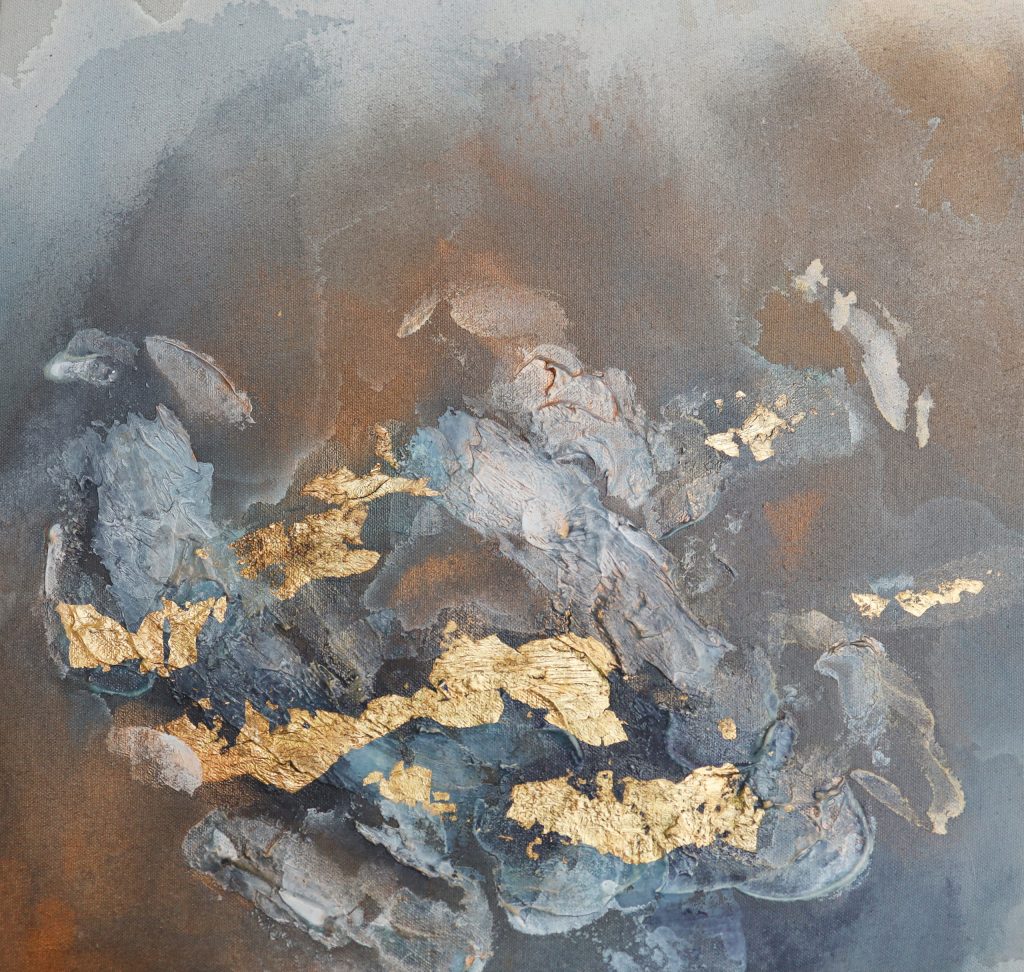
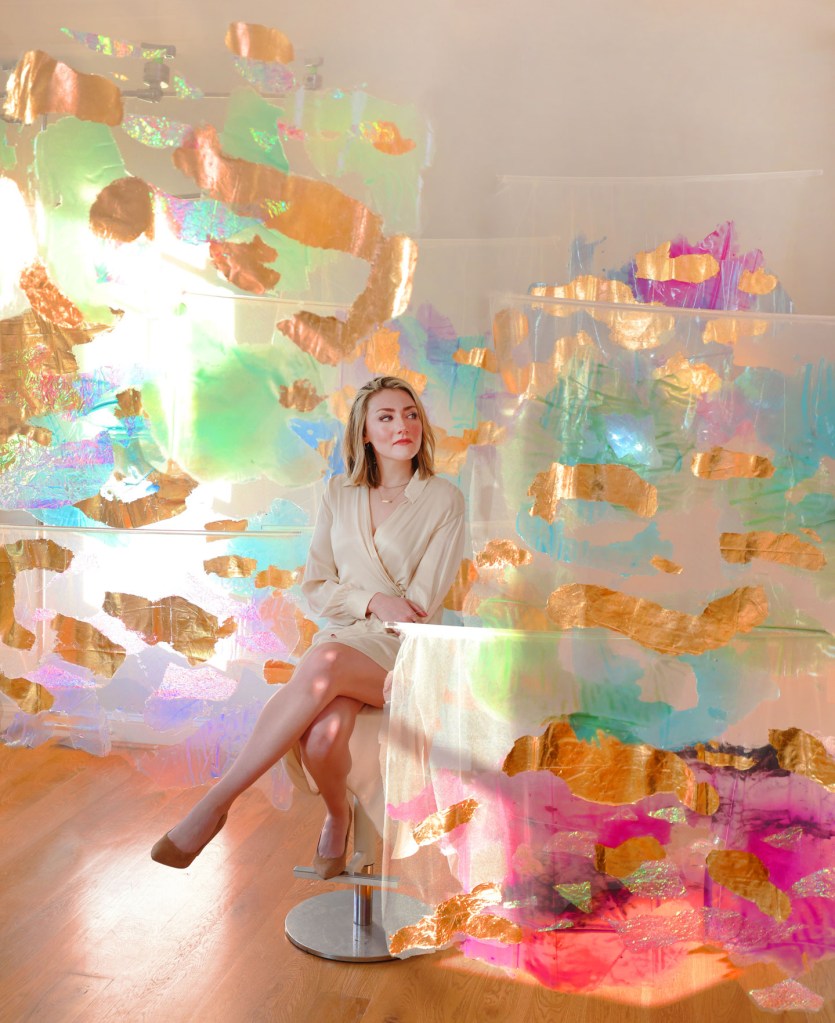
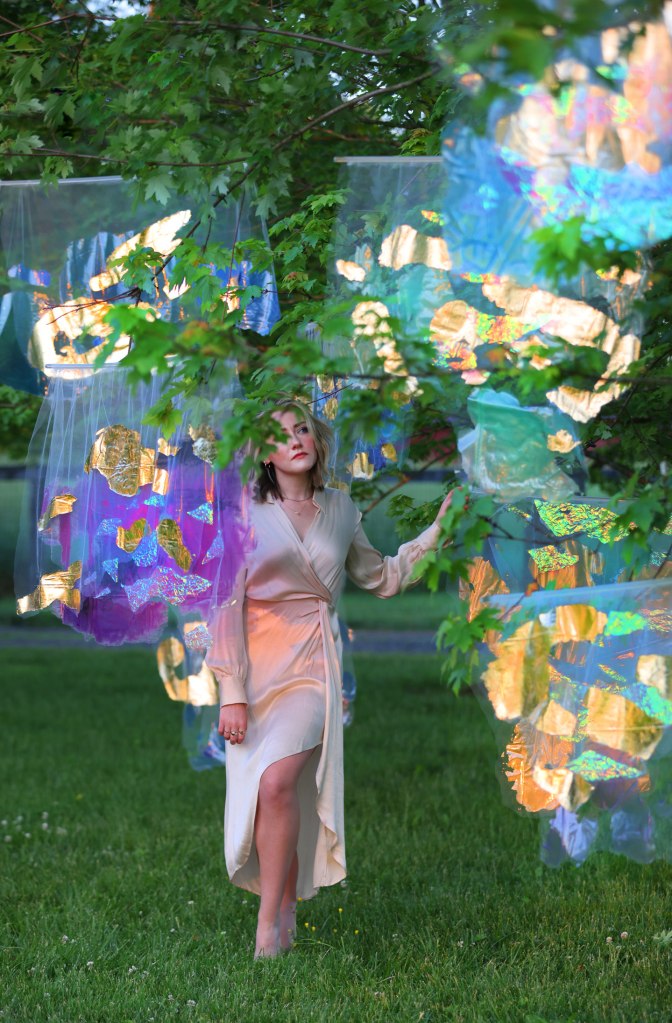
Christine posing with her Synesthetic Bodies collection. The use of 24K gold is a signature technique of hers.

My dream for the studio is that it’s also sort of, not a community space, but a place where I can host events and other artists and where people in my community, other artists or friends can say, “Hey, I’m going to bring over a bottle of wine and let’s talk”, or “I want to show you my work”, or “Hey, can I see what you’re working on?”  And, you know, maybe even do dinners in the studio.  And I would love for it to be a mixed use space where so many things can happen, and there can be deeper connections.  A multi-purpose space, but also my studio. 

That sounds absolutely incredible, and it kind of leads onto my next question.  What goals do you have for the future and what would you like to achieve artistically and professionally?  
Career wise, goals wise, I mean wouldn’t we all love to be in The Met or something.  But you know, to be in a museum, if that sort of thing were to ever happen, you know, it’ll probably be when I’m dead.  I don’t anticipate that necessarily in my lifetime.  I think that’s a very big goal to have.  But I want to continue to be able to be sustained and supported by my work.  That’s a goal.  I want to bring people together and give them a piece of hope, mostly. 

Christine’s latest collection is called Fun, and was inspired by something her marriage counsellor said to her and her husband:
“OH MY GOSH YOU GUYS ARE SO SERIOUS, DO YOU EVER HAVE ANY FUN!?!”

I like that you want to give people hope.  And I think it’s quite noble of you really, because there’s a lot of it lacking, in the world right now.
Yeah.  I would say that I lack it a lot, and that’s probably why I want to try to give it to the people.

Are you giving yourself some hope too?
Yeah, I’m trying to.  I’m trying to.

Tell me about someone who has inspired you artistically, whether it’s someone that you know, or another artist.
First and foremost is my mum, just because she gave us a lot of tools growing up, to understand art. When I was about two and a half years old, I made a whole series of tulips. They were abstract tulips.  And I made hundreds of these things, and it was because she had told me about the impressionists.  My mum loves impressionism. 

You were two and a half? 
Yeah.  And so she was showing me Monet and I thought, oh, I can do that.  At two and a half [laughs]. And so I did one stripe of black paint, and then either green, or green and yellow, over top.  And then the tulip bulb colour was red with a white stripe over, or pink with red over.  And so, I understood the basics of what she was talking about, but I made so many of these, and she framed one of them and she still has it in her bathroom.  And that’s a silly little thing, but because I know how much she values art, it meant so much to me that she thought that one of my tulips was worthy of being framed.  And that inspired me to think that what I make could be valuable.

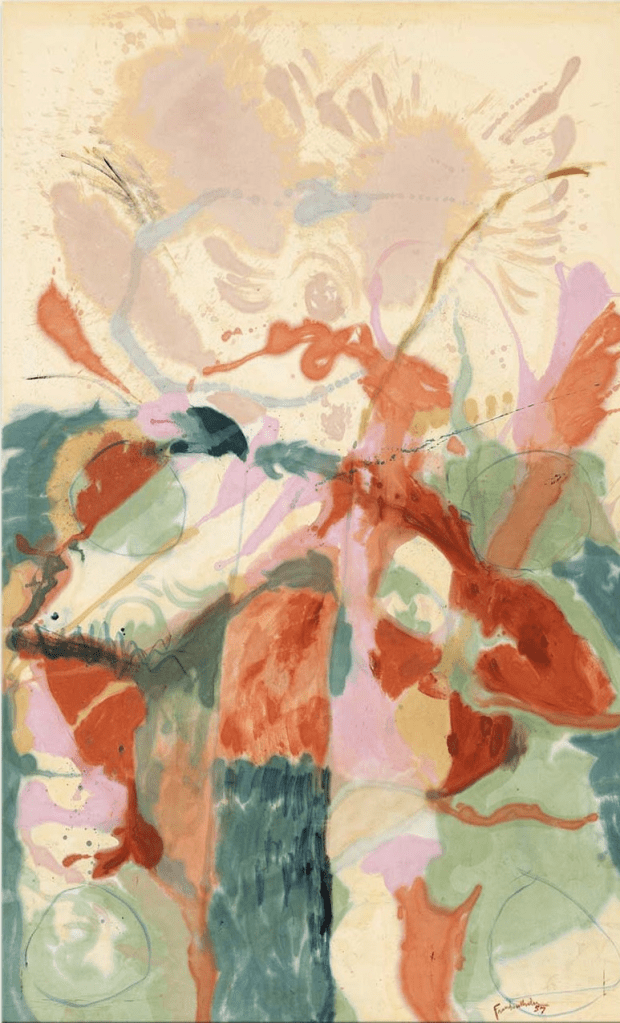
And then the other artists that inspired me, I really love Joan Mitchell and Helen Frankenthaler.  I remember seeing Frankenthaler’s piece Jacob’s Ladder, and it just brought me to tears .  And the way Joan Mitchell uses paint and texture, just beautiful.  She’s one of my favourite artists, if not my favourite.  I think her works are beautiful, and her pieces are the ones that have moved me the most.  I like Mitchell’s painting style more, but I do love Frankenthaler’s creativity.

Helen Frankenthaler’s Jacob’s Ladder.

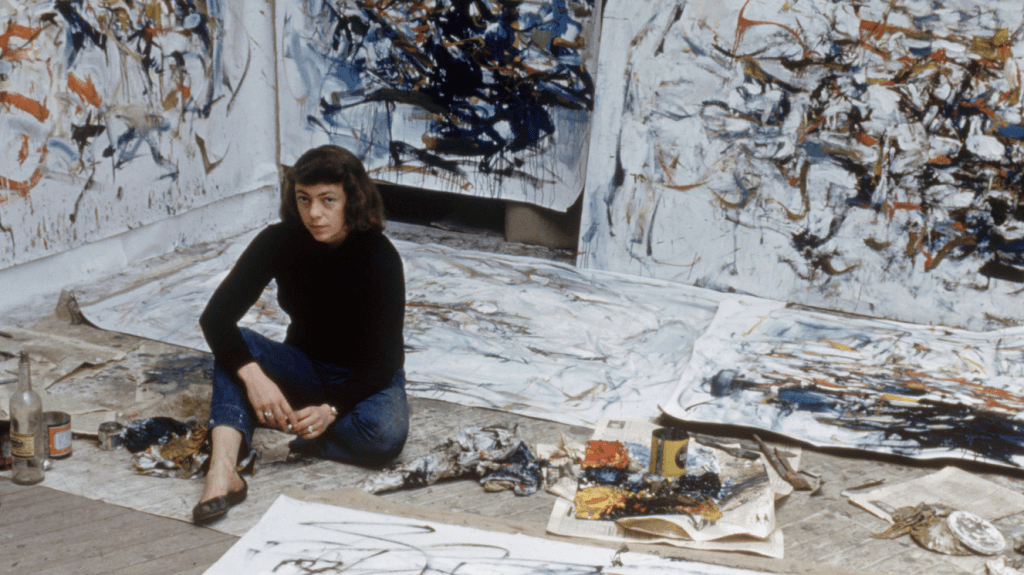
There were some things about Joan Mitchell, like she’s also synaesthetic, and the way she approaches painting is the way that I was approaching painting before I knew about her methods.  In the sense that she would paint music, and she would paint a poem, and she gives bodies to intangible things.  And that’s the way that I was viewing the world and my work, as well.  Can I give a body to a concept or an idea?  Like what would love look like?  Or what would peace look like.  You can see the outworkings of those things in the world, but if it did exist, what would it look like?  So I loved that.  Not that I’m anything like her, because she’s prolific and amazing, but once I learned about her it was like, we thought in the same ways.

Joan Mitchell (1925-1992) in her studio, Paris, France, September ’56. Photo: L. Dean/The LIFE Picture Collection/Shutterstock

You have synaesthesia?
Yeah.

Can you tell me more?  I’m so fascinated by this.
So, I have a couple of different kinds, but the one that is the most fun, and that I enjoy the most and use the most in work, is sound to sight synaesthesia.  So when I hear music, I see it as colour and movement.  And honestly they’re not all really pretty.  Some of them are… well, it depends on the music.  So I don’t paint songs, because a video would be better, animation would be the best medium for that, I think.  But what I do use synaesthesia for in my work is for colour inspiration, because different genres of music or different pieces of music in particular tend to have overarching colours, right?  Like one of my pieces, if you look at this, you’d think mostly blue, but of course there are other colours dancing around in there. So that’s the way a song is.  It’s maybe mostly blue, but it moves with other colours too.  

Synaesthesia is being able to experience more than one sense simultaneously. Christine listens to music, and sees colour and movement.

It’s a dynamic thing?
Right, right.  Exactly.  So when I listen to music while I paint, I usually choose music based on what palette I know it’s in.

And is it the same colour every time you hear a song?
It’s always the same palette, but it might move differently, you know?  And depending on what you’re paying attention to in the song, you can focus in on different colours, or movements. So I mostly use it for colour inspiration, but it’s a fun way of existing.

What advice would you give to yourself when you first started pursuing art, and would that differ to advice that you would give to somebody else that was starting a career in art?
I’m definitely a believer in individual solutions, so I wouldn’t give the same advice to everyone, because I think everybody has different values and everybody wants something different out of life.  So I don’t think that advice is universal.

So what advice would you give to yourself?
To myself, I think I would say slow down.  Yeah, I think I would tell myself to slow down.  It’s hard to tell yourself that when you’re young though, you know, because there’s so much pressure and you feel like you have to be something and do something.  And there’s also pressure to provide for yourself.  So I wish I could have told myself to slow down.  I think that’s the main thing I would say.  Just go slower. 

Do you push yourself?
Yeah.  Yes.  I’m not good at resting, I don’t think.  So yeah, try to slow down.