ramadan

Ejo #20 – A Few Thoughts On Islam (And What It Means To Be Muslim)

“Beware! Whoever is cruel and hard on a non-Muslim, or curtails their rights, or burdens them with more than they can bear, or takes anything from them against their free will; I will complain against that person on the Day of Judgement.”  So said the Prophet Mohammed, preaching tolerance, kindness and understanding towards us heretics.  It isn’t the picture most people have in their minds of the Islamic faith – and that is, perhaps, unfortunate.  The reason could be related to the rising number of acts of aggression against the western world, ostensibly in the name of Islam.  But as many Muslims would be at great pains to point out, these acts of terrorism strike against the very kernel of what it is to be a member of the Islamic faith.


I’m not religious in the least but I have always been curious about the concept. When I moved to Dubai I was able to learn a little bit about Islam.  I could probably write 20 ejos on the subject, but I won’t.  What I’d like to do is shed some light on a belief system and way of life that is sometimes shrouded in mystery, and quite often veiled by misinterpretation.  If I can bust just one myth or clear up one misconception for anyone that’ll make me happy.  I’m hardly an expert though; what follows is just a few personal observations backed up with a bit of research.


Let us begin.  The reason Muslims call their deity Allah is to differentiate him from other gods – it is the personal name of Islam’s one true god.  Whereas the word “god” can be pluralised and genderised, the word Allah cannot.  Allah is merciful and compassionate, and really just a very nice god indeed.  For instance, if you intend to do a bad deed and then don’t actually go through with it, he won’t hold it against you (even though, of course, he is fully aware that you did think about it).  It is only when you act on the intention that it counts against you.  Furthermore, if you truly regret what you did, the slate automatically wipes clean.  The simple act of repentance leads to Allah’s forgiveness.


Some people wonder about the importance of the Prophet Mohammed in the faith.  He was just one of many thousands of prophets, but Mohammed is the greatest of them all because he was the last prophet, the one that completed all of Allah’s revelations and sealed them together to create the teachings of Islam as they have been known, unaltered, for the last 1400 years.  He is second only to Allah in importance.


The word Muslim means “to submit” and Islam is based on its believers living out the will of Allah, as far as humanly possible.  It is founded on five pillars.  They are:

1) testimony of faith, i.e. accepting that there is no god but Allah, and Mohammed is his messenger.

2) praying five times a day;

3) Zakat, which is the giving back to the community of a certain amount of money, usually as a charitable donation;

4) fasting during Ramadan; and

5) pilgrimage to the holy city of Mecca at least once during a Muslim’s lifetime (for those who are physically and financially able).


The second pillar of Islam is prayer.  Muslims are required to pray five times a day– furthermore they must be “clean” when they do so.  A ritual ablution occurs before the prayer and this includes washing the face, arms and feet so as to be pure when presenting themselves to Allah.  To facilitate this in Dubai, every toilet (private and public) has a long hose and nozzle in it so that wherever they may find themselves at prayertime, a Muslim is able to wash in preparation.  It is also why, sometimes, when entering a bathroom after a Muslim you may find it absolutely soaking wet.  I guess in striving to become clean, it is sometimes necessary to create a mess.  You get used to it.


Zakat is the requirement to donate to charity or to give to those less fortunate. Muslims are obligated to give 2.5% of any income they’ve earned for the year which is surplus to their family’s requirements.  This is usually collected and distributed during Ramadan.


Ramadan is the month of the Islamic calendar during which Muslims must fast – refraining from eating, drinking, smoking, having impure thoughts or engaging in sexual activity during daylight hours.  These sacrifices transcend physical discipline and bring the faster closer to Allah.  This year Ramadan has fallen during August, which happens to be the hottest time of year. Fasters have been going without food and water for up to 15 long hours a day, which as you can imagine is super difficult.  Hunger and thirst remind fasters of others who are less fortunate and who go hungry and thirsty everyday.  It also serves as a trigger to commune with Allah, to give thanks, and also to atone for any sins committed during the year.  It is an extremely important time of year for all Muslims.  To read more about Ramadan check out Ejo #9 – Ramadan In Dubai (What It Means And What To Expect).


As with all religions, some things are considered right, and others wrong.  “Halal”encompasses everything which is good (and thus permitted in the eyes of God), whereas “haram” describes the opposite – all which is harmful (and thus forbidden).  The word halal actually refers to a wide spectrum of things, but is most commonly used to describe meat that has been prepared in an approved way. A lot of animals these days are killed by electrocution – but this method is deemed haram by Muslims.  The animal suffers and so it is forbidden to eat its meat.  To be considered humane, the knife that will kill the animal must not be sharpened in front of it.  Animals should be killed quickly, and as comfortably as possible, and one animal must never witness the slaughter of another as this would frighten it, making the meat haram.  The animal should be well fed and watered despite the fact that it shall soon be lunch.


Intoxicants, such as alcohol, are considered haram – the reason being that alcohol decreases your ability to control your own mind and body.  There is an old Islamic fable: “A man was told to either rip up the Holy Quran, or murder a child, or bow in worship to an idol, or drink one cup of alcohol, or sleep with a woman.  He thought the least sinful thing to do was drink the cup, so he drank it.  Then he slept with the woman, killed the child, tore up the Quran and bowed in worship to the idol”.  Being a Muslim is all about controlling your impulses and you attain closeness to God when you restrain yourself from physical and mental urges.  Alcohol takes away all of that restraint, rendering one vulnerable to the temptations of the devil (and anyone who’s ever been drunk can surely attest to that – I know I can!).


The Quran clearly refers to men and women as being equal.  Oppression of women tends to be more culturally and nationalistically based, than theistically.  But often the culture fostering the oppression is so closely entwined in an Islamic identity it is difficult to separate the two.  Although women are thought of as being equal to men, the physical differences between them has been taken into account and because of this women have been granted the right of protection by (and from) men. One of the major components of Islam is modesty (for both sexes, albeit predominantly for women).  As such, men are required to not look upon women sexually and women are required to cover up in public.  Islam sees the covering up of a woman’s body as the opposite of female repression. Because it hides her womanliness they believe that it is really a form of female liberation, allowing her to be appreciated for her character and mind, and not just for her body.  Nowhere in the Quran or in the prophet’s messages does it state that women must cover their faces – to force a woman to do so (as the Taliban do in Afghanistan) goes against the very spirit of Islam.


Even with all this covering up though, occasionally a person might find themselves sexually aroused in a public place by a person who is not their spouse. Hey, it happens!  One of my favourite of prophet Mohammed’s recommendations is that, should this occur to you, you must immediately hurry home to your husband (or wife) and satisfy that sexual urge honourably.  Yipee!


While men and women are created equal, they most definitely have different roles to play in marriage and family life.  The husband is expected to provide for the family and the wife is expected to look after him and the household (including children when/if they have them).  This doesn’t mean a woman can’t go out and work if she wants to.  She can, but she must still fulfil her obligations at home too (what else is new, right?).  The role of housewife and mother is regarded as one of the most honourable occupations in Islam.  Staying home to raise a family garners the greatest respect from the community, because it is arguably one of the most difficult jobs to do.


Polygamy is permitted in Islam but not in the way most people imagine.  Men are allowed to marry up to only four women, and there are many restrictions.  For instance, a man can only marry another woman if he can afford to keep her in the same way he keeps his first wife; giving them the same amount of food, clothing, leisure, living space, time and compassion.  Plus, he actually needs the permission of his first wife in order to take another.  Theoretically, anyway.  Polygamy was sanctioned, initially, with the intention of providing security and a stable family life for the women left behind after the first Islamic war. Rather than leave the many widows and orphans to fend for themselves it was encouraged for families to give them a home – and since a woman and a man who are not married are forbidden from living under the same roof, marriage was the solution.  Today, however, women are able to support themselves.  This negates the requirement for a man to marry multiple women.  Governments look after those in need, providing welfare to ensure financial stability and security.  The burden of this responsibility has been removed from the man, however polygamy (of course) still occurs.


Well, that’s just a drop in the ocean.  If you have any questions about Islam please feel free to ask and I will try and get an informed answer from one of my Muslim colleagues.  Look out next month for another episode from The Misadventures Of Dangerous Doug.

Ejo #10 (Part I) – Our Trip To Jordan (Amman And Petra)

So we went to Jordan. The first day, we arrived at our hotel in Amman and realised that what we would ‘normally’ do is walk around, find a nice cafe and have a drink and a bite to eat. Obviously this was not on the agenda (it’s Ramadan remember?), so what did we do for the next three days? Let’s just say that we sat in our room and ploughed through our 4 litres of duty free alcohol from the airport fairly quickly. In retrospect we should have rationed it out, but oh well, it was nice while it lasted. We didn’t stay in the hotel room the whole time. We did go out for dinner to break our ‘fast’ and had some wonderful meals. We also went out for a few walks, just to feel the vibe of the city but it really was almost shut down during the day, so not much vibing going on. 

During one of these walks we came across a little convenience store where we stopped to get some naughty non-Ramadan sanctioned snacks and drinks and while shopping we noticed some Efes beers in the fridge (for those of you who have read Ejo#8, you’ll remember that Efes is the national beer of Turkey). We were super shocked that a store would be selling beer in the middle of the day during Ramadan as it’s illegal in Jordan but we certainly weren’t going to complain. We picked up a six pack and trudged back to our room for some decidedly non-Ramadan eating and drinking. Popping open the bottles, the excitement was rife. We cheered, had a little celebratory kiss, and gulped away ready to be transported to beer heaven… only to stop drinking, make a face and say, ‘It tastes funny.”. Further inspection revealed… well, let’s just say that I will always double check the label from now on (to make sure I never again subject myself to the horror of non-alcoholic beer). To say we were disappointed would be making a gross understatement.

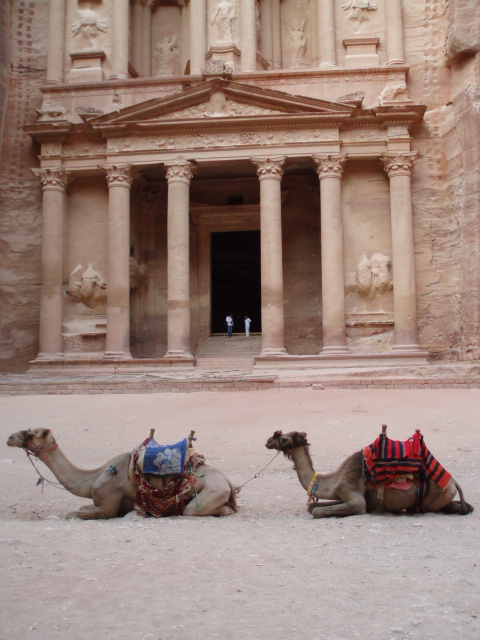
By the time we got to Petra we were feeling like we weren’t really giving Jordan the attention it deserved and decided to act like real tourists(for once) and see all the sites in the area. This turned out to be a brilliant idea as Petra is one of the most incredible places on earth. I’d go so far as to agree with the dude that said everyone should go and see it once before they die. It is essentially an entire (ancient) city which has been carved into the mountain rock. Yes, INTO the mountain rock. It is bizarre, awe-inspiring, magnificent and simply astonishing.

This city was created about 2100 years ago by a nomadic Arabic tribe called the Nabataeans, who liked the place so much they stopped their wandering ways and set up shop for a while and they created some spectacular architecture. I promise you the pictures do not do this place justice. It’s breathtaking. You get to the site itself by walking through a canyon called The Siq which is basically a meandering path surrounded by a rock face on either side reaching up to heights of more than 200 feet. It twists and winds for 1.2km before opening up to the most famous Petra ‘building’ known as The Treasury (no-one seems to know why it’s called this, it just is). The full site is absolutely enormous (of course, being the remains of an entire city), so if you are feeling lazy you can jump on a horse, camel or donkey and see it that way. And the entire time we were there, we were harangued non-stop by offers of a ‘cheap’ ride on one of these animals. You’ll be pleased (and perhaps not a little surprised) to hear that we decided to walk it. Oh yes, when I decide to be a tourist, I do it right!! So we walked.

For some inexplicable reason I had made the choice to forego socks on putting on my sneakers that morning. Let’s say right out in the open that this turned out to be a monstrously bad decision. Foolish even. I especially thought so after climbing the 862 rocky steps up a friggin’ mountain in 40C heat to see “The Monastery”, another carved building. This upward journey took about an hour and when we got to the top my legs felt like jelly and my feet were on fire. Fun times! But you know what? We WALKED!! On our way down, nearly everyone we saw on their way to the top was riding on donkeys. Poor little donkeys. Anyway, the way down is when the blisters started to hurt. Which is when I remembered that we’d packed my socks in our daypack. Lucky because by that stage I could barely take a step without all seven (yes seven) of my blisters causing me great grief and a fairly healthy dose of agony. The socks helped.

Throughout our time at the site we were approached by several young children selling stuff like beaded necklaces and bracelets. Some were extremely young. I swear one girl was about three years old. I swear!! She grabbed my hand and tried to kiss it which I didn’t let her do (call me mean-spirited but when I saw the crusty, dirty spit gathered at the corners of her mouth I snatched my hand away – I have a rule, I don’t touch stray dogs, cats and now children). Anyway, all the kids there have memorised this spiel which goes like this: 

“Hello” 

“Why, hello there” 

“Where you from?” 

“We’re from Australia” 

“Welcome!! You buy my ……. (insert beaded product)” 

“No, but thank you anyway, bye now”. 

Towards the end of our day it went a little more like this. 

“Hello” 

“Hi” 

“Where you from?” 

“The Moon” 

“Welcome!! You buy my ……. (insert beaded product)” 

“NO!!”

One absolutely beautiful girl of about 12 gave me some colourful rocks and didn’t seem to be selling anything. She followed us around for a while and after a few minutes of chatting to her, she told us she loved us. Awww, of course she did, who wouldn’t? Anyway, we loved her too. We gave her 1 Dinar to let us take her picture. Her name is Rania (the same name as the Queen of Jordan – worlds apart but just as beautiful, if not more so). All the children we encountered seemed like street kids and we realised they were Bedouins – nomadic Arabic gypsies that tend to live in tents in the desert. I guess they’ve adapted their survival skills to include sucking up to tourists for cash. A little later on, another young girl, on a black donkey called Michael (a good Islamic name), tried to give me a similar rock but when I politely declined she threw it at me. Charming!!. Suffice to say I didn’t buy anything from her. 

After a long day walking around the Petra site in the soaring heat (able to only occasionally steal furtive sips of water, away from the eyes of thirsty, fasting Muslims) we were exhausted. We should have gone back to the hotel, put our aching feet up and stayed there but we’d already bought tickets to an event called “Petra By Night” so we went back after darkness fell to once again walk the 1200 metres through the Siq, which this time was illuminated with over 1000 candles. Though we were tired, it was worth it. It really was beautiful and serene. At the end of the Siq, the Treasury was also lit up with hundreds of candles (no pics as I forgot to take my camera – I was tired alright!!). We were treated to two musical performances on Arabic instruments and also a lovely cup of mint tea. Most civilised. We slept deeply that night.

Ejo #9 – Ramadan In Dubai (What It Means And What To Expect)

It’s been a while between drinks, hasn’t it?  Fear not, the ejo’s are not drying up, merely gathering steam in order to (hopefully) entertain and inform you.  For those of you new to the ejo, welcome and enjoy.


So, what have David and I been up to?  Well we’ve been quite busy, and allowed our itchy feet to take us where they will.  Since the last ejo we’ve been to Thailand and Jordan but what I’d really like to talk to you about in this email is our experience of Ramadan.  Now, before I packed up to move to a Muslim country, I’d certainly heard of Ramadan but I had no real concept of what it meant, or entailed.  Following is what I’ve learnt:


Ramadan is the name of the 9th month of the Islamic Calendar in the same way that September is the 9th month of our Gregorian Calendar.  Unlike our calendar though the Islamic one is based on lunar sightings and so is unfixed, changing from year to year (on average it starts 11 days earlier than the year before).  Ramadan is also the month during which the first verses of the Quran are said to have been revealed to the prophet Muhammad (peace be upon him).  This is kinda comparable to Moses bringing the ten commandments down the mountain but in fact much more important because it is considered the birth of Islam.  Exciting stuff huh?


Sooooo, to honour this major event (and because Allah told them to), Muslims around the world undertake to fast.  This means no eating, drinking, smoking, chewing gum, singing, dancing, swearing, thinking impure thoughts, playing music or showing affection in public during daylight hours.  (Daylight is deemed to have commenced at the first moment the naked eye can discern a white thread from a black one.)  The purpose of all this restraint is to separate the person’s physical body with their spiritual self.  It’s a time of increased spirituality, more intense praying and an opportunity to commune with Allah.


For us non-Muslims, it’s an opportunity to experience enforced denial (at least in public) of things you wouldn’t even think twice about before doing.  Things like having a sip of water when you’re thirsty, of going out to grab a bite to eat for lunch, and during this time, even holding hands with your partner is frowned upon.  If you are caught, say drinking water in public, the police may just give you a warning, but it is completely within their rights to throw you in jail for the remainder of the festival (yes, it’s considered a festival, go figure!!).


It is a really difficult thing to do (especially refraining from drinking liquid all day long when the temperatures right now are getting up to 42C/107F) and I especially feel sorry for the Indian construction workers who are outdoors for 12 hours a day.  They’re not even Muslim but they still have to deny themselves a drink of water.  It doesn’t exactly seem fair, and I’m not sure what Allah would think of it. But I don’t want to give the wrong impression.  I do admire and respect the basic principle behind it.


The daily highlight of Ramadan is, of course, the breaking of the fast after sundown.  This is called ‘iftar’ and the custom is to just eat a couple of dates initially in order to get the digestive system ready for the feast ahead.  And what a feast it is!!  Traditionally, a small animal (goat, sheep) is slaughtered as sacrifice, and then roasted to tender, succulent perfection to reward all those who have fasted during the day.  Occasionally this still occurs.  While driving through Jordan, David saw them slit a lamb’s throat, right out there on the road, and drain the blood in a bucket (halal style).  But it is more common these days for several families to get together each night and for each family to bring several small dishes of food, resulting in a massive and delicious buffet meal.  Yum!  Unfortunately we haven’t been invited to iftar this year but I’ll be angling for an invite next year for sure – especially if there’s a goat or sheep involved.


During Ramadan, all the big 5 star hotels make up for not serving food during the day by erecting enormous, air-conditioned Iftar Tents and then put on a huge buffet feast, kind of trying to replicate the traditional family breaking of the feast.  The other big eating time of day (or night, rather) is called Suhoor, and it’s the big feast before sunrise (or before you can tell that white thread from the black).  So people get up at 4am to stuff their faces with what is usually a very heavy, rich meal (to stave off the future hunger for as long as possible), and drink litres of water before going back to bed.  I’m not convinced this is the healthiest thing in the world to do but then again, I’m not the one fasting, so I’ll just shut up.  I’m pretty sure I’d be eating non-stop from iftar to suhoor, so there you go.


Being a Muslim country, the city, very thoughtfully, makes it pretty easy for the fasters.  As I’ve said, eating, drinking and chewing in public are basically illegal.  To that effect most cafes, restaurants, bars etc are closed during the day, and those that are open (to cater to non-Muslims) must conceal their dining areas behind screens or by blacking out the windows (alcohol is not permitted to be served anywhere in the city until after sundown).  I’ll tell you what, it’s a strange experience to walk through a mall foodcourt, usually buzzing with hundreds of people munching and slurping away, and to see it completely empty, tumbleweeds blowing past (well, not really but it conjures an image, no?).


Of course Islam seems to be a very reasonable religion, so the elderly, physically and mentally ill, children, pregnant and menstruating women are exempt from fasting.  Depending on the reason, a person will either be required to make up the missed fasting days at a later stage, or they must pay enough to feed one poor person for every day that they miss.  How much more reasonable can you get?


Anyway, Ramadan segues beautifully into my next ejo (coming out soon) which is about our trip to Jordan.  Funny story actually.  David had some leave from work and we thought, “Wouldn’t it be nice to get out of Dubai during Ramadan?”.  So we looked up the special fares that Emirates Airlines (our preferred airline of course) was offering during the period and we booked an AMAZING deal to Jordan.  About five minutes after we’d booked and paid for the tickets, we looked at each other and one of us (I can’t remember who) said, “Do they follow Ramadan in Jordan?”.  To which the answer turned out to be: DO THEY EVER!!


We weren’t going to let a little thing like that stop us enjoying our twelve days in Jordan though (being the bold travellers that we are).  And this is where I’ll leave you.  I hope you’ve enjoyed my little lesson about Ramadan (I do like to share everything that I learn here and I hope I’m not stuffing it down your throats). 


Kisses to all
Chryss


PS David says hi