
I’ve been an air traffic controller for over 22 years. It’s part of who I am now. And a big part of being a controller is the crazy shift work hours. But what exactly is shift work, anyway? It’s basically anything that requires people to work outside of regular office hours. Restaurants, hospitals, nightclubs, fast food joints, bodegas and milk bars, call centres, media outlets, retail shops, security and airports all run by the grace of those of us who sacrifice normal lives to work shifts. We’re a weird bunch, that’s for sure. But I wouldn’t have it any other way. I absolutely love shift work, and wouldn’t go back to an office job with office hours in a million years. I love having time off when everyone else is at work, and I really love being at work on the weekends, when the desk jockeys of the world flock to the beaches, the shops, the cinemas, and all the cafes, bars and restaurants. Have at it normies!! Fill your boots. I’ll be eating out next Tuesday!
So yes, I do love shift work, but I don’t want to sugarcoat it. It’s pretty hard yakka. Regular people work some variation of nine to five, Monday to Friday, with weekends off, right? We don’t get weekends off. Or public holidays. What’s Christmas, what’s New Year’s Eve, what’s Easter, what’s Melbourne Cup day? Also, what’s Saturday, and what the fuck is Sunday? I do not recognise any of these days. They are meaningless to me. For I am shift worker. Honestly, I never have any idea what day of the week it is. Occupational hazard, I guess. Our work week is six and a half days long, and we are rewarded for that toil with three and a half days off. Your cycle is seven days. Ours is ten. And it looks a little something like this.
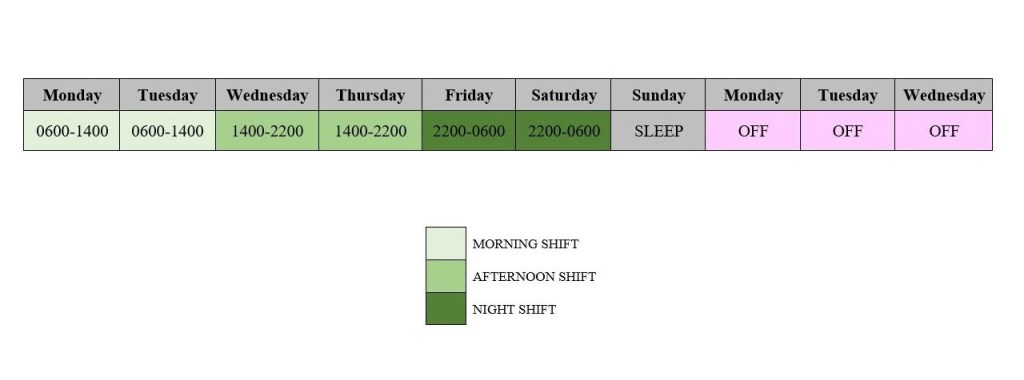
The truth, however, is that even though this is the “standard” work cycle for ATCs in Dubai, our rosters are a lot more fluid, and a lot less predictable (we usually find out what shifts we’ve been rostered to work for a given month about half way through the previous one). I very rarely work the prescribed cycle of two mornings, two afternoons and two nights. I wish I did, I would love that kind of stability. But unfortunately due to staff shortages, training, annual leave, sick leave and controllers being seconded to the office, the roster is usually all over the place.

So, how does a typical work cycle actually play out? Let’s start with morning shifts. We are required to be at work by 0545 for a 0600 start (I’ll be using 24 hour time in this post, as per aviation convention), but I do like to get to work a little earlier to let the night shift zombies go home. So, for me to be at work by, say, 0530 I need to leap out of bed at 0400. I actually like to snooze my alarm for about 45 minutes before I actually get up (yes, I’m a weirdo). This means that my first (of many) alarms goes off at the ungodly hour of 0315.

The philosophy behind the myriad alarms is that my everyday alarm tone is a very soothing harpsichord sound, designed to gently rouse me from my slumber. At 0315 in the morning, however, this doesn’t always do the trick. The choice of alarms is progressively more likely to penetrate my repose. To that effect, the duck tone alarm is quite annoying. The bark tone alarm is extremely irritating. And the Leanne alarm (the back-up alarm of last resort) is actually my telephone ringtone which is the sound I would hear if I did accidentally sleep in and my watch manager was calling me to see where the fuck I was. It instils enough fear and panic to wake me up no matter how sleepy I might be. Committing the cardinal sin of sleeping in for a morning shift is a really horrible feeling. Not only are you late for work, but there’s someone in the tower who has worked an eight hour night shift waiting for you to come and relieve them so that they can go home. And they’re not allowed to leave until you actually get there. I’ve only slept in for a morning shift once, and let me tell you it’s a very discombobulating situation.
Another reason for the plethora of alarms is that it’s virtually impossible to get a good night’s sleep before that first morning shift. I spend all night tossing and turning, subconsciously worrying that I’ll sleep in, inducing anxiety, which (of course) prevents a good sleep. It’s a vicious circle. Plus the only way to get eight hours in bed before my alarm goes off is to retire at 1915 the night before. Which is impossible. I always harbour well-meaning intentions of going to bed super early before my morning shifts, but usually turn the lights out sometime between 2100 and 2200 giving me about five or six hours of downtime. Not only do I usually wake up tired for the shift, but the entire cycle is off to a terrible start. Welcome to shift work world.
So I get up at 0400 and I get ready for work. My routine at this time of day is so well rehearsed, it’s as smooth as Swiss clockwork. Everything is done on autopilot. David and I dance around each other like a beautifully choreographed ballet. I don’t rush around like a crazy person, but every minute counts and there isn’t a lot of room for unforeseen variables. The last couple of years I’ve also had to factor in an extra five minutes sprawled on the couch for the inevitable early morning hot flush episode that has become a stalwart component of my routine. Menopause is fun!
I’m usually out the door by 0450 and get to the tower by 0530 to take over position. Depending on how many controllers are rostered for the morning, I might rotate through two hours in position, followed by a two hour break for the eight hour shift, or I might work two hours in position with a one hour break. The maximum number of hours I can legally work is two and a half, after which I’m required to have at least a thirty minute rest period. These rules are set by the General Civil Aviation Authority (GCAA), which is the regulatory body for aviation in the UAE. And they lay down a lot of other rules regarding shift work in the tower, which I’ll talk more about later. At the end of my shift, I’ll usually leave the tower some time between 1330 and 1400 and reach home by 1500 at the latest. Those of you who read my previous ejo know that this is the ideal time for a coffee nap, and I almost always have one after a morning shift.
Afternoons are my least favourite shifts. The whole day is kind of fucked for getting anything done. We usually get up around 0830 which isn’t super late, but it’s still an extra four and a half hours sleep than the previous two days so it feels like a real luxury, and actually plays a large part in our sleep debt recovery. We have a little over four hours to get shit done before leaving for work. Shit includes going for a walk followed by a yoga session, showering and washing my hair, reading my emails, playing Wordle, responding to messages, cooking and eating lunch (which is usually a delicious, juicy steak) and then doing the dishes, and also preparing something to snack on at work later that evening. It can be a bit hectic to be honest. I normally get to the tower at around 1330, send the morning shift on their merry way, and settle in for the next eight hours. Maybe it’s because the shift straddles the transition from day to night, but afternoon shifts just seem to drag on and on and on. They’re boring as hell and by the time I get home at around 2300 it’s way too late to do anything.
Morning shifts used to be my favourite because I’d get the whole afternoon off, but lately I’m starting to really feel the exhaustion of having to wake up so goddamn early. Let’s not mince words, I’m an old lady now. My new favourite shifts are night shifts. Sure it’s tiring having to stay up all night, but when there are only two of us rostered, we work a great schedule that gives each of us a two and a half hour break in the middle, so that we can both have a good rest. This means that I have the entire tower to myself for a couple of hours at a time while my colleague naps. It’s me time, baby. I play a little background music, I eat a little midnight snack, I talk to some pilots in my night shift voice, I plan holidays, I water the tower plants, I do some squats and I work on my ejos. I actually have a really good time. David doesn’t have it so lucky. Night shifts at DXB are usually the busiest shift of the day, so while I’m dancing around my tower, David’s working his ass off in his.
Despite me having it relatively easy on the night shifts, I still have to be awake and alert at an hour when most people are fast asleep. By the time David and I get home at 7am after a night shift, we are both pretty fucking knackered. We’ll have a quick shower and go to bed for a few hours, and get up just before midday. It’s definitely not enough rest, but sleeping into the PM messes with my circadian rhythms too much. Everyone deals with night shifts differently and a lot of the local guys sleep until the late afternoon following a night shift, but there’s no way I could do that. I subscribe to the jet lag school of thought, sticking as close as possible to my regular schedule, even though it’s exhausting, and even though it means I need a little extra time to recover. At least I’m not completely screwing up my sleep/wake routine. David and I tend to take it very easy in between night shifts, rarely scheduling social engagements or appointments that would require us to leave the house. We lay low and make sure to squeeze in a 20 minute coffee nap sometime during the afternoon. It ain’t a lot, but it definitely helps. And later that evening, we lock up the house, get in our cars and set off in opposite directions to our respective airports to do it all again.
The day after our second night shift is called a sleep day, or a rest day, for obvious reasons. It isn’t actually considered a day off (since we’ve worked the first six hours of it), but it’s not considered a full work day either (since the shift started the previous day). When I was a younger woman, I secretly did think of sleep days as a day off. Oh, the impertinence of youth. These days it truly is a day of rest, and it generally takes me the whole day to recover from having worked the cycle.
Fatigue caused by shift work is a massive concern in the aviation industry, and there are very strict rules about the hours that air traffic controllers can work. I already mentioned that we need to take a break every two and a half hours, but there are many other rules governing our rostering principles. For instance, a controller can only work a maximum of ten hours in a single shift. And we must have a minimum of ten hours between shifts. We can’t be rostered to work more than three night shifts in any rolling ten day period. And if we’re rostered to work seven days in a row, we must have a minimum break of two and a half days (or 60 hours) before coming back to work. And there are lots of other restrictions that get a little technical, things like “Within 720 consecutive hours (30 days) the aggregate of duty periods and standby duties shall not exceed 300 hours, provided that duty periods do not exceed 200 hours.” Blah blah blah. At the end of the day the rules are there to protect us, the controllers. But they’re also there to protect the unit. And our employer. And the airlines. And the pilots. And the flying public. Fatigue is no joke. It causes errors in judgement, and that’s something air traffic controllers simply can’t afford.
Working a reverse rotating shift cycle (starting with early mornings and progressing through to night shifts) is supposed to be the least fatiguing roster, and I actually prefer it to the forward rotating cycle that we used to work in Melbourne tower (which started in the evenings and progressed through to morning shifts). But at the end of the day, fatigue wins. It always wins, and it’s impossible to avoid. All we can do is mitigate it, but it will always be a huge issue in air traffic control. As I mentioned earlier, I need to be functional while doing a relatively complex job at a time of night when all my body wants to do is curl up and go to sleep. And that takes a toll. Shift workers are notoriously prone to a cornucopia of health problems including heart disease, obesity, high blood pressure, reproductive issues, ulcers, diabetes, depression, low testosterone, insomnia and stroke. In fact working shifts is so bad for your health it even has a disorder named after it. Yay?
As a bonus, we are also way more susceptible to death. In a very large, famous, longitudinal study, The Nurse’s Health Study, researchers followed 74,862 nurses over a period of 22 years and concluded that the nurses who worked rotating shifts for more than 15 years were 38% more likely to die from heart disease, 25% more likely to die from lung cancer and 33% more likely to die from colon cancer than their counterparts who worked day shifts only. Sobering. In fact it’s so unhealthy that in 2007 the World Health Organisation declared that shift work was a probable carcinogenic.
So how does shift work wreak such havoc in the body? It’s all to do with circadian disruption. Having to be wide awake at 0200 isn’t just a pain in the ass, it also throws a spanner in the body’s finely tuned chemistry, creating hormonal chaos and laying waste to our biological homeostasis. This is such an interesting and expansive topic that I’ll be writing about it in my next ejo, so keep an eye out for that. In the meantime, all you need to know is that my highly paid job is almost definitely killing me.
But I do not want your sympathy. Absolutely not. Fuck that noise. I’ve made a choice to stick to this beautiful career, and despite its pitfalls I feel absolutely #blessed. If you go back and have another look at that 2018 roster, zoom in and check out all those greyed out dates. Those are holidays, bitches. In January we went to one of our favourite destinations, Japan, spending time in the ski fields of Nagano, as well as drinking our body weight in sake in bustling downtown Tokyo. In February we took a short four day trip to Sri Lanka during our days off for David’s birthday. In mid-April we travelled back home to Australia to see family and friends. And five days later we jetted off to France for a couple of weeks, attending a close friend’s wedding in the French countryside. In June/July we spent two and a half glorious weeks in Amsterdam, introducing my youngest sister, Pieta, to our favourite city. And in mid-August we were lucky enough to be able to travel to America for six days to go to the wedding of another close friend. When we got home we had enough time to do some laundry before heading straight back out again three days later, visiting Sicily for the very first time. We obviously loved it because we went back in October, this time with my sister Mary in tow. So yeah, while my job is basically murdering me, at least I’m having fun with the time I’ve got left.
So now you know what it’s like to be a shift worker. Or rather, now you have an inkling of what it’s like to be a shift worker. If you dare, I challenge you to simulate just one of my night shifts and see how it really feels. One Saturday morning, just get up at your normal time and go about your day. Remember to have a coffee nap (or maybe an even better idea might be to have a proper, long nap), and then at 2050, get in your car and drive around for 45 minutes. Come back into the house and start working on something. Maybe you have some office work to do, maybe a hobby. But you’re not allowed to watch TV or use your phone (coz we’re not allowed to either). At 2330 you’re on a break for two and a half hours. I suggest trying to sleep. But don’t forget to set an alarm (or four) to make sure you are up and ready to take over again at 0200. This is the tough part. It’s usually quiet on the night shifts, but sometimes you wake up from your nap and you have to hit the ground running. You can’t afford to give in to your sleep urges. Feel free to have a coffee if you think it’ll help. I no longer drink coffee on the night shifts (in fact I only have it for coffee naps), but I’ll often have a little snack right around this time for some energy. A boiled egg or a few strips of bacon. But you do whatever you need to do to stay awake. And don’t forget to work. You’re in position until 0430. You can’t slack off. And you can’t fall asleep. So keep working. Naps on the job will get you fired. Or, worst case scenario, kill people. At 0430 your imaginary partner takes over and you can chill for a while, but you can’t go home yet. Not until the morning crew arrives to relieve you from your duties. You can have another little nap while you wait, but at 0600 you need to get up, get in your car and drive around for another 45 minutes. When you finally get home on Sunday morning, you’re done. Congratulations, you’re an honorary shift worker. How do you feel? Now do it again. And repeat every ten days for the next twenty years. Bet you can’t.
So, think of us… next time you have a late night pizza delivered, next time you need to go to the hospital in the wee hours of the morning, or have to call an Uber to take you home after a big night out. Think of us when you need to call a locksmith, or have to catch an obscenely early flight. Think of us, the weirdos, the shift workers. While you’re sleeping, we keep the world turning. It’s tough work, but someone’s got to do it.






 Chryss In Dubai