Good Life

Ejo #157 – Gratitude

Today, I was grateful to get up early, watch the sun rise and put the finishing touches on this ejo.  Yesterday, I was grateful to be able to give my friend a hug after learning that his mum had died the night before.  And on Sunday, I was grateful to spend the day picnicking with my sisters, aunt and cousins in Cape Schanck.  I am a gratitude queen, able to find things to be grateful for, even in the most difficult of circumstances.  Damn, I could represent Australia at the Gratitude Olympics.  I am that good.  But how did I get there?  How did my gratitude muscle get that strong?  Just as an elite athlete needs a team, a coach, and a training partner to improve their physical performance, I too have a training partner. A gratitude partner.  Someone who has committed to the challenge of sharing gratitudes with me.  Every. Single. Day. No. Matter. What.

I’ve known my friend Melinda for about 28 or 29 years (shut up, you’re old!).  We even lived together for a while in the mid 1990s with our friend Svetlana.  But after we all moved out and went our separate ways, Melinda and I didn’t stay super close.  Like most of my friendships after I moved to Dubai, we’d exchange an email every now and again, and we’d catch up at the big parties that David and I throw whenever we visit Melbourne.  And that was OK. It was enough.  

But that all changed eight years ago today, when Mel and I started a challenge to email each other one gratitude a day for a whole year.  We both happened to be going through a rough patch at the time, struggling to find positivity in our day to day lives.  Melinda was feeling overwhelmed as a working mum to two young boys, trying to balance work and family commitments.  And I was missing my friends and family in Australia.  I yearned for the easygoing way of life back home, and wasn’t enjoying living in Dubai at all.  Everything about the city was getting on my nerves, and bringing me down.  And I wasn’t afraid to write about it.  In fact, some of you might remember that I used to write a very acerbic ejo series called Things I Hate About Dubai, in which I unabashedly bashed the shit out of the city, on the regular.  I used to really enjoy doing that, but in January 2015 I decided to decommission that series when a reader of mine called Flo wrote to me to express dismay at my attitude.  

Flo scolded me, “I am so disappointed by your latest post, and this will be the last one I read from you, as we do not share the same vision of expatriation.  Indeed I am very disappointed by the way you think.  I experience this every day in France where I keep hearing people say they don’t like anything (or anyone) about it, and it just pisses me off.  This is so disrespectful.  You may not understand, and you might even be angry at me, telling me not to come back to your ejo if I don’t like it.  But I just need to express myself!”

For my January 2015 ejo, which was titled Freedom, I responded to Flo, and defended my right to express dissatisfaction with certain aspects of life in Dubai.  But secretly, Flo’s words had pierced my heart like an arrow.  I had imagined that I was coming across as mischievous and spicy, but what was happening when I allowed myself to wallow in my negativity was that I just came across as… well, negative.  And I didn’t want to be negative.  I’d spent too much time and money on therapy to allow myself to slide back into old thought patterns and behaviours.  So while I publicly justified my opinions, I privately resolved to not write a single bad word about Dubai for a whole year.  For my own mental health and wellbeing.  I wanted to change.  I wanted to do better.

While I was making an effort to be more positive by not slinging shit at Dubai, Mel was doing something even more proactive and constructive to bring more joy into her life.  You all remember the #100happydays challenge, right?  Post a photo a day of something that makes you happy.  For one hundred days.  It was a lovely idea, encouraging participants to focus on all the positive things in their lives.  The challenge went viral, generating over 30 million happy moment posts on Facebook.  I probably should have taken part in the challenge, but I remember just not feeling it.  It seemed a little forced and superficial to me, which is probably an indication of where my head was at.  Melinda did take part in the challenge, and she got a lot out of it.  But once she’d finished the hundred days, she was left with a feeling of “now what?”  It occurred to her that a longer term commitment to a daily practise of positivity would be more beneficial than a flash-in-the-pan, social media challenge.  Something she could share privately with a trusted friend, rather than posting online.  Being a Doctor of Psychology, Mel knew that the idea was a good one, but she was unsure of how to implement it in a practical way. 

And then she read my Freedom ejo.  And she had a lightbulb moment.  She wrote to me, “My unrequested thoughts/suggestion for you to do with as you wish.  For improving your ongoing wellbeing in the place you reside, I think there is much to gain in training your mind to see and appreciate even the smallest positives around you each and every day.  Even in the country I love I’ve found myself in the mental habit of critiquing every experience and overlooking so many positives.  The 100 happy days challenge helped to shift my mindset, as I was struggling to focus on the upside of everyday life.  It definitely helped to be publicly forced to find something, anything, each and every day.  I often consider doing 365 happy days!  Instead I’ve decided to do “gratefuls” this year.  Here’s what I’d like to propose.  I will send my grateful to you each day.  Don’t feel you have to respond in detail, or at all.  If you’d like to share your gratitude in return, well, that would be an amazing honour.”

Of course I said yes.  And the rest is history.  Along the way we negotiated some guidelines.  We’d exchange a gratitude, every day for a whole year.  We would make an effort to not repeat ourselves, so that we would always be on the lookout for new things to be grateful for.  And our gratitude emails would be a no-complaint zone.  The goal of the project was to be totally focussed on things that we were grateful for, and not an opportunity to whinge about life.  We both understood that the intention of this wasn’t to paint an unnaturally rosy picture of our days, but rather to acknowledge that despite the inevitability of things not always going our way, we could still find something to be grateful for.  

Melinda and me in 2015, less than a month after starting our gratitude challenge.

I remember how delighted I was after just the first few days of exchanging gratitudes.  From the very beginning it felt like a really positive and optimistic ritual, and I really enjoyed reconnecting with Melinda, and reigniting our friendship, getting to know each other all over again.  Getting to know each other even better than before.  

But devastatingly, only fourteen days into our challenge, Mel’s mettle was sorely tested when she received some terrible news about her close friend Cara.  She wrote to me, “Today I’m struggling to be grateful as I learned some very sad news that one of my closest friends has cancer that has metastasised to her bones.  So I guess I’m grateful for my health, and that she feels supported by me.”

Over the next five years, our daily gratitude practise helped Melinda deal with the burden of initially having to keep her friend’s diagnosis a secret, of being there when Cara needed her, and of knowing when to step back when she needed space.  Melinda was there when her close friend battled chemotherapy and radiation therapy, and she supported her when she became sicker after taking part in an experimental trial.  She held hope for her friend, even when things were hopeless.  She honoured Cara’s final wishes, and at the end she said goodbye, long before she was ready to let go.  Mel tells me that our daily gratitude practise got her through the hardest five years of her life.  And I am beyond grateful that I was able to be there for her, in that way.

Today marks the 2922nd day that Melinda and I have exchanged daily gratitudes.  What started as a one year challenge, blossomed into something that I can’t even imagine my life without, and the two of us have been at it for eight, glorious, years.  Along the way we’ve both become more positive and more resilient.  We’ve both learned to laugh in the face of adversity, and we’ve developed the ability to find acceptance and peace when things don’t go our way.  For instance, on Thursday, 19th January 2017 I had a skiing accident on the slopes of Nagano, Japan tearing the ACL in my good knee.  My email to Mel that day read, “Today I was grateful beyond belief to everyone that helped me when I crashed on the mountain and hurt my knee.  David, who came running down to check on me and then carried BOTH our pairs of skis back up a very steep slope.  The ski instructor who noticed I wasn’t well and called the ski patrol.  The ski patrol people who skied me off the mountain on a special stretcher.  The hotel who sent someone in a car to pick us up so we didn’t need to catch the bus, and then drove us to the doctor.  The clinic where they looked at me straight away and were so kind.  The lady at the hotel who was SO concerned for me and let me lean on her as I limped to the elevator – later on, at dinner, she made me a beautiful origami crane and told me she hopes I feel better soon.  It’s been heart-warming to the max.”  

I know that in the past I would have let that accident wreck my day, my holiday and even the next few months of my life, as I hobbled around in pain.  I know that I would have wallowed in self-pity and misery.  And the reason I know it is because that’s exactly what happened in 1995 when I tore the ACL ligament in my other leg in another skiing accident (no, I’m not a very good skier).  But my gratitude practise gave me the ability to rise above it this time, and to deal with it positively.  It allowed me to see that my injury didn’t have to define me, and that despite it being a bit of a bummer, there were so many other, wonderful things to focus on.  I was getting really good at this gratitude thing.  

And then my Mum died. And somehow, I was still able to find a number of things to be grateful for, even on the worst day of my life. On the 26th March 2019, I wrote to Melinda, “I feel tremendous gratitude to my Mum for all her unconditional love my whole life.  I am grateful that she and I texted yesterday, and that we got to see her recently on our trip back home.  I am grateful to David for being so supportive and caring and loving and gentle.  And for buying us both tickets back home.  I’m an absolute mess right now but really grateful that even during something as devastating as this I can still find things to be grateful for.”

When you can look around you and see things to be grateful for, when everything else in your life is falling apart, you’ve reached a higher state.  You rise above.  You transcend.  And that is a super power.  Daily gratitude has given me fortitude.  No matter what happens, everything is OK.  It’s always OK.  

Melinda’s not the only person I exchange daily gratitudes with.  My sister Mary and I also do it, via text.  We started about four and a half years ago when we both took part in Zimmy’s Happiness Project, a three month course designed to rewire our thoughts and actions, creating new habits scientifically geared towards increasing our happiness.  A major pillar of that course focussed on gratitude, and one of the tasks was to share five daily gratitudes with a partner.  I was already really adept at finding gratitude in my day to day life with Melinda, but Zimmy’s project required a little more.  Not only did it call for five gratitudes a day, it also required them to be shared with someone in person (or via video).  I was really grateful that my sister was doing the project with me, and that she accepted my invitation to be video gratitude partners.  It was still a task that took me slightly out of my comfort zone, but doing it with a family member, someone I loved and trusted, made it a lot easier.  During the three month project, Mary and I exchanged videos every single day, talking about all the things we were grateful for, which was a beautiful way to feel more involved in my sister’s life, something which I’d always felt I was missing out on, living so far away from her.  It was a wonderful and easy way to get to know her better.  It deepened our relationship and helped us create a more enduring bond.  

I feel the same deep bond with Melinda.  She shares her intimate life with me.  I know when she’s had a great Pilates session, when her husband cooks a yummy dinner, when her teenage sons help around the house, and when she’s had a good night’s sleep.  And I share parts of my life that no-one else in the world, apart from my husband, knows.  Melinda knows when I’m happy.  She knows when I’ve had a good day at work.  When I’ve had a relaxing bath.  When I’ve had an earth shattering orgasm.  When I’ve found what I’m looking for at the supermarket, or when my favourite colleague is rostered to work with me.  Melinda knows when I’ve had an interesting dream, and when I’ve been upgraded to business class on a flight.  She knows when I’ve had a satisfying shit.  When I’ve been paid, and when I’ve been able to bring one of my houseplants back to life with a little extra TLC.  She knows when I’ve found a spare lip balm in my car and when I’ve discovered a really cool new TV show.  She knows when I have fresh towels, and when I sleep on fresh, clean sheets.  She knows when there’s soft toilet paper at work, and when someone’s recommended a great new podcast.  Melinda knows when I’ve had a breakthrough in one of my sessions with Zimmy, when the price of Bitcoin’s trending up and when the tower toilet, which is prone to blocking, is flushing again.  And she knows all the wonderful, thoughtful, kind, generous things David does for me every single day. She knows everything about my life, and being able to share that all with her is a beautiful gift for which I am very grateful.  
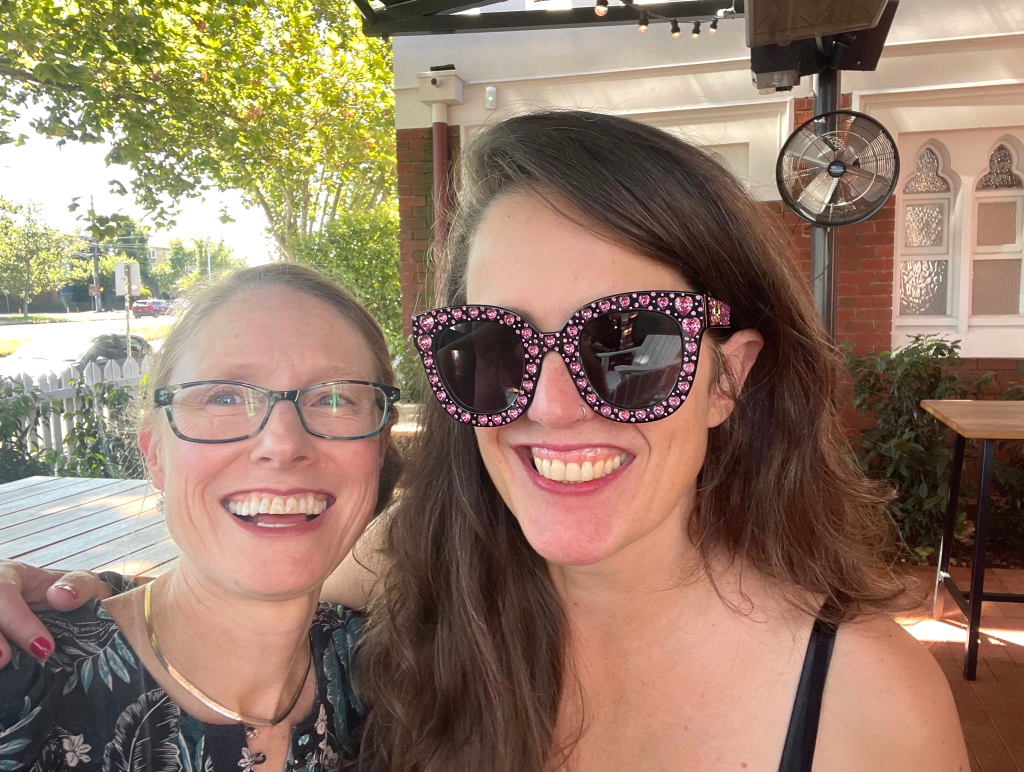
Melinda and me a couple of days ago. Gratitude partners for life!

In 2015, when Melinda and I first committed to our daily gratitude challenge, it was a challenge.  Sometimes it was hard to find something to be grateful for.  Sometimes I really struggled.  And sometimes it just felt impossible.  But we stuck it out, and we got better.  We got really fucking good at it.  I really do feel that if more people practiced daily gratitude, the world would be a much better place.  My life is undoubtedly better for it, and I want to be able to pay that forward.  If sharing a daily gratitude with a friend sounds like something you’d like to try, then I’m your girl, so hit me up and let’s do this. It might be hard at first, but if you stick to it, it’ll get easier.  I promise. 
Ejo #155 – Let There Be Light

Last month I wrote about the health hazards of shift work, almost all of which are caused by the violence perpetrated against our circadian rhythms when we suffer from disrupted sleep.  Today I’m going to talk about why that matters so much.  Not just for shift workers, but for everyone. 

Over the last 50,000 years, we have driven the progress of our species forward at an alarming rate, transforming ourselves from primitive hunter-gatherers; first into farmers and then ultimately into what we are today (whatever you want to call that).  In most ways this progress has benefited us.  In many others, it has not.  The transition from hunter-gatherer to agronomist was thanks to the agricultural revolution approximately 10,000 years ago which is seen at once, as humankind’s greatest achievement, and our greatest failure.  It set us on the path that we find ourselves on today, by forcing us to settle in one place and allowing us to feed multitudes more of us, but it definitely wasn’t a benefit to our health.  Almost overnight, we went from chasing and eating a predominantly meat based diet, supplemented by tubers and the occasional fruit and berry, to a diet consisting almost entirely of grains.  It is commonly perceived that humans domesticated wheat, but the truer story is that wheat domesticated us.  And in doing so, it made us fatter and shorter, it made us more prone to disease and it significantly lowered our longevity. 

Things have improved, of course, and we now live long lives, full of creature comforts, mod-cons and all the good things that life has to offer.  But for all the progress our civilisation has made, our bodies lag behind, having evolved to survive the conditions that existed on earth 50,000 years ago.  We might be stuffing our faces with avocado toast and scrolling on our phones for hours, but our bodies still think we’re hunter-gatherers, roaming the plains of the Upper Paleolithic era.  All the progress we have made as a species has been truly remarkable, and the life that we’ve created for ourselves is an astonishing achievement, but for our animal bodies this progress has trapped us in a golden cage that is slowly killing us.  We no longer live in nature, and our bodies are paying the price.  To achieve optimal health, we all need to make more of an effort to return to our natural element, to get more fresh air, to move more and to get more sunshine.  This isn’t a new age, airy-fairy aspiration.  It’s a fact, rooted in hard science.  We need sunlight not just to thrive, but to survive. 

In his 1973 book “Health and Light“, which I recently finished reading, Dr. John Ott describes conducting research about how full spectrum light can improve our health, or make us sick if we are exposed to a distorted or incomplete spectrum.  Dr. Ott coined the term mal-illumination, which he compares to malnutrition, and which is caused by our widespread fear of the sun.  We aren’t doing ourselves any favours when we restrict our intake of full spectrum sunlight by shielding our eyes and skin behind sunglasses, tinted windows and sunscreen.  Doing so has created an epidemic of people who are deficient not only in Vitamin D, but in a very crucial, beneficial and life-promoting form of energy.  Sunlight. 

Of course we need to be sensible and not overdo it, because too much shortwave UV light is harmful, and can cause sunburn, premature aging and skin cancer.  But most UV light is long wavelength light.  It’s a nutrient, that nourishes us and gives us energy, and is just as important as the nutrients we consume from food.  In fact, it doesn’t matter how good your diet is, or how much you exercise, if you’re not getting optimal sunlight (infrared light, followed by red light, followed by UVA, and then UVB, in that order) you will never reach peak health.  You will always be operating sub-optimally.  And the scientific world has known that for a long time.  A 1967 study into illumination for health concluded that, “If human skin is not exposed to solar radiation for long periods of time, disturbances occur in the physiological equilibrium of the human system, resulting in functional disorders of the nervous system, vitamin-D deficiency, a weakening of the body’s defences and an aggravation of chronic diseases.” 

Speaking of Vitamin D, why are so many people supplementing with exogenous Vitamin D when all they need to do is go outside for a few minutes each day and commune with the almighty, life-giving sun?  Why are we all so happy to just pop a pill, when the answer to our health problems literally hangs in the sky outside our front doors.  Factors that affect your personal Vitamin D levels include where you live in the world, how old you are, what colour skin you have, how much you weigh, what foods you eat and what other conditions you might be suffering from.  How can all of that be effectively corrected with an over-the-counter course of vitamins created in a factory?  It can’t.  When we go outside and expose our skin to sunlight, the body knows what it needs to do.  It knows how much Vitamin D to produce and it creates the most bio-available form of it.  Two recent studies showed that increased blood levels of supplemental Vitamin D actually caused elderly people to fall over more often, and to suffer more frequent and more severe bone fractures.  And taking Vitamin D supplements has been shown in countless studies to actually increase the overall risk of cancer, and even death.  So stop popping the pills please, and just get out in the sunshine!!!! 

Sunlight isn’t just a requirement for Vitamin D synthesis.  Almost every living organism on earth dances to the beat of a circadian drum.  We all possess biological processes that naturally occur around a 24 hour cycle, usually in response to the position of the sun in the sky.  Humans are no exception to this.  Sunrise and early morning exposure to light kickstart the circadian rhythm into motion, communicating to every single cell in the body, and setting them all up to synchronise their tasks for the day.  This messaging is vitally important and we miss out on it if we don’t get that early morning light in our eyes.  But how many of us are willing to sacrifice that benefit so we can sleep in just one more hour.  Almost everyone has some level of chronically disrupted circadian rhythm, so it’s no wonder that so many of us suffer from constant fatigue, low mood, anxiety, infertility, erectile dysfunction and a plethora of metabolic issues.  And for some reason, we just normalise that.  We just accept that we feel that way.  And that’s not cool.  These symptoms are all treatable, and the prescription is sunlight. 

From daybreak to nightfall, the sun shines its magical and wondrous light on us, bestowing us with life and good health – that is, if we don’t hide ourselves away from it.  Sunshine contains light from the full spectrum; of course visible light, but also infrared, red and ultraviolet light. And all of these wavelengths are transformed by the body into energy which is required for a myriad of biochemical reactions.  The proportion of each of these wavelengths of light changes, depending on what time of day it is.  Infrared and red light is present in all sunlight, but is more concentrated at sunrise and sunset.  Infrared light is soothing, healing and anti-inflammatory.  Ultraviolet light appears sometime within two hours after sunrise, depending on your location.  UVA comes first, when the sun is around 10° above the horizon, followed by UVB some time later.  The Circadian app is a great source of information about what light is present at what time of day in your part of the world.

The Circadian app tells me exactly when UVA rises and sets in Dubai.

Receiving indirect UVA sunlight into our eyes comes with an abundance of perks, so for maximum benefits make sure to take off spectacles, sunglasses and contact lenses, but please don’t look directly at the sun, mmmkay. Morning UVA actually prepares our bodies to receive the stronger UVB light later in the day.  Clever, right?  It’s almost as if we were designed to be outside in the sun.  UVA is also the precursor to the release of thyroid hormones that are needed to regulate our metabolism, energy levels and weight, as well as hair, nail and skin growth.  And it also releases a beautiful rush of feel-good hormones like serotonin (which makes us feel happy), dopamine (which makes us motivated and curious), norepinephrine (which focusses concentration) and beta endorphins (which give us a runner’s high and makes us lust after sunlight even more).  These are the same hormones that get people hooked on drugs, alcohol, gambling and other problematic behaviour.  The only difference is that when you’re addicted to morning sunlight, you’re getting high on life.  Literally! 

Sunlight is the trigger for so many biological processes, and we receive that signal not just in our eyes, but also through our skin.  The skin is an amazing self-regulating organ which not only protects our insides from spilling out, but also allows us to experience touch and changes in temperature.  It quietly and efficiently battles the harsh external world, ensuring that our body remains in homeostasis on the inside, despite what might be happening on the outside.  It does this by facilitating constant two way communication between itself and the immune, endocrine and central nervous systems.  Our skin is a beautiful, complex and elegantly designed system, which has evolved over millennia to absorb UV light for beneficial metabolic and biochemical reactions. 

One surprising benefit of exposing our skin to UVB light is an increase in the sex hormones oestrogen and testosterone (both of which are present in men and women), resulting in a natural increase in libido.  And who couldn’t use a little pick-me-up in that department?!  In his very informative, and fascinating, podcast about the health benefits of light Dr. Andrew Huberman suggests a protocol designed to boost reproductive health and libido.  All you have to do is expose as much skin as you (decently) can to the midday sun for about 20-30 minutes a day, two to three times a week.  This protocol is based on studies conducted on humans that showed not only a significant blood serum increase in oestrogen and testosterone, but a psychological increase in perceived attractiveness of others as well as an increased desire to have sex.  I mean, c’mon, if that sounds as good to you as it does to me, let’s get on out there in the sunshine people.  Testosterone levels in men have been declining for years. This is a beautiful way to remedy that. Following this protocol takes about a month to start feeling more randy, so what are we waiting for?  Let’s go get it.

UVB doesn’t just make us horny.  It’s the magic ingredient for producing that essential, endogenous Vitamin D we were talking about earlier.  And when our eyes and skin are exposed to it, it also increases our pain tolerance, and boosts our mood and energy levels throughout the day, and I don’t know how you can put a price on that. 

I recently broke my ankle and was stuck at home for three weeks doing ATC office work.  It was the perfect time to start a morning sunlight protocol, as I wasn’t doing shift work, and I was able to stick to a consistent schedule.  My routine is extremely simple, but provides outsized benefits.  Every morning, I get up and go outside to watch the sun rise, staying outside for about twenty minutes.  Even three or four minutes is enough to get some benefit, but I like to stay out there for longer.  I gaze up at the brightest part of the sky, while avoiding looking directly at the sun (obvs).  After twenty minutes, I go inside to prepare and eat a high protein snack, before stepping back out and spending another twenty minutes exposing my naked eyes to the light, just as the UVA wavelengths begin to emerge. 

Catching the early morning rays from my balcony.

I’m not gonna lie, when I first started my routine, getting up so early in the morning was hard.  It was really hard.  Like, so, so hard.  But after just three days, I actually started looking forward to waking up before dawn.  I crave it now.  I love being up when most people are still in bed.  I love listening to the birds singing in the trees, feeling the cool sea breeze on my skin and witnessing the creation of each new day.  It’s a truly beautiful experience and a wonderful way to start the morning, setting me up to be healthier and happier all day long.  Getting UVA actually makes me feel hopeful, happy and full of love.  It washes over me like a warm blanket, giving me a wonderful feeling of wellbeing, and I finish each session with a huge smile on my face.  I feel so fucking good from making this tiny change to my routine.  The vast improvement in my mood, mental health and energy levels absolutely makes it worth getting up so early every day.  Going back to shift work has unfortunately made it slightly more difficult to be consistent in my routine, but I still make an effort to get early morning sunlight in my eyes, every single day, even after working a night shift.  Sunlight is the cure, and I’m out there every day, religiously taking my dose of medicine as if my quality of my life depended on it. Because it does. 

So we’ve talked about what we need to do during the day to improve our health, and now it’s time to discuss what happens at night.  We learned that UVB is great during the day, but it probably won’t surprise you to learn that it’s not so great after dark. 

We’ve all heard of melatonin, right?  It’s well known for helping us fall asleep, but it also has several other functions in the body, both regulative and protective.  These include stem cell production to make our bones stronger, the regulation of cardiovascular function and activation of the immune system.  Physiological melatonin has also been shown to have a very dynamic anti-oxidant effect, and even some anti-cancer properties to boot.  Contrary to popular opinion though, this doesn’t mean that we should all run out and start taking supplemental melatonin.  Far from it.  The anti-cancer properties occur with the natural rise and fall of the hormone.  Taking supplemental melatonin for long periods of time, can severely reduce adrenal output resulting in the suppression of cortisol and epinephrine, which may be known as stress hormones, but which are actually required by the body in order to function properly.  Supplemental melatonin tends to be an unnaturally fixed, and usually extremely high dose of the hormone, and taking it at the same time every night drastically differs from the way in which melatonin is naturally released by the body, gently rising and falling according to the time of day and the seasons. 

So, what is melatonin, and how does it work?  It’s a hormone secreted by the pineal gland, which is found in the centre of the brain.  The excretion of melatonin from the pineal gland is dependent on what time of day or night it is, and is actually governed by light.  Bright light turns off the production of melatonin, and darkness prompts it to be secreted.  The pea-sized pineal gland, however, is located very deep in the brain, so how on earth could it possibly know what time of day it is in order to regulate the production and release of melatonin?  I’m glad you asked.  There is a fancy-pants cell in our eyes called the intrinsically photosensitive ganglion, also known as the melanopsin cell, which is responsible for absorbing sunlight, and escorting the signal through a series of messaging posts in the brain until it reaches it’s destination, the pineal gland.  Morning sunlight in the eyes is the catalyst that signals to the pineal gland that it’s time to gently reduce the release of melatonin, while at the same time triggering production of it for later that night.  Yes, paradoxically we need sunlight to produce the hormone that will help us sleep. 

Melatonin also communicates information to our bodies about how much light is in our environment, and therefore what time of the day it is and also what time of the year it is, which is just remarkable.  The environment around us, i.e. light, changes the environment within us, all thanks to the super-hormone melatonin.  Which is why we should be vigilant about getting more sunlight, as well as making an effort to avoid artificial light at night. 

Of course, in this (marvellous) modern day and age, it’s difficult to avoid artificial light after dark.  It sure would be awesome if we could all have open fireplaces, and homes lit with romantic candlelight.  And I can guarantee you that we’d all sleep a hell of a lot better if we did.  But unfortunately, that’s probably not going to happen.  So we need to focus on what we can do.  If you have dimmers, turn the lights all the way down at night.  If you don’t have dimmers, try lower wattage (or lower lumen) light bulbs.  A really important thing you can also do is stop watching TV and scrolling on your phone about an hour before bed.  So many people are in the habit of falling asleep while looking at their phones.  This is the absolute worst thing you can do for the quality of your sleep.  Sure, it might help you drop off, but you definitely aren’t going to have a restful sleep.  So give your eyes a break from all that blue light.  Let the melatonin do it’s thing.  These small changes in our environment can make a huge difference to sleep quality.  

Knowing that light has such a severely inhibitory effect on melatonin should serve as a warning about exposing our eyes to bright lights at night.  Even something that might seem as inconsequential as turning on the light to go the toilet in the middle of the night, immediately causes your lovely, sleepy-beepy, high levels of melatonin to crash to near zero.  The artificial light immediately shuts down melatonin release.  Chk! Chk! Boom!  And then of course you’ll have trouble getting back to sleep.  Melatonin naturally begins to rise early in the evening in preparation for bedtime, but it continues to increase as we sleep, well into the night.  So if you habitually get up in the middle of the night to go to the toilet, and turn on the lights every time you do, your melatonin signalling is going to be up shit creek, aka chronically disrupted.  You’ll have issues, not just with falling asleep every night, and being tired all the time, but with all the other things that melatonin regulates and protects in the body, that I mentioned earlier. You’ll forget what it feels like to feel your best.  Most of us have already forgotten. 

Even just one night sleeping in a moderately lit room has been shown to increase your sleeping heart rate, decrease heart rate variability, overstimulate the sympathetic nervous system and increase waking insulin resistance.  All very bad things.  A good guide is, if you can see your hand 30cm in front of your face while you’re in bed with the lights out, your room is too bright, and I’m sorry but you are not going to get a good night’s sleep.  David and I live in the middle of a big city.  When I’m in bed with the lights out at night, I can actually read a book by the external ambient light coming in through our floor to ceiling windows.  Even when we’re sleeping with our eyes closed, ambient light penetrates our eyelids and makes its way through our grey matter to the pineal glad, where we know it causes sleep damage.  Having this occur regularly is very harmful because sleep is supposed to be the time when the body and brain regenerate, and heal.  A lot of stuff goes on when we’re sleeping – our body temperature drops, our breathing, heart rate and blood pressure lower, our brains sort through all the information it received that day, removing what isn’t needed, our immune system kicks in to repair the body, and the brain stem temporarily paralyses our muscles.  And of course, the beautiful symphony orchestra that is our hormonal cascade has free rein to work it’s magic as we sleep. 

It seems, these days, that almost everyone is tired, all of the time.  So perhaps more of us would benefit from being more mindful of our bedroom’s light hygiene at bedtime, and ensuring we sleep in as dark a room as possible.  If installing blackout blinds or curtains isn’t practical, consider sleeping with an eye mask.  Eye masks have come a long way, and there is now a multitude of designs, so finding one that is comfortable for your face and sleeping style should be easy.  David and I recently started using them at night and it’s been an absolute game changer for me.  Actually, it’s much bigger than that.  Along with my morning light routine, it’s been life changing, and I’m not even joking.  I’m sleeping better than I have in my entire life, and waking up feeling more rested, despite working shifts.  I honestly cannot rave enough about it, because the transformation in the quality of my sleep has been simply extraordinary.  I always had this dumb kind of boastful pride about being able to sleep without curtains on our windows after a night shift, with the bright sun just streaming in.  And for many years I did myself a disservice because of that.  I feel like a bit of an idiot for waiting so long to try wearing an eyemask to bed.  But I’m well and truly on the bandwagon now, and I’d really recommend it to everyone to at least try it out and see how they feel in the morning. 

Disrupting sleep with light pollution does more than just make us tired.  It makes us ill.  It makes us ache and feel low and unmotivated.  It makes us fat, depressed and prematurely old.  It makes all of us function less than optimally.  And it doesn’t have to be that way.  But the wonderful thing about it is that you don’t have to take a pill to feel better.  You just have to go outside and let the sun shine down on you. 

Ejo #154 – ATC 101: Shift Work (aka Fatigue)

I’ve been an air traffic controller for over 22 years.   It’s part of who I am now.  And a big part of being a controller is the crazy shift work hours.  But what exactly is shift work, anyway?  It’s basically anything that requires people to work outside of regular office hours.  Restaurants, hospitals, nightclubs, fast food joints, bodegas and milk bars, call centres, media outlets, retail shops, security and airports all run by the grace of those of us who sacrifice normal lives to work shifts.  We’re a weird bunch, that’s for sure.  But I wouldn’t have it any other way.  I absolutely love shift work, and wouldn’t go back to an office job with office hours in a million years.  I love having time off when everyone else is at work, and I really love being at work on the weekends, when the desk jockeys of the world flock to the beaches, the shops, the cinemas, and all the cafes, bars and restaurants.  Have at it normies!!  Fill your boots. I’ll be eating out next Tuesday!

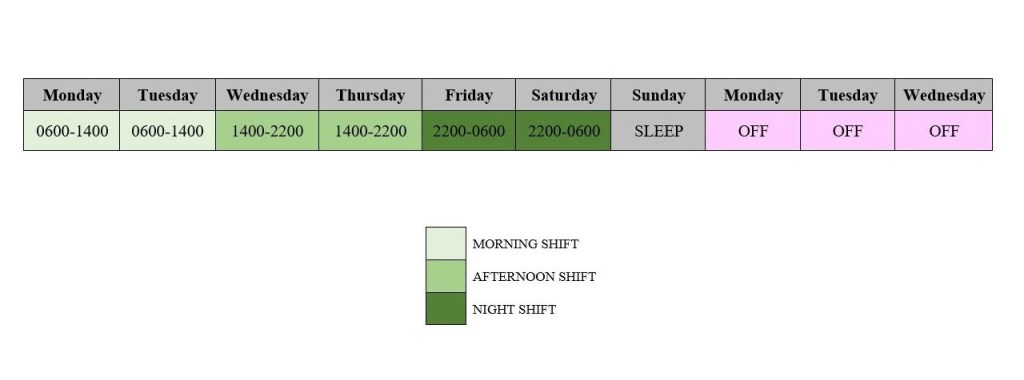
So yes, I do love shift work, but I don’t want to sugarcoat it.  It’s pretty hard yakka.  Regular people work some variation of nine to five, Monday to Friday, with weekends off, right? We don’t get weekends off. Or public holidays.  What’s Christmas, what’s New Year’s Eve, what’s Easter, what’s Melbourne Cup day?  Also, what’s Saturday, and what the fuck is Sunday?  I do not recognise any of these days.  They are meaningless to me.  For I am shift worker.  Honestly, I never have any idea what day of the week it is.  Occupational hazard, I guess.  Our work week is six and a half days long, and we are rewarded for that toil with three and a half days off.  Your cycle is seven days.  Ours is ten.  And it looks a little something like this.

Rinse and repeat.

The truth, however, is that even though this is the “standard” work cycle for ATCs in Dubai, our rosters are a lot more fluid, and a lot less predictable (we usually find out what shifts we’ve been rostered to work for a given month about half way through the previous one). I very rarely work the prescribed cycle of two mornings, two afternoons and two nights.  I wish I did, I would love that kind of stability.  But unfortunately due to staff shortages, training, annual leave, sick leave and controllers being seconded to the office, the roster is usually all over the place.


On the left, the standard roster template for 2018. On the right, the actual 2018 roster. Oh Mr. Hart, what a mess.

So, how does a typical work cycle actually play out?  Let’s start with morning shifts.  We are required to be at work by 0545 for a 0600 start (I’ll be using 24 hour time in this post, as per aviation convention), but I do like to get to work a little earlier to let the night shift zombies go home.  So, for me to be at work by, say, 0530 I need to leap out of bed at 0400.  I actually like to snooze my alarm for about 45 minutes before I actually get up (yes, I’m a weirdo).  This means that my first (of many) alarms goes off at the ungodly hour of 0315. 

Sleepy beepy!

The philosophy behind the myriad alarms is that my everyday alarm tone is a very soothing harpsichord sound, designed to gently rouse me from my slumber.  At 0315 in the morning, however, this doesn’t always do the trick.  The choice of alarms is progressively more likely to penetrate my repose. To that effect, the duck tone alarm is quite annoying.  The bark tone alarm is extremely irritating.  And the Leanne alarm (the back-up alarm of last resort) is actually my telephone ringtone which is the sound I would hear if I did accidentally sleep in and my watch manager was calling me to see where the fuck I was.  It instils enough fear and panic to wake me up no matter how sleepy I might be.  Committing the cardinal sin of sleeping in for a morning shift is a really horrible feeling.  Not only are you late for work, but there’s someone in the tower who has worked an eight hour night shift waiting for you to come and relieve them so that they can go home.  And they’re not allowed to leave until you actually get there.  I’ve only slept in for a morning shift once, and let me tell you it’s a very discombobulating situation. 

Another reason for the plethora of alarms is that it’s virtually impossible to get a good night’s sleep before that first morning shift.  I spend all night tossing and turning, subconsciously worrying that I’ll sleep in, inducing anxiety, which (of course) prevents a good sleep.  It’s a vicious circle.  Plus the only way to get eight hours in bed before my alarm goes off is to retire at 1915 the night before.  Which is impossible.  I always harbour well-meaning intentions of going to bed super early before my morning shifts, but usually turn the lights out sometime between 2100 and 2200 giving me about five or six hours of downtime. Not only do I usually wake up tired for the shift, but the entire cycle is off to a terrible start.  Welcome to shift work world. 

So I get up at 0400 and I get ready for work.  My routine at this time of day is so well rehearsed, it’s as smooth as Swiss clockwork.  Everything is done on autopilot.  David and I dance around each other like a beautifully choreographed ballet.  I don’t rush around like a crazy person, but every minute counts and there isn’t a lot of room for unforeseen variables.  The last couple of years I’ve also had to factor in an extra five minutes sprawled on the couch for the inevitable early morning hot flush episode that has become a stalwart component of my routine.  Menopause is fun! 

I’m usually out the door by 0450 and get to the tower by 0530 to take over position.  Depending on how many controllers are rostered for the morning, I might rotate through two hours in position, followed by a two hour break for the eight hour shift, or I might work two hours in position with a one hour break.  The maximum number of hours I can legally work is two and a half, after which I’m required to have at least a thirty minute rest period.  These rules are set by the General Civil Aviation Authority (GCAA), which is the regulatory body for aviation in the UAE.  And they lay down a lot of other rules regarding shift work in the tower, which I’ll talk more about later.  At the end of my shift, I’ll usually leave the tower some time between 1330 and 1400 and reach home by 1500 at the latest.  Those of you who read my previous ejo know that this is the ideal time for a coffee nap, and I almost always have one after a morning shift. 

Afternoons are my least favourite shifts.  The whole day is kind of fucked for getting anything done.  We usually get up around 0830 which isn’t super late, but it’s still an extra four and a half hours sleep than the previous two days so it feels like a real luxury, and actually plays a large part in our sleep debt recovery.  We have a little over four hours to get shit done before leaving for work.  Shit includes going for a walk followed by a yoga session, showering and washing my hair, reading my emails, playing Wordle, responding to messages, cooking and eating lunch (which is usually a delicious, juicy steak) and then doing the dishes, and also preparing something to snack on at work later that evening.  It can be a bit hectic to be honest.  I normally get to the tower at around 1330, send the morning shift on their merry way, and settle in for the next eight hours.  Maybe it’s because the shift straddles the transition from day to night, but afternoon shifts just seem to drag on and on and on.  They’re boring as hell and by the time I get home at around 2300 it’s way too late to do anything.

Morning shifts used to be my favourite because I’d get the whole afternoon off, but lately I’m starting to really feel the exhaustion of having to wake up so goddamn early.  Let’s not mince words, I’m an old lady now.  My new favourite shifts are night shifts.  Sure it’s tiring having to stay up all night, but when there are only two of us rostered, we work a great schedule that gives each of us a two and a half hour break in the middle, so that we can both have a good rest.  This means that I have the entire tower to myself for a couple of hours at a time while my colleague naps.  It’s me time, baby. I play a little background music, I eat a little midnight snack, I talk to some pilots in my night shift voice, I plan holidays, I water the tower plants, I do some squats and I work on my ejos.  I actually have a really good time.  David doesn’t have it so lucky.  Night shifts at DXB are usually the busiest shift of the day, so while I’m dancing around my tower, David’s working his ass off in his. 

Despite me having it relatively easy on the night shifts, I still have to be awake and alert at an hour when most people are fast asleep.  By the time David and I get home at 7am after a night shift, we are both pretty fucking knackered.  We’ll have a quick shower and go to bed for a few hours, and get up just before midday.  It’s definitely not enough rest, but sleeping into the PM messes with my circadian rhythms too much. Everyone deals with night shifts differently and a lot of the local guys sleep until the late afternoon following a night shift, but there’s no way I could do that. I subscribe to the jet lag school of thought, sticking as close as possible to my regular schedule, even though it’s exhausting, and even though it means I need a little extra time to recover. At least I’m not completely screwing up my sleep/wake routine. David and I tend to take it very easy in between night shifts, rarely scheduling social engagements or appointments that would require us to leave the house.  We lay low and make sure to squeeze in a 20 minute coffee nap sometime during the afternoon.  It ain’t a lot, but it definitely helps.  And later that evening, we lock up the house, get in our cars and set off in opposite directions to our respective airports to do it all again. 

The day after our second night shift is called a sleep day, or a rest day, for obvious reasons.  It isn’t actually considered a day off (since we’ve worked the first six hours of it), but it’s not considered a full work day either (since the shift started the previous day).  When I was a younger woman, I secretly did think of sleep days as a day off.  Oh, the impertinence of youth.  These days it truly is a day of rest, and it generally takes me the whole day to recover from having worked the cycle. 

Fatigue caused by shift work is a massive concern in the aviation industry, and there are very strict rules about the hours that air traffic controllers can work.  I already mentioned that we need to take a break every two and a half hours, but there are many other rules governing our rostering principles.  For instance, a controller can only work a maximum of ten hours in a single shift.  And we must have a minimum of ten hours between shifts.  We can’t be rostered to work more than three night shifts in any rolling ten day period.  And if we’re rostered to work seven days in a row, we must have a minimum break of two and a half days (or 60 hours) before coming back to work.  And there are lots of other restrictions that get a little technical, things like “Within 720 consecutive hours (30 days) the aggregate of duty periods and standby duties shall not exceed 300 hours, provided that duty periods do not exceed 200 hours.”  Blah blah blah.  At the end of the day the rules are there to protect us, the controllers.  But they’re also there to protect the unit.  And our employer.  And the airlines.  And the pilots. And the flying public.  Fatigue is no joke. It causes errors in judgement, and that’s something air traffic controllers simply can’t afford.

Working a reverse rotating shift cycle (starting with early mornings and progressing through to night shifts) is supposed to be the least fatiguing roster, and I actually prefer it to the forward rotating cycle that we used to work in Melbourne tower (which started in the evenings and progressed through to morning shifts).  But at the end of the day, fatigue wins.  It always wins, and it’s impossible to avoid. All we can do is mitigate it, but it will always be a huge issue in air traffic control.  As I mentioned earlier, I need to be functional while doing a relatively complex job at a time of night when all my body wants to do is curl up and go to sleep.  And that takes a toll.  Shift workers are notoriously prone to a cornucopia of health problems including heart disease, obesity, high blood pressure, reproductive issues, ulcers, diabetes, depression, low testosterone, insomnia and stroke.  In fact working shifts is so bad for your health it even has a disorder named after it.  Yay? 

As a bonus, we are also way more susceptible to death.  In a very large, famous, longitudinal study, The Nurse’s Health Study, researchers followed 74,862 nurses over a period of 22 years and concluded that the nurses who worked rotating shifts for more than 15 years were 38% more likely to die from heart disease, 25% more likely to die from lung cancer and 33% more likely to die from colon cancer than their counterparts who worked day shifts only.  Sobering.  In fact it’s so unhealthy that in 2007 the World Health Organisation declared that shift work was a probable carcinogenic.

So how does shift work wreak such havoc in the body?  It’s all to do with circadian disruption.  Having to be wide awake at 0200 isn’t just a pain in the ass, it also throws a spanner in the body’s finely tuned chemistry, creating hormonal chaos and laying waste to our biological homeostasis.  This is such an interesting and expansive topic that I’ll be writing about it in my next ejo, so keep an eye out for that.  In the meantime, all you need to know is that my highly paid job is almost definitely killing me. 

But I do not want your sympathy.  Absolutely not.  Fuck that noise.  I’ve made a choice to stick to this beautiful career, and despite its pitfalls I feel absolutely #blessed.  If you go back and have another look at that 2018 roster, zoom in and check out all those greyed out dates.  Those are holidays, bitches.  In January we went to one of our favourite destinations, Japan, spending time in the ski fields of Nagano, as well as drinking our body weight in sake in bustling downtown Tokyo.  In February we took a short four day trip to Sri Lanka during our days off for David’s birthday.  In mid-April we travelled back home to Australia to see family and friends.  And five days later we jetted off to France for a couple of weeks, attending a close friend’s wedding in the French countryside.  In June/July we spent two and a half glorious weeks in Amsterdam, introducing my youngest sister, Pieta, to our favourite city.  And in mid-August we were lucky enough to be able to travel to America for six days to go to the wedding of another close friend.  When we got home we had enough time to do some laundry before heading straight back out again three days later, visiting Sicily for the very first time.  We obviously loved it because we went back in October, this time with my sister Mary in tow.  So yeah, while my job is basically murdering me, at least I’m having fun with the time I’ve got left.

So now you know what it’s like to be a shift worker.  Or rather, now you have an inkling of what it’s like to be a shift worker.  If you dare, I challenge you to simulate just one of my night shifts and see how it really feels.  One Saturday morning, just get up at your normal time and go about your day.  Remember to have a coffee nap (or maybe an even better idea might be to have a proper, long nap), and then at 2050, get in your car and drive around for 45 minutes.  Come back into the house and start working on something.  Maybe you have some office work to do, maybe a hobby.  But you’re not allowed to watch TV or use your phone (coz we’re not allowed to either).  At 2330 you’re on a break for two and a half hours.  I suggest trying to sleep.  But don’t forget to set an alarm (or four) to make sure you are up and ready to take over again at 0200.  This is the tough part.  It’s usually quiet on the night shifts, but sometimes you wake up from your nap and you have to hit the ground running.  You can’t afford to give in to your sleep urges.  Feel free to have a coffee if you think it’ll help.  I no longer drink coffee on the night shifts (in fact I only have it for coffee naps), but I’ll often have a little snack right around this time for some energy.  A boiled egg or a few strips of bacon.  But you do whatever you need to do to stay awake.  And don’t forget to work.  You’re in position until 0430.  You can’t slack off. And you can’t fall asleep.  So keep working.  Naps on the job will get you fired.  Or, worst case scenario, kill people.  At 0430 your imaginary partner takes over and you can chill for a while, but you can’t go home yet.  Not until the morning crew arrives to relieve you from your duties.  You can have another little nap while you wait, but at 0600 you need to get up, get in your car and drive around for another 45 minutes.  When you finally get home on Sunday morning, you’re done.  Congratulations, you’re an honorary shift worker.  How do you feel?  Now do it again.  And repeat every ten days for the next twenty years.  Bet you can’t.

So, think of us… next time you have a late night pizza delivered, next time you need to go to the hospital in the wee hours of the morning, or have to call an Uber to take you home after a big night out. Think of us when you need to call a locksmith, or have to catch an obscenely early flight.  Think of us, the weirdos, the shift workers.  While you’re sleeping, we keep the world turning. It’s tough work, but someone’s got to do it.