The Extraordinary People I Know

Ejo #165 – Dad

My father died 20 years ago today.  His death fucked me up pretty good.  Actually, his illness didn’t do a bad job of fucking me up either.  Watching him deteriorate from a strong and vital man into a shell of a human being, someone I barely recognised, sent me plummeting into the deepest and darkest depression I’ve ever experienced.  The ten months of his illness were agonising, and the months afterwards were very much worse. 

Until my father died, work was a source of great comfort for me.  A place I could escape the gnawing torment of his decline.  A place of relief from the anguish.  I was working as a junior air traffic controller at Moorabbin, which is a busy airport full of training aircraft.  It’s chaos.  Delving into work, my focus was laser sharp and blinkered, all the better to not allow any thoughts of my father to seep into my consciousness.  I was depressed, yes, but I was functional.  In stark contrast, after Dad died, I became catatonic.  I couldn’t eat, I couldn’t sleep, I couldn’t do anything.  And I certainly couldn’t work. 

I was off work for three months, and spent all that time at our family home with my Mum and sisters.  I slept in the living room on a foam mattress which I made up every night, and packed away every morning.  Sleep was elusive; my head filled with swirling memories and jagged thoughts that were so painful I would just sob into my pillow for hours.  I was eventually prescribed sweet, merciful Temazepam to help with the debilitating insomnia, which was a life buoy thrown to me when I was drowning in a tempestuous sea of grief.  My waking hours were spent staring into space.  Aimlessly shuffling from room to room.  I was completely numb and I don’t remember much from that time.  I lost a lot of weight.  I rarely left the house.  I cut myself off from all my friends.  My father’s death knocked me out.  It was a king-hit that took me more than 18 months to emerge from.    

My mother never resurfaced from her loss.  When Dad died, a very large part of her did as well.  She never stopped loving him with all her heart, and she stubbornly refused to live a full life without him.  To my Mum, Kon’s ashes embodied his soul, and until the day she died she kept a lit candle beside his urn on the mantelpiece in the living room.  She said goodbye to him when she left the house, and hello when she returned.  Goodnight when she went to bed, and good morning when she woke up.  It was her way of staying connected to him, even though he was gone.  It was her way of keeping him alive, and that gave her comfort. 

My mother’s death hit me very differently.  Firstly, even though I knew she was sick, I didn’t know that she was at death’s door, so I was totally unprepared.  Secondly, she was my mother, not my father.  And thirdly, after Dad died, I still had my Mum around for another 15 years.  But when she died too, suddenly they were both gone and I experienced not just the loss of a very important person in my life, but the loss of my roots, my anchor, my family unit, and my very foundation.  And the loss was profound.  I didn’t get depressed, like when Dad died.  Instead I succumbed to an extreme and overpowering sadness, the depth of which I could never have imagined possible.  The sadness that I felt was not normal.  My whole life leading up to this event, sadness was a room on the ground floor.  Maybe when things got really bad, it went down to the basement.  But suddenly, when my Mum died, I realised that it was not the lowest, or the worst, that I could feel.  I learned that there were twenty cavernous levels below the earth that could fill up and overflow with my sadness.  It’s like when people say you don’t know how much love you can truly feel until you have a baby.  Well, maybe you don’t know how much sadness you can feel until you lose your mother. 

I’ve spent the last four and a half years since my mother’s death fiercely grieving her.  I miss her deeply and still sometimes cry myself to sleep when it just hits me in the chest that she’s gone and that she’s never coming back.  I think of her every single day.  I see her picture on my bedroom wall every single day.  And every single day something reminds me of her, and I’ll say emphatically, “I love my Mum”.  Because I really fucking do.    

Conversely, in the last four and a half years, I have hardly thought about my Dad at all.  Deplorably, I haven’t had any room in my heart for him.  And I feel so incredibly guilty that the all-consuming grief I feel for Mum has completely supplanted the grief that I was holding for my Dad.  And of course, intellectually and emotionally, I know (I know!) that I still love my father and I know that I miss him and I know that I grieve for him.  And of course it’s not a competition about who I love or miss the most.  But I am grateful that this, twentieth anniversary of his passing, is an opportunity for me to once again focus on my Dad, and to once again make some room for him in my heart where he belongs. 

My parents were very different people, and had very different parenting styles.  My Mum was all heart, loving, open and warm.  My Dad was more outgoing and filled the room with his personality… which could sometimes be a lot.  He had been raised in a household where the man was in charge, the man was the be-all and end-all, the man wore the pants and the man had the last word.  My Dad’s gentle nature prevented him from becoming the kind of authoritarian parent that his own father was, but still he could be pretty strict and uncompromising, especially when my sisters and I were teens.  I think that when his three daughters started growing up, it triggered an internal clash between his easy-going personality and the stern parental conditioning he’d grown up with.  And this started causing a rift in our family.  Being the first born child, being the one for whom rebellion simply wasn’t an option, I accepted all the rules.  I was the good girl.  And I’m grateful to both of my sisters, for being significantly more ballsy than I was and smashing down the barriers that had been put around us.  I’m grateful because, even though it caused a great deal of heartbreak and strife and tension in the house at the time, it was the catalyst for our father to change.  As a parent, and as a man. 

I have to give my Dad props for being able to shed generations of toxic masculinity, and to look inwards and realise that he no longer had to be so overprotective and controlling of his daughters.  He understood that if he didn’t make changes within himself, he was at risk of pushing us away, or even losing us completely.  And he changed.  He just did it.  He softened, he became more accepting, and he became more affectionate and open and loving.  He became more himself.  It was a truly remarkable transformation.  Over the years, my relationship to my Dad evolved from worship, to reverence, to fear, to shame, to disrespect, to ambivalence.  And then I went back, and I got to know him as a person, as a human being.  And I started loving him again.  And finally, at the end, after all that, we were friends.  I’m so grateful that we had the opportunity to complete that circle while he was still alive. 

I have so many beautiful memories of my extravagant and irrepressible father, whose extraordinary zest for life left an impression on everyone who knew him.  Even though it may seem trivial, a memory that I hold very dearly is of how gentle my Dad was when he put my hair up in a ponytail when I was a kid.  As opposed to my Mum’s confident and efficient method of whisking my hair up and quickly twisting the hair-tie around the ponytail, my entire head fit into my Dad’s enormous hands as he tenderly stroked my hair, trying so hard to not pull even a single one as he lovingly gathered it up on top of my head.  And I knew, I just knew, even then, as a five, or six, or seven year old, that it was a special moment between us.  I cherished that moment when I was a kid.  And I cherish it now. 

One family story that became legend over the years demonstrates how meticulous and fastidious Dad was about certain things.  He always took such great pride in the way that he looked, and in particular the clothes that he wore.  His sisters, Dimitra and Sophia, recently recalled the story for me, setting the scene at a large family dinner.  Dad, Mum, aunts and uncles and friends of the family were all there, gathered around the table.  Someone was carving and serving a large roast chicken, and a few droplets of gravy splashed onto my Dad’s shirt.  As was his wont, he became very upset.  Everyone there was accustomed to witnessing Dad’s over-the-top reactions whenever he got even a minor stain on his clothes.  But this time, apparently, he became so melodramatic about it that my Aunt Sophia (who was up to here with Dad’s histrionics) lost her patience, and lost the plot.  Wild-eyed, she pushed her chair back, walked around the table to where my Dad was sitting, grabbed the chicken drumstick off his plate and furiously started rubbing it all over his shirt, yelling, “It’s just a fucking stain, Kon!!!”  As you can imagine, everyone was so shocked at the unexpected insanity of the moment, they all burst into laughter.  Everyone, that is, except my Dad, who sat frozen like a statue, staring straight ahead with a stony look on his face. 
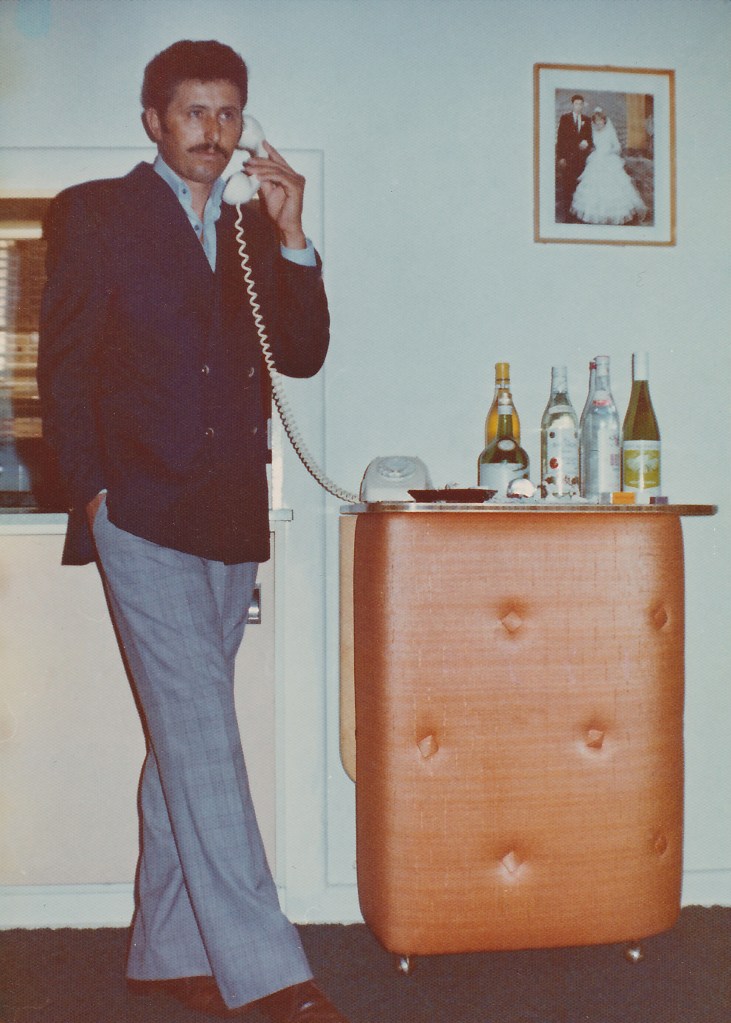
Hello police, I’m dressed to kill and I’d like to report a murder.

Thinking back, I remember lots of stories from my Dad’s youth.  Like the time a tree he was standing right next to was struck by lightning.  Knocked out by the impact, my father lost his sight and couldn’t see for hours afterwards.  When his eyesight returned, he went back to the tree, which had been cleaved in two, and found a stunning gemstone in the cradle of the split trunk.  The stone was a brilliant azure blue, and I remember seeing it and holding it and being in awe of it when I was a kid.  My Dad treasured that gemstone, and I wish with all my heart that I knew where it was. 

My father’s family were so poor that his parents couldn’t afford to feed all six of their children, so when my Dad was 17 years old, a deal was struck to foster him out to some neighbours, a rich family that lived just down the road.  Until then, my father had never even worn a pair of shoes.  So the pride that he took in his clothes later on in life makes total sense to me.  The couple that “adopted” my Dad were in their sixties and didn’t have any children, but they promised to secure him financially and to love him like their own.  The first few months went smoothly, and Dad helped them on their farm and generally did whatever was needed around the house.  He even used to drive the couple to church every week.  In a village where most families couldn’t even afford a bicycle, this was a big deal. 

After a while though, the couple started talking about weddings, suggesting that Kon marry their niece, but he wasn’t interested.  So the old guy started imposing a curfew, saying that my Dad (who was 19 years old by that time) had to be home by 10pm on Saturdays.  Obviously this was total bullshit and Kon justifiably stayed out until the wee hours of the morning that first weekend.  He did the same the weekend after.  And on the third weekend in a row that he came home late, he found the door to the house locked.  And that was it, that was the end of the deal.  That Sunday morning, his younger brothers and sisters woke up to find Kon sleeping on the floor next to their beds, and the whole family rejoiced that he was finally back where he belonged. 
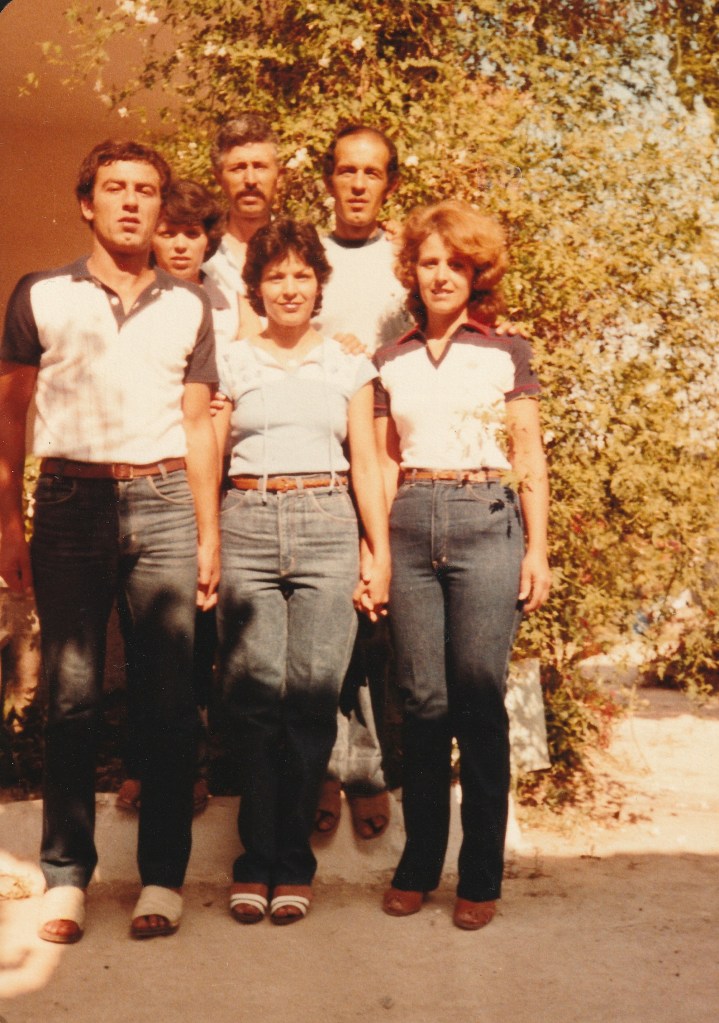
Beloved siblings (Back row: Roula, Kon & Christos and Front row: Stavros, Sophia & Dimitra)

Kon Stathopoulos was a singularly brilliant man.  He pulled himself out of abject poverty in Greece, and created a whole new life for himself in Australia.  He completely rewrote his destiny.  My Dad was a dreamer and a big thinker!  Sure, he drove trucks, and then later taxis, but my Dad was too big to be a taxi driver forever.  He worked some shitty jobs to make ends meet, but in his spare time he was an enthusiastic entrepreneur.  Bow ties, light up yo-yos, silver screens for cars, decorative ceramic tiles.  He tried a whole bunch of innovative business ideas before finally starting his own company, Plastercraft Contractors. 

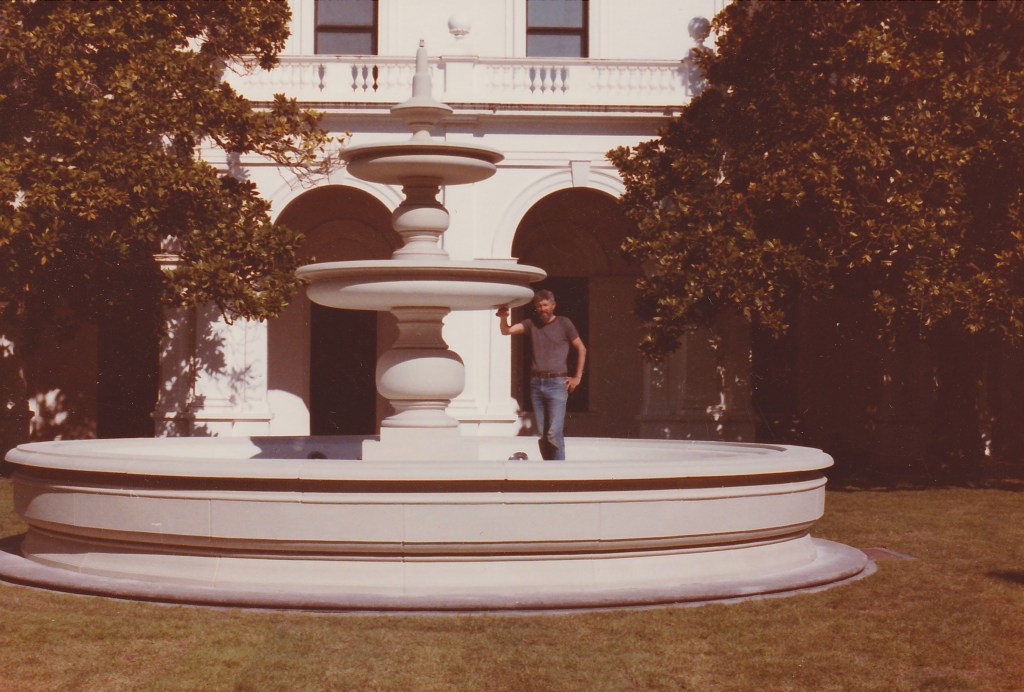
A one-man show, my Dad took solid plastering to the next level, turning it into an artform.  Within just a couple of years he had built such a great reputation in the industry that he was asked to singlehandedly restore the exterior of a large church in Ballarat.  He was also commissioned to create a new plaster cast emblem for the Red Eagle Hotel, in Albert Park, the very same bar where Kylie Minogue had her 21st birthday party!!!  He then landed the extremely exclusive job of re-designing and building the beautiful and iconic fountain at Government House in Victoria.  Every year on 26th January, Government House opens its doors to the public, and thousands of people get a chance to peek inside the stately home and to roam through the gardens.  There are also monthly tours of the 11 hectare garden which anyone can book, so why not go along on one of these tours and see for yourselves the amazing sculptural achievement created by my very own father. 

.

.
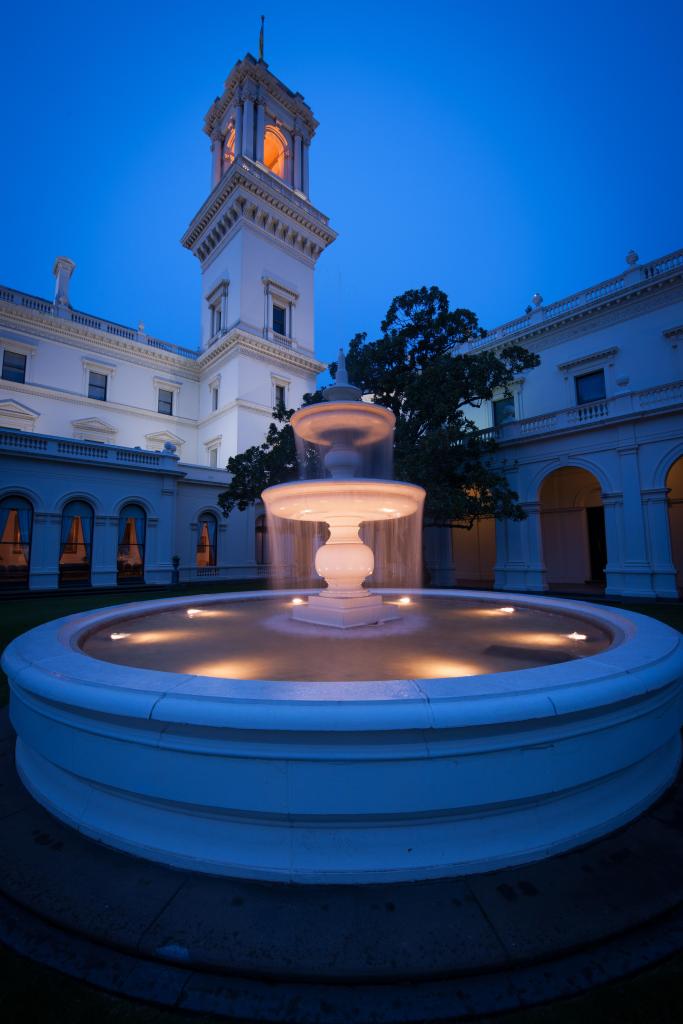
The current phase.

Later on, due to the success of his business Dad expanded into larger scale projects like apartment building construction sites.  He often invited me to join him and earn a little bit of extra cash, and I once hit the jackpot, making $400 in one week being an elevator girl, asking big burly construction workers wearing hardhats, “Which floor?” for eight hours a day.  It was here that I first saw the man that my father had to be when he wasn’t with his family.  For the first time, I heard him casually throwing around words like, “fair dinkum”, “bloke”, “smoko”, and I even heard him say “fuck” a few times.  My brain exploded.  As a 21 year old I’d never heard my Dad swear at home, yet here he was cursing with such ease and regularity.  It was surprising, but also kind of nice, to discover this other side of Dad that I’d never seen before.  It added yet another dimension to him. 

My Dad left his mark on some pretty important buildings, but his passion project was building a holiday home for our family in Ancient Korinthos, in Greece.  The construction took him several years, and was (mostly) finished just before he was diagnosed with lung cancer in 2002.  His dream was for the five of us to holiday there, as a family.  But tragically, he never lived to see that happen.  The house is still there, an empty monument to one man’s vision. 

.
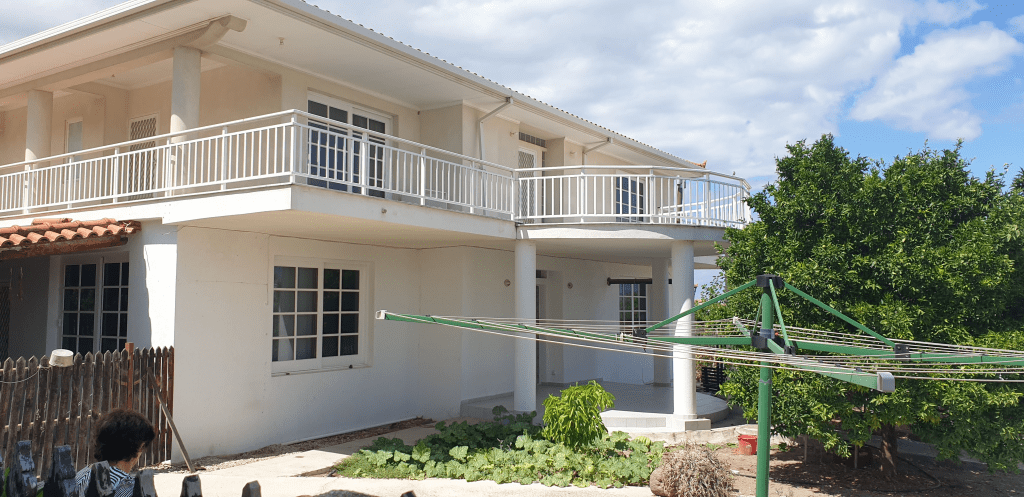
The dream. With Greece’s only Hill’s Hoist.

I have a cute little blue urn on my bedside table, which holds a little bit of my Mum’s ashes and a little bit of my Dad’s ashes all mixed together.  I thought that having my parents close to me when I sleep would provide me with some sense of closeness to them, like my Mum used to get from having Dad’s ashes near to her.  But I was wrong.  I get nothing from it, except an academic understanding that my Mum and Dad’s cremated remains are next to me when I’m in bed.  I have no response to it at all, emotionally.  Sometimes I’ll shake the urn, and listen to their bone fragments rattling inside.  I know what’s in there, I know that it’s them, but even so, there’s no connection to who they were when they were alive.  I wish there was. 

Hello Mum and Dad, it’s me, Chryss.

My Dad really shaped the first 32 years of my life.  His first job in Melbourne was in the inner-city suburb of Carlton.  So naturally my father was a Bluebagger.  Therefore I am a Bluebagger.  Dad inspired my love of tennis, and I played competitively for years, even aspiring to turn professional when I was sixteen.  He taught me all the tricks of how to play a solid game of backgammon.  When I was 15, he taught me how to drive a manual in a rusty old Land Rover on a hilly farm with no roads.  And once I’d mastered that, he took me to an abandoned industrial estate in Springvale to learn how to drive his crappy work van. The one with the dodgy clutch and the sticky column shift.  And once I could drive that, I could drive anything.  I’m pretty sure that the reason I love to throw epic parties (and I really do love to throw epic parties) is because I inherited my Dad’s passion for entertaining, and showing people a good time, and living large.  It’s funny, what gets passed down from father to child.  Being a sports fan can be one of those things.  Wanting things to be just right, might be another.  A house in Greece, another still.  But maybe a zest for life and knowing how to dream big are the most important things a man can pass on to his daughter. Thanks Dad.

Ejo #164 – The Extraordinary People I Know: Mear

Some of you might remember the opus I wrote on NFTs about a year ago.  Even though the heat on NFTs has cooled a little, I’m still involved in the scene, especially on Twitter which has a very strong and vibrant NFT community.  My feed is often filled with gorgeous artworks, posted by artists trying to get their name out there.  About ten months ago I was scrolling Twitter and came across an absolutely stunning piece by a Chinese artist called Mear.  I commented on it, we chatted for a while and got to know each other a little bit, and I decided to buy the NFT.  In fact, I fell in love with the entire series and bought all six pieces.  It feels very special to have supported Mear as she was starting out in the NFT world, and over the months we have come to know each other quite well.  One of the reasons I love NFTs as much as I do is that as a collector you can discover art that you never would have otherwise been exposed to.  And for Mear, as an artist, the converse is also true.  Would she have sold the entire collection of her Swaying series to an Australian woman working as an air traffic controller in Dubai if it wasn’t for NFTs?  I highly doubt it.  I feel very honoured that Mear took time out from her very busy schedule as a full time artist, teacher and prospective PhD student to answer a few questions about her art and about herself.  Mear’s English is way better than my Mandarin so we conducted our interview in English, with a little help from Baidu and Google translate.  I do hope you enjoy our conversation as much as we did. 

Thank you so much Mear, for taking the time to talk to me about NFTs and art, and in particular your specialty, Chinese painting.  I absolutely treasure the six NFTs in my collection that comprise the Swaying series.  Can you tell me the inspiration for the series, what each one of them means and why you chose these individual names: Imagine, Disconnected, Vague, Praise, Flourish and Indigo?  
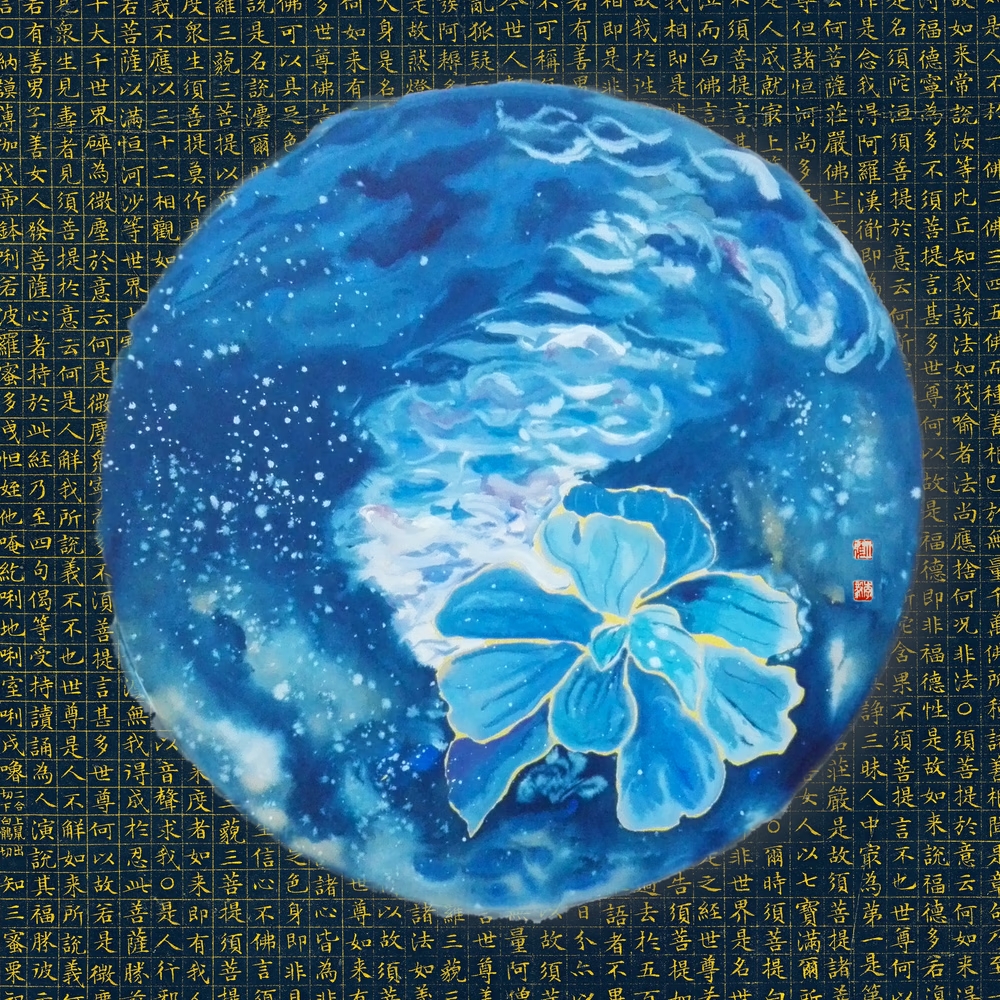
The Swaying series is based on the practice of using heavy colour to create small paintings.  I was inspired by some wildflowers on the side of the road.  It was a rainy day, and the wildflowers were swaying, east and west, causing the water on the petals to produce a magical refraction effect.  I imagined the flowers floating in the buoyant sea, swaying in the water and creating beautiful ripples.  So, I began to draw these pictures from my imagination. 

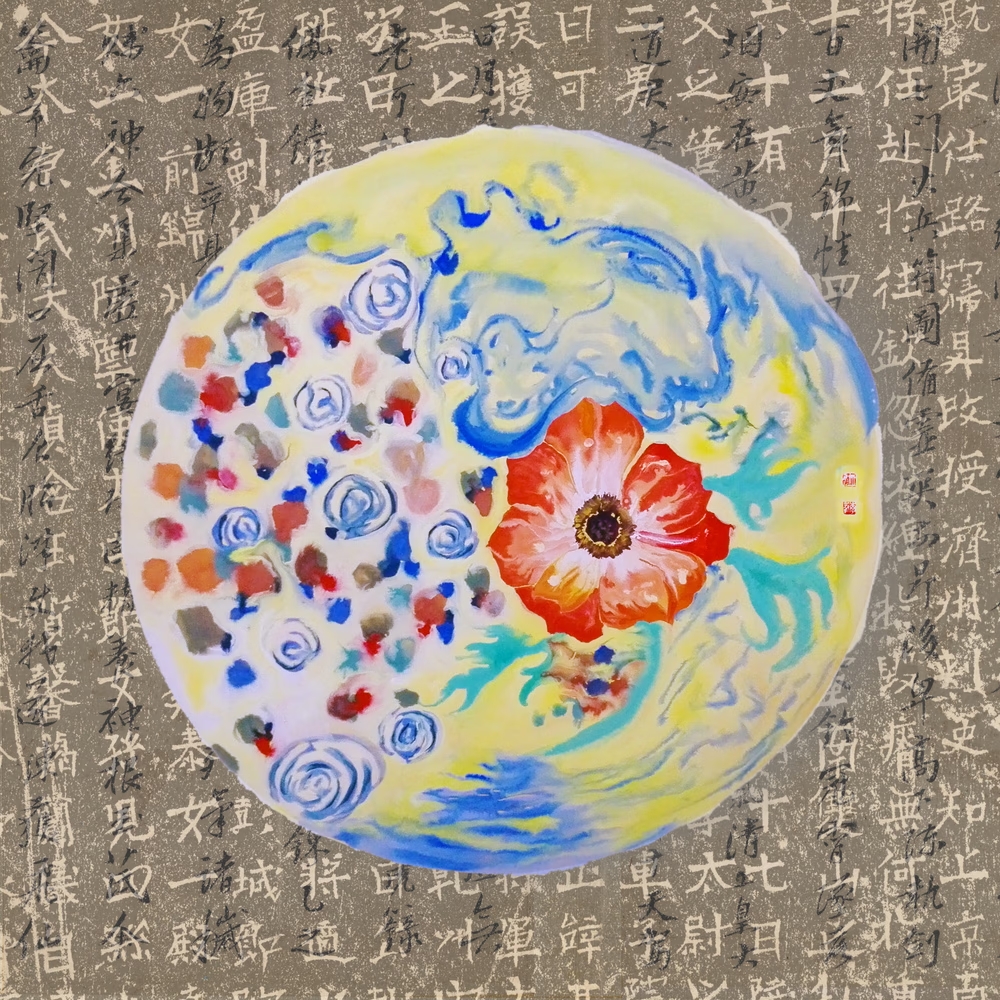
The Swaying series is a dynamic description of petals floating in water.  The Chinese word for each of the paintings is very simple, but very clear.  Imagine is the first painting in the series, and represents the fluctuation of my creative thoughts.  When I was a child I remember watching a cartoon called Bug Division, and a scene from that impressed me very deeply.  So I used rattan yellow and a little gold to try to recreate the gold and black space from the TV show. 

Imagine

Disconnected describes the camellia at night, a bit like smoky moonlight.  Vague uses the purple tone that I like, but purple is very difficult to show, so I added some clam powder to foil to make it stronger.  Praise depicts the summer forest, with a variety of different colours of leaves.  I added the rock colour, to make it look even more gorgeous and thick. 

.

Indigo depicts a four-leaf clover floating in the lake in winter.  The lake is usually blue, and the water is very deep, but clear.  And Flourish depicts a variety of colourful flowers blooming in spring.  It represents the Chinese people walking in the flower filled street during the Spring Festival.  Very rich and beautiful, it indicates strong vitality.

.

You hand painted each one using ink and brush on paper, and digitally added the Chinese characters in the background.  What do the characters say?  Do they have a special meaning?  
The calligraphy pictures in the background are high-definition pictures I downloaded from an app called China Treasure Museum, which are all very good works by famous masters before the Qing Dynasty. 

For example, as the background in Imagine, I chose a short section from Zhu Dao’s Seven Frames of the Interior Classic from the Qing Dynasty, which is a work mainly about the preservation of health.  And in Disconnected, I chose a paragraph from the epitaph of Zhang Sizhong of the Liao Dynasty.  The epitaph is written for the dead, recording the names, titles and life stories of the deceased.  These pieces were chosen as the backgrounds because the calligraphy is really very good, and worthy of our observation and study.

I’d love to go back to the beginning, if that’s OK.  Your formative years, your childhood, where you grew up, how you grew up. Were you raised in an artistic family? 
People who know me well are aware of my cheerful disposition and how I love to crack jokes. My mother often refers to me as the “happy nut” in our family. However, in public, I tend to come off as introverted and shy, speaking very little. This is for two reasons. Firstly, I’m near-sighted and don’t like wearing glasses, making everything seem blurred. This causes me to overlook many people and things, but it also makes me more focussed on myself, rather than paying attention to external gazes and discussions. Secondly, my dad taught me from a young age that, “The more one talks, the more mistakes one can make”, so I’m always extra careful when I speak or act outside.

I suppose my personality could be classified as a people-pleaser.  Much of it has to do with my parents’ subtle influence. My sister and I are twins, and we were born when my father was quite old, so he’s always been particularly protective. Even to this day, he often warns us about dangers (which I understand, considering he grew up in a time of turmoil, poverty and hardship). For instance, he advises us to be cautious about falling when using an elevator, to keep looking behind us when walking in case someone is following, to not accept food from strangers and always to bring him along for job interviews (though I’ve never actually done so).

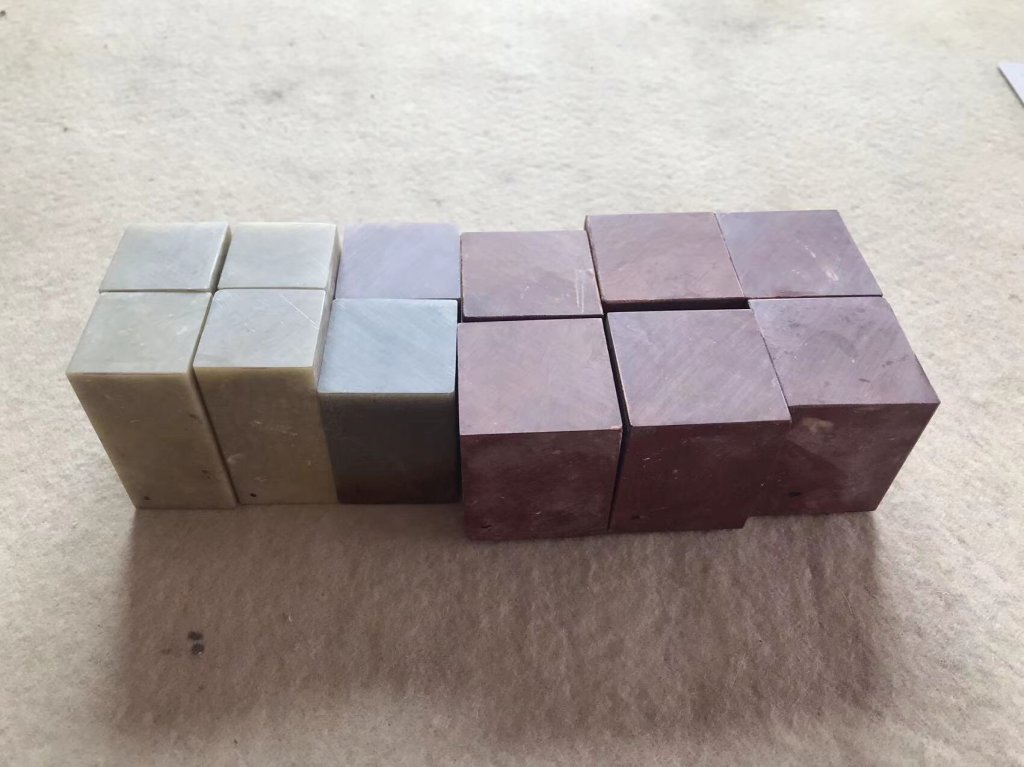
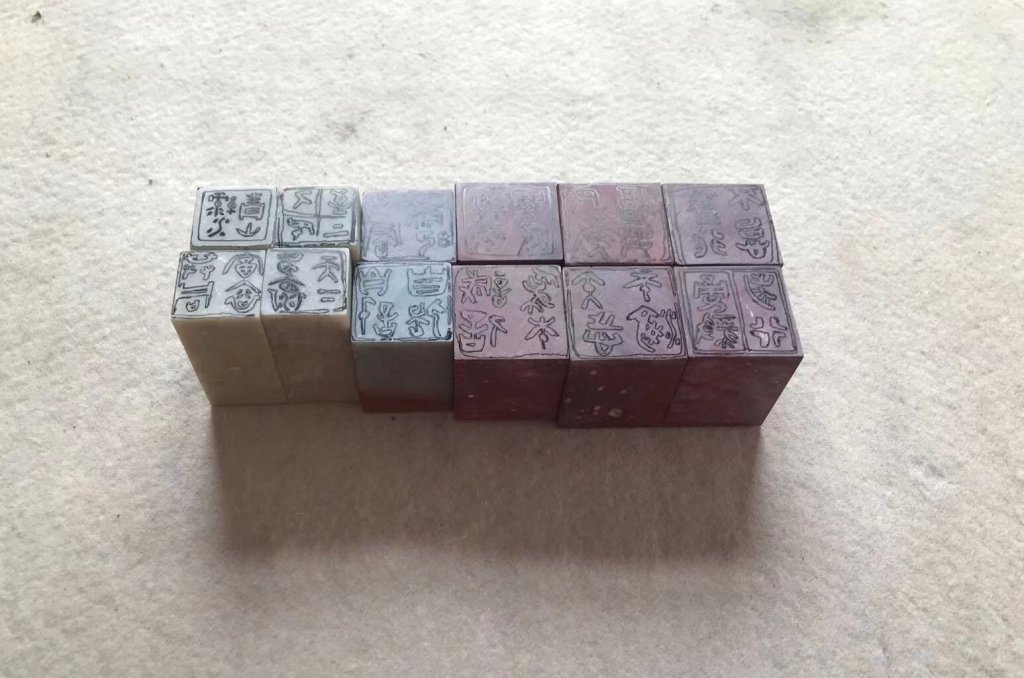
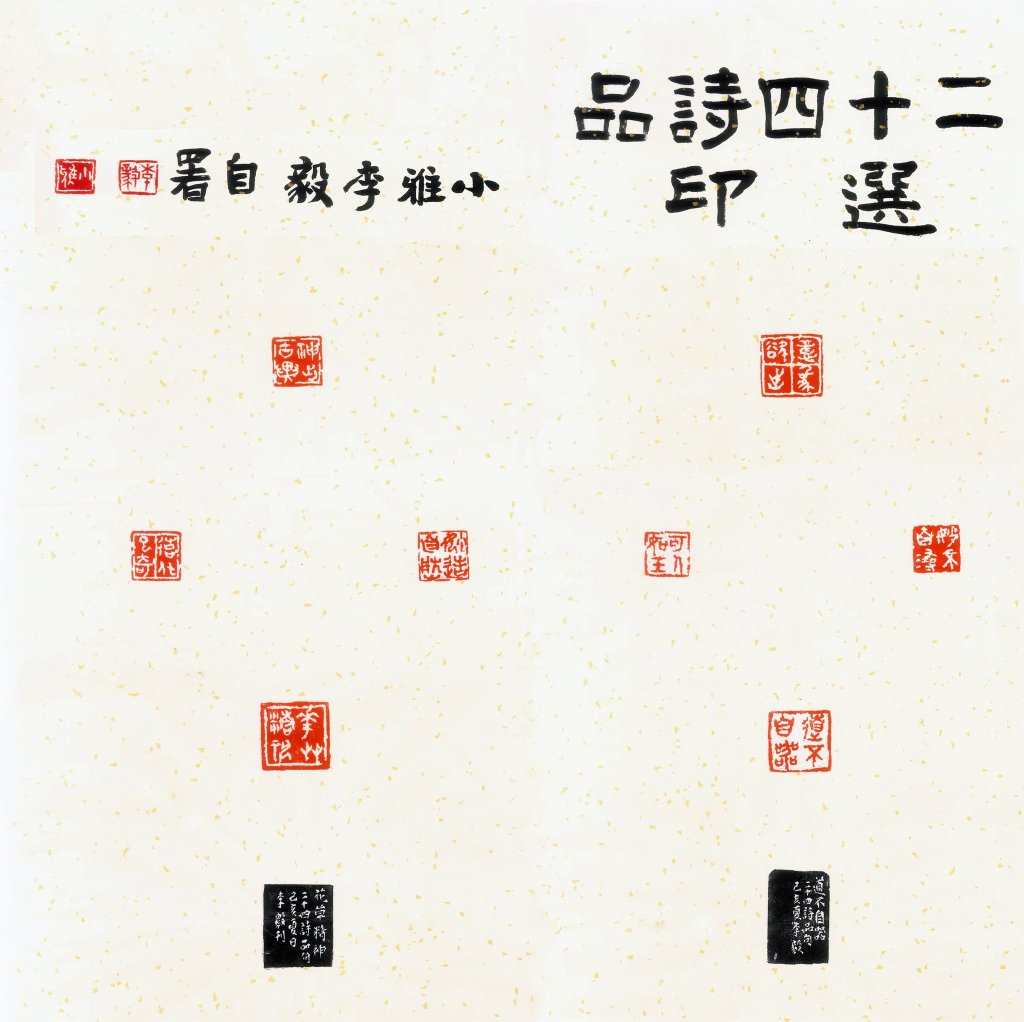
I was born and grew up in Guangzhou, China. Cantonese and Mandarin are my mother tongues. My English education began with my mother, who served as my father’s translator in the 90s; she isn’t so proficient now due to lack of practice. My father only speaks his dialect and isn’t keen on learning new languages. From an early age, he taught us calligraphy and seal carving, but because I was too playful, I didn’t learn calligraphy well, which I regretted later in university (where I was even more playful, haha!). We visited parks every year for our birthdays, so it’s fair to say we’ve explored all the parks in Guangzhou. I joined a sketching training camp one summer in middle school which meant I woke up at 5am and finished at around 5pm every day.  And in the final semester of high school, I attended a painting training camp.  My sister and I were admitted to one of China’s top art colleges. Traditional Chinese painting is something that I picked up in university and have been studying since.

I have to admit that my dad is a good teacher.  His knowledge is extensive and he is incredibly smart.  At my graduation, he was able to discuss poetry and classical texts with my tutor for an entire afternoon.  He has indeed taught me a great deal.  However, he can be too dominant, overly protective and he limits our actions a lot.  By the way, he is a Leo, and I have decided never to marry a Leo man, haha!  

I enjoy discussing artistic concepts and creative processes.  And I also really enjoy painting and I love the surprises that uncertainty brings to my work.  If the surprise is upsetting, I laugh it off, change it and make it beautiful.  Its beauty then reaches others who come in contact with it.  If the surprise is just right, I am overjoyed and celebrate.  

Can you tell us about what you learned at art college?  Have you been working as an artist since then? 
When I was admitted to college, I chose to major in Chinese painting, which is completely different from sketch and colour. It is the pursuit of two-dimensional performance, such as painting figures in exquisite black, white and grey. The description of the painting “object” must be very accurate and careful in order to create a three-dimensional sense from it. Traditional Chinese painting pays attention to artistic conception. Artistic conception is hazy beauty, or transcendent beauty, from limited to infinite.  The concept of “mood” is richly embodied in Chinese painting. The theme, its composition, depiction, emotion, and overall arrangement must all convey this mood, sometimes described as the soul of a painting. Chinese paintings are often called silent poetry. The harmony between an object’s characteristics and the artist’s emotions is what gives a painting its poetic essence, creating art that intrigues and resonates. A painting that deeply conveys emotions and has strong expressiveness captivates its viewers.

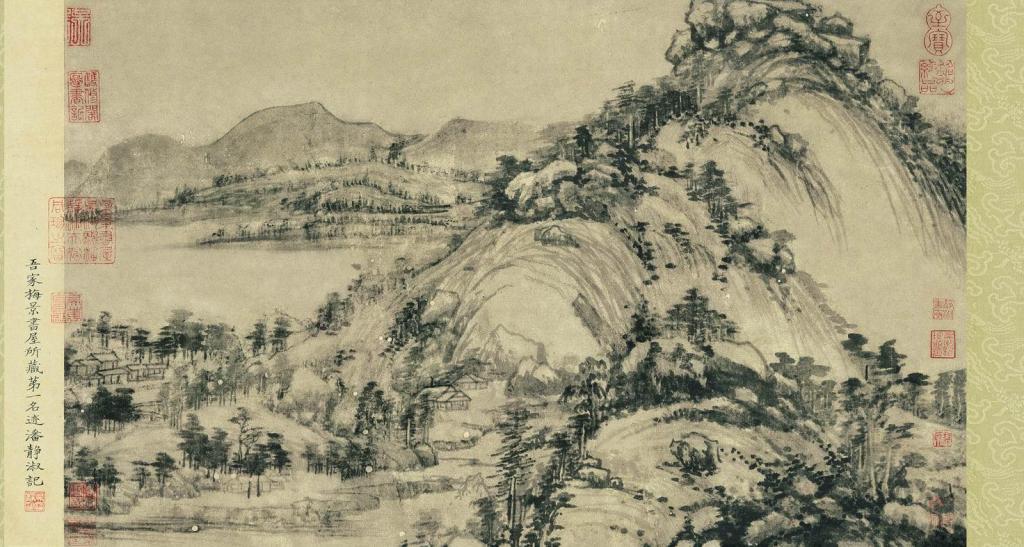
Traditional Chinese painting is done with a brush. The front of the brush can be long or short, and the amount of hair will affect its water absorption. Therefore, there are often uncertain factors when using a brush, so strong control ability is needed. When I was an undergraduate, the teacher let us learn landscapes, figures, flowers and birds, and then choose the direction we wanted to further our study. I chose landscape painting. To draw a landscape, we must first practice the basic elements of the painting method, such as: trees, stones, clouds, water flow, etc. And then, we do a lot of copying. We copy the excellent traditional paintings of ancient times, for example Wang Meng’s Seclusion in Qing Bian, Fan Kuan’s Journey to Xishan and Huang Gongwang’s Residence in Fuchun Mountain, etc.  

.

Huang Gongwang’s Residence in Fuchun Mountain

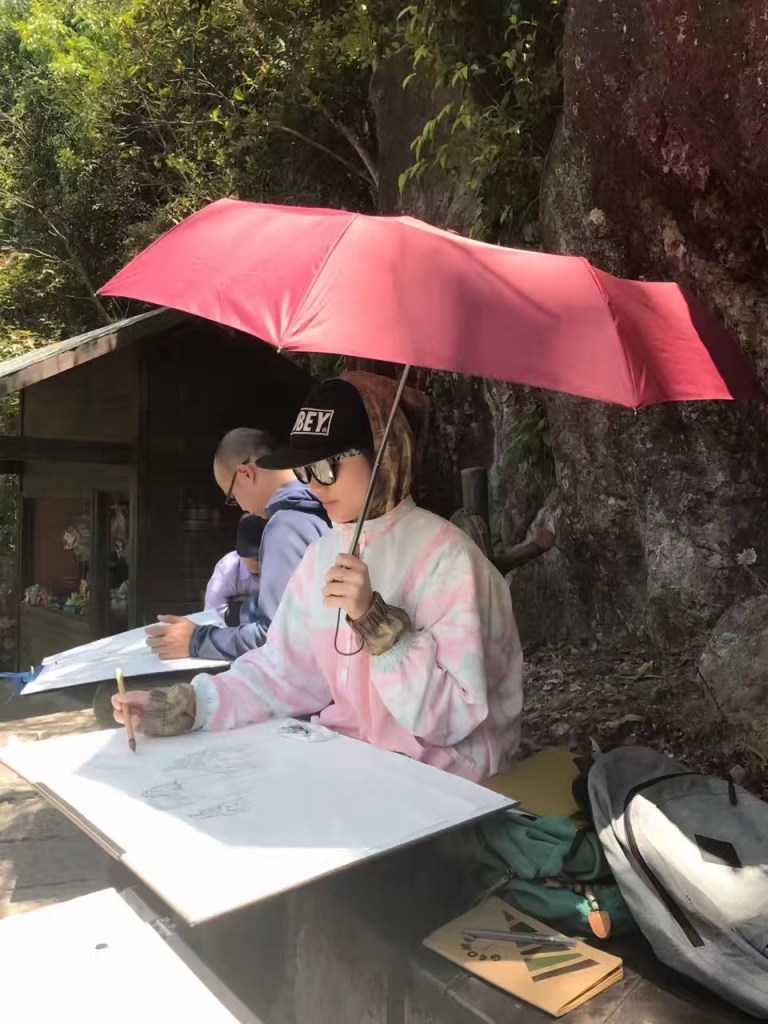
And then, we go back to sketching again.  Every year, we follow our teachers all over the country to sketch.  Places such as Taihang Mountain in Henan Province, Tiantai Mountain in Zhejiang Province and Jinggangshan Mountain in Jiangxi Province.  And finally, the creative stage.  Creation stage is the hardest; to draw a picture from present life, and to combine the techniques learned to make the performance work.  In this process, I often experience long periods of self-doubt because a brush stroke might not meet my expectations.  It’s just a very struggling process.

Taihang Mountain

I am a professional artist, but not full-time, I am an art teacher for children because I need a stable job to guarantee my life.  My teacher at college told me to “Live first, and then pursue the ideal”.  I am an idealist in the bottom of my heart and a very romantic person, but I also know that I must face reality. 

Two of Mear’s students earnestly creating their masterpieces

How did you first hear about NFTs, and how did your classical art training translate to digital art? 
I heard about it from my friend.  At first, I didn’t care about it, but later, when more people discussed it, I gradually learned more and then became interested.  I draw with pen and paper and then take photographs of the artwork, which I adjust through the computer to form an NFT.  I use simple retouching tools like Sketchbook, because I feel that the computer is hard to operate, at least for me.

What advice would you give to artists who know nothing about the NFT space, but are interested in trying it? 
At present, I often mention NFTs to my classmates, but because we have to use a VPN to get access, many people are not willing to really understand it.  They think it is a new field, or that it is very troublesome, and that it is better to just draw their own paintings.  I would like to say to the artists who are interested in NFTs, that you are very welcome to the world of NFT. Although it is a little difficult to cast into it, isn’t it good to share your works and to find people who like them?

I agree totally, and I’m so glad that you did join the NFT community! Finally, Mear, can you please share with us what you are working on at the moment? And what are your wishes and hopes for the future? 
At present, I am drawing some large landscape paintings, and plan to participate in more exhibitions held by provinces, or by the state. Of course, it is difficult to get the qualification for these exhibitions, but I will try my best. For the future, I hope to become a successful professional painter, just like the famous painters in history.

If you are interested in checking out (and even better, buying) some of Mear’s work, you can find her art at OpenSea and Foundation marketplaces.

Ejo #158 – The Extraordinary People I Know: Melinda Norris (aka My Gratitude Partner)

Last month I wrote about the gratitude practise that I have shared with my beautiful friend, Dr. Melinda Norris, for over eight years.  This month the two of us sat down (virtually speaking) and had a chat about our project, its benefits, and how easy it is to incorporate an everyday gratitude practice into your own life.  Please give a very warm welcome to my close friend, and longtime gratitude partner, Mel. 

I’m still basking in the afterglow of the wonderful day we spent together when David and I were in Australia last month. After dinner at your place, I noticed a copy of your thesis for your doctorate in Psychology being used (egad!!) as a keyboard stand.  And I was absolutely blown away by it.  It’s such an impressive work.  Can you tell us a little bit about it?
Of course. My thesis was an applied PhD as part of a longitudinal project with Victoria Police.  I followed 7,000 staff over three years with a focus on wellbeing.  My research particularly looked at how people cope effectively with the daily hassles and stresses in work and life.  Which strategies are most effective?  How stable is our behaviour over time?  And, how much can be predicted by our personality, versus learnt by life lessons.  It highlighted the value of humour and seeking emotional, and practical, support as three highly effective coping strategies.  It also showed that a lot of our stable patterns of behaviour are just as much, if not more, learned rather than purely a product of our personality.  Which is great, as it means we can learn new ways, and improve how we cope with the challenges that life throws at us!  

Mel’s opus

This might be an obnoxious question, but do you ever take inspiration from our gratitude practise and incorporate it back into your work as an organisational psychologist? 
It’s really rewarding to tap into my passion, research and personal experiences to help others.  So I do take inspiration from our gratitude practice all the time, and build it into work, formally and informally.  For example, I try to explicitly express my gratitude for any support and collaboration with leaders and team members.  This builds relationships and trust quickly, leading to more effective collaboration as a result.  It also helps me to appreciate the small things every day, and to get through setbacks better.  I notice I don’t get stuck in a negative mindset anymore.  I can bounce back quicker, and find a more optimistic outlook. 

Trust me, I’m a doctor.

I think I got really lucky that you asked me to be your gratitude partner. You’re someone who’s made the wellbeing of others their life’s work, and I don’t think it gets any better than that! Do you remember how our gratitude challenge started all those years ago? 
Yes, I clearly remember how it started.  I was reading your Freedom ejo in our kitchen and getting really engrossed in your story.  I got the clear sense that you were committed to staying in Dubai for a variety of good reasons (career, travel opportunities etc.), but that you missed Australia desperately (your friends, family, the environment and climate).  And I got the sense you were struggling with the downsides of your day-to-day life.

I still miss my friends so much.

I could relate.  I too was struggling to feel the joy in my daily life, but for different reasons.  I was working in a high pressure, deadline-driven job with a lot of responsibilities.  Working four days a week, but squeezing what felt like at least five days of work into those days.  I was also a parent to two gorgeous young boys, and I wanted to be more a part of their lives.  I felt so much guilt and sadness, having to utilise before, and after, school care.  I found a solution with a nanny for a few years.  Kim picked the boys up from school, helped them with homework, and prepared dinner three days a week.  Still, I felt incredibly torn.  I wasn’t succeeding in all my roles in life like I wanted to.  And that was just the two most consuming roles.  I also wanted to be a better wife, a better friend, and a better sister.  There just weren’t enough hours in the day, the week, the year!  I was efficient like a ninja, making every minute count.  Doing so much work on my daily commute, so that I could drop everything when I got home and be fully present.  But I still couldn’t help feeling torn between my career and my family. 

I’d been trying different strategies to enhance my wellbeing and help make my life more enjoyable, and less stressful.  As a psychologist, I knew of the power and benefits of practising daily gratitude, empathy and mindfulness.  I tried writing a gratitude journal, but found it tough to stick with, so that strategy didn’t work well for me.  Something was missing.  A key ingredient.

As I read your ejo that day Chryss, I was inspired by the idea of a gratitude partner.  Adding a social component to any wellbeing strategy has an amplifying effect on the benefits.  Just like exercising with a fitness partner; you enjoy it more, you keep up the habit, and therefore you experience the full potential benefits on your wellbeing.  I was so delighted with the idea and thought that you would be the perfect gratitude partner for me.  You seemed like you’d be open to it, like you needed it too; and we were good friends.  Friends that had lost touch a bit over the years, but you were a friend I could trust, and be open with.  A friend I wanted to stay close to, but found that hard with the tyranny of distance. 

So I wrote to you then and there in my kitchen, letting you know that I’d read your ejo, and that I could relate; that I thought we’d both benefit from sharing the things we were grateful for with each other at the end of every day.  I suggested that we keep it simple.  I didn’t want it to feel hard, or like a burden for either of us.  I hoped it would help me to stick to my commitment and form a new habit.  But more importantly, I hoped that you would reciprocate, and also experience the benefits of practising daily gratitude.  What eventuated was much more than I’d ever really hoped for!  It certainly proved that my idea of adding the ingredients of social connection and reciprocation was incredibly beneficial. 

After the success of our first year of gratitude, we both decided that we wanted to keep it going.  What is it about our gratitude project that’s kept you wanting to continue, year after year? 
I’ve found it so helpful to have you as my gratitude partner.  It has definitely been the key ingredient that’s contributed to the desire to keep at it, and to continue the routine.  For me, it makes it so much more than just searching for, and noticing, all the good things that happen each day.  It makes it interesting and rewarding. And it’s the reciprocal nature of the relationship that makes it really special.  Having you, Chryss, as my gratitude partner, was a winning selection!  You care as much about it as I do, so we are well matched in our commitment to the habit.  You’re also a friend whose opinion I value, and a friend who I want to stay close to.  One precious outcome was that our old friendship was rekindled and deepened.  Actually, I don’t communicate this regularly with anyone else!  So the relationship provides me with a strong social connection, and frequent deep exchanges that I really enjoy, and need, to experience my best life.  

Another surprising benefit for me has been that I’ve felt heard, understood and even supported through some incredibly difficult times by our relationship and regular contact.  We agreed not to communicate negative things, or use it as a place to complain.  We didn’t want that to creep in.  We’ve both been very good at keeping that promise, demonstrating discipline and sticking to our commitment.  And I believe that has maximised our experience, and the benefits.  We keep each other going, encouraging each other and reinforcing the practice.  There are days, here and there, when we don’t communicate, but we always catch up.  These pauses tend to happen when we are on holidays, or deeply engrossed in a busy and challenging time.  Which is when it matters the most to keep at it.  The other partner keeps sharing and asking questions to nudge and help the other person along, but without guilt or judgement.  It has always felt supportive and uncomplicated.  Never a burden or a hassle.  Just a reminder that this helps, and that there is someone who cares and notices, in loving kindness.

It has also cultivated empathy.  You share in the other person’s triumphs and challenges. You realise that everyone has small and big struggles in their lives, regardless of how “successful” or “happy” they seem on the surface. You live through that with the other person.  Another thing Chryss, is that you always have a way of asking me very insightful questions or making thoughtful comments that trigger self-reflection, or just help me feel really understood and supported. 

Thanks Mel, I feel exactly the same way.  I always love getting your feedback, or a question probing more deeply into something I’ve shared with you.  And I think that’s another facet of our routine that has contributed to us becoming closer.  It’s never just a list of things.  It’s a real conversation. 

So, you and I have both experienced some pretty big emotional challenges over the last eight years.  Can you talk about how our gratitude practise may have helped you get through some dark times?
Our partnership started just fourteen days before Cara, one of my closest and most treasured friends, was diagnosed suddenly with terminal breast cancer.  It came out of nowhere, and at a stage that ruled out the hope for remission.  The only options were lots of treatments to prolong and preserve her life.  It was devastating news; news she only shared with me and one other close friend for a long time.  During that period I had a demanding job that required a huge amount of my energy and brain power.  And I was a mum to two beautiful primary school aged boys that needed me too.  Around the same time, my oldest son was suddenly, and frequently, hospitalised with recurring post viral myo-pericarditis.  Essentially, his heart, and the lining of his heart, became inflamed every time he became unwell with a cold or flu.  So as you can imagine, my life at that time, and for the next five years, required a lot of emotional energy each day.  It made practising daily mindfulness, gratitude and empathy critical for my own wellbeing.  Critical for sustaining myself during significant upheaval.  I think this helped establish a strong habit early on in our partnership.  I really needed it!  It got me through five incredibly hard years, and the death of a dear friend.  I coped well with this, and felt resilient, even greatly in touch with the meaning of life.  Trivial upsets, I could see clearly as being just that!

Three months before Melinda’s friend, Cara, passed away, she and some friends took a very special trip to Uluru.

Over the years, things have improved and I’ve not had so many huge challenges in front of me.  Or maybe I have, but my perspective has changed me forever!  Actually, when I reflect on this now I can see that there have been huge challenges – a global pandemic, my son having surgery on his heart in between lockdowns, and my nephew being diagnosed with leukaemia.  Mostly, I’ve come to realise that it’s like going to the gym each day to stay fit.  It’s only a habit if you keep it up; it only has the desired impact if you keep the recipe consistent.  You can’t expect to stay fit, if you don’t work out regularly!  Practising gratitude daily is the same.  It only works well if you form a rewarding habit that keeps you coming back for more!

Do you have any suggestions for people wanting to start their own gratitude project with a friend?
Find someone you feel you can share this experience with.  Someone who matches your commitment, and also desires the same outcomes.  Someone you care about and are motivated to help.  Most importantly someone you can be honest with, that won’t judge you, but simply offer support and encouragement.

Develop and agree to your own guiding principles for how you share.  Maybe you love writing in a journal each night.  You could simply photograph the page, and send the photo to your friend.  Maybe you send an email, or start a chat in Signal or WhatsApp.  You can make this your own.  But whatever you do, I’d recommend making it easy to do each day for you and your partner.

The only core element that I’d say must be included is finding and communicating at least three things each day that you were grateful for, no matter how small.  The secret is in noticing and being grateful for all the little things each day that we often take for granted.  If we only notice the big positive things in life there can be a long time between drinks!

In last month’s ejo I offered to be a gratitude partner to whoever was interested in trying it out for themselves.  A lot of people told me that they enjoyed the ejo and that they loved the idea, but so far no one has taken me up on my offer.  Why do you think that might be?  
Perhaps they need time for the idea to take hold.  I think you have to be ready for it, and really want it.  You and I had already been working up to it, so our desire and readiness was matched.  Snap!  Perfect timing; perfect partner.  I wonder if people also see that you already have partners in me and your sister, so they don’t want to add to that.  Perhaps they’d rather find their own special partner?

Fair enough.  I do hope that more people give it a shot.  But if the idea of doing a gratitude sharing project like ours feels too daunting, what is one piece of advice you can give to people right now to find more gratitude in their lives?
Even the act of thinking about what you are grateful for is beneficial!  So I would try to notice gratitude in the moment, to be mindful of it.  Most importantly, to express it then and there if another person is involved.  Express your gratitude to others explicitly in the moment, when you feel it.  They’ll appreciate it and you’ll feel better for it.  Be specific about what you’re grateful for, and why.  What’s the impact on you?  A simple wave when someone lets you in, while driving.  A clear thank you to your partner for making dinner.  Thanking your colleague for offering to buy you a coffee. It’s not that hard but it makes your day, and the day of others, so much better. 

I know you’re a super busy working woman and mother Mel, so I really appreciate you taking the time to have this awesome chat with me. I’ve really enjoyed taking a deep dive into our very special gratitude ritual, and I hope that by sharing it with the world we’ve been able to inspire others to look for, and express, more gratitude in their day-to-day lives.  And finally, at the risk of sounding terribly corny, I’d like to express how very grateful I am to you for being there with me, every day during the last eight years. And how grateful I am that I can count on you being there with me again tomorrow.

I’m grateful every time I see Mel’s megawatt smile!!!