Ejo #83 – Fergus Miller: Because Your Candle Burns Too Bright

In late 2012 my friend Svetlana was given a subscription to a music streaming service as a gift, from her husband Andrew.  One of the first new albums she discovered was from a band she’d never heard of called Bored Nothing.  I’ll let Svet describe her reaction:

I have no idea what made me click on the Bored Nothing album, but doing so literally changed my life.  I became completely obsessed with it.  It was absolutely perfect in every way.   I listened to it five times a day for two months. I’d listen to it when I got dressed in the morning, driving in the car, hanging up the washing. I drove my family crazy. I probably drove my neighbours crazy too as I’d blast it through the speakers while jumping on the trampoline with the kids.

I kept thinking that if I were an indie movie, this album would be my soundtrack.  There was a song for every single mood I’ve ever experienced.   Elated, serene, sad or pissed off – I could find a track that matched my frame of mind.  It wasn’t just the music that I loved, it was also the incredibly thoughtful and poignant lyrics.

I asked my friends if they had heard of Bored Nothing and not a single one had.  Sadly, they were all listening to the same stuff they listened to ten years ago because they couldn’t find new music that they liked.  So I started a music blog – to help my old-fart friends discover new music.

And that’s how the Australian music blog “7 Seconds Of Sound” was born.  The fifteen months I spent as guest writer on the blog were, creatively, some of the best of my life.  I love music and I love writing, so when Svet asked me to be a contributor it was a no-brainer.  The rewards were many.  The discovery of incredible new music that I would otherwise be oblivious to.  The opportunity to hone my writing (and interviewing) skills.  And a wonderful new way to bond with my gorgeous friend, Svet, whom I missed dreadfully.

Another, unexpected bonus was the chance to actually get to know some of the artists we were reviewing.  Both Svet and I got close to a couple of musicians, our admiration for them as musicians evolving into a mutual appreciation of each other as human beings.  I feel lucky to still be in contact with a couple of the people I reviewed, and to call them my friends.  But my experience pales with the rapport that Svet developed with Ferg.  They transcended the fan/artist bond that brought them together to form a true friendship (OK not BFF’s, but still, the type of friend you can message at 4am knowing they won’t get pissed off at you).  Svet describes meeting him for the first time, at one of his gigs:

I was so ridiculously nervous. It was pretty comical considering I was a confident woman almost twice this dude’s age.  I just walked up and said “Hello, I love your music” suddenly stuck in a weird, awkward moment with my musical hero.  Shaking like a leaf, I told him how super nervous I was and he asked “Why? Are you about to take a test?”.  I laughed, but didn’t tell him it was because he’d been in my head for hours a day, every day, for months.

When the gig finished Ferg came up to me and Andrew, and we started chatting. He gave me a record of his self-titled album. I was so blown away by this. The artist that I was obsessed with was not just a great musician but such an incredibly lovely and generous person. I told him about my blog and asked if I could interview him, and he agreed.

That was in early 2013. They did the interview and had a couple of drinks.  Over the next few years they sent each other emails and messages (yep, even at 4 o’clock in the morning) and had lots of diverse and interesting conversations at his gigs.

ferg-3


Earlier this month Fergus Miller, tragically, killed himself.  He was 26 years old, he was a beautiful person and he was an incredibly talented, self-taught musician who played almost every instrument on his debut album.  This ejo isn’t about his depression or about his suicide.  It’s about Ferg.  It’s a celebration of his spirit, which will always live on in his music.  It’s about making sure that as many people as possible can hear the songs that he gave life to.  It’s about music, and how it eclipses all the bullshit and rises above the pain of the person creating it (however excruciating), to become something that touches and connects people.  And perhaps even soothes their own pain.

Svet has, understandably, been devastated by Ferg’s death.  She cried for days after learning the terrible news from his wife, Anna (who must be utterly heartbroken).  The intensity of Svet’s grief caused her to be angry at herself though, reasoning that they hadn’t been close enough for her to have the right to be so sad:

“But after listening to his friends and family talk at the funeral and seeing all the touching tributes on social media, I understood my grief. Ferg was such a warm and sweet person. He gave so much of himself, through his music and his relationships with people, that even meeting him once felt like you’d known him for a lifetime.

We may not have known each other well but I will never forget his sincerity and kindness to me over the years. His music has played in my head pretty much every day since I first heard it in 2012. It inspired me to set up a music blog that resulted in some incredible experiences and connections with artists I respect and admire from all over the world.”

A regular series on 7 Seconds Of Sound was called “Give Me Five” where we asked musicians to talk about five songs of their choosing.  As a tribute to Ferg, I’ve asked Svet to select five of his songs, and to write a few words about each one.  I’d really love it if you would take the time to listen.

“Bliss” – Bored Nothing

“My second post on the blog featured Bored Nothing’s “Bliss”. I love this video as it shows what makes Fergus so bloody special. Here was this dude who just wanted to make music for the love of it. He doesn’t look like he has tonnes of cash to buy the most expensive instruments or put together an extravagant and stupidly shallow video clip. He just obviously loves making music and is lucky enough to have awesome friends who help him make video clips.  Even if he had millions to spend, his video clips would probably still be the same as there’s nothing better than hanging out with your mates and a bunch of ducks in the backyard.”


“Get Out Of Here” – Bored Nothing

“Get Out Of Here” and “Charlie’s Creek” are definitely my favourite Bored Nothing songs. Both songs have a nostalgic beauty to them and flawlessly balance Ferg’s soft voice with quiet instrumentals. He is a great storyteller of sad tales of love. It just blows me away that he was probably about 20 when he recorded these songs and possibly much younger when he wrote them. Maybe it takes the confusion of adolescence to write sweet songs like these but so many people try hard to capture the bewilderment and uncertainty of that stage of life and fail whereas Ferg seems to be able to do it effortlessly.


“We Lied” – Bored Nothing

This film clip is a perfect visual accompaniment for this gorgeously wistful song. It was filmed during Bored Nothing’s 2014 European tour.  It’s serene and simple with no hint of boastful pretense of life on the road. It feels a bit voyeuristic watching it as you’re not just observing a band during quite moments on tour but you’re watching sweet and intimate moments between Ferg and his girlfriend at the time, fellow musician Anna Davidson. They were married not long after this video was filmed.


“Public Phone” – Wedding Ring Bells

I once gave Ferg some completely unsolicited advice and luckily his gentlemanliness prevented him from telling me to get stuffed. I told him two things. The first was to definitely include subdued tracks like “Get Out Of Here” and “Charlie’s Creek” on his next album as the focus of those songs are his beautiful lyrics and his great vocals. The second piece of advice was to incorporate more cowbells in his music. Disappointingly, he never did the cowbell thing but after Bored Nothing broke up, the self-titled album for his next project Wedding Ring Bells was laden with softly sung, quietly played songs. Public Phone is my favourite track on that album, with its sweetly sung philosophical lyrics about love and the inevitability that it will end in bitterness and disappointment. It’s the perfect song to listen to while looking out the window on a rainy day.


“You Win, Baby” – Wedding Ring Bells

Ferg’s friend Marcus Sellars put together an incredibly touching playlist for Ferg’s funeral. He included a lovely demo version of “You Win, Baby” that sounded like it was recorded in his lounge room. Ferg was playing this song to his friends for the first time and there was some funny banter between Ferg and his mates at the beginning, including his friend Catie saying she needed to put on her glasses so she could hear better. It was so nice hearing his laughter and listening to how relaxed and happy he was. For a moment I forgot where I was and then he started singing and it hit me yet again that Ferg was gone, at which point I completely lost it and broke down in tears. 

ferg-2


For nearly two and a half years 7 Seconds Of Sound has been on indefinite hiatus.  During that time I’ve applied gentle pressure on Svet, every now and then, to perhaps revive the blog, because I miss it.  In a way, now that Ferg is gone, it’s almost like the closing of a circle.  Even though I never met him, Ferg had an effect on both Svet’s life and mine.  His life was short, but his influence was wide.  Rest in peace, Fergus Miller.

Ejo #82 – Censorship

We can easily forgive a child who is afraid of the dark;
the real tragedy of life is when men are afraid of the light.”
Plato

The Guardian recently published an article in which a Norwegian newspaper editor blasted Mark Zuckerberg for deleting a Facebook post featuring an iconic photo taken more than 40 years ago.  The social media behemoth deleted the post of a journalist who had used the photo in a story about war – and then followed up by punitively suspending the writer’s Facebook account. A media storm ensued after editor Espen Egil Hansen skewered Mark Zuckerberg, accusing him of “limiting freedom” in an “authoritarian way”.

Facebook has since reversed its initial decision to censor the photo, allowing users to freely share the image without fear of being blocked or having their account suspended.  The back down is welcome, but it doesn’t address the underlying problem of Facebook’s power in controlling what its 1.23 billion users see.  Especially when you take into account the fact that more than 40% of people (in America, anyway) use Facebook as their primary source of news.

Did you know that the news stories Facebook promotes are decided by computers?  An algorithm dictates what news we get to see.  And what’s scary is that it also dictates what news we don’t see.  But what’s scarier than that, to me, is that some people actually welcome this kind of regulation.  Or let’s call it what it really is: censorship.  When I posted the Guardian’s story of the napalm photo (with the caption, “WTF, Facebook”) one of my FB friends responded that she thought the picture should actually be censored by pixelating the image of the naked girl, and that if people wanted to see it, they could click through to the website.  I respect that people have different opinions than me about things but to welcome censorship seems small-minded and a huge step in the wrong direction.  Especially when information is a freedom that has been bloodily fought for throughout history.  And I choose to exert my right to oppose it.

I live in a country where the media does not have the right to publish the truth.  It’s a place where the news is censored as a matter of course.  In a Muslim autocracy, perhaps this is to be expected.  But the western world doesn’t (or at least shouldn’t) operate in this way.  We already get a very filtered version of what’s going on around us.  As well as Facebook’s algorithms, we also have news agencies cherry-picking what stories to broadcast or publish, meaning we do not get the full picture.  I was watching the six o’clock news in Melbourne a couple of days ago and was appalled that the top two stories of the day were about football.  Not just one story, but two.  In the meantime, on the same day five people were murdered in Washington, USA after a 20 year old gunman shot them in a rampage in a shopping mall, and 85 innocent people were killed in Aleppo in Russian airstrikes supported by the Syrian government.  The mass shooting was mentioned, briefly, after even more features about football, including six minutes of airtime in which Footscray Bulldogs fans gushed about how their team making the finals was the best thing that had ever happened to them.  I mean, for fuck’s sake.  I am totally on board with the Doggies and really hope they win the grand final next weekend.  But this is not news.  This is a feel good story.  It’s human interest.  It belongs at the end of the program, as a snippet.  When did Australian news become so watered down?  And why aren’t people pissed off about it.

I’m pissed off about it.  The Aleppo story didn’t even rank a spot in that day’s news.  I’m posting a photo here of a man who died trying to protect his child during the attack, not because I want to shock people but because it happened, and we need to know that it happened.  And to those of you who would rather go on Facebook to just look at pictures of cats and post inspirational memes, I am not sorry.  If you don’t like it, you can unfriend me.

160923203919-heartbreaking-syria-photo-cleared-for-platforms-super-169_0

Awful, yes. But we need to see this, not hide from it.

I can’t help going back to that picture of Kim Phúc as a nine year old girl running away from her home after being bombed with napalm.  The photo, titled “The Terror of War” is so confronting because of its stark depiction of a horrible event.  It simply would not have the same impact if the little girl was Photoshopped to be wearing clothes (and if you ask me, pixelating her is the same as putting clothes on her – you might as well dress her up as Santa Claus).  If the photo is censored, it loses its power.  The reason the little girl is naked is because napalm burned the clothes right off her body, melting her skin in the process.  Phúc herself has spoken out about the outcry, saying “I’m saddened by those who would focus on the nudity in the historic picture rather than the powerful message it conveys.  I fully support the documentary image taken by Nick Ut as a moment of truth that capture the horror of war and its effects on innocent victims.”

napalm-girl

The iconic photo Facebook initially deemed offensive.

I’m saddened too.  Are people calling for censorship of the photo because they think that the image is sexual??  If so, they’re stupid.  Initially, Facebook claimed they removed the photo because “it’s difficult to create a distinction between allowing a photograph of a nude child in one instance and not others”.  But if people can’t tell the difference between child pornography and journalistic fact reporting, then the problem lies with them.  Let’s not pander to the lowest common denominator.

The person that told me Facebook should have pixelated the photo, went on to argue that she also hadn’t enjoyed her feed being filled with images and videos of two black men being killed by police officers in routine traffic stops in the US a couple of months ago.  She thought that these images in Facebook should also have been pixelated, and that if people were interested in the headline, they could click the link to read the full article.  She was worried that allowing the pictures of these atrocities to be so readily available, would de-sensitise people to violent death by normalising it.

I disagree.  I think that when people are able to see incidents like police brutality against African-Americans themselves, they become more aware of the problem than if they were to just read a report about it.  I believe that when we see photos of dead children washed up on the beach after trying to escape war-torn countries, we are more likely to have empathy for refugees.  I personally do not like to see death.  I baulk at photos of dead bodies.  But I would rather be uncomfortable than be in the dark.  War is hell.  Burying your head in the sand might make you feel better in the short term, but the fact is that this shit is going on out there in the world and just because you can’t see it does not mean that you are immune to it.  Choosing to live in a bubble might feel safe, but it is not safe.  When information is withheld from us, we are being controlled.  And that’s dangerous.  We must insist on a free flow of information.  Plato knew this, so why are we still debating it?

It might not seem like such a big deal to agree to censor a photo in which a young girl is depicted naked.  But I see it as the beginning of a slippery slope of suppression which is difficult to control.  If we pixelate the napalm girl, why don’t we also start banning books again.  There are some pretty offensive things written in books.  Vile, nasty things that perhaps we’d be better off not reading.  Right?  But who gets to decide which books are offensive, and which books are acceptable for public consumption?  Did you know that “Winnie-The-Pooh” was once banned for “dubious sexuality” and “inappropriate dress”?  Some idiot decided that.  When you court the “protection” of censorship, you actively relinquish control and you give away your power and your freedom of choice to somebody else.  Somebody that might not have your best interests at heart.  Why would you allow that?  My Facebook friend said, “I really didn’t want to see it.  I think I still have a choice as in to what I see on Facebook”.  But the problem is that if she is happy for her Facebook news to be censored, she’s actually not the one making the choice at all.

Ejo #81 – ATC 101: Stress

Air traffic control is one of the few things I know well enough to write about with any authority.  Turns out, it’s also one of the more popular topics I write about.  So, being the people pleaser that I am, I’ve decided to start a new series called ATC 101.  It will delve into the basics of the job, as well as my thoughts about various aspects of it.  Obviously I won’t be going into too much detail (coz shit can get technical and -believe it or not- quite boring), and most of what I’ll write about is most definitely going to consist solely of my opinion – meaning that it is in no way a definitive account of the job.  Just my two cents worth.

This month, spurred by a recent incident that occurred at Dubai International Airport, I’m going to write about stress and the air traffic controller.  Whenever I tell someone what I do they always respond with some variation of, “Wow, that’s such a stressful job”.  But is it actually stressful? What exactly is stress?  How is stress defined in this context?  If the question being asked is, “Am I constantly on edge with my heart racing and sweat beading on my forehead, from the time I clock on to the time I go home?” the answer is no.  But for some reason, the flying public’s perception of the job is that it’s super high pressure all the time.  Nothing could be further from the truth. Though if you were to read the ridiculous New York Times article that inspired the ridiculous movie “Pushing Tin” you could be forgiven for thinking that it was.

Taking away the fact that my current job is obviously less taxing than when I was an air traffic controller at an airport with more traffic (i.e. Melbourne), I’m still going to lead with the premise that the job itself, despite its reputation, is actually not stressful.  Yes, over the course of a day we handle billions of dollars worth of aircraft holding the lives of thousands of people.  But we are just one line of defence against an accident occurring.  There are safety systems in place – procedures, equipment, pilots, aircraft maintenance, emergency responders – the list goes on.  Sure, we can’t afford to make mistakes but a whole bunch of mistakes have to be made along the line before an accident happens.

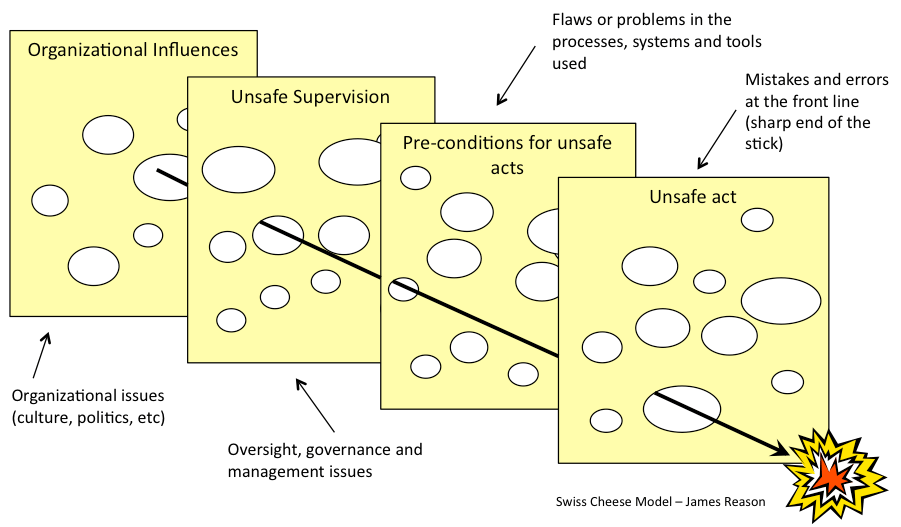
There’s a theory about the cause of accidents put forward by researcher Professor James Reason famously known as the Swiss Cheese model of accident causation.  The theory posits that each line of defence against an accident is basically a piece of Swiss cheese.  Sure, it might have holes in it (and that’s OK, because there is no perfect resistance against errors) but when the holes of successive pieces of cheese line up, an accident occurs.  So I am a piece of cheese, and yes, my actions prevent an unknown number of accidents but that’s my job and that’s what I’m trained to do.  Just as the pilots are trained to do their job, and airport electricians are trained to do theirs etc. and collectively we make it a safe and efficient way to travel.


Reason Model

When the holes line up = bad.


Air traffic control, by its very nature, is a job defined by rules and procedures that MUST be adhered to.  And we all know that when you do the same thing, over and over and over and over again, it becomes monotonous.  So air traffic control can sometimes actually be a really dull job.  Even when you’re dealing with lots of traffic. But no-one ever says, “Ugh, that must be a really boring job!”

In my personal experience, there are three situations which have caused me stress at work.  The first is training. Training is stressful.  Yes, we learn the basics of ATC at the beginning but each new place we work has local instructions in addition to the regular rules.  New routes to learn, new procedures, new phraseology, new traffic patterns.  Training sucks.  Seriously, just ask any air traffic controller.

Something else that sucks is the annual competency check we have to do, to ensure that we are operating to the expected standard.  It consists of a written exam, the questions for which are mined from the reams of paperwork we are expected to memorise in order to do our job.  In addition, there is an oral examination (which is basically the same as the written exam, but just seems SO much harder) and then a two hour assessment in each position that you’re qualified to control in.  You might be the best ATC in the world, it does not matter.  No-one likes having another person sitting over their shoulder watching them work and taking notes.  No-one.  Decisions that you would make every day without blinking an eye suddenly become difficult.  You second-guess yourself.  It’s just awful.  But hey, standards have to be maintained and that’s just the nature of the job.  If you fail a check, you need to get re-trained in the necessary areas.  It’s a way of keeping everyone sharp.  So yeah, every October, when my check is rostered, you could say I find that to be a stressful situation.  And even though I know what I’m doing and feel very confident about my abilities, the relief is enormous every time I pass and it’s over for another year.

The third situation that I found stressful was actually one that isn’t necessarily associated with the job itself.  A couple of years after I qualified as an ATC, in late 2002, my father got sick with cancer.  He was sick for ten months, and during that time my work was actually a really great distraction from the depressing situation at home.  It was an escape.  But then, in September 2003 my father died and suddenly my world fell apart.  I tried to continue at work but I knew, I just knew, that I couldn’t put on a headset and talk to pilots and still be safe.  I pulled myself from the roster.

One of the definitions of the word “stress” is being in a state of “mental or emotional strain or tension resulting from adverse or demanding circumstances”.  My work has never caused that. But my father’s death was stressful.  And it caused me stress in the workplace.  Perhaps if I had a different kind of job I could have continued working.  But being an ATC, I couldn’t. You have to know your limits  and you have to know yourself. Maybe that constant self-scrutiny also contributes to latent stress. Who knows?

There is something, in my line of work, called CISM.  It stands for critical incident stress management.  And it refers to the education and support provided to air traffic controllers in order to help them deal with stressful situations.  Now, a stressful situation can be something that occurs outside of the workplace, like a loved one’s death.  But more often than not, CISM is provided in response to an incident that happens at work.  Like an accident.  Like earlier this month, when EK521 crashed on landing at Dubai International.  We don’t yet know the reason for the crash.  We don’t know which Swiss cheese holes lined up to cause the accident. We do know that the Airport Fire Service were the piece of cheese with no holes. If it wasn’t for their incredible response, the outcome could have been catastrophic.

The first I heard of the accident was when I arrived at work for an afternoon shift and was told to expect a busy shift because an aircraft had just crashed at Dubai.  My immediate response was to ask, “Oh shit, did everyone get out OK?” which is what most people would ask.  But my second instinct was to ask about the air traffic controller who was in charge of the flight, and ask if they were OK too. And that’s something that most people would not necessarily think about.  They wouldn’t think about the guy or girl who has responsibility for that tin can full of human beings. Or how it must feel to have that tin can impact with the earth – something that’s never supposed to happen.  But I did. Because I’m that guy or girl. And that aeroplane full of people is our responsibility. Even when there’s absolutely nothing we could have done to prevent it.  We are the ones talking to the pilot.  That aircraft was in our jurisdiction.  We had “control” – it’s in the fucking job title.

So I guess, that’s where the most stress lies.  In the possibility that something that happens safely every day thousands and thousands of times (aeroplanes taking off, and aeroplanes landing) might, one day, go wrong.  But here’s the thing.  As air traffic controllers, we simply cannot think about that.  We can’t worry about the holes lining up.  Because if we did, we’d be paralysed.  We just have to get on with the job of trying to keep the holes in our cheese as small and as few in number as possible.

I was talking to a friend of mine the other day.  We studied ATC together, sixteen years ago.  She’s one of the most experienced, and one of the best, controllers I know.  But she’s no longer working traffic.  She is now a manager in the Safety department – an office job.  When I mentioned to her that I was feeling a little under the weather that day for my morning shift she said she was really pleased not to have to deal with the stress of turning up to work every day at 100% capacity. Even though she had no idea I was writing this ejo, she said that she was a lot less stressed now that she was no longer an air traffic controller. She also said that she never would have thought of herself as stressed when she was doing the job. She only realised it after she switched to office work

And therein, I suppose, lies the crux of what we do.  We deal with stress, with stressful situations, all the time.  But we don’t consider it stressful.  We can’t afford to. The stress is there – but we raise our threshold in order to cope with it.  We toughen our skins, and we harden the fuck up. And we pay the price for that. Increased risk of heart disease, diabetes, high blood pressure, sterility (yup, sterility), divorce and obesity. And you know what? There’s nothing else we’d rather do. But more than that, we’re the only ones who can do it.