happy

Ejo #157 – Gratitude

Today, I was grateful to get up early, watch the sun rise and put the finishing touches on this ejo.  Yesterday, I was grateful to be able to give my friend a hug after learning that his mum had died the night before.  And on Sunday, I was grateful to spend the day picnicking with my sisters, aunt and cousins in Cape Schanck.  I am a gratitude queen, able to find things to be grateful for, even in the most difficult of circumstances.  Damn, I could represent Australia at the Gratitude Olympics.  I am that good.  But how did I get there?  How did my gratitude muscle get that strong?  Just as an elite athlete needs a team, a coach, and a training partner to improve their physical performance, I too have a training partner. A gratitude partner.  Someone who has committed to the challenge of sharing gratitudes with me.  Every. Single. Day. No. Matter. What.

I’ve known my friend Melinda for about 28 or 29 years (shut up, you’re old!).  We even lived together for a while in the mid 1990s with our friend Svetlana.  But after we all moved out and went our separate ways, Melinda and I didn’t stay super close.  Like most of my friendships after I moved to Dubai, we’d exchange an email every now and again, and we’d catch up at the big parties that David and I throw whenever we visit Melbourne.  And that was OK. It was enough.  

But that all changed eight years ago today, when Mel and I started a challenge to email each other one gratitude a day for a whole year.  We both happened to be going through a rough patch at the time, struggling to find positivity in our day to day lives.  Melinda was feeling overwhelmed as a working mum to two young boys, trying to balance work and family commitments.  And I was missing my friends and family in Australia.  I yearned for the easygoing way of life back home, and wasn’t enjoying living in Dubai at all.  Everything about the city was getting on my nerves, and bringing me down.  And I wasn’t afraid to write about it.  In fact, some of you might remember that I used to write a very acerbic ejo series called Things I Hate About Dubai, in which I unabashedly bashed the shit out of the city, on the regular.  I used to really enjoy doing that, but in January 2015 I decided to decommission that series when a reader of mine called Flo wrote to me to express dismay at my attitude.  

Flo scolded me, “I am so disappointed by your latest post, and this will be the last one I read from you, as we do not share the same vision of expatriation.  Indeed I am very disappointed by the way you think.  I experience this every day in France where I keep hearing people say they don’t like anything (or anyone) about it, and it just pisses me off.  This is so disrespectful.  You may not understand, and you might even be angry at me, telling me not to come back to your ejo if I don’t like it.  But I just need to express myself!”

For my January 2015 ejo, which was titled Freedom, I responded to Flo, and defended my right to express dissatisfaction with certain aspects of life in Dubai.  But secretly, Flo’s words had pierced my heart like an arrow.  I had imagined that I was coming across as mischievous and spicy, but what was happening when I allowed myself to wallow in my negativity was that I just came across as… well, negative.  And I didn’t want to be negative.  I’d spent too much time and money on therapy to allow myself to slide back into old thought patterns and behaviours.  So while I publicly justified my opinions, I privately resolved to not write a single bad word about Dubai for a whole year.  For my own mental health and wellbeing.  I wanted to change.  I wanted to do better.

While I was making an effort to be more positive by not slinging shit at Dubai, Mel was doing something even more proactive and constructive to bring more joy into her life.  You all remember the #100happydays challenge, right?  Post a photo a day of something that makes you happy.  For one hundred days.  It was a lovely idea, encouraging participants to focus on all the positive things in their lives.  The challenge went viral, generating over 30 million happy moment posts on Facebook.  I probably should have taken part in the challenge, but I remember just not feeling it.  It seemed a little forced and superficial to me, which is probably an indication of where my head was at.  Melinda did take part in the challenge, and she got a lot out of it.  But once she’d finished the hundred days, she was left with a feeling of “now what?”  It occurred to her that a longer term commitment to a daily practise of positivity would be more beneficial than a flash-in-the-pan, social media challenge.  Something she could share privately with a trusted friend, rather than posting online.  Being a Doctor of Psychology, Mel knew that the idea was a good one, but she was unsure of how to implement it in a practical way. 

And then she read my Freedom ejo.  And she had a lightbulb moment.  She wrote to me, “My unrequested thoughts/suggestion for you to do with as you wish.  For improving your ongoing wellbeing in the place you reside, I think there is much to gain in training your mind to see and appreciate even the smallest positives around you each and every day.  Even in the country I love I’ve found myself in the mental habit of critiquing every experience and overlooking so many positives.  The 100 happy days challenge helped to shift my mindset, as I was struggling to focus on the upside of everyday life.  It definitely helped to be publicly forced to find something, anything, each and every day.  I often consider doing 365 happy days!  Instead I’ve decided to do “gratefuls” this year.  Here’s what I’d like to propose.  I will send my grateful to you each day.  Don’t feel you have to respond in detail, or at all.  If you’d like to share your gratitude in return, well, that would be an amazing honour.”

Of course I said yes.  And the rest is history.  Along the way we negotiated some guidelines.  We’d exchange a gratitude, every day for a whole year.  We would make an effort to not repeat ourselves, so that we would always be on the lookout for new things to be grateful for.  And our gratitude emails would be a no-complaint zone.  The goal of the project was to be totally focussed on things that we were grateful for, and not an opportunity to whinge about life.  We both understood that the intention of this wasn’t to paint an unnaturally rosy picture of our days, but rather to acknowledge that despite the inevitability of things not always going our way, we could still find something to be grateful for.  

Melinda and me in 2015, less than a month after starting our gratitude challenge.

I remember how delighted I was after just the first few days of exchanging gratitudes.  From the very beginning it felt like a really positive and optimistic ritual, and I really enjoyed reconnecting with Melinda, and reigniting our friendship, getting to know each other all over again.  Getting to know each other even better than before.  

But devastatingly, only fourteen days into our challenge, Mel’s mettle was sorely tested when she received some terrible news about her close friend Cara.  She wrote to me, “Today I’m struggling to be grateful as I learned some very sad news that one of my closest friends has cancer that has metastasised to her bones.  So I guess I’m grateful for my health, and that she feels supported by me.”

Over the next five years, our daily gratitude practise helped Melinda deal with the burden of initially having to keep her friend’s diagnosis a secret, of being there when Cara needed her, and of knowing when to step back when she needed space.  Melinda was there when her close friend battled chemotherapy and radiation therapy, and she supported her when she became sicker after taking part in an experimental trial.  She held hope for her friend, even when things were hopeless.  She honoured Cara’s final wishes, and at the end she said goodbye, long before she was ready to let go.  Mel tells me that our daily gratitude practise got her through the hardest five years of her life.  And I am beyond grateful that I was able to be there for her, in that way.

Today marks the 2922nd day that Melinda and I have exchanged daily gratitudes.  What started as a one year challenge, blossomed into something that I can’t even imagine my life without, and the two of us have been at it for eight, glorious, years.  Along the way we’ve both become more positive and more resilient.  We’ve both learned to laugh in the face of adversity, and we’ve developed the ability to find acceptance and peace when things don’t go our way.  For instance, on Thursday, 19th January 2017 I had a skiing accident on the slopes of Nagano, Japan tearing the ACL in my good knee.  My email to Mel that day read, “Today I was grateful beyond belief to everyone that helped me when I crashed on the mountain and hurt my knee.  David, who came running down to check on me and then carried BOTH our pairs of skis back up a very steep slope.  The ski instructor who noticed I wasn’t well and called the ski patrol.  The ski patrol people who skied me off the mountain on a special stretcher.  The hotel who sent someone in a car to pick us up so we didn’t need to catch the bus, and then drove us to the doctor.  The clinic where they looked at me straight away and were so kind.  The lady at the hotel who was SO concerned for me and let me lean on her as I limped to the elevator – later on, at dinner, she made me a beautiful origami crane and told me she hopes I feel better soon.  It’s been heart-warming to the max.”  

I know that in the past I would have let that accident wreck my day, my holiday and even the next few months of my life, as I hobbled around in pain.  I know that I would have wallowed in self-pity and misery.  And the reason I know it is because that’s exactly what happened in 1995 when I tore the ACL ligament in my other leg in another skiing accident (no, I’m not a very good skier).  But my gratitude practise gave me the ability to rise above it this time, and to deal with it positively.  It allowed me to see that my injury didn’t have to define me, and that despite it being a bit of a bummer, there were so many other, wonderful things to focus on.  I was getting really good at this gratitude thing.  

And then my Mum died. And somehow, I was still able to find a number of things to be grateful for, even on the worst day of my life. On the 26th March 2019, I wrote to Melinda, “I feel tremendous gratitude to my Mum for all her unconditional love my whole life.  I am grateful that she and I texted yesterday, and that we got to see her recently on our trip back home.  I am grateful to David for being so supportive and caring and loving and gentle.  And for buying us both tickets back home.  I’m an absolute mess right now but really grateful that even during something as devastating as this I can still find things to be grateful for.”

When you can look around you and see things to be grateful for, when everything else in your life is falling apart, you’ve reached a higher state.  You rise above.  You transcend.  And that is a super power.  Daily gratitude has given me fortitude.  No matter what happens, everything is OK.  It’s always OK.  

Melinda’s not the only person I exchange daily gratitudes with.  My sister Mary and I also do it, via text.  We started about four and a half years ago when we both took part in Zimmy’s Happiness Project, a three month course designed to rewire our thoughts and actions, creating new habits scientifically geared towards increasing our happiness.  A major pillar of that course focussed on gratitude, and one of the tasks was to share five daily gratitudes with a partner.  I was already really adept at finding gratitude in my day to day life with Melinda, but Zimmy’s project required a little more.  Not only did it call for five gratitudes a day, it also required them to be shared with someone in person (or via video).  I was really grateful that my sister was doing the project with me, and that she accepted my invitation to be video gratitude partners.  It was still a task that took me slightly out of my comfort zone, but doing it with a family member, someone I loved and trusted, made it a lot easier.  During the three month project, Mary and I exchanged videos every single day, talking about all the things we were grateful for, which was a beautiful way to feel more involved in my sister’s life, something which I’d always felt I was missing out on, living so far away from her.  It was a wonderful and easy way to get to know her better.  It deepened our relationship and helped us create a more enduring bond.  

I feel the same deep bond with Melinda.  She shares her intimate life with me.  I know when she’s had a great Pilates session, when her husband cooks a yummy dinner, when her teenage sons help around the house, and when she’s had a good night’s sleep.  And I share parts of my life that no-one else in the world, apart from my husband, knows.  Melinda knows when I’m happy.  She knows when I’ve had a good day at work.  When I’ve had a relaxing bath.  When I’ve had an earth shattering orgasm.  When I’ve found what I’m looking for at the supermarket, or when my favourite colleague is rostered to work with me.  Melinda knows when I’ve had an interesting dream, and when I’ve been upgraded to business class on a flight.  She knows when I’ve had a satisfying shit.  When I’ve been paid, and when I’ve been able to bring one of my houseplants back to life with a little extra TLC.  She knows when I’ve found a spare lip balm in my car and when I’ve discovered a really cool new TV show.  She knows when I have fresh towels, and when I sleep on fresh, clean sheets.  She knows when there’s soft toilet paper at work, and when someone’s recommended a great new podcast.  Melinda knows when I’ve had a breakthrough in one of my sessions with Zimmy, when the price of Bitcoin’s trending up and when the tower toilet, which is prone to blocking, is flushing again.  And she knows all the wonderful, thoughtful, kind, generous things David does for me every single day. She knows everything about my life, and being able to share that all with her is a beautiful gift for which I am very grateful.  
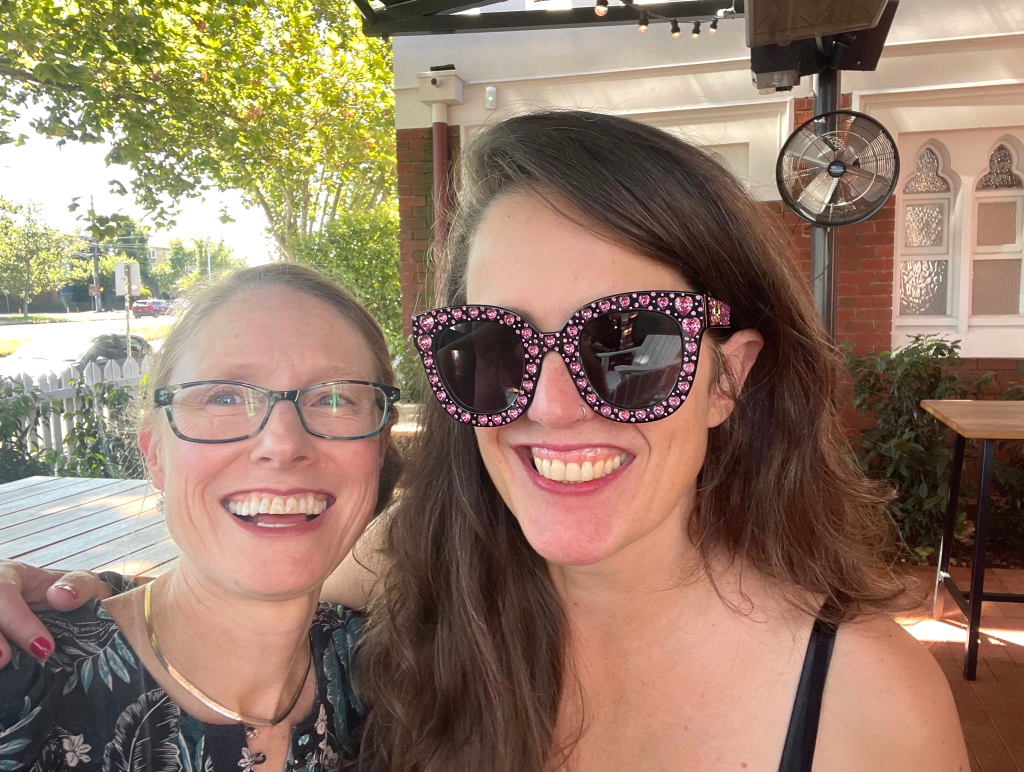
Melinda and me a couple of days ago. Gratitude partners for life!

In 2015, when Melinda and I first committed to our daily gratitude challenge, it was a challenge.  Sometimes it was hard to find something to be grateful for.  Sometimes I really struggled.  And sometimes it just felt impossible.  But we stuck it out, and we got better.  We got really fucking good at it.  I really do feel that if more people practiced daily gratitude, the world would be a much better place.  My life is undoubtedly better for it, and I want to be able to pay that forward.  If sharing a daily gratitude with a friend sounds like something you’d like to try, then I’m your girl, so hit me up and let’s do this. It might be hard at first, but if you stick to it, it’ll get easier.  I promise. 

Ejo #110 – The Happiness Project: Part 3

Well, we’ve reached the Happiness Project finale!  I hope you’ve enjoyed reading about some of the strategies available to all of us to increase our happiness levels.  When I first started the project I was already pretty happy thanks to my years of working closely with Zimmy (who David accurately refers to as my “guru”).  But the three months I spent closely monitoring the way I think, and the things I do, actually increased my happiness score significantly.  For some of us, constant vigilance and consistency is necessary in order to be happy.  For others, dipping in and out, as required is enough to do the trick.  Everyone is different, but we all deserve happiness, so read on to learn about the final seven rewirements of the project.

YOGA
Yoga is amazing because it ticks so many boxes on the path to happiness. Contrary to popular belief, the core purpose of yoga isn’t actually achieving pretzel pose perfection, but rather the accompanying breathing  (though the poses and stretches are a fantastic workout). I always walk away from a yoga session with a sense of euphoria, and the great thing is that almost anyone can do it. A simple series of movements called a sun salutation done first thing in the morning is a wonderful way to start your day. It gets the blood and energy in your body flowing, and it eases the transition from sleep to wakefulness for both the body and the mind.

sun


PERSONALITY RESHUFFLE
Zimmy considers that our personalities are actually a composite of beliefs, behaviours and habits that we develop to cope with previous traumas, or challenging events from our past. What she would like us to do is to ask ourselves who we are outside of our pain, anxiety, insecurities and fears. What would we be? How would we think, or feel, if we stopped living our lives as a product of the story we have created about ourselves? To be honest, I initially misinterpreted this rewirement as needing to change the way I viewed the world, and in particular my feelings towards Dubai. But when I discussed this with Zimmy during one of our in-person sessions, she pointed out that it wasn’t about affirming a new intention but actually adopting a whole new personality and then basically trying that new personality out, like in a role-playing game (kind of like faking it ‘til you make it). I totally understand how this rewirement has the potential to make me happier. By taking on a survivor mentality about living in Dubai, I’m creating that reality around me. This one isn’t easy – you have to first identify the obsolete dominating personality and then lovingly let it go, while supporting another, healthier personality to come forward.

PRACTISE FORGIVENESS
Forgiveness does not mean letting someone “get away with it”. It doesn’t mean that what they did is OK. What it does mean is that you release the burden of holding onto resentment and negativity because of what someone did to you. Isn’t it crazy that painfully holding onto that shit can sometimes seem easier than just letting it go? This rewirement is definitely one that requires you to put in the work, especially if you have something major you’d like to let go of. But when you can learn to forgive, easily and without feeling like you’re losing something in the process, you will feel a weight lift from your shoulders. You’ll be empowered because your well-being is no longer dependent on other people’s actions and words. And, as a bonus, you’ll also experience health benefits like a stronger immune system, heart health and self-esteem. Holding onto pain and resentment and anger only hurts you, not the other person. Even worse, it tethers you to them, and what they did. Forgiving is freeing. Let karma take care of the rest.

DECLUTTER
As I already mentioned in Part 1, stuff doesn’t make us happy. And research shows that it can actually make us stressed, anxious and unhappy. It’s human nature to gather stuff. If you’ve ever moved house you’ll know the shock of realising exactly how much shit you’ve accumulated over the years. What feels less natural is getting rid of it, but that’s exactly what you need to do in order to be happier. It might feel really difficult to let go of some things, but the catharsis you’ll feel by decluttering makes it worth the effort. I have a general rule of thumb whenever I get the urge to spring clean – if I haven’t used it or enjoyed it in over a year, I try to get rid of it. I’ll admit I’m not as brutal as I could be when it comes to throwing things out, but I do know I love to live in a minimal house that isn’t full of crap. The state of your home can have a real impact on the state of your mind, so see how it feels to start decluttering it.

BE MORE CHARITABLE
The benefits of being charitable are fairly well documented, and I’m proud to say that most of my friends are already pretty amazing in this regard. Every time David and I raise money for a food handout I’m always overwhelmed by the huge response. It’s funny when I thank my friends for donating, how many of them thank me back for actually doing the handout but really, that’s the most rewarding part of the experience. Seeing someone’s face express joy, gratitude or even just relief at receiving something given with no expectation of anything in return is an incredible feeling and I actually feel lucky that I can be so hands-on with making a difference. But there are so many other ways in which you can be charitable. Of course you can volunteer at an organisation that helps others. You can declutter your home and give your unwanted items to someone who needs them, or to a charity. You can donate blood, and hair (if it’s long enough), or the ultimate charitable act, your organs. You can help someone cross the street or carry their shopping to their car. You can foster an animal (or a child)! There are so many ways to help out our fellow humans, and in the process of making the world a better place, you also end up helping yourself.

PRACTICE KINDNESS
Think about the last time someone was kind to you. How did their act of compassion or generosity make you feel? I bet it was good. When you do something kind for someone, or when you’re the recipient of someone’s kindness, incredible things happen in your brain. A whole bunch of feel-good hormones get released into your body. Stuff like endorphins, which you also get after running a marathon. Serotonin, which is the hormone released when you take lots of ecstasy (though kindness has the benefit of being a lot less illegal, and a lot better for you). Dopamine, which is known as the reward hormone, and the reason some people become addicted to gambling (though I reckon kindness is a helluva nicer thing to be addicted to).  And finally, oxytocin, known as the “love” hormone, which also floods the body during orgasm.  I’ll just leave that there for you to think about. 😉

PLAY
So tell me guys, why do kids get to have all the fun? When did we, as grown ups, stop playing? And more importantly, why? It’s well known that kids need to play in order for their brains to develop empathy, communication and resilience. But adults can also benefit by incorporating some playtime into their day. Firstly, the act of playing releases dopamine, which makes you feel good. But more than that, it’s been proven to increase productivity, creativity and connection. Which is why the most progressive companies in the world factor playtime into their office design and schedules. Being playful doesn’t necessarily have to be a structured thing, either. Finding the humour in situations, being silly, making jokes, flirting, play-fighting and role-playing all contribute to our well-being, as well as making us healthier and happier. And isn’t that what we’re all looking for?!

Ejo #109 – The Happiness Project: Part 2

And away we go with Part 2 of The Happiness Project (which has actually blown out to be a chunky three parter, to be continued next month). Zimmy’s just opened registration for the second round of the project, which is due to start in a couple of weeks, and if you can spare the time and money I would really highly recommend you get on board and commit to doing something that will definitely change your life for the better. What have you got to lose?

So here is Zimmy’s offer:

image

Do you want to be happier – but just don’t know how to go about it, or where to start? Rather than waiting for certain things to happen, that you think will make you happy, would you like to learn how to create happiness in your existing circumstances? A large number of research studies have been conducted about happiness and how to create it in our daily lives. We now have a great amount of guidance on how to be more empowered in this pursuit. On how to create the life we want, rather than just responding to life, or surviving it.

Last year I completed a degree from Yale University – The Science of Well-being. It showed me that many of the things I’ve learnt over the past few years, and have been practicing diligently, are in fact the cornerstones of creating happiness. I realised that these practices have produced very tangible positive results in my life, and in the lives of my friends and clients too.

So with that in mind, I have created this project, and we have already completed Round 1 a couple of months ago, with 20 participants who were able to increase their happiness scores significantly through the practices that were shared in the course. During this 12 week project, we will be using scientifically proven tests to measure your authentic happiness score before, during and after the course. You will receive clear, proven tools and techniques to employ every single day via email, that will help you create more happiness in your life, more consistently. And you will have these for life, to use for yourself and share with loved ones.

This course can be done by people not only in Dubai, but anywhere around the world, as it will be conducted through emails, and two personal one-on-one progress meetings, either in person (if you are in Dubai) or on video chat. There will also be a Facebook forum for group discussions and sharing of challenges, breakthroughs, inspiration and achievements.

Special introductory offer for all Epiphany clients is 2,750 AED.
Early bird offer, if paid before February 6th is 2,500 AED.
If you get a friend to sign up for the project with you, you’ll both pay 2,250 AED each.

If you are interested in doing the course, and know that you will be able to access your email every day, as well as meet with me twice during this period, please let me or Chryss know by February 4th 2019, and we will send you further details. This course is limited to 20 participants so that I can give each of you the right amount of attention and focus required to master the practices.

And now we’ll carry on with twelve more of the happiness rewirements.

INTERACT MORE MINDFULLY WITH SOCIAL MEDIA
Self-explanatory. I definitely had a problem with my phone before this project. A problem that I think I now have under control. During the project, I just decided I wasn’t going to use my phone at all, half an hour before bed. And I’ll tell you what has happened as a result. It takes me much less time to go to sleep, and I sleep so much better. It was hard in the beginning, because I had to break the habit, but once I did I felt free. Free, I tell you!!!!!

SPEAK TO YOURSELF MORE KINDLY
This one kind of matches with the first rewirement. We can be so loving and kind to other people, and so harsh and critical of ourselves. One way to make ourselves happier is to be gentler and kinder to ourselves. So when you catch yourself being critical or mean, turn that shit around. Go from saying, “Fuck, I’m such an idiot” to “Wow, I miscalculated that, but it’s OK, I’ll do better next time”. It seems like such a simple thing, but the way we speak to ourselves has such a big influence on our self-worth, and ultimately our happiness.

SELF-LOVE AFFIRMATIONS
As I mentioned in Part 1, most of us have this negative background tape playing on a loop, pretty well every moment that we’re awake. The idea of self-love affirmations is to counter the bullshit with something positive. If we hear something often enough, we start to believe it. But at the end of the day, whether you believe in it or not, choosing positivity over negativity has to be the better choice. I chose three self-love affirmations, that I repeated in front of the mirror seven times, three times a day during the project (and beyond). My favourite was (and still is), “I am confident in my individuality”. When I first started telling myself this, I felt like a fraud. Today, I mean it.

AMPLIFY HIGH RANKING STRENGTH & LOW RANKING STRENGTH
We all have character strengths (and weaknesses). The purpose of this rewirement is to become aware of what they are in order to appropriately amplify them. As part of the project we all did a survey to figure out the exact ranking of our character traits (my top three were love, kindness and honesty and my bottom three were humility, teamwork and self-regulation). Zimmy then provided detailed methods to take advantage of, and develop, these individual characteristics depending on their ranking. Only by knowing where we’re strong, and where we can do more work, can we then use these traits to enrich our own lives, and the lives of others.

WRITE A LETTER OF GRATITUDE TO YOUR YOUNGER SELF
As I’ve already mentioned, gratitude is the big kahuna of happiness. This one involves handwriting a letter to yourself from a time when you might have been going through something difficult or after learning an important life lesson, and thanking yourself for getting through it so well. This task invokes self-love, compassion, appreciation and hope, as well as gratitude towards ourselves for navigating life’s crazy rollercoaster. It’s tough out there people. Give yourself a pat on the back, because you seriously deserve it. It’s so liberating and soothing to acknowledge yourself in this way. I actually cried about four different varieties of tears when I wrote this to myself: “Thank you for being so brave when it got so fucking hard. Thank you for somehow controlling the damage, even from the depths of despair.

WRITE A LETTER OF GRATITUDE TO SOMEONE ELSE
Continuing on with gratitude, this one is directed outward to someone who has made a big difference in your life. Someone that you want to thank, but haven’t had the chance to do so. Again, it needs to be handwritten (and it can’t be addressed to your significant other). And…. here’s the doozy. It has the most impact if you can arrange to actually read your letter aloud to the recipient. In person. Whoa, right?!! I was lucky enough to have the chance to read my letter of gratitude to Zimmy (meta, much?) and it got pretty damn intense. It was a really beautiful moment between the two of us and I’m so thrilled I had the opportunity to make her feel so special and loved and adored. This task is something that a lot of people might find difficult to muster up the courage to do, but if you can manage to overcome that, the pay off is enormous.

EAT MINDFULLY
Well, this one is obvious. We all need to eat better. And we all know it. But it actually takes a bit of a tectonic plate shift to adapt that knowledge into our every day lives. Seriously though, the difference this can make to your entire mindset and wellbeing (and ultimately happiness) is enormous! I would personally like to advocate for giving up sugar. I haven’t eaten any sugar since 8th November 2018 and I feel amazing for it. I don’t experience any more weirdo mood swings and my energy levels are so much higher. Giving up sugar wasn’t specifically part of the Happiness Project but rewiring the way I looked at food was a natural precursor to quitting. Another thing David and I do is try to savour our dinner when we eat together at home. That means lighting candles, putting down our cutlery between bites, trying to actually taste what we’re eating and really trying not to rush a meal.

DRINK ALCOHOL MORE MINDFULLY, AND DRINK MORE WATER
Mindful drinking of alcohol is a big “thing” right now (congratulations to everyone who made it through dry January). And so it should be. Alcohol can be a bit of a danger zone for some of us these days. Lots of people are tending towards some kind of emotional dependency on the booze and I can totally relate to that. But I also know how liberating it can be to break free of that dependency and learn that you can actually enjoy life (and I mean REALLY enjoy it) without the crutch that alcohol provides. Blurring your life doesn’t make it happier. Fully experiencing it, in sharp relief, actually can. Also, just drink more fucking water. You simply can’t go wrong with that advice.

GET ENOUGH DEEP SLEEP
Well, this one is easier said than done for a shift worker, so that kinda sucks for David and me. More often that not we both feel tired from lack of sleep. It’s just something that comes with the job, sadly. But hey, most of you aren’t shift workers and there IS something you can do about it. A good night’s sleep isn’t a luxury. There’s a whole bunch of evidence about the benefits of getting a good solid seven hours a night. Did you know that while you sleep your brain essentially refreshes and regenerates?? And you actually NEED to be deeply asleep for that to happen. Try making it a priority for a while and see how much happier you feel.

DO 15 MINUTES OF EXERCISE EVERY DAY
Another oldie (but a goodie) is, of course, to just squeeze some physical activity into your daily routine. It doesn’t have to be a big deal. Go for a walk, take the stairs, go for a swim, do a class, clench your butt at the supermarket checkout. Squat while you’re in the elevator. Just move your body, damn it! And hey, if you can get it, a great way to move your body is to get funky with it. Grab someone you love (or like, or even just dig a little bit) and get down on it, coz sex is a magnificent way to generate a bit of body heat (and in the process happiness, intimacy, a sense of belonging, higher self esteem and better health).

MINDFUL BREATHING
Check this out. I’m 47 years old and only just recently realised that I didn’t know how to breathe. What the actual fuck?! Most of us tend to breathe way too shallowly, and only in the upper part of our respiratory system. When you figure out how to breathe deeply, into your abdomen, your life will fucking change. And I’m not joking when I say this. Think of every deep breath you take as a love letter to your body ❤️. And when you exhale properly you do amazing things for your parasympathetic nervous system. You will ease your anxiety, insomnia, post-traumatic stress disorder, depression and attention deficit disorder. And if you don’t suffer from these conditions, will simply realise that you’re able to operate at a much more optimal level, and just generally feel so much better. Yoga helps. Tai chi helps. Qigong helps (look it up – it’s easy to do and you feel amazing afterwards). Just breathe. It seems like something you shouldn’t have to think about, but when you do you can seriously improve your wellbeing.

DAILY MEDITATION
I’ve been meditating (on and off) for a couple of years but only recently started doing Vedic meditation, twenty minutes a day. This is another big one for me. Something that I would say is a definite requisite for life happiness and a daily practice that I’ve found to positively contribute to my wellbeing. In fact meditation is a massively trending topic these days and you can easily get a lot of information about it online. There are shitloads of apps you can use to meditate, but in reality all you need is somewhere to sit for a spell. You can do it just about anywhere and anytime, though I’d recommend starting off in a peaceful, quiet environment where you won’t be disturbed. At least until you get better at it. And you will get better, I promise. You just have to keep at it for a while. So many people give up practicing meditation because they think they’re not doing it right, or they expect to achieve immediate nirvana. When you boil it right down, meditation is simply the act of not allowing yourself to get caught up in your thoughts. The idea is not to empty your head, but rather to not fixate on what does crop up. It helps to have something to anchor your attention on, and your own breath is a hugely popular thing to focus on because it’s something that is always present. Another thing is a mantra (which is what I use when I do Vedic meditation). You just say the mantra over and over again, bringing your attention back to the words whenever you get distracted by a thought. And that’s it. It sounds ridiculously simplistic, and it is, but the positive effects are extremely powerful.

Here’s the thing, guys. You all know this stuff. There’s nothing new or magical here. But the project takes all of these ingredients and alchemises them into a potent elixir that will make you happier. I guarantee it.