mental health

Ejo #162 – Chaos & Order

Chaos and order are not two sides of a coin, but rather two extremities on a continuum, and most of us strive to strike a balance between the chaos and order in our lives, hopefully finding a resting place somewhere near the middle.  Of course there are some people who seem to court chaos, living a tumultuous life of pandemonium, mayhem and strife.  And others who tend towards being super methodical and organised, never allowing themselves to stray outside of a life of perfectionism.  At the extremes, these characteristics become problematic and can even be indicative of serious mental health disorders.  What is needed is a balanced blend of both, as both are necessary for a good life.  A steady foundation of order is needed to provide a safe haven to operate from, but too much stifles and smothers our development and growth.  Chaos is also needed to some degree, in order to prevent us from vegetating in our comfort zones.  It helps us to remain adaptable to change, which is a good thing.  But too much can be catastrophic, plunging us into destabilising anguish and distress. 

Would it surprise you to learn that every single month, the task of writing my ejo manifests as an epic symphony co-created by the opposing forces of chaos and order that coexist within my mind?  This usually plays out as a cage fight in three parts.  The first part is the idea.  A theme.  A topic.  I never start writing straight away, but normally allow the concept to just be.  Knowing that it’s there, I simply allow it to linger in my brain.  To marinate. Sometimes within my awareness but mostly not.  And though it may appear that I am doing nothing, this period of dormancy is a vital part of the creative process for me.  My subconscious makes connections, kneading out the flesh of the idea.  Lines are cast, and concepts coalesce.  I make no conscious effort towards this. 

When the time is right, part two begins.  This is the disgorging of words.  And it really is kind of like a mental vomit.  Words just hurl out, accreting into clunky, awkward fragments.  Sentences spew forth before amassing into ponderous paragraphs.  Sometimes it makes sense, other times it’s a dog’s breakfast.  Sometimes it’s projectile, and sometimes it’s chin dribble.  But I write it all down, no matter how much barf it’s covered in.  And sometimes, when the words won’t come, I have to do the mental equivalent of sticking my fingers down my throat.  It’s not easy, but you do it in order to feel better.  This part of the process is pure mayhem.  Unadulterated chaos.  There is absolutely no order, rhyme or reason to this madness.  I just have to trust that from the bucket of puke I end up with, an ejo can be forged.  And it always is.  Part two is not writing, it’s a tornado.  The result is barely intelligible, and a first draft bears almost zero resemblance to what ends up being published. 

Part three is when the writer comes out.  The writer’s job is not to write, but to rewrite.  To make sense of the vomit.  To move the carrot chunks around, so to speak, in order to turn them somehow into something beautiful.  This is really hard work.  This is the part that requires a structured way of thinking, and it requires order and discipline.  It is repetitive, monotonous and can appear mechanical.  But it is from this drudgery that the magic happens.  In fact the magic cannot happen without it.  Part three requires skill, and the meticulous application of that skill.  It is the opposite of chaotic. 

Writing my ejos is actually a pretty monumental task.  One that I’m proud of accomplishing month after month after month for more than 12 years.  As soon as one ejo is published, I immediately start the process again with the next one.  The three parts of my writing method take up the entire month, so my ejos are something that I am always engaged in.  They are also probably the most elegant illustration of how the complicated interplay of deep-seated chaos and order can give birth to something unique and singular.  But this is unusual.  Most of the time it just gives birth to a goddamn mess. 

I may come across as being someone who is spontaneous, free and easy.  And I can be.  I am capable of it.  But that is not my nature.  My nature loves order.  And abhors chaos.  Unscheduled spontaneity is chaos to me, and as much as I love the idea of it, the reality can send me into a tailspin.  This is something that I have only recently become concretely aware of, and something that I would like to change about myself.  But my nature is strong.  My nature wants routine, it wants rules, it wants discipline and order.  I do better, mentally and physically, when I have that structure in my life. 

Of course, as you’d expect, this aligns beautifully with air traffic control, where a very high standard for detail is required.  But when I first applied for the job way back in the late 90s, the business consultants and HR execs that comprised the interview panel expressed concern about one of the hobbies I’d mentioned in my application.  Writing.  The impertinent mofos had the gall to say, “We don’t think you’re suitable for the job because there’s no room for creativity in ATC”.  Firstly, they were wrong, because there is room for creativity in aviation.  In fact flexibility, and the capacity to change tack is absolutely necessary in such an unpredictable environment.  No two days are ever the same in this job.  And something that might work one day, will not work the next.  You have to be able to think on your toes.  Secondly, they were wrong, because I am suitable for the job.  The need for hyper-vigilance in ATC actually suits my personality to a tee.  I’m such a stickler for the rules, I’d go so far as to say that I’m famous for it round these parts (and you’d best not think about that too much).  I can’t afford for any elements of chaos to enter my workplace, and thus high-level order is my default work state. 

Unfortunately, this fastidiousness spills over into my personal life where it isn’t necessarily as warranted, or even desired.  Turns out I can be a little bit obsessive (my saving grace is that I am not also compulsive).  I just need some things to be a certain way, and it can be potentially distressing for me when they’re not.  Exempli gratia, the toilet paper needs to be rolled over, and not under (and I will not be accepting comments on this matter).  For over a decade, I waged a relentless, unspoken battle against the toilet paper roll in David’s parents’ house, switching the roll so that the paper rolled over, and not under, every single time I went to the bathroom.  And I’m still not sure if it was David’s mum or dad, but someone was fighting back.  The last couple of years we’ve visited them, however, I’ve started questioning myself.  Why am I doing this?  Who’s house is it anyway?  Why should I exert my will over their toilet paper alignment preferences?  Of course it still irritates me when I go to the loo at their place and have to unroll the toilet paper from underneath.  It’s like an itchy scab being picked in my brain.  But I now resist the urge to flip the roll over, and that’s huge for me.  Interestingly enough, studies have shown that people who prefer their toilet paper rolled over (which is actually the correct way) have more dominant personalities, and so are also more likely to change the orientation of the toilet paper roll in other people’s homes.  I think the end of the Adelaide toilet paper saga was the beginning of a softening of the uncompromising rigidity which has ruled my adulthood.  I no longer feel I need to strive for perfect order in every single facet of my life.  I think I just don’t care so much any more.  I think this is what getting older looks like.  And I rather like it.

That doesn’t mean I can just suddenly become loosey goosey about everything though.  One zany example of this is my locker at work.  Everything contained within the thin metallic walls of my work locker is there because of a previous lacking, and the desire to not ever be found lacking again.  I once arrived at work only to realise that I had forgotten to put on deodorant, shock horror!!  So now there is a can of deodorant in my locker.  Another time, I woke up after my night shift nap with dry eyes, so now I always have eyedrops in my locker.  On a recent night shift, I had to share the break room with a colleague and had trouble sleeping thanks to his snoring.  You can bet your sweet ass the next day I brought ear plugs to work and popped them in my trusty locker.  I may never need them again, but if I do they’ll be there.  And just the other day, I forgot to bring a coffee pod to work for my afternoon shift coffee nap, and was forced to steal one from the training department!  So now my locker has a couple of extra coffee pods in it.  Also, aloe vera tissues, face towels, tampons (even though I haven’t had a period in over three years), a spare 50dhs note, dental floss refill, a mini-vial of perfume, a couple of lip balms, a jacket, a toothbrush and toothpaste, lipstick, Band-Aids, Ibuprofen and Paracetamol, hairpins and hair ties, a mug (that I never use, but you never know), beef jerky (in case I need a snack), a magazine, electrolytes, a couple of spare face masks, a bowl, a fork, a spoon and a knife, and a mini-can of hairspray to tame my flyaway tresses in Dubai’s unforgiving humidity.  Also, a spare set of glasses.  This is actually a requirement from the regulator, but I’d have them anyway after once cleaning my specs at work with a dish scourer, scratching the shit out of them so badly that I couldn’t continue working and couldn’t even drive home.  As you can see, I’m now ready for anything. 

I’ve been thinking a lot lately about why order and structure and routine make me feel better than freewheeling spontaneity does.  And I believe the reason is comfort.  For better or worse, it would seem that comfort is my highest priority in life, greater than ambition, or the desire for success or money.  Greater even than the need to be liked (though of course I am more comfortable when I am liked).  I do think that my propensity towards order is borne from this desire, or at least amplified by it.  If I have everything I need around me, ordered in a certain way, then the odds of me being uncomfortable are reduced.  Which sounds great, but is actually kind of really shit when you think about it.  And completely at odds with the way that I intellectually and spiritually strive to live my life.  It’s the opposite of going with the flow and letting go.  In Volume 3 of my Words With Chryss ejo I talked about my attempts to transcend difficult feelings and situations.  Part of my ongoing endeavours to improve myself involve learning to find comfort in discomfort (yoga is amazing for this).  Alas it’s so extremely counterintuitive for me, that I have to work really hard to achieve it.  Sometimes I do, but mostly I don’t.  But learning to keep your equilibrium no matter what is happening around you is a very powerful trick to have up your sleeve.  It’s freedom from the shackles of needing order to be happy.  It’s freedom from needing anything to be happy.  What I’d really like is to no longer have to arrange things to be just right.  I want to be happy even if I run out of lip balm.  Which sounds inconceivable to me right now, but is something worth pursuing.  Do I sound like a hot mess?  It’s because I am.

I have a disease.

Entropy is the ultimate expression of chaos.  Life, the universe and everything are all mercilessly advancing towards randomness and disorder.  This explains why we die.  It goes no way towards explaining why we exist in the first place.  But here we are.  Little pockets of order, we resist the irresistible.  We oppose the inexorable.  For a short while anyway.  Life, while at times chaotic, is the ultimate expression of order.  Still, this order has no choice but to yield to the rules of the universe.  Life is fleeting, and order is just an illusion after all. 

Ejo #158 – The Extraordinary People I Know: Melinda Norris (aka My Gratitude Partner)

Last month I wrote about the gratitude practise that I have shared with my beautiful friend, Dr. Melinda Norris, for over eight years.  This month the two of us sat down (virtually speaking) and had a chat about our project, its benefits, and how easy it is to incorporate an everyday gratitude practice into your own life.  Please give a very warm welcome to my close friend, and longtime gratitude partner, Mel. 

I’m still basking in the afterglow of the wonderful day we spent together when David and I were in Australia last month. After dinner at your place, I noticed a copy of your thesis for your doctorate in Psychology being used (egad!!) as a keyboard stand.  And I was absolutely blown away by it.  It’s such an impressive work.  Can you tell us a little bit about it?
Of course. My thesis was an applied PhD as part of a longitudinal project with Victoria Police.  I followed 7,000 staff over three years with a focus on wellbeing.  My research particularly looked at how people cope effectively with the daily hassles and stresses in work and life.  Which strategies are most effective?  How stable is our behaviour over time?  And, how much can be predicted by our personality, versus learnt by life lessons.  It highlighted the value of humour and seeking emotional, and practical, support as three highly effective coping strategies.  It also showed that a lot of our stable patterns of behaviour are just as much, if not more, learned rather than purely a product of our personality.  Which is great, as it means we can learn new ways, and improve how we cope with the challenges that life throws at us!  

Mel’s opus

This might be an obnoxious question, but do you ever take inspiration from our gratitude practise and incorporate it back into your work as an organisational psychologist? 
It’s really rewarding to tap into my passion, research and personal experiences to help others.  So I do take inspiration from our gratitude practice all the time, and build it into work, formally and informally.  For example, I try to explicitly express my gratitude for any support and collaboration with leaders and team members.  This builds relationships and trust quickly, leading to more effective collaboration as a result.  It also helps me to appreciate the small things every day, and to get through setbacks better.  I notice I don’t get stuck in a negative mindset anymore.  I can bounce back quicker, and find a more optimistic outlook. 

Trust me, I’m a doctor.

I think I got really lucky that you asked me to be your gratitude partner. You’re someone who’s made the wellbeing of others their life’s work, and I don’t think it gets any better than that! Do you remember how our gratitude challenge started all those years ago? 
Yes, I clearly remember how it started.  I was reading your Freedom ejo in our kitchen and getting really engrossed in your story.  I got the clear sense that you were committed to staying in Dubai for a variety of good reasons (career, travel opportunities etc.), but that you missed Australia desperately (your friends, family, the environment and climate).  And I got the sense you were struggling with the downsides of your day-to-day life.

I still miss my friends so much.

I could relate.  I too was struggling to feel the joy in my daily life, but for different reasons.  I was working in a high pressure, deadline-driven job with a lot of responsibilities.  Working four days a week, but squeezing what felt like at least five days of work into those days.  I was also a parent to two gorgeous young boys, and I wanted to be more a part of their lives.  I felt so much guilt and sadness, having to utilise before, and after, school care.  I found a solution with a nanny for a few years.  Kim picked the boys up from school, helped them with homework, and prepared dinner three days a week.  Still, I felt incredibly torn.  I wasn’t succeeding in all my roles in life like I wanted to.  And that was just the two most consuming roles.  I also wanted to be a better wife, a better friend, and a better sister.  There just weren’t enough hours in the day, the week, the year!  I was efficient like a ninja, making every minute count.  Doing so much work on my daily commute, so that I could drop everything when I got home and be fully present.  But I still couldn’t help feeling torn between my career and my family. 

I’d been trying different strategies to enhance my wellbeing and help make my life more enjoyable, and less stressful.  As a psychologist, I knew of the power and benefits of practising daily gratitude, empathy and mindfulness.  I tried writing a gratitude journal, but found it tough to stick with, so that strategy didn’t work well for me.  Something was missing.  A key ingredient.

As I read your ejo that day Chryss, I was inspired by the idea of a gratitude partner.  Adding a social component to any wellbeing strategy has an amplifying effect on the benefits.  Just like exercising with a fitness partner; you enjoy it more, you keep up the habit, and therefore you experience the full potential benefits on your wellbeing.  I was so delighted with the idea and thought that you would be the perfect gratitude partner for me.  You seemed like you’d be open to it, like you needed it too; and we were good friends.  Friends that had lost touch a bit over the years, but you were a friend I could trust, and be open with.  A friend I wanted to stay close to, but found that hard with the tyranny of distance. 

So I wrote to you then and there in my kitchen, letting you know that I’d read your ejo, and that I could relate; that I thought we’d both benefit from sharing the things we were grateful for with each other at the end of every day.  I suggested that we keep it simple.  I didn’t want it to feel hard, or like a burden for either of us.  I hoped it would help me to stick to my commitment and form a new habit.  But more importantly, I hoped that you would reciprocate, and also experience the benefits of practising daily gratitude.  What eventuated was much more than I’d ever really hoped for!  It certainly proved that my idea of adding the ingredients of social connection and reciprocation was incredibly beneficial. 

After the success of our first year of gratitude, we both decided that we wanted to keep it going.  What is it about our gratitude project that’s kept you wanting to continue, year after year? 
I’ve found it so helpful to have you as my gratitude partner.  It has definitely been the key ingredient that’s contributed to the desire to keep at it, and to continue the routine.  For me, it makes it so much more than just searching for, and noticing, all the good things that happen each day.  It makes it interesting and rewarding. And it’s the reciprocal nature of the relationship that makes it really special.  Having you, Chryss, as my gratitude partner, was a winning selection!  You care as much about it as I do, so we are well matched in our commitment to the habit.  You’re also a friend whose opinion I value, and a friend who I want to stay close to.  One precious outcome was that our old friendship was rekindled and deepened.  Actually, I don’t communicate this regularly with anyone else!  So the relationship provides me with a strong social connection, and frequent deep exchanges that I really enjoy, and need, to experience my best life.  

Another surprising benefit for me has been that I’ve felt heard, understood and even supported through some incredibly difficult times by our relationship and regular contact.  We agreed not to communicate negative things, or use it as a place to complain.  We didn’t want that to creep in.  We’ve both been very good at keeping that promise, demonstrating discipline and sticking to our commitment.  And I believe that has maximised our experience, and the benefits.  We keep each other going, encouraging each other and reinforcing the practice.  There are days, here and there, when we don’t communicate, but we always catch up.  These pauses tend to happen when we are on holidays, or deeply engrossed in a busy and challenging time.  Which is when it matters the most to keep at it.  The other partner keeps sharing and asking questions to nudge and help the other person along, but without guilt or judgement.  It has always felt supportive and uncomplicated.  Never a burden or a hassle.  Just a reminder that this helps, and that there is someone who cares and notices, in loving kindness.

It has also cultivated empathy.  You share in the other person’s triumphs and challenges. You realise that everyone has small and big struggles in their lives, regardless of how “successful” or “happy” they seem on the surface. You live through that with the other person.  Another thing Chryss, is that you always have a way of asking me very insightful questions or making thoughtful comments that trigger self-reflection, or just help me feel really understood and supported. 

Thanks Mel, I feel exactly the same way.  I always love getting your feedback, or a question probing more deeply into something I’ve shared with you.  And I think that’s another facet of our routine that has contributed to us becoming closer.  It’s never just a list of things.  It’s a real conversation. 

So, you and I have both experienced some pretty big emotional challenges over the last eight years.  Can you talk about how our gratitude practise may have helped you get through some dark times?
Our partnership started just fourteen days before Cara, one of my closest and most treasured friends, was diagnosed suddenly with terminal breast cancer.  It came out of nowhere, and at a stage that ruled out the hope for remission.  The only options were lots of treatments to prolong and preserve her life.  It was devastating news; news she only shared with me and one other close friend for a long time.  During that period I had a demanding job that required a huge amount of my energy and brain power.  And I was a mum to two beautiful primary school aged boys that needed me too.  Around the same time, my oldest son was suddenly, and frequently, hospitalised with recurring post viral myo-pericarditis.  Essentially, his heart, and the lining of his heart, became inflamed every time he became unwell with a cold or flu.  So as you can imagine, my life at that time, and for the next five years, required a lot of emotional energy each day.  It made practising daily mindfulness, gratitude and empathy critical for my own wellbeing.  Critical for sustaining myself during significant upheaval.  I think this helped establish a strong habit early on in our partnership.  I really needed it!  It got me through five incredibly hard years, and the death of a dear friend.  I coped well with this, and felt resilient, even greatly in touch with the meaning of life.  Trivial upsets, I could see clearly as being just that!

Three months before Melinda’s friend, Cara, passed away, she and some friends took a very special trip to Uluru.

Over the years, things have improved and I’ve not had so many huge challenges in front of me.  Or maybe I have, but my perspective has changed me forever!  Actually, when I reflect on this now I can see that there have been huge challenges – a global pandemic, my son having surgery on his heart in between lockdowns, and my nephew being diagnosed with leukaemia.  Mostly, I’ve come to realise that it’s like going to the gym each day to stay fit.  It’s only a habit if you keep it up; it only has the desired impact if you keep the recipe consistent.  You can’t expect to stay fit, if you don’t work out regularly!  Practising gratitude daily is the same.  It only works well if you form a rewarding habit that keeps you coming back for more!

Do you have any suggestions for people wanting to start their own gratitude project with a friend?
Find someone you feel you can share this experience with.  Someone who matches your commitment, and also desires the same outcomes.  Someone you care about and are motivated to help.  Most importantly someone you can be honest with, that won’t judge you, but simply offer support and encouragement.

Develop and agree to your own guiding principles for how you share.  Maybe you love writing in a journal each night.  You could simply photograph the page, and send the photo to your friend.  Maybe you send an email, or start a chat in Signal or WhatsApp.  You can make this your own.  But whatever you do, I’d recommend making it easy to do each day for you and your partner.

The only core element that I’d say must be included is finding and communicating at least three things each day that you were grateful for, no matter how small.  The secret is in noticing and being grateful for all the little things each day that we often take for granted.  If we only notice the big positive things in life there can be a long time between drinks!

In last month’s ejo I offered to be a gratitude partner to whoever was interested in trying it out for themselves.  A lot of people told me that they enjoyed the ejo and that they loved the idea, but so far no one has taken me up on my offer.  Why do you think that might be?  
Perhaps they need time for the idea to take hold.  I think you have to be ready for it, and really want it.  You and I had already been working up to it, so our desire and readiness was matched.  Snap!  Perfect timing; perfect partner.  I wonder if people also see that you already have partners in me and your sister, so they don’t want to add to that.  Perhaps they’d rather find their own special partner?

Fair enough.  I do hope that more people give it a shot.  But if the idea of doing a gratitude sharing project like ours feels too daunting, what is one piece of advice you can give to people right now to find more gratitude in their lives?
Even the act of thinking about what you are grateful for is beneficial!  So I would try to notice gratitude in the moment, to be mindful of it.  Most importantly, to express it then and there if another person is involved.  Express your gratitude to others explicitly in the moment, when you feel it.  They’ll appreciate it and you’ll feel better for it.  Be specific about what you’re grateful for, and why.  What’s the impact on you?  A simple wave when someone lets you in, while driving.  A clear thank you to your partner for making dinner.  Thanking your colleague for offering to buy you a coffee. It’s not that hard but it makes your day, and the day of others, so much better. 

I know you’re a super busy working woman and mother Mel, so I really appreciate you taking the time to have this awesome chat with me. I’ve really enjoyed taking a deep dive into our very special gratitude ritual, and I hope that by sharing it with the world we’ve been able to inspire others to look for, and express, more gratitude in their day-to-day lives.  And finally, at the risk of sounding terribly corny, I’d like to express how very grateful I am to you for being there with me, every day during the last eight years. And how grateful I am that I can count on you being there with me again tomorrow.

I’m grateful every time I see Mel’s megawatt smile!!!

Ejo #157 – Gratitude

Today, I was grateful to get up early, watch the sun rise and put the finishing touches on this ejo.  Yesterday, I was grateful to be able to give my friend a hug after learning that his mum had died the night before.  And on Sunday, I was grateful to spend the day picnicking with my sisters, aunt and cousins in Cape Schanck.  I am a gratitude queen, able to find things to be grateful for, even in the most difficult of circumstances.  Damn, I could represent Australia at the Gratitude Olympics.  I am that good.  But how did I get there?  How did my gratitude muscle get that strong?  Just as an elite athlete needs a team, a coach, and a training partner to improve their physical performance, I too have a training partner. A gratitude partner.  Someone who has committed to the challenge of sharing gratitudes with me.  Every. Single. Day. No. Matter. What.

I’ve known my friend Melinda for about 28 or 29 years (shut up, you’re old!).  We even lived together for a while in the mid 1990s with our friend Svetlana.  But after we all moved out and went our separate ways, Melinda and I didn’t stay super close.  Like most of my friendships after I moved to Dubai, we’d exchange an email every now and again, and we’d catch up at the big parties that David and I throw whenever we visit Melbourne.  And that was OK. It was enough.  

But that all changed eight years ago today, when Mel and I started a challenge to email each other one gratitude a day for a whole year.  We both happened to be going through a rough patch at the time, struggling to find positivity in our day to day lives.  Melinda was feeling overwhelmed as a working mum to two young boys, trying to balance work and family commitments.  And I was missing my friends and family in Australia.  I yearned for the easygoing way of life back home, and wasn’t enjoying living in Dubai at all.  Everything about the city was getting on my nerves, and bringing me down.  And I wasn’t afraid to write about it.  In fact, some of you might remember that I used to write a very acerbic ejo series called Things I Hate About Dubai, in which I unabashedly bashed the shit out of the city, on the regular.  I used to really enjoy doing that, but in January 2015 I decided to decommission that series when a reader of mine called Flo wrote to me to express dismay at my attitude.  

Flo scolded me, “I am so disappointed by your latest post, and this will be the last one I read from you, as we do not share the same vision of expatriation.  Indeed I am very disappointed by the way you think.  I experience this every day in France where I keep hearing people say they don’t like anything (or anyone) about it, and it just pisses me off.  This is so disrespectful.  You may not understand, and you might even be angry at me, telling me not to come back to your ejo if I don’t like it.  But I just need to express myself!”

For my January 2015 ejo, which was titled Freedom, I responded to Flo, and defended my right to express dissatisfaction with certain aspects of life in Dubai.  But secretly, Flo’s words had pierced my heart like an arrow.  I had imagined that I was coming across as mischievous and spicy, but what was happening when I allowed myself to wallow in my negativity was that I just came across as… well, negative.  And I didn’t want to be negative.  I’d spent too much time and money on therapy to allow myself to slide back into old thought patterns and behaviours.  So while I publicly justified my opinions, I privately resolved to not write a single bad word about Dubai for a whole year.  For my own mental health and wellbeing.  I wanted to change.  I wanted to do better.

While I was making an effort to be more positive by not slinging shit at Dubai, Mel was doing something even more proactive and constructive to bring more joy into her life.  You all remember the #100happydays challenge, right?  Post a photo a day of something that makes you happy.  For one hundred days.  It was a lovely idea, encouraging participants to focus on all the positive things in their lives.  The challenge went viral, generating over 30 million happy moment posts on Facebook.  I probably should have taken part in the challenge, but I remember just not feeling it.  It seemed a little forced and superficial to me, which is probably an indication of where my head was at.  Melinda did take part in the challenge, and she got a lot out of it.  But once she’d finished the hundred days, she was left with a feeling of “now what?”  It occurred to her that a longer term commitment to a daily practise of positivity would be more beneficial than a flash-in-the-pan, social media challenge.  Something she could share privately with a trusted friend, rather than posting online.  Being a Doctor of Psychology, Mel knew that the idea was a good one, but she was unsure of how to implement it in a practical way. 

And then she read my Freedom ejo.  And she had a lightbulb moment.  She wrote to me, “My unrequested thoughts/suggestion for you to do with as you wish.  For improving your ongoing wellbeing in the place you reside, I think there is much to gain in training your mind to see and appreciate even the smallest positives around you each and every day.  Even in the country I love I’ve found myself in the mental habit of critiquing every experience and overlooking so many positives.  The 100 happy days challenge helped to shift my mindset, as I was struggling to focus on the upside of everyday life.  It definitely helped to be publicly forced to find something, anything, each and every day.  I often consider doing 365 happy days!  Instead I’ve decided to do “gratefuls” this year.  Here’s what I’d like to propose.  I will send my grateful to you each day.  Don’t feel you have to respond in detail, or at all.  If you’d like to share your gratitude in return, well, that would be an amazing honour.”

Of course I said yes.  And the rest is history.  Along the way we negotiated some guidelines.  We’d exchange a gratitude, every day for a whole year.  We would make an effort to not repeat ourselves, so that we would always be on the lookout for new things to be grateful for.  And our gratitude emails would be a no-complaint zone.  The goal of the project was to be totally focussed on things that we were grateful for, and not an opportunity to whinge about life.  We both understood that the intention of this wasn’t to paint an unnaturally rosy picture of our days, but rather to acknowledge that despite the inevitability of things not always going our way, we could still find something to be grateful for.  

Melinda and me in 2015, less than a month after starting our gratitude challenge.

I remember how delighted I was after just the first few days of exchanging gratitudes.  From the very beginning it felt like a really positive and optimistic ritual, and I really enjoyed reconnecting with Melinda, and reigniting our friendship, getting to know each other all over again.  Getting to know each other even better than before.  

But devastatingly, only fourteen days into our challenge, Mel’s mettle was sorely tested when she received some terrible news about her close friend Cara.  She wrote to me, “Today I’m struggling to be grateful as I learned some very sad news that one of my closest friends has cancer that has metastasised to her bones.  So I guess I’m grateful for my health, and that she feels supported by me.”

Over the next five years, our daily gratitude practise helped Melinda deal with the burden of initially having to keep her friend’s diagnosis a secret, of being there when Cara needed her, and of knowing when to step back when she needed space.  Melinda was there when her close friend battled chemotherapy and radiation therapy, and she supported her when she became sicker after taking part in an experimental trial.  She held hope for her friend, even when things were hopeless.  She honoured Cara’s final wishes, and at the end she said goodbye, long before she was ready to let go.  Mel tells me that our daily gratitude practise got her through the hardest five years of her life.  And I am beyond grateful that I was able to be there for her, in that way.

Today marks the 2922nd day that Melinda and I have exchanged daily gratitudes.  What started as a one year challenge, blossomed into something that I can’t even imagine my life without, and the two of us have been at it for eight, glorious, years.  Along the way we’ve both become more positive and more resilient.  We’ve both learned to laugh in the face of adversity, and we’ve developed the ability to find acceptance and peace when things don’t go our way.  For instance, on Thursday, 19th January 2017 I had a skiing accident on the slopes of Nagano, Japan tearing the ACL in my good knee.  My email to Mel that day read, “Today I was grateful beyond belief to everyone that helped me when I crashed on the mountain and hurt my knee.  David, who came running down to check on me and then carried BOTH our pairs of skis back up a very steep slope.  The ski instructor who noticed I wasn’t well and called the ski patrol.  The ski patrol people who skied me off the mountain on a special stretcher.  The hotel who sent someone in a car to pick us up so we didn’t need to catch the bus, and then drove us to the doctor.  The clinic where they looked at me straight away and were so kind.  The lady at the hotel who was SO concerned for me and let me lean on her as I limped to the elevator – later on, at dinner, she made me a beautiful origami crane and told me she hopes I feel better soon.  It’s been heart-warming to the max.”  

I know that in the past I would have let that accident wreck my day, my holiday and even the next few months of my life, as I hobbled around in pain.  I know that I would have wallowed in self-pity and misery.  And the reason I know it is because that’s exactly what happened in 1995 when I tore the ACL ligament in my other leg in another skiing accident (no, I’m not a very good skier).  But my gratitude practise gave me the ability to rise above it this time, and to deal with it positively.  It allowed me to see that my injury didn’t have to define me, and that despite it being a bit of a bummer, there were so many other, wonderful things to focus on.  I was getting really good at this gratitude thing.  

And then my Mum died. And somehow, I was still able to find a number of things to be grateful for, even on the worst day of my life. On the 26th March 2019, I wrote to Melinda, “I feel tremendous gratitude to my Mum for all her unconditional love my whole life.  I am grateful that she and I texted yesterday, and that we got to see her recently on our trip back home.  I am grateful to David for being so supportive and caring and loving and gentle.  And for buying us both tickets back home.  I’m an absolute mess right now but really grateful that even during something as devastating as this I can still find things to be grateful for.”

When you can look around you and see things to be grateful for, when everything else in your life is falling apart, you’ve reached a higher state.  You rise above.  You transcend.  And that is a super power.  Daily gratitude has given me fortitude.  No matter what happens, everything is OK.  It’s always OK.  

Melinda’s not the only person I exchange daily gratitudes with.  My sister Mary and I also do it, via text.  We started about four and a half years ago when we both took part in Zimmy’s Happiness Project, a three month course designed to rewire our thoughts and actions, creating new habits scientifically geared towards increasing our happiness.  A major pillar of that course focussed on gratitude, and one of the tasks was to share five daily gratitudes with a partner.  I was already really adept at finding gratitude in my day to day life with Melinda, but Zimmy’s project required a little more.  Not only did it call for five gratitudes a day, it also required them to be shared with someone in person (or via video).  I was really grateful that my sister was doing the project with me, and that she accepted my invitation to be video gratitude partners.  It was still a task that took me slightly out of my comfort zone, but doing it with a family member, someone I loved and trusted, made it a lot easier.  During the three month project, Mary and I exchanged videos every single day, talking about all the things we were grateful for, which was a beautiful way to feel more involved in my sister’s life, something which I’d always felt I was missing out on, living so far away from her.  It was a wonderful and easy way to get to know her better.  It deepened our relationship and helped us create a more enduring bond.  

I feel the same deep bond with Melinda.  She shares her intimate life with me.  I know when she’s had a great Pilates session, when her husband cooks a yummy dinner, when her teenage sons help around the house, and when she’s had a good night’s sleep.  And I share parts of my life that no-one else in the world, apart from my husband, knows.  Melinda knows when I’m happy.  She knows when I’ve had a good day at work.  When I’ve had a relaxing bath.  When I’ve had an earth shattering orgasm.  When I’ve found what I’m looking for at the supermarket, or when my favourite colleague is rostered to work with me.  Melinda knows when I’ve had an interesting dream, and when I’ve been upgraded to business class on a flight.  She knows when I’ve had a satisfying shit.  When I’ve been paid, and when I’ve been able to bring one of my houseplants back to life with a little extra TLC.  She knows when I’ve found a spare lip balm in my car and when I’ve discovered a really cool new TV show.  She knows when I have fresh towels, and when I sleep on fresh, clean sheets.  She knows when there’s soft toilet paper at work, and when someone’s recommended a great new podcast.  Melinda knows when I’ve had a breakthrough in one of my sessions with Zimmy, when the price of Bitcoin’s trending up and when the tower toilet, which is prone to blocking, is flushing again.  And she knows all the wonderful, thoughtful, kind, generous things David does for me every single day. She knows everything about my life, and being able to share that all with her is a beautiful gift for which I am very grateful.  

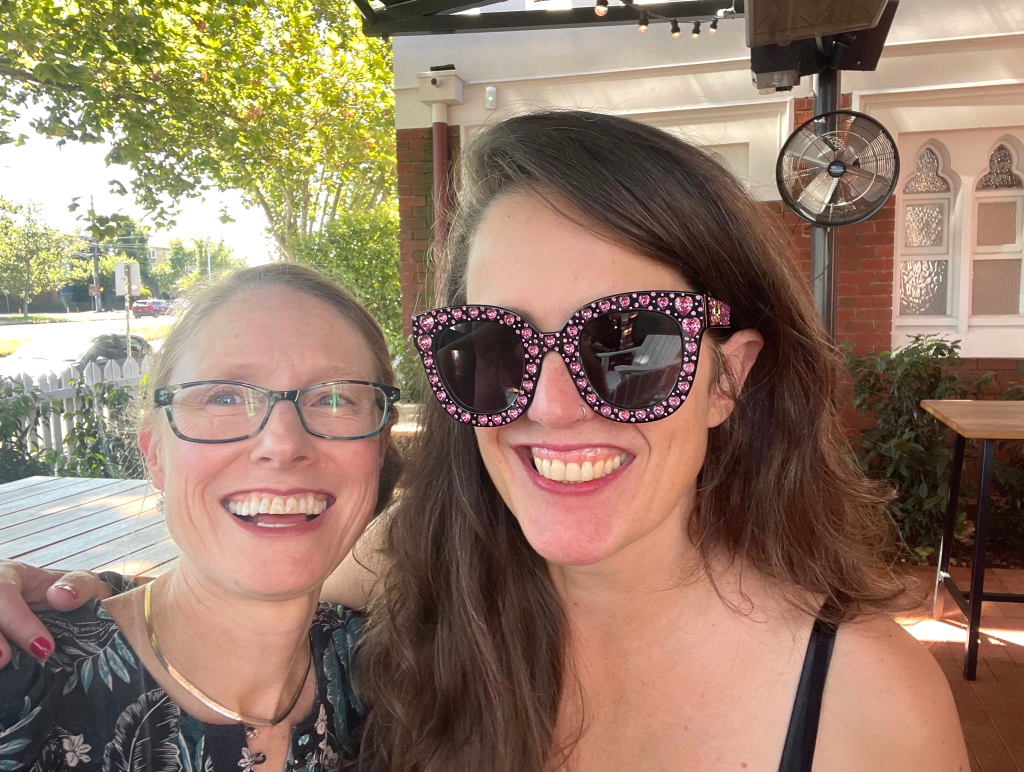
Melinda and me a couple of days ago. Gratitude partners for life!

In 2015, when Melinda and I first committed to our daily gratitude challenge, it was a challenge.  Sometimes it was hard to find something to be grateful for.  Sometimes I really struggled.  And sometimes it just felt impossible.  But we stuck it out, and we got better.  We got really fucking good at it.  I really do feel that if more people practiced daily gratitude, the world would be a much better place.  My life is undoubtedly better for it, and I want to be able to pay that forward.  If sharing a daily gratitude with a friend sounds like something you’d like to try, then I’m your girl, so hit me up and let’s do this. It might be hard at first, but if you stick to it, it’ll get easier.  I promise.