wellness

Ejo #157 – Gratitude

Today, I was grateful to get up early, watch the sun rise and put the finishing touches on this ejo.  Yesterday, I was grateful to be able to give my friend a hug after learning that his mum had died the night before.  And on Sunday, I was grateful to spend the day picnicking with my sisters, aunt and cousins in Cape Schanck.  I am a gratitude queen, able to find things to be grateful for, even in the most difficult of circumstances.  Damn, I could represent Australia at the Gratitude Olympics.  I am that good.  But how did I get there?  How did my gratitude muscle get that strong?  Just as an elite athlete needs a team, a coach, and a training partner to improve their physical performance, I too have a training partner. A gratitude partner.  Someone who has committed to the challenge of sharing gratitudes with me.  Every. Single. Day. No. Matter. What.

I’ve known my friend Melinda for about 28 or 29 years (shut up, you’re old!).  We even lived together for a while in the mid 1990s with our friend Svetlana.  But after we all moved out and went our separate ways, Melinda and I didn’t stay super close.  Like most of my friendships after I moved to Dubai, we’d exchange an email every now and again, and we’d catch up at the big parties that David and I throw whenever we visit Melbourne.  And that was OK. It was enough.  

But that all changed eight years ago today, when Mel and I started a challenge to email each other one gratitude a day for a whole year.  We both happened to be going through a rough patch at the time, struggling to find positivity in our day to day lives.  Melinda was feeling overwhelmed as a working mum to two young boys, trying to balance work and family commitments.  And I was missing my friends and family in Australia.  I yearned for the easygoing way of life back home, and wasn’t enjoying living in Dubai at all.  Everything about the city was getting on my nerves, and bringing me down.  And I wasn’t afraid to write about it.  In fact, some of you might remember that I used to write a very acerbic ejo series called Things I Hate About Dubai, in which I unabashedly bashed the shit out of the city, on the regular.  I used to really enjoy doing that, but in January 2015 I decided to decommission that series when a reader of mine called Flo wrote to me to express dismay at my attitude.  

Flo scolded me, “I am so disappointed by your latest post, and this will be the last one I read from you, as we do not share the same vision of expatriation.  Indeed I am very disappointed by the way you think.  I experience this every day in France where I keep hearing people say they don’t like anything (or anyone) about it, and it just pisses me off.  This is so disrespectful.  You may not understand, and you might even be angry at me, telling me not to come back to your ejo if I don’t like it.  But I just need to express myself!”

For my January 2015 ejo, which was titled Freedom, I responded to Flo, and defended my right to express dissatisfaction with certain aspects of life in Dubai.  But secretly, Flo’s words had pierced my heart like an arrow.  I had imagined that I was coming across as mischievous and spicy, but what was happening when I allowed myself to wallow in my negativity was that I just came across as… well, negative.  And I didn’t want to be negative.  I’d spent too much time and money on therapy to allow myself to slide back into old thought patterns and behaviours.  So while I publicly justified my opinions, I privately resolved to not write a single bad word about Dubai for a whole year.  For my own mental health and wellbeing.  I wanted to change.  I wanted to do better.

While I was making an effort to be more positive by not slinging shit at Dubai, Mel was doing something even more proactive and constructive to bring more joy into her life.  You all remember the #100happydays challenge, right?  Post a photo a day of something that makes you happy.  For one hundred days.  It was a lovely idea, encouraging participants to focus on all the positive things in their lives.  The challenge went viral, generating over 30 million happy moment posts on Facebook.  I probably should have taken part in the challenge, but I remember just not feeling it.  It seemed a little forced and superficial to me, which is probably an indication of where my head was at.  Melinda did take part in the challenge, and she got a lot out of it.  But once she’d finished the hundred days, she was left with a feeling of “now what?”  It occurred to her that a longer term commitment to a daily practise of positivity would be more beneficial than a flash-in-the-pan, social media challenge.  Something she could share privately with a trusted friend, rather than posting online.  Being a Doctor of Psychology, Mel knew that the idea was a good one, but she was unsure of how to implement it in a practical way. 

And then she read my Freedom ejo.  And she had a lightbulb moment.  She wrote to me, “My unrequested thoughts/suggestion for you to do with as you wish.  For improving your ongoing wellbeing in the place you reside, I think there is much to gain in training your mind to see and appreciate even the smallest positives around you each and every day.  Even in the country I love I’ve found myself in the mental habit of critiquing every experience and overlooking so many positives.  The 100 happy days challenge helped to shift my mindset, as I was struggling to focus on the upside of everyday life.  It definitely helped to be publicly forced to find something, anything, each and every day.  I often consider doing 365 happy days!  Instead I’ve decided to do “gratefuls” this year.  Here’s what I’d like to propose.  I will send my grateful to you each day.  Don’t feel you have to respond in detail, or at all.  If you’d like to share your gratitude in return, well, that would be an amazing honour.”

Of course I said yes.  And the rest is history.  Along the way we negotiated some guidelines.  We’d exchange a gratitude, every day for a whole year.  We would make an effort to not repeat ourselves, so that we would always be on the lookout for new things to be grateful for.  And our gratitude emails would be a no-complaint zone.  The goal of the project was to be totally focussed on things that we were grateful for, and not an opportunity to whinge about life.  We both understood that the intention of this wasn’t to paint an unnaturally rosy picture of our days, but rather to acknowledge that despite the inevitability of things not always going our way, we could still find something to be grateful for.  

Melinda and me in 2015, less than a month after starting our gratitude challenge.

I remember how delighted I was after just the first few days of exchanging gratitudes.  From the very beginning it felt like a really positive and optimistic ritual, and I really enjoyed reconnecting with Melinda, and reigniting our friendship, getting to know each other all over again.  Getting to know each other even better than before.  

But devastatingly, only fourteen days into our challenge, Mel’s mettle was sorely tested when she received some terrible news about her close friend Cara.  She wrote to me, “Today I’m struggling to be grateful as I learned some very sad news that one of my closest friends has cancer that has metastasised to her bones.  So I guess I’m grateful for my health, and that she feels supported by me.”

Over the next five years, our daily gratitude practise helped Melinda deal with the burden of initially having to keep her friend’s diagnosis a secret, of being there when Cara needed her, and of knowing when to step back when she needed space.  Melinda was there when her close friend battled chemotherapy and radiation therapy, and she supported her when she became sicker after taking part in an experimental trial.  She held hope for her friend, even when things were hopeless.  She honoured Cara’s final wishes, and at the end she said goodbye, long before she was ready to let go.  Mel tells me that our daily gratitude practise got her through the hardest five years of her life.  And I am beyond grateful that I was able to be there for her, in that way.

Today marks the 2922nd day that Melinda and I have exchanged daily gratitudes.  What started as a one year challenge, blossomed into something that I can’t even imagine my life without, and the two of us have been at it for eight, glorious, years.  Along the way we’ve both become more positive and more resilient.  We’ve both learned to laugh in the face of adversity, and we’ve developed the ability to find acceptance and peace when things don’t go our way.  For instance, on Thursday, 19th January 2017 I had a skiing accident on the slopes of Nagano, Japan tearing the ACL in my good knee.  My email to Mel that day read, “Today I was grateful beyond belief to everyone that helped me when I crashed on the mountain and hurt my knee.  David, who came running down to check on me and then carried BOTH our pairs of skis back up a very steep slope.  The ski instructor who noticed I wasn’t well and called the ski patrol.  The ski patrol people who skied me off the mountain on a special stretcher.  The hotel who sent someone in a car to pick us up so we didn’t need to catch the bus, and then drove us to the doctor.  The clinic where they looked at me straight away and were so kind.  The lady at the hotel who was SO concerned for me and let me lean on her as I limped to the elevator – later on, at dinner, she made me a beautiful origami crane and told me she hopes I feel better soon.  It’s been heart-warming to the max.”  

I know that in the past I would have let that accident wreck my day, my holiday and even the next few months of my life, as I hobbled around in pain.  I know that I would have wallowed in self-pity and misery.  And the reason I know it is because that’s exactly what happened in 1995 when I tore the ACL ligament in my other leg in another skiing accident (no, I’m not a very good skier).  But my gratitude practise gave me the ability to rise above it this time, and to deal with it positively.  It allowed me to see that my injury didn’t have to define me, and that despite it being a bit of a bummer, there were so many other, wonderful things to focus on.  I was getting really good at this gratitude thing.  

And then my Mum died. And somehow, I was still able to find a number of things to be grateful for, even on the worst day of my life. On the 26th March 2019, I wrote to Melinda, “I feel tremendous gratitude to my Mum for all her unconditional love my whole life.  I am grateful that she and I texted yesterday, and that we got to see her recently on our trip back home.  I am grateful to David for being so supportive and caring and loving and gentle.  And for buying us both tickets back home.  I’m an absolute mess right now but really grateful that even during something as devastating as this I can still find things to be grateful for.”

When you can look around you and see things to be grateful for, when everything else in your life is falling apart, you’ve reached a higher state.  You rise above.  You transcend.  And that is a super power.  Daily gratitude has given me fortitude.  No matter what happens, everything is OK.  It’s always OK.  

Melinda’s not the only person I exchange daily gratitudes with.  My sister Mary and I also do it, via text.  We started about four and a half years ago when we both took part in Zimmy’s Happiness Project, a three month course designed to rewire our thoughts and actions, creating new habits scientifically geared towards increasing our happiness.  A major pillar of that course focussed on gratitude, and one of the tasks was to share five daily gratitudes with a partner.  I was already really adept at finding gratitude in my day to day life with Melinda, but Zimmy’s project required a little more.  Not only did it call for five gratitudes a day, it also required them to be shared with someone in person (or via video).  I was really grateful that my sister was doing the project with me, and that she accepted my invitation to be video gratitude partners.  It was still a task that took me slightly out of my comfort zone, but doing it with a family member, someone I loved and trusted, made it a lot easier.  During the three month project, Mary and I exchanged videos every single day, talking about all the things we were grateful for, which was a beautiful way to feel more involved in my sister’s life, something which I’d always felt I was missing out on, living so far away from her.  It was a wonderful and easy way to get to know her better.  It deepened our relationship and helped us create a more enduring bond.  

I feel the same deep bond with Melinda.  She shares her intimate life with me.  I know when she’s had a great Pilates session, when her husband cooks a yummy dinner, when her teenage sons help around the house, and when she’s had a good night’s sleep.  And I share parts of my life that no-one else in the world, apart from my husband, knows.  Melinda knows when I’m happy.  She knows when I’ve had a good day at work.  When I’ve had a relaxing bath.  When I’ve had an earth shattering orgasm.  When I’ve found what I’m looking for at the supermarket, or when my favourite colleague is rostered to work with me.  Melinda knows when I’ve had an interesting dream, and when I’ve been upgraded to business class on a flight.  She knows when I’ve had a satisfying shit.  When I’ve been paid, and when I’ve been able to bring one of my houseplants back to life with a little extra TLC.  She knows when I’ve found a spare lip balm in my car and when I’ve discovered a really cool new TV show.  She knows when I have fresh towels, and when I sleep on fresh, clean sheets.  She knows when there’s soft toilet paper at work, and when someone’s recommended a great new podcast.  Melinda knows when I’ve had a breakthrough in one of my sessions with Zimmy, when the price of Bitcoin’s trending up and when the tower toilet, which is prone to blocking, is flushing again.  And she knows all the wonderful, thoughtful, kind, generous things David does for me every single day. She knows everything about my life, and being able to share that all with her is a beautiful gift for which I am very grateful.  
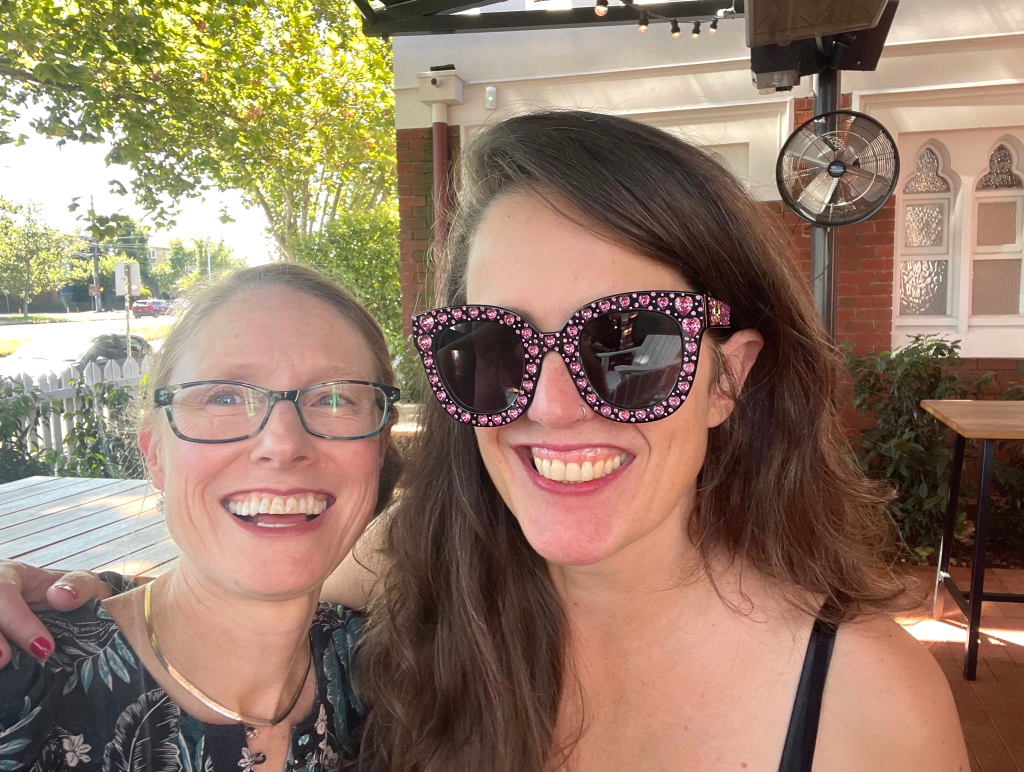
Melinda and me a couple of days ago. Gratitude partners for life!

In 2015, when Melinda and I first committed to our daily gratitude challenge, it was a challenge.  Sometimes it was hard to find something to be grateful for.  Sometimes I really struggled.  And sometimes it just felt impossible.  But we stuck it out, and we got better.  We got really fucking good at it.  I really do feel that if more people practiced daily gratitude, the world would be a much better place.  My life is undoubtedly better for it, and I want to be able to pay that forward.  If sharing a daily gratitude with a friend sounds like something you’d like to try, then I’m your girl, so hit me up and let’s do this. It might be hard at first, but if you stick to it, it’ll get easier.  I promise. 
Ejo #155 – Let There Be Light

Last month I wrote about the health hazards of shift work, almost all of which are caused by the violence perpetrated against our circadian rhythms when we suffer from disrupted sleep.  Today I’m going to talk about why that matters so much.  Not just for shift workers, but for everyone. 

Over the last 50,000 years, we have driven the progress of our species forward at an alarming rate, transforming ourselves from primitive hunter-gatherers; first into farmers and then ultimately into what we are today (whatever you want to call that).  In most ways this progress has benefited us.  In many others, it has not.  The transition from hunter-gatherer to agronomist was thanks to the agricultural revolution approximately 10,000 years ago which is seen at once, as humankind’s greatest achievement, and our greatest failure.  It set us on the path that we find ourselves on today, by forcing us to settle in one place and allowing us to feed multitudes more of us, but it definitely wasn’t a benefit to our health.  Almost overnight, we went from chasing and eating a predominantly meat based diet, supplemented by tubers and the occasional fruit and berry, to a diet consisting almost entirely of grains.  It is commonly perceived that humans domesticated wheat, but the truer story is that wheat domesticated us.  And in doing so, it made us fatter and shorter, it made us more prone to disease and it significantly lowered our longevity. 

Things have improved, of course, and we now live long lives, full of creature comforts, mod-cons and all the good things that life has to offer.  But for all the progress our civilisation has made, our bodies lag behind, having evolved to survive the conditions that existed on earth 50,000 years ago.  We might be stuffing our faces with avocado toast and scrolling on our phones for hours, but our bodies still think we’re hunter-gatherers, roaming the plains of the Upper Paleolithic era.  All the progress we have made as a species has been truly remarkable, and the life that we’ve created for ourselves is an astonishing achievement, but for our animal bodies this progress has trapped us in a golden cage that is slowly killing us.  We no longer live in nature, and our bodies are paying the price.  To achieve optimal health, we all need to make more of an effort to return to our natural element, to get more fresh air, to move more and to get more sunshine.  This isn’t a new age, airy-fairy aspiration.  It’s a fact, rooted in hard science.  We need sunlight not just to thrive, but to survive. 

In his 1973 book “Health and Light“, which I recently finished reading, Dr. John Ott describes conducting research about how full spectrum light can improve our health, or make us sick if we are exposed to a distorted or incomplete spectrum.  Dr. Ott coined the term mal-illumination, which he compares to malnutrition, and which is caused by our widespread fear of the sun.  We aren’t doing ourselves any favours when we restrict our intake of full spectrum sunlight by shielding our eyes and skin behind sunglasses, tinted windows and sunscreen.  Doing so has created an epidemic of people who are deficient not only in Vitamin D, but in a very crucial, beneficial and life-promoting form of energy.  Sunlight. 

Of course we need to be sensible and not overdo it, because too much shortwave UV light is harmful, and can cause sunburn, premature aging and skin cancer.  But most UV light is long wavelength light.  It’s a nutrient, that nourishes us and gives us energy, and is just as important as the nutrients we consume from food.  In fact, it doesn’t matter how good your diet is, or how much you exercise, if you’re not getting optimal sunlight (infrared light, followed by red light, followed by UVA, and then UVB, in that order) you will never reach peak health.  You will always be operating sub-optimally.  And the scientific world has known that for a long time.  A 1967 study into illumination for health concluded that, “If human skin is not exposed to solar radiation for long periods of time, disturbances occur in the physiological equilibrium of the human system, resulting in functional disorders of the nervous system, vitamin-D deficiency, a weakening of the body’s defences and an aggravation of chronic diseases.” 

Speaking of Vitamin D, why are so many people supplementing with exogenous Vitamin D when all they need to do is go outside for a few minutes each day and commune with the almighty, life-giving sun?  Why are we all so happy to just pop a pill, when the answer to our health problems literally hangs in the sky outside our front doors.  Factors that affect your personal Vitamin D levels include where you live in the world, how old you are, what colour skin you have, how much you weigh, what foods you eat and what other conditions you might be suffering from.  How can all of that be effectively corrected with an over-the-counter course of vitamins created in a factory?  It can’t.  When we go outside and expose our skin to sunlight, the body knows what it needs to do.  It knows how much Vitamin D to produce and it creates the most bio-available form of it.  Two recent studies showed that increased blood levels of supplemental Vitamin D actually caused elderly people to fall over more often, and to suffer more frequent and more severe bone fractures.  And taking Vitamin D supplements has been shown in countless studies to actually increase the overall risk of cancer, and even death.  So stop popping the pills please, and just get out in the sunshine!!!! 

Sunlight isn’t just a requirement for Vitamin D synthesis.  Almost every living organism on earth dances to the beat of a circadian drum.  We all possess biological processes that naturally occur around a 24 hour cycle, usually in response to the position of the sun in the sky.  Humans are no exception to this.  Sunrise and early morning exposure to light kickstart the circadian rhythm into motion, communicating to every single cell in the body, and setting them all up to synchronise their tasks for the day.  This messaging is vitally important and we miss out on it if we don’t get that early morning light in our eyes.  But how many of us are willing to sacrifice that benefit so we can sleep in just one more hour.  Almost everyone has some level of chronically disrupted circadian rhythm, so it’s no wonder that so many of us suffer from constant fatigue, low mood, anxiety, infertility, erectile dysfunction and a plethora of metabolic issues.  And for some reason, we just normalise that.  We just accept that we feel that way.  And that’s not cool.  These symptoms are all treatable, and the prescription is sunlight. 

From daybreak to nightfall, the sun shines its magical and wondrous light on us, bestowing us with life and good health – that is, if we don’t hide ourselves away from it.  Sunshine contains light from the full spectrum; of course visible light, but also infrared, red and ultraviolet light. And all of these wavelengths are transformed by the body into energy which is required for a myriad of biochemical reactions.  The proportion of each of these wavelengths of light changes, depending on what time of day it is.  Infrared and red light is present in all sunlight, but is more concentrated at sunrise and sunset.  Infrared light is soothing, healing and anti-inflammatory.  Ultraviolet light appears sometime within two hours after sunrise, depending on your location.  UVA comes first, when the sun is around 10° above the horizon, followed by UVB some time later.  The Circadian app is a great source of information about what light is present at what time of day in your part of the world.

The Circadian app tells me exactly when UVA rises and sets in Dubai.

Receiving indirect UVA sunlight into our eyes comes with an abundance of perks, so for maximum benefits make sure to take off spectacles, sunglasses and contact lenses, but please don’t look directly at the sun, mmmkay. Morning UVA actually prepares our bodies to receive the stronger UVB light later in the day.  Clever, right?  It’s almost as if we were designed to be outside in the sun.  UVA is also the precursor to the release of thyroid hormones that are needed to regulate our metabolism, energy levels and weight, as well as hair, nail and skin growth.  And it also releases a beautiful rush of feel-good hormones like serotonin (which makes us feel happy), dopamine (which makes us motivated and curious), norepinephrine (which focusses concentration) and beta endorphins (which give us a runner’s high and makes us lust after sunlight even more).  These are the same hormones that get people hooked on drugs, alcohol, gambling and other problematic behaviour.  The only difference is that when you’re addicted to morning sunlight, you’re getting high on life.  Literally! 

Sunlight is the trigger for so many biological processes, and we receive that signal not just in our eyes, but also through our skin.  The skin is an amazing self-regulating organ which not only protects our insides from spilling out, but also allows us to experience touch and changes in temperature.  It quietly and efficiently battles the harsh external world, ensuring that our body remains in homeostasis on the inside, despite what might be happening on the outside.  It does this by facilitating constant two way communication between itself and the immune, endocrine and central nervous systems.  Our skin is a beautiful, complex and elegantly designed system, which has evolved over millennia to absorb UV light for beneficial metabolic and biochemical reactions. 

One surprising benefit of exposing our skin to UVB light is an increase in the sex hormones oestrogen and testosterone (both of which are present in men and women), resulting in a natural increase in libido.  And who couldn’t use a little pick-me-up in that department?!  In his very informative, and fascinating, podcast about the health benefits of light Dr. Andrew Huberman suggests a protocol designed to boost reproductive health and libido.  All you have to do is expose as much skin as you (decently) can to the midday sun for about 20-30 minutes a day, two to three times a week.  This protocol is based on studies conducted on humans that showed not only a significant blood serum increase in oestrogen and testosterone, but a psychological increase in perceived attractiveness of others as well as an increased desire to have sex.  I mean, c’mon, if that sounds as good to you as it does to me, let’s get on out there in the sunshine people.  Testosterone levels in men have been declining for years. This is a beautiful way to remedy that. Following this protocol takes about a month to start feeling more randy, so what are we waiting for?  Let’s go get it.

UVB doesn’t just make us horny.  It’s the magic ingredient for producing that essential, endogenous Vitamin D we were talking about earlier.  And when our eyes and skin are exposed to it, it also increases our pain tolerance, and boosts our mood and energy levels throughout the day, and I don’t know how you can put a price on that. 

I recently broke my ankle and was stuck at home for three weeks doing ATC office work.  It was the perfect time to start a morning sunlight protocol, as I wasn’t doing shift work, and I was able to stick to a consistent schedule.  My routine is extremely simple, but provides outsized benefits.  Every morning, I get up and go outside to watch the sun rise, staying outside for about twenty minutes.  Even three or four minutes is enough to get some benefit, but I like to stay out there for longer.  I gaze up at the brightest part of the sky, while avoiding looking directly at the sun (obvs).  After twenty minutes, I go inside to prepare and eat a high protein snack, before stepping back out and spending another twenty minutes exposing my naked eyes to the light, just as the UVA wavelengths begin to emerge. 

Catching the early morning rays from my balcony.

I’m not gonna lie, when I first started my routine, getting up so early in the morning was hard.  It was really hard.  Like, so, so hard.  But after just three days, I actually started looking forward to waking up before dawn.  I crave it now.  I love being up when most people are still in bed.  I love listening to the birds singing in the trees, feeling the cool sea breeze on my skin and witnessing the creation of each new day.  It’s a truly beautiful experience and a wonderful way to start the morning, setting me up to be healthier and happier all day long.  Getting UVA actually makes me feel hopeful, happy and full of love.  It washes over me like a warm blanket, giving me a wonderful feeling of wellbeing, and I finish each session with a huge smile on my face.  I feel so fucking good from making this tiny change to my routine.  The vast improvement in my mood, mental health and energy levels absolutely makes it worth getting up so early every day.  Going back to shift work has unfortunately made it slightly more difficult to be consistent in my routine, but I still make an effort to get early morning sunlight in my eyes, every single day, even after working a night shift.  Sunlight is the cure, and I’m out there every day, religiously taking my dose of medicine as if my quality of my life depended on it. Because it does. 

So we’ve talked about what we need to do during the day to improve our health, and now it’s time to discuss what happens at night.  We learned that UVB is great during the day, but it probably won’t surprise you to learn that it’s not so great after dark. 

We’ve all heard of melatonin, right?  It’s well known for helping us fall asleep, but it also has several other functions in the body, both regulative and protective.  These include stem cell production to make our bones stronger, the regulation of cardiovascular function and activation of the immune system.  Physiological melatonin has also been shown to have a very dynamic anti-oxidant effect, and even some anti-cancer properties to boot.  Contrary to popular opinion though, this doesn’t mean that we should all run out and start taking supplemental melatonin.  Far from it.  The anti-cancer properties occur with the natural rise and fall of the hormone.  Taking supplemental melatonin for long periods of time, can severely reduce adrenal output resulting in the suppression of cortisol and epinephrine, which may be known as stress hormones, but which are actually required by the body in order to function properly.  Supplemental melatonin tends to be an unnaturally fixed, and usually extremely high dose of the hormone, and taking it at the same time every night drastically differs from the way in which melatonin is naturally released by the body, gently rising and falling according to the time of day and the seasons. 

So, what is melatonin, and how does it work?  It’s a hormone secreted by the pineal gland, which is found in the centre of the brain.  The excretion of melatonin from the pineal gland is dependent on what time of day or night it is, and is actually governed by light.  Bright light turns off the production of melatonin, and darkness prompts it to be secreted.  The pea-sized pineal gland, however, is located very deep in the brain, so how on earth could it possibly know what time of day it is in order to regulate the production and release of melatonin?  I’m glad you asked.  There is a fancy-pants cell in our eyes called the intrinsically photosensitive ganglion, also known as the melanopsin cell, which is responsible for absorbing sunlight, and escorting the signal through a series of messaging posts in the brain until it reaches it’s destination, the pineal gland.  Morning sunlight in the eyes is the catalyst that signals to the pineal gland that it’s time to gently reduce the release of melatonin, while at the same time triggering production of it for later that night.  Yes, paradoxically we need sunlight to produce the hormone that will help us sleep. 

Melatonin also communicates information to our bodies about how much light is in our environment, and therefore what time of the day it is and also what time of the year it is, which is just remarkable.  The environment around us, i.e. light, changes the environment within us, all thanks to the super-hormone melatonin.  Which is why we should be vigilant about getting more sunlight, as well as making an effort to avoid artificial light at night. 

Of course, in this (marvellous) modern day and age, it’s difficult to avoid artificial light after dark.  It sure would be awesome if we could all have open fireplaces, and homes lit with romantic candlelight.  And I can guarantee you that we’d all sleep a hell of a lot better if we did.  But unfortunately, that’s probably not going to happen.  So we need to focus on what we can do.  If you have dimmers, turn the lights all the way down at night.  If you don’t have dimmers, try lower wattage (or lower lumen) light bulbs.  A really important thing you can also do is stop watching TV and scrolling on your phone about an hour before bed.  So many people are in the habit of falling asleep while looking at their phones.  This is the absolute worst thing you can do for the quality of your sleep.  Sure, it might help you drop off, but you definitely aren’t going to have a restful sleep.  So give your eyes a break from all that blue light.  Let the melatonin do it’s thing.  These small changes in our environment can make a huge difference to sleep quality.  

Knowing that light has such a severely inhibitory effect on melatonin should serve as a warning about exposing our eyes to bright lights at night.  Even something that might seem as inconsequential as turning on the light to go the toilet in the middle of the night, immediately causes your lovely, sleepy-beepy, high levels of melatonin to crash to near zero.  The artificial light immediately shuts down melatonin release.  Chk! Chk! Boom!  And then of course you’ll have trouble getting back to sleep.  Melatonin naturally begins to rise early in the evening in preparation for bedtime, but it continues to increase as we sleep, well into the night.  So if you habitually get up in the middle of the night to go to the toilet, and turn on the lights every time you do, your melatonin signalling is going to be up shit creek, aka chronically disrupted.  You’ll have issues, not just with falling asleep every night, and being tired all the time, but with all the other things that melatonin regulates and protects in the body, that I mentioned earlier. You’ll forget what it feels like to feel your best.  Most of us have already forgotten. 

Even just one night sleeping in a moderately lit room has been shown to increase your sleeping heart rate, decrease heart rate variability, overstimulate the sympathetic nervous system and increase waking insulin resistance.  All very bad things.  A good guide is, if you can see your hand 30cm in front of your face while you’re in bed with the lights out, your room is too bright, and I’m sorry but you are not going to get a good night’s sleep.  David and I live in the middle of a big city.  When I’m in bed with the lights out at night, I can actually read a book by the external ambient light coming in through our floor to ceiling windows.  Even when we’re sleeping with our eyes closed, ambient light penetrates our eyelids and makes its way through our grey matter to the pineal glad, where we know it causes sleep damage.  Having this occur regularly is very harmful because sleep is supposed to be the time when the body and brain regenerate, and heal.  A lot of stuff goes on when we’re sleeping – our body temperature drops, our breathing, heart rate and blood pressure lower, our brains sort through all the information it received that day, removing what isn’t needed, our immune system kicks in to repair the body, and the brain stem temporarily paralyses our muscles.  And of course, the beautiful symphony orchestra that is our hormonal cascade has free rein to work it’s magic as we sleep. 

It seems, these days, that almost everyone is tired, all of the time.  So perhaps more of us would benefit from being more mindful of our bedroom’s light hygiene at bedtime, and ensuring we sleep in as dark a room as possible.  If installing blackout blinds or curtains isn’t practical, consider sleeping with an eye mask.  Eye masks have come a long way, and there is now a multitude of designs, so finding one that is comfortable for your face and sleeping style should be easy.  David and I recently started using them at night and it’s been an absolute game changer for me.  Actually, it’s much bigger than that.  Along with my morning light routine, it’s been life changing, and I’m not even joking.  I’m sleeping better than I have in my entire life, and waking up feeling more rested, despite working shifts.  I honestly cannot rave enough about it, because the transformation in the quality of my sleep has been simply extraordinary.  I always had this dumb kind of boastful pride about being able to sleep without curtains on our windows after a night shift, with the bright sun just streaming in.  And for many years I did myself a disservice because of that.  I feel like a bit of an idiot for waiting so long to try wearing an eyemask to bed.  But I’m well and truly on the bandwagon now, and I’d really recommend it to everyone to at least try it out and see how they feel in the morning. 

Disrupting sleep with light pollution does more than just make us tired.  It makes us ill.  It makes us ache and feel low and unmotivated.  It makes us fat, depressed and prematurely old.  It makes all of us function less than optimally.  And it doesn’t have to be that way.  But the wonderful thing about it is that you don’t have to take a pill to feel better.  You just have to go outside and let the sun shine down on you. 

Ejo #144 – “A Family Guide: Herbal Remedies” by Maria Stathopoulos

So it’s the last day of the year.  Time to pay the piper.  As you may recall, earlier this year I laid down a strongly worded promise to my Mum, in addition to a few other shitkicker goals that I’d hoped to have completed by the end of this year.  In other words, today. 

To recap, the first goal was to learn all the words to the eight minute rap song, The New Rap Language.  It brings me no joy to report to you that while I did learn the first few stanzas, there were another 45 verses that I didn’t quite get around to.  Bummer.  I also wanted to learn how to pick locks.  Sadly, no-one will be calling me to take part in any craftily planned heists any time soon.  Zero progress.  Bummer.  As for my goal to put together a fabulous death party (also known, by more basic bitches, as a funeral), I have managed to put together a list of some pretty kick-ass ideas, so I am happy about that.  But these promises were all secondary to the one that I made to my Mum that I would translate her book of herbal remedies into English. 

So, how’d I go?  Well, technically the promise has been satisfied.  I have, with some help from google translate, made a rudimentary translation of every single chapter from Greek into English.  And the reason I say “technically” is that google translate isn’t great at translating nuance, so I need to go through the entire text word by word with a dictionary to ensure the veracity of the translation.  And I’m not that great at translating Greek, so it’s a slog.  And I am nowhere near a final draft.  So technically, yes, it is something I can tick off, but it almost feels like a hollow victory.  In my mind, when I said that I’d translate Mum’s book this year, I’d idealistically imagined that I’d be holding a printed copy, hot off the presses, in my hand right now.  And that definitely isn’t the case.  And I am disappointed. 

My Mum isn’t alive so I don’t know how she would feel about it, but I do like to think that she would be forgiving, sympathetic and understanding.  Because that’s who she was.  And instead of beating myself up about it, I think I should also be forgiving, sympathetic and understanding towards myself.  I have resolved to get my Mum’s work out there in one form or another.  And I will.  Whether it’s an actual physical book, an e-book or even perhaps a website.  Her wisdom must be shared, and it has to be me that makes that happen.  Because I said I would do it. 

When I started doing the painstaking, word by word translation I learned things about my mother that I had never known before.  Can you believe that I had never even read the introduction to her book?  Why would I?  It was in Greek!  Ugh, I’m definitely not proud of that.  Regrets, I have a few.  But in translating the introduction, I found that I was bringing my Mum, through her words and through her experiences, back to life.  The urge to call her, to talk to her, was overwhelming.  It felt like she was right there. And I have so many questions that I wish I could ask her.  I would have loved nothing more than to work on a translation together with my Mum, as a team, and I know that she would have loved it too.  That’s no longer possible but I am going to stick to my promise.  I will find a way to print my Mum’s work in a way that pays tribute to all her knowledge and all the hard work she put into her learning, into her garden and into this book.

Below, I am publishing my English translation of the introduction to “A Family Guide: Herbal Remedies” by Maria Stathopoulos.  Our writing styles are very different so I have made a great effort to remain faithful to Mum’s voice, and to not imbue it my own tone.  It has given me unparalleled joy to open my mother’s book, take out the words she wrote and be able to publish them here. It feels like I’ve unearthed some long-buried treasure for you all. Please enjoy, and I wish you all a healthy, happy and wonderful new year ahead.  🎉

____________________________________________________________________________

The author. ♥

My name is Maria Stathopoulos née Roumelioti.  I was born in 1947 in Ancient Korinthos, a beautiful village at the foot of the mountain castle Akrokorinthos.  I lived there until I emigrated to Australia in 1965.

When I was a young girl, my village didn’t have its own doctor, but a doctor did visit once a week and we would go and see him if we weren’t well.  When that doctor wasn’t available, we would have to travel to New Korinthos, which was a one hour donkey ride away.  The long distance was always a problem and many times it prevented us from travelling at all, which is why we only made the journey in cases of serious illness. 

At that time, the elderly women of most small villages in Greece used herbs as first-aid for many different ailments, helping those who were in need.  I watched what they were doing with fascination, curiosity and awe for their methods, and for the ease with which they would mix the herbs when making medicines.  I wanted to be like them when I grew up.  The fact that they were always willing to help anyone who needed it was also a reason I was interested in studying botany.  As a young girl I kept detailed notes about which herbs were used, and how they were applied.  I always dreamed that, one day, I too would specialise in the use of herbs.  

Anyway, the years passed, and I grew up and came to Australia, like so many others.  In Australia I worked hard and started a family.  Everything was going well until I suddenly became very sick with chronic internal infection and bleeding, blood in the urine and terrible pains in my abdomen.  I remembered the herbs of my childhood and decided to experiment with my own treatments.  But I discovered that everything I had seen, heard and learned in my village was useless to me, because I did not know the names of the herbs in English.  The knowledge I had was insufficient to help myself.  The horrible pains forced me to go to the doctor many times, and after undergoing the appropriate examinations without being able to find the cause of the problem, they referred me to another doctor, who also found nothing and referred me to a specialist.  The specialist, despite conducting many tedious examinations, could also not find the cause of the problem and sent me to another doctor who in turn sent me to another specialist.  One specialist sent me to another.  And then they would refer me to yet another.  I felt like a tennis ball, bouncing from doctor to doctor, from examination to examination, from cauterisation to cauterisation and from surgery to surgery, all to no avail.

At that time I was a mother of three small children and many times I remember having to crawl on my hands and knees to do the housework and to look after my kids.  This went on for 15 whole years.  The doctors prescribed, and I took, every antibiotic and every painkiller available on the market, all without any relief.

Desperate, I stared truth in the eye and decided that in order to get better I had no choice but to become my own doctor.  The treatments I had undergone with synthetic drugs had not helped me at all.  They just created new problems for me, and increased my suffering.  Fifteen years of necessarily excessive drug consumption had also resulted in chronic nephritis and a very dangerous penicillin allergy.  “Only a miracle can save you”, I thought to myself.  A miracle to rid me of all the pain and suffering.  I threw away the drugs and looked for treatment elsewhere.  In my despair, I once again remembered the herbal remedies of my childhood and decided to try again.  I started reading books about my problem, and how herbs could treat it.  Timidly at first, I started experimenting on myself, and very quickly I realised that I was doing something right, because the pain started to diminish so clearly.  I continued the treatment.  My pain and symptoms subsided continuously and I felt better every day.  Using herbs on a daily basis I regained my health and eventually became completely well.  The problems that had tormented me for 15 years just disappeared, and have never returned.  The miracle I had hoped for actually happened. 

I had solved my problem, but ultimately that was not enough for me.  I wanted to know why, when and which herbs act positively on which diseases.  So I decided to enroll in a botany class at the local college, which has a dedicated horticultural department.  That’s where I learned the names of herbs in English, their uses, their structures, their healing properties, what each plant contains within it, and how and when to use them.  Although I got the result I wanted for myself, I did not stop studying.  I continued reading, and learning more every day. What I remembered as a child and all that I learned at school, I write about in this book, to help as many people as I can.  To help those who wish to no longer suffer needlessly, as I did.  They will realise, as I and so many others have realised, that herbs bring balance to the body.  Their healing substances help to heal our shocked health and strengthen us because, like them, we also belong to nature.  A nature so powerful that she provides us with everything we need in the form of food and medicine.  All you have to do is reach out and take what nature offers to us so generously. 

It’s a shame that humans have created a world of our own making, in which our own synthetic substances sicken and kill us every day.  We refuse to abandon them because they’re convenient and comfortable.  But this convenience makes us unable to see that we are losing what is most valuable to us; our health.  Unfortunately we have become what we eat; foods full of poison, toxins, chemicals, preservatives and artificial colours that are harmful.  Will we ever understand that the foods containing these ingredients should never be eaten? The human body endures to a point, but then begins to react, giving us danger signals that we sometimes recognise, but not always.  We breathe polluted air, exhaust fumes, industrial waste and more.  We eat inappropriate food and drink dirty water.  And the danger lurks.  Our only shield is to add herbs to our diet and to make better choices about what we eat.  It is only then that we may be able to avoid the diseases that threaten us every step of the way.  Everything we eat, everything we drink and everything we breathe is reflected in our health, whether we like it or not.  The time has come to realise that without health we have nothing.  Who knows, if I had continued taking the pharmacological drugs that did me so much harm, I might still be sick and running from doctor to doctor.  Fortunately, I stopped in time.  I searched for a cure in nature, and I found it.

In herbs we discover beneficial and healing properties that give us confidence over time, because the more we use them the more we realise and understand that they protect us and help us.  I am not a doctor, nor do I try to present myself as a doctor.  But I was suffering and I speak from experience.  I tried the herbs and I know they work.  For my problem, which was internal infection, bloating and blood in the urine, I eliminated from my diet white bread, white flour, peanuts, mushrooms, yeast, tomatoes, dry figs and dairy of all kinds except plain yoghurt for six months.  I did herbal treatments every day, and after six months I reintroduced everything except sugar. 

After going to hell and back, I was finally able to solve the problem that had tormented me for 15 years by using humble but powerful herbs.  That’s why I’m proud of, and want to share, what I know with those who are interested to learn.  With herbs I did something that the doctors I’d visited hundreds of times could not do, because they believed only in chemical treatments.  Before readers conclude that I am against orthodox medicine and its doctors, let me assure you that I firmly believe in them, and in science. We need doctors for diagnoses, surgeries, etc. but we do not need to ingest chemicals for minor conditions, and I do not believe in the way, or the ease with which, drugs are prescribed to us. 

Nature has provided our planet with all the herbs to treat every disease, and a natural bounty with which to live comfortably, free of health problems.  We were not given chemicals or fast food.  These were created by us, and as a result we all suffer issues with our health.  So it is time to take the steering wheel of health in our hands and turn it towards mother nature. She has provided us with the medicine for all our ailments.  These are found in various types of food, containing ingredients suitable for the proper functioning of the body and with no side effects.

In order to be worthy descendants of the ancient Greek philosophers and herbalists Socrates, Dioscorides, Aristotle and Galen, we must believe, as they believed and taught, that in order to cure a disease we must cure the whole body and not only the symptoms.  These great sages, writers and doctors of antiquity posited that food be our medicine and medicine be our food.  In other words, what we eat should not only satisfy our hunger, but also heal us.  If we can truly understand the depth and the meaning of these words, we will forever hold onto these useful, tried-and-true herbal remedies.  Everything I have learned through personal study and diligence, everything that I have put into practise, I have recorded for you in this informative book which was written with patience and love.  It is my hope, my wish and my belief that one day the doctor’s office and hospitals will all be emptied of patients.